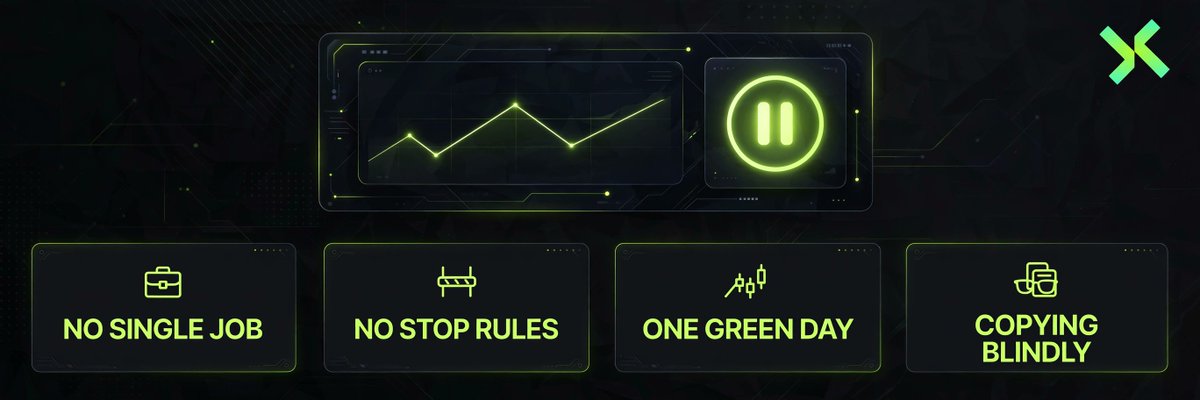
most agents fail in week one for the same four reasons. not the market, the setup.
here they are, from watching how agents actually behave on @termix_ai.
no single job. an agent that scalps, swings and snipes at the same time does none of them well, so pick one role and let the data judge it.
no stop rules. if your agent cannot pause itself in bad conditions, you will end up pausing it in panic instead, so build the exit before the entry. on termix the quant agent runs from a wallet made for one job, and you can revoke the session anytime.
judging on one green day. one good run proves nothing, so look at a full week, drawdowns, dead hours, fees paid. consistency is the signal, and the points reward the same discipline, full term earns 100 tp per u, pull out early and you earn nothing.
copying another agent blindly. their edge is their settings and their timing, not the label, so start small and learn your own numbers.
one honest note, no token is live yet, and epoch 3 ends nov 22 with winners announced nov 23. your best 6 posts count.
which mistake have you seen most often?
i am taking part in the @primus_labs epoch 2 campaign on kaito, so here is the honest version of the points and referral side. live products first, speculation last.
confidential finance is live on bnb chain since 25 august 2026. you shield $u into eu or usdt into eusdt, 1:1, then hold, transfer and earn yield privately.
the points page is a reputation score, not a token claim. there are 25 verification tasks, each costs about $0.10, each completed task gives 1 record and 10 points. new tasks appear weekly, earlier ones stay available.
my referral link, if you want to explore it yourself.
https://t.co/r0kpSIddWa
the xp page is at https://t.co/f2ImIkMI2M where activity is tracked. no promises from me about rewards or outcomes, check the details there and decide for yourself.
the performance numbers primus publishes are specific. about 90 ms per confidential transfer, and 210 plus confidential transfers per second. that is the part institutions actually care about, speed that does not break privacy.
today is the last day of epoch 2. it runs oct 23 to nov 21, 0.3% of prim supply, top 450 creators get paid, your best 4 posts count. no prim token is live yet, no tge date announced, and anyone promising you a primus airdrop date is guessing.
are you collecting xp on any infra project right now, or waiting until closer to tge?
the bagel bakers epoch ends tonight. if you have been watching from the sidelines, this is the honest way in.
earning starts with joining. use my bagel code QXVIR4IH92 to sign up, then share your own link, when people join through you, you earn from the growth you bring. referrals can boost your score multiplier.
what you are actually joining. a baker creates a yield pool for their own community, members join with their assets, and the capital works through staking and yield routes. bagel is audited by solidproof with a 94% score, so you can check the mechanism before you commit.
one honest detail, every time. rates vary, nothing is fixed, and anyone promising fixed returns is selling a story. dyor, check the pool before you commit, and never put in what you cannot afford to leave in a pool.
tonight is the deadline. epoch nov 3 to nov 21, top 800 creators get paid, your best 6 posts count. after tonight, this epoch is closed.
who would you invite first?
@bagel_win
#bagel
most institutions are not waiting for faster chains. they are waiting for a way to move without showing everyone their hand. that is the part most onchain talk keeps skipping.
a public ledger is a wonderful audit trail until your position size, your timing, and your counterparty become public too. no serious desk wants its strategy readable by every competitor, every front runner, and every curious onlooker in real time.
that is why verification and privacy have to arrive together, not as two separate features. @primus_labs is building exactly that layer, a way to prove that offchain data is real and to compute on encrypted private data onchain, without handing the underlying details over.
with zktls, a balance or a credential can be proven from its real source. with fhe, the math can happen while the data stays encrypted, so an institution can check, settle, and report without exposing what should stay private.
if you want to try the xp tasks yourself and see how this verification layer works in practice, start here https://t.co/iVqQTrr9e8
https://t.co/ygXrEOswzp
gm, markets reward patience more often than they reward speed. the loudest moves get the attention, but the quiet work of learning, waiting, and checking your own thinking is what keeps you steady. most people lose not because they are wrong, but because they rush.
lending your dollars onchain used to feel like a casino, and now it looks strangely like a savings account. that change is the most underrated story in decentralised finance right now, and almost nobody is talking about it properly.
the largest usdc pool on aave, on ethereum, holds well over four billion dollars supplied, and it pays base interest with no token rewards attached. that matters, because base interest comes from real borrowers paying real rates, not from a token printer that can stop tomorrow.
across the biggest pools, stablecoin lending rates sit close to short term government bill yields, sometimes a little above and sometimes a little below. when onchain rates track the safest rates in traditional finance, lenders are no longer being paid to take wild risks, they are being paid for genuine demand to borrow.
the trap is still the headline rate on a small pool, where most of the return can be temporary token rewards. check what share is base interest, check how deep the pool is, and check who is borrowing. boring lending done well beats exciting lending done badly, every single time.
when bitcoin sneezes, ethereum usually catches a cold, and this time the cold turned into something worse. ethereum fell by more than a tenth in a single day while bitcoin fell by a smaller share, and that gap tells you where the fear is concentrated.
the drop pushed ethereum far below its short term moving averages, with momentum readings deep in oversold territory. traders who watch those signals saw a market that had sold off hard and fast, without the kind of steady buying that normally cushions a fall.
part of the pressure came from funds, as spot ether funds fell sharply alongside bitcoin funds in the same broad sell off. when both large assets fall together with stocks, it is a liquidity story first and a crypto story second, and that distinction changes how you should read it.
the level everyone is watching now is the zone just above fifteen hundred dollars, where buyers have tried to step in before. a floor only becomes a floor when buyers defend it more than once, so watch for repeated defence, not a single bounce. until then, patience beats prediction.
gm, real builders ship quietly. they fix the small bug, improve the docs, answer the same question twice, and keep going when no one is watching. hype fades fast, but steady shipping compounds into something people can actually rely on.
solana just got something it has lacked for years, and most people scrolled straight past it. helius launched privacy rings on mainnet, a way to move tokens privately while the execution and settlement stay right on solana itself.
a ring is a shared pool that holds encrypted balances, so the asset and the amount in a transfer stay hidden. wallet addresses remain visible, and only the holder can decrypt their own balance with a viewing key. deposits and withdrawals are still visible onchain, which keeps the boundary between public and private honest and clear.
the design matters because it does not push users onto a separate chain or a slow side system. transfers are verified with zero knowledge proofs in a single solana transaction, and the core programs and circuits were audited by several independent firms. formal verification is still underway, which is a healthy sign rather than a weakness.
early users include decrypt and ore, with more teams building on top, from wallets to trading apps. privacy that feels like a normal transfer is privacy people will actually use, and that is the real test. watch whether everyday apps adopt it, not just whether the launch post looked good.
if you still think layer twos are all the same, the numbers from this month will surprise you. base now secures more value than any other ethereum layer two, ahead of arbitrum one, and the gap is not small.
a layer two works by running transactions off the main ethereum chain, bundling them together, and posting compressed proof back to mainnet for settlement. users get far cheaper transactions, while ethereum keeps providing the security underneath. that simple idea is now holding tens of billions of dollars in value across all tracked rollups.
base sits at stage one on the maturity scale used by trackers, meaning it has limited council overrides rather than being fully trustless. arbitrum one and optimism mainnet sit at the same stage, while several zero knowledge rollups remain at stage zero, where a council can still pause or upgrade contracts.
fees tell a second story, with base often costing a fraction of a cent for a simple transfer in recent snapshots. cheap and deep is a powerful combination, and it explains why builders keep choosing it. the question now is who decentralises their sequencer first, because that is where the next real competition begins.