Trading Quenton Nelson and DeForest Buckner provided draft capital and financial flexibility for a Colts franchise that will need all the resources it can get to accelerate a rebuild.
More on how it all went down and why the value was right in The Sweep: https://t.co/8A90ILi9GR
Breaking: the Arizona Cardinals are finalizing a deal to trade WR Marvin Harrison, sources tell me and @RapSheet.
The team informed Harrison this morning that he will be inactive for Sunday’s game vs Detroit as details of the trade are finalized.
@BRAD_711sa@DrkSymphony@CallofDuty@BasedGodBemo Because there is still warzone right now that it is not taking effect on yet so it says season 1 meaning it won’t be in place until everything is updated and switched over with the next game and new season. Not that hard to figure out…
🚨 CLEVELAND GIVEAWAY 🚨
Thanks to @Homage, ONE lucky winner is taking home this Cleveland Starter Jacket 🔥
HOW TO ENTER:
• Follow @JoShowAdell + @Homage
• Like + RT this post
• Reply #GuardsBall
🇺🇸 Must be in the U.S. to win.
Winner will be selected RIGHT BEFORE GAME 2.
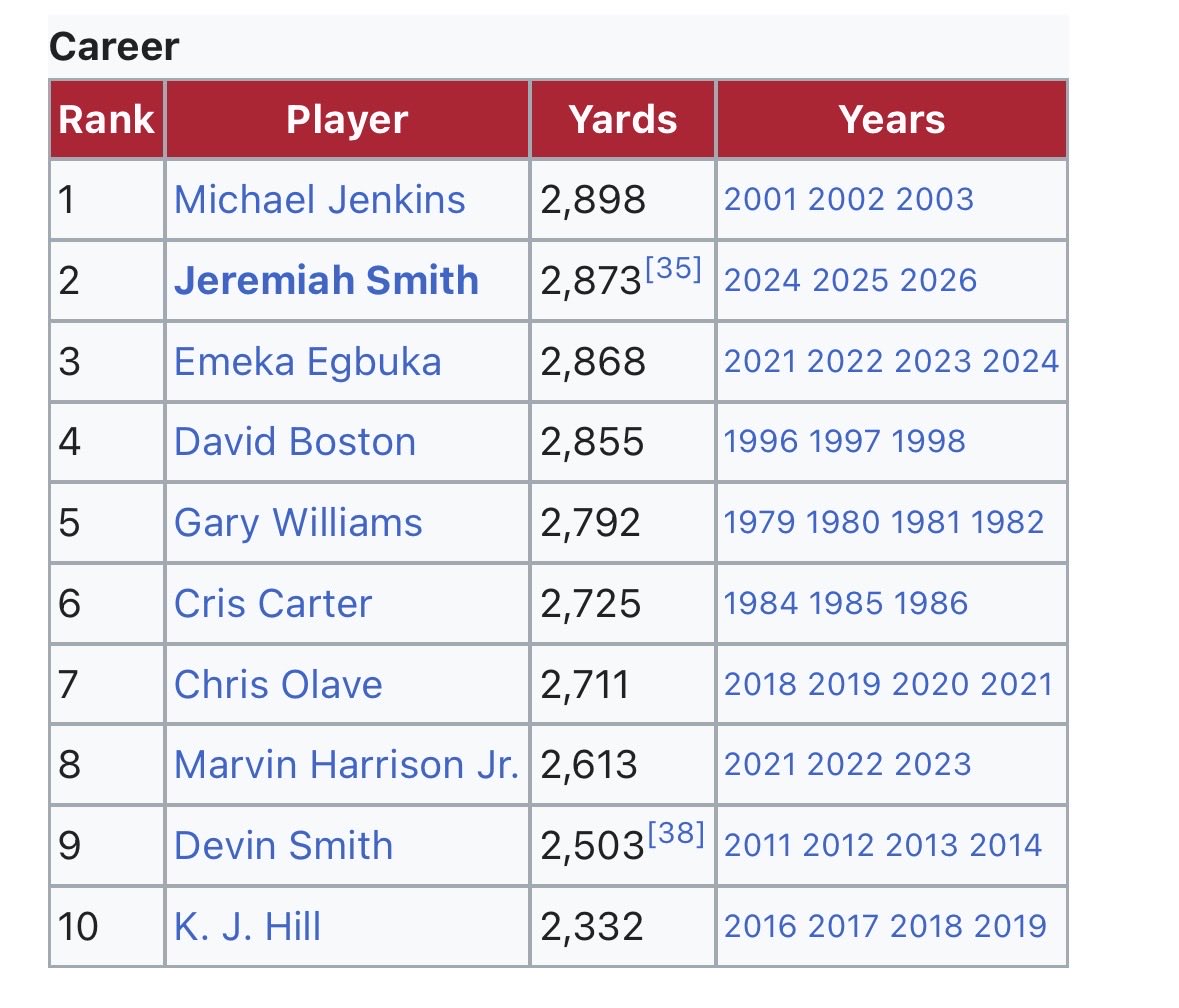
A 23-year-old Ohio State receiving record is getting broken tomorrow by none other than Jeremiah Smith
And it won’t be close after it’s all said and done. He’ll be knocking on the doorstep of 4k
After September 11, more than a million tons of the World Trade Center was loaded onto barges and shipped to a garbage dump on Staten Island.
Then hundreds of men and women stood at conveyor belts for ten months and picked through every ounce of it by hand.
They were looking for people.
The place is called Fresh Kills. For fifty years it was the largest landfill in the world. It took its last barge of household trash on March 22, 2001, and shut down for good. New York was finally done with it.
Five and a half months later, at two o'clock in the morning on September 12, the landfill's director got a phone call at home. He had just walked in the door.
Two trucks were at the gate. They were carrying pieces of the World Trade Center.
He drove back.
The man who ran the dump would later say, without any drama, that if Fresh Kills had not been closed, this could never have happened. There would have been no room. The garbage would have been in the way.
The site was empty. So that is where the towers went.
Here is how it worked.
At Ground Zero, cranes and grapplers lifted the debris into dump trucks. The trucks drove to a pier on the Hudson. There, the load went onto barges, six hundred tons at a time. The barges were towed down the harbor, past the Statue of Liberty, to Staten Island. More than fifteen hundred barges made the trip.
At Fresh Kills, sanitation workers unloaded them onto a hill.
And then the sorting began.
The debris was mechanically screened into three sizes. Chunks bigger than eight inches. Two to eight inches. A quarter inch to two inches. Anything smaller than a quarter of an inch, the size of a fingernail, fell through the last sieve.
Everything above that size went onto a conveyor belt.
And along the belts stood the detectives.
NYPD. FBI. Port Authority police. Medical examiners. Dressed head to toe in white Tyvek suits, in masks, in gloves, on a hill that stank of jet fuel and pulverized concrete and things nobody wanted to name. Looking down at the belt, hour after hour, as the towers rolled past them a fist-sized chunk at a time.
When they saw something, they reached in and took it, and placed it in a white bucket at their feet.
A wedding ring. A photo ID. A set of keys. A shoe.
A piece of a person.
The white buckets went to a tent that served as a morgue.
The volume was beyond comprehension. In mid-September the operation was processing 1,750 tons of debris a day. By mid-October, 17,500 tons a day. Ten times more. Round the clock. The 200-acre hill was declared a federal crime scene and stayed one for ten months.
A retired NYPD detective later wrote down what a shift looked like, because almost nobody outside knew it existed.
You wake at 3 a.m. You get a giant coffee. You drive two hours in the dark from Orange County, through New Jersey, to Staten Island. You park at the bottom of a hill that looks like the end of the world. You put on the white suit. You go to your belt. You stand there. You look.
Then you drive two hours home and do it again tomorrow.
Sanitation workers pulled sixteen-hour shifts, seven days a week. One of them, a supervisor named Barry Asnes, said afterward what kept him there. We were attacked on our own soil, in the city where I was born. This was personal.
The operation did not stop for weather. It did not stop for Christmas. It ran until July 2002. Ten months.
By the end, the men and women on that hill had recovered thousands of human remains. Tens of thousands of personal effects. Wallets, badges, wedding bands, photographs, all cleaned and catalogued and returned to families who had nothing else to bury.
When they were finished, the remaining material was placed in a 48-acre section of the landfill, a mound two hundred and twenty-five feet high, and covered.
It is a park now.
Many of the men and women who stood on that hill have lung disease. Asthma. Cancer. PTSD. The air they were breathing, eight and ten and sixteen hours a day, was full of the towers. Some of them have died of it.
Almost nobody knows their names. Almost nobody knows the place.
Mention Fresh Kills and 9/11 in the same sentence, the retired detective wrote, and most people will have no idea what you are talking about.
Here is what you should know.
Two thousand seven hundred and fifty-three people were murdered in those towers. Only about six in ten have ever been identified.
Every one of those identifications came out of a white bucket.
Every wedding ring returned to a widow. Every badge returned to a firehouse. Every fragment of bone matched to a name and buried with a headstone instead of a question mark.
Somebody in a white suit, standing at a belt on a garbage dump at four in the morning, reached into the World Trade Center as it rolled past, and picked that person up, and put them in a bucket, and sent them home.
They did that for ten months.
Nobody applauded on the hill. There was nobody to watch.
They did it anyway. 🇺🇸
Storming the field after needing a illegitimate hail mary to beat a MAC team you were favored by to beat at home by 28 points is the most pathetic field storming ever 🥀
The US Navy operates a 50,000 acre forest in Indiana whose entire job is keeping one wooden ship from 1797 afloat.
The ship is USS Constitution, still a commissioned warship with an active-duty crew. Cannonballs bounced off her in 1812 because the hull sandwiches a wall of live oak ribs between two layers of white oak planking, nearly 2 feet of solid wood so dense it barely floats. British 18-pounders hit it and dropped into the sea. A sailor yelled "her sides are made of iron" and the nickname stuck.
Here's the problem with owning a 229-year-old wooden ship: you can't buy the parts. Hull planks run up to 40 feet long and 7 inches thick, cut from single white oak trunks. A white oak takes over a century to grow that big. No lumberyard on earth stocks it.
So the Navy grows its own. Constitution Grove at Naval Support Activity Crane holds trees over 100 years old, reserved exclusively for this ship. Foresters there are managing oaks today that will become hull planking in the 2100s. The maintenance plan literally runs on tree time.
Every 20 years or so she enters dry dock and shipwrights swap out rotted timber. After two centuries of this, estimates put original 1797 wood at maybe 10 to 15 percent of the ship. The Navy keeps replacing her plank by plank because Congress mandated her preservation and because she's the only active US warship that has sunk an enemy vessel.
Every other asset in the Navy has a decommission date. This one has a tree farm.
America burned Japan's first gift of cherry trees. All 2,000 of them, on President Taft's direct order.
The 1910 shipment arrived in DC crawling with insects and nematodes. Agriculture inspectors condemned the lot, Taft signed off on the bonfire, and the State Department braced for a diplomatic disaster. Tokyo's mayor, Yukio Ozaki, responded by sending 3,020 more, grafted from the famous grove along the Arakawa River.
Those trees have spent a century paying the friendship back.
Four days after Pearl Harbor, vandals chopped down four of them. Park officials renamed the survivors "Oriental" cherry trees for the rest of the war to protect them from axes.
Then came the twist. By 1952 the original Arakawa grove in Tokyo, the parent stock, had nearly died from wartime neglect. Japan asked Washington for help. The Park Service shipped budwood from DC's trees back across the Pacific and restored the grove that created them. When a flood wiped out more Japanese trees in 1982, horticulturists took 800 fresh cuttings from the Tidal Basin.
These 250 new trees solve a real problem too. The Tidal Basin is sinking, and a $133 million seawall rebuild forced crews to rip out roughly 150 trees. Japan offered replacements before anyone asked, timed to America's 250th birthday.
So the genetics run in a loop. Tokyo's grove seeded Washington's. Washington's saved Tokyo's. The saplings going in this spring descend from both.
114 years of diplomacy, running on grafted branches.