Well here we go...
If you work in tech or develop software and want to know how you stand on quality, check out The QA Bubble Checklist on @Gumroad#softwaredev | #qa | #coding
https://t.co/QdJmCdKDFl
BREAKING: Anthropic has urged for a global pause in AI development as artificial-intelligence models are nearing capability to improve without human intervention, per WSJ
@svpino You're just thinking like an engineer instead of a vinden "coder" and that's a compliment.
Try coding with 3 devs in the same repo...
There's your answer
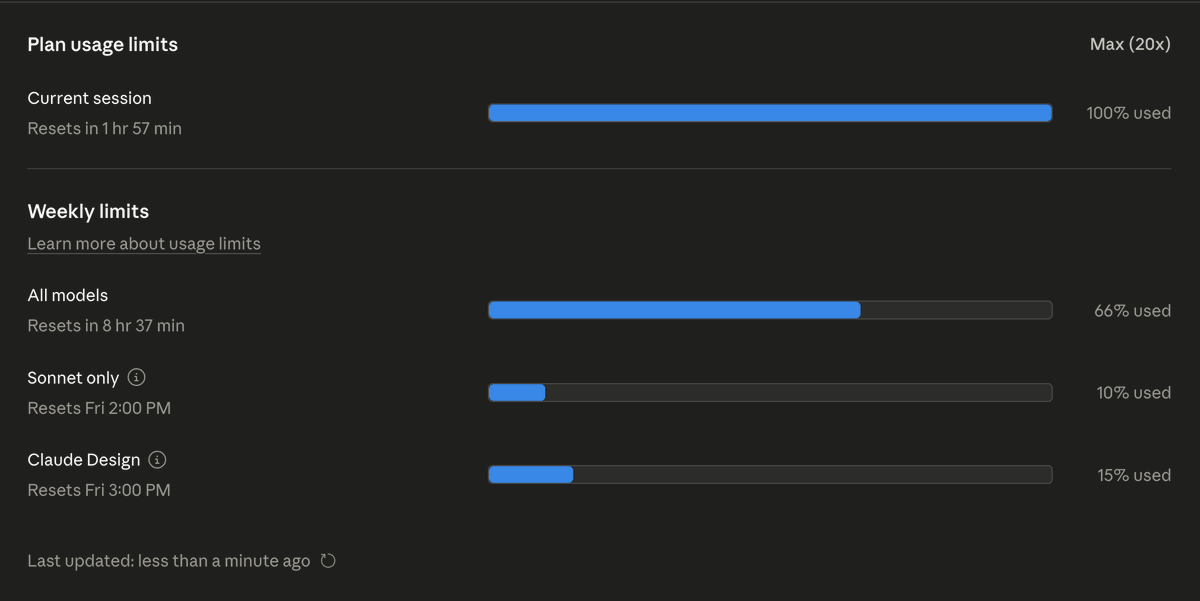
We can all say it... Claude 20x is dead.
The previous "feel unlimited usage" doesn't exist anymore.
Usage increases quickly and scales really fast...
People who discover Claude Code now: you missed a time that will never come back, I think.
Can we just take a second to really take this in? How on earth has it come to this? Where a man can performatively ‘admit’ to sex with a child on an international platform but then couch it as some form of reflection or responsible accountability exercise - whilst deliberately leaning on our terrible, useless, outdated sexual offences act and age of consent?
This man was 30 years old, and at the height of his fame - when he made an active choice to have sex with a child. I would use much stronger language here but he’s deliberately leaning on our consent laws, that a 16 year old child can technically consent to sex - meaning that he could technically have ‘consensual sex’ with a school age child.
His admission and his disgusting performative ‘progressive’ ‘reflection’ that he is ‘exploitative’ makes my effin skin crawl. If this is not a predator in full swing, I do not know what is.
This man is admitting to sex with children and no one is going to do a thing about it. Absolutely atrocious. Our laws need urgently updating to ensure no adult can ever have technically consensual sex with a child. No adult should ever want that; and no child should ever be exposed to it.
End.
I am confident that the mind is computable; consciousness is an exquisite consequence of the laws of physics.
I am also confident that contemporary systems such as @claudeai are without a doubt not only not conscious but are in fact architecturally incapable of consciousness.
And furthermore, we are not even close to closing that gap.
Don't take people's comments about you too seriously.
People see reality through their fears, struggles, and beliefs.
And their reality doesn't always match yours.
When they believe you can't do it, it doesn't mean you can't...
It just means they don't think they can.
@Vitus_osst@throwem_out Belgium, France and the south of the Netherlands have deep rooted traditions of monks brewing beer.
Send me a DM and I can send you a pack if you want.
Self-guaranteeing promises
Companies break promises all the time. A self-guaranteeing promise does not require you to trust anyone. You can verify a self-guaranteeing promise yourself.
File over app is a self-guaranteeing promise. If files are in your control, in an open format, you can use those files in another app at any time. Not an export. The exact same files. It’s good practice to test this with any self-proclaimed file-over-app app you use.
Terms and policies are not self-guaranteeing. A company may promise the privacy of your data, but those policies can change at any time. Changes can retroactively affect data you have spent years putting into the tool. A self-guaranteeing promise about privacy gives you proof that the tool cannot access your data in the first place. Examples: Google, Zoom, Dropbox, Tumblr, Slack, Adobe, Figma (see links).
Encoding values into a governance structure is not self-guaranteeing. Given enough motivation, the corporate structure can be reversed. The structure is not in your hands. Example: OpenAI.
Open source alone is not self-guaranteeing. Even open source apps can rely on data that is stuck in databases or in proprietary formats that are difficult to switch away from. Open source is not a reliable safeguard against the biases of venture capital. Examples: Omnivore, Skiff.
When you choose to use a tool, the future of that tool is always ambiguous. On a long enough timeline the substrate changes. Your needs change, the underlying operating system changes, the company goes out of business or gets acquired, better options come along.
It is possible to accept the ambiguousness of a tool's future if you choose tools that make self-guaranteeing promises.