Good visual reminder of the importance of daily disciplines and playing the long game. Health (emotional, mental, physical, spiritual) doesn't happen overnight.
Church planting has to become less about attracting people to services and more about creating environments where trust can slowly develop. Distrustful people don't respond to marketing.
"Most people don't want accurate information, they want validating information. Growth requires you to be open to unlearning ideas that previously served you." ~ James Clear
Growth demands we critically examine the ideas, assumptions, and even "truths" that have long guided us. These ideas served us well at one point, providing stability or a framework for understanding the world. However, as we grow and mature, and as the world changes, some of those previously useful ideas become limiting, inaccurate, outdated, and even detrimental.
What are the things you need to unlearn and relearn? #Metanoia
"Letting go of familiar ways of living is harder than it looks. We get used to the posture we’ve carried for years, even when it no longer serves us, and eventually the past can start to feel more comfortable than the possibility of change. Some exiles, it turns out, become quite attached to being in charge of life in Israel and will not be open to accepting an exile posture."
The Hidden Curriculum of "Church Life" https://t.co/waE10tgpSX
I've had several conversations lately about online courses. Each time, I shared research showing that completion rates in online learning, compared with other formats, reveal something about how people actually learn and grow.
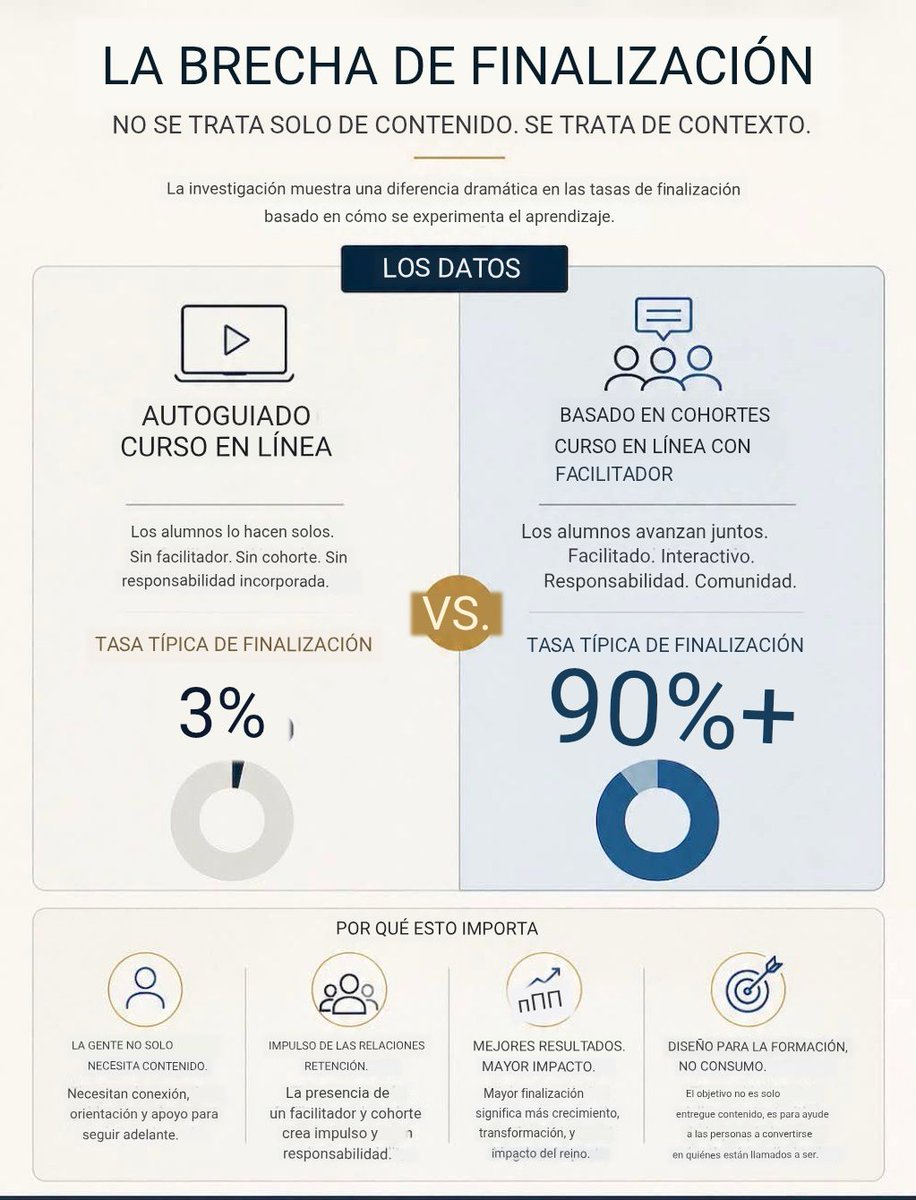
Self-guided courses hover around a 3% completion rate. But when learning is cohort-based and guided by a facilitator, completion rates often exceed 90%. This isn't just about delivery models. It's about formation. People don't just need content; they need community and guidance. #Learning #Courses #Training
Mission takes place where the church — in its total involvement with the world — bears its testimony in the form of a servant, with reference to unbelief, exploitation, discrimination and violence, but also with reference to salvation, healing, liberation, reconciliation and righteousness.
~ David Bosch
"Forgiveness flounders because I exclude the enemy from the community of humans even as I exclude myself from the community of sinners."
~ Miroslav Volf from "Exclusion and Embrace."
An interesting excerpt from the book "The Taste for the Other: The Social and Ethical Thought of C. S. Lewis," where Lewis contends that in light of the need to both enjoy and, at times, renounce certain created things, the Christian life can not be flattened into a system:
The person who wants the Christian story to shape the contours of his life will want to enter into this dialectical movement between enjoyment and renunciation. Lewis is more willing to discuss the dialectic than to offer practical suggestions for the living of it. But any reader of his works will recognize certain themes which fit well into this pattern. There is, in the first place, his constant concern that we remember the necessity of both affirming and negating created things. Neither side of the movement can be turned into a principle. Ordinarily it is the side of self-denial or renunciation which is formalized and turned into a policy. (One who follows the way of enjoyment is perhaps less likely to be consciously formulating a policy.)
In any case, no principle can be derived from the dialectic. Enjoyment and renunciation are both required. "One of the marks of a certain type of bad man is that he cannot give up a thing himself without wanting everyone else to give it up" (Mere Christianity, p. 62). Hence, the particular way in which one enters into the dialectic involves personal decision.
When talking about midlife, I love this from Bill Gallagher:
I think this is what the midlife shift actually asks of us. Not less ambition. Different ambition. Trade the swagger for steady rhythms. Trade hero for host. #MidLife#SecondHalfOfLife
Three phrases I wish I had learned and incorporated into my life much sooner, but I'm grateful I know now. I tell myself these things (especially the first two) daily. If you're in a season of growth, maybe one of these meets you where you are.
"Be where your feet are."
Don't focus on yesterday's regrets or tomorrow's worries. Be present in this moment.
"Let them."
Let them think what they think. Let them misunderstand you. Let them. Don't waste energy trying to manage, fix, and seek approval from others.
"Role to soul."
For too long, I let what I did define who I was. The quiet work has been learning to separate my identity from my function. Beneath the striving, the performance, the persona/ego, there's something quieter and truer at work. Stop drowning it out with noise and distraction. Slow down. Be quiet. Start listening more closely.
I have been researching completion rates in online learning, and the contrast reveals something about how people actually learn and grow.
Self-guided courses hover around a 3% completion rate. But when learning is cohort-based and guided by a facilitator, the completion rates often exceed 90%.
This isn’t just about delivery models. It’s about formation. People don’t just need content, they need community and guidance.
Brad Brisco provides a framework for thinking about how to evangelize in the different areas of your life. Using concentric circles, he gives guidance for creating rhythms of evangelism in your life.
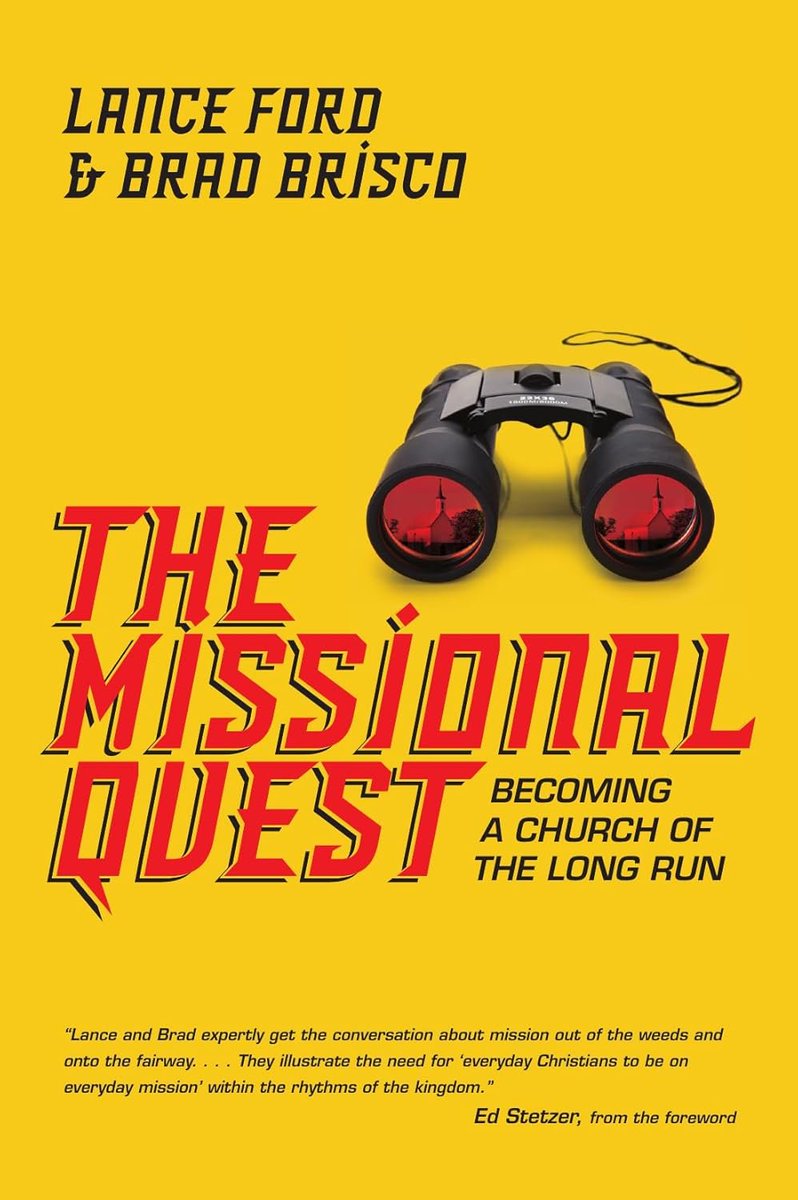
The Missional Quest: Becoming a Church of the Long Run by @lanceford & @bradleybrisco
Kindle: $3.99
"Not only are Brad Brisco and Lance Ford great friends, but they are also highly gifted colleagues deeply involved in helping to birth and nurture the missional church in America and beyond. This is a top-class practical resource to help any community live into its own missional future." -
@AlanHirsch, author of The Permanent Revolution
"The Missional Quest is a practical guide for how to get everyone in your church engaged in the mission of Jesus. I dream of a church where 100 percent of the people are sold-out, surrendered and serving Jesus, and Lance Ford and Brad Brisco show us how to make it happen." -
@DaveFerguson, CEO & President of Exponential. Co-Founding Pastor of COMMUNITY, Author of award-winning books including "Hero Maker", "B.L.E.S.S." & upcoming "Multiplier."
purchase link: https://t.co/vT1hiHotjH
@ivpress
If we don’t have a theology of work, Bivo/Covo ministry will always feel like a compromise.
But if we recover a robust theology of work, it becomes a strategic advantage for mission.
#Bivo#Covo#ChurchPlanting#WorkMatters
I have been researching completion rates in online learning, and the contrast reveals something about how people actually learn and grow.
Self-guided courses hover around a 3% completion rate. But when learning is cohort-based and guided by a facilitator, the completion rates often exceed 90%.
This isn’t just about delivery models. It’s about formation. People don’t just need content, they need community and guidance.
I am taking a break from social media for a while, but before I do, I want to share a wonderful experience today. I facilitated a session on the topic of #Covocational planting/leadership at the Recovery Church Conference in Brandenton, FL. What an incredible encouragement this group of people is. The Recovery Church Movement is a network of more than 140 churches, started about 15 years ago by @Pastordvorak. Almost all of the churches are led by Bivo/Covo leaders. I was blessed by the conversations and am grateful for the amazing work this network of churches is doing. If you have any interest in starting a recovery church or want to be involved on some level, check it out at https://t.co/UsULbzX3hf