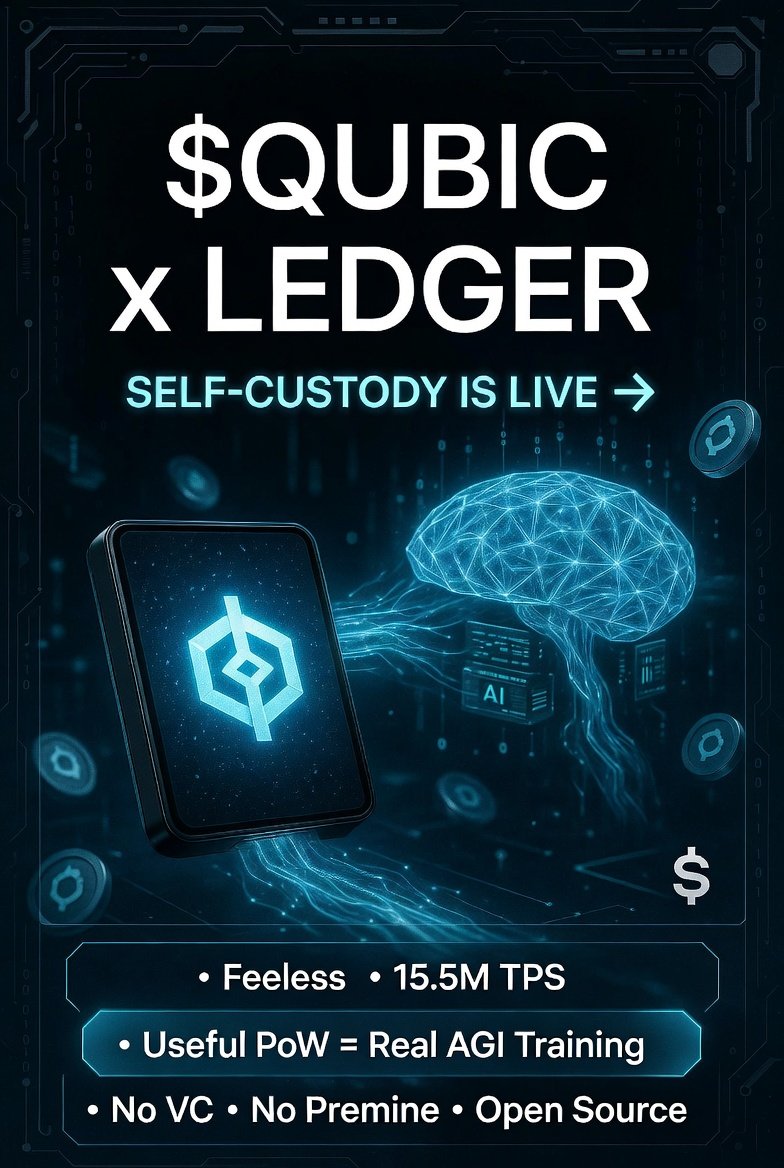
$QUBIC is now officially live on Ledger , you know what that means? Self-custody just got real. Private keys stay offline. No exchange risk. No phishing worries. No “not your keys, not your coins” problems.This isn’t hype. This is infrastructure:
Feeless transactions • 15.5M TPS (CertiK verified) • Useful Proof of Work that actually trains AI toward AGI • Upcoming halving in August • No VC, no premine, open source.Real projects build the rails first. The rest chase pumps.Who’s moving their stack to cold storage today? Drop a or RT if you’re securing $QUBIC long-term. In addition to @quipnetwork $QUIP , I'm watching a new project @pauv_inc #Ledger #Crypto #AI #SelfCustody
We're hiring a Head of Marketing & Growth.
This isn't a typical marketing role. You'll lead your own workgroup, propose your own budget, build your own team, and own the results. Fully remote. You own the strategy, the budget, and the team.
If you think like an operator and want to build something from the ground up, we want to hear from you.
AI data centers are on track to consume up to 70% of the world’s memory chips this year.
The knock-on effect is already here: memory prices are climbing, and laptops and phones are likely to get more expensive because of it.
The cause is one assumption the whole industry runs on:
More intelligence means more scale.
Bigger models.
More memory.
More data centers.
Every high-bandwidth chip the big memory makers produce is roughly three conventional chips they choose not to make.
Qubic bets against that assumption on two fronts.
First, the science.
Qubic’s Neuraxon research argues that brute-force scale is not intelligence at all.
Intelligence is efficiency: how well a system learns the unfamiliar, not how much it memorized.
You do not get there by buying more memory.
Second, the compute.
Qubic’s Useful Proof of Work runs AI training across thousands of machines that already exist, owned by the people securing the network.
It does not need to win a bidding war for scarce data center silicon because it was never built to fight in one.
The memory crunch is what an industry pays when it assumes the only way forward is bigger.
Qubic started from a different premise.
Bloomberg reported, half the AI data centers planned for 2026 will not get built.
Of 16 GW of capacity scheduled for the US this year, only ~5 GW is under construction. Sightline Climate expects 30–50% of planned builds to be delayed or canceled.
The constraint isn't capital. Hyperscalers are spending $650B+ this year.
It's transformers. Switchgear. Grid queues taking 5 years to clear.
The bottleneck of the AI revolution is not chips. It's the equipment that turns them on.
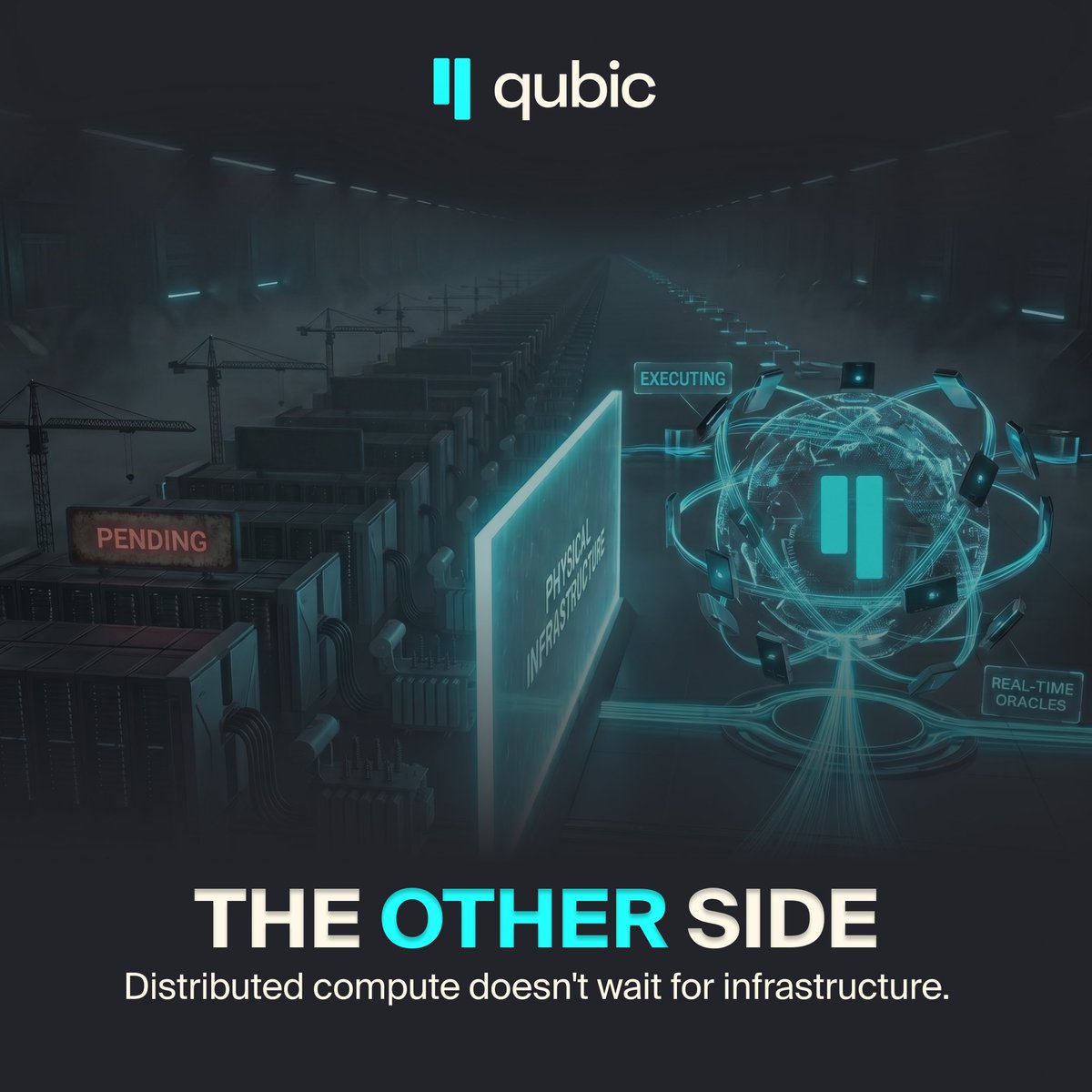
Qubic runs on hardware already deployed. Electricity is already on someone's bill. 676 Computors. No grid queue. No 200-acre site review. Online for four years.
200M transactions. 600K oracle queries. Per week. Already.
Which compute layer is on the other side?
The $QUBIC story, written down 👇
A blockchain without blocks
Mining without waste
AI without a centralized lab
Three contradictions that turn out to make sense.
It's worth understanding before the next halving in August👀⏳️
#AGI#Altseason#Crypto
The agent economy just got its launch announcement.
GPT-5.5. Google's Agentic Enterprise platform. Autonomous agents with persistent memory running for days. The capability is real and it's here.
Here's the question nobody is asking:
Where does the compute live?
Every agent OpenAI just shipped runs on Microsoft Azure.
Every Google agent runs on Google Cloud.
Persistent memory plus multi-day execution means these agents are renting compute around the clock, indefinitely.
The economic outcome is straightforward.
More agents = more compute hours = more revenue concentrating to three companies.
That's not a complaint. That's the mechanism.
Now, look at the same input on a different architecture.
Every smart contract execution on Qubic burns QUBIC.
Every Oracle Machine query burns QUBIC.
Every IPO auction burns QUBIC.
Every mining surplus burns QUBIC.
More agents = more burns = supply pulled permanently from circulation.
When AI compute scales on AWS, profit concentrates.
When AI compute scales on Qubic, supply tightens.
Same input. Two opposite approaches.
The infrastructure layer of the agent economy is being decided in 2026, not 2030.
One configuration of that choice is already running.
Today I showed the QUBIC project to a computer engineering professor at the university where I study Artificial Intelligence (yes, I am an AI academic).
He called me a “liar” as if he were joking with me. I sent him the Whitepaper and asked if I was “crazy” or if all these years studying development had messed with my head.
The result after analyzing the material? He bought QUBIC. What do you think I ended up doing once again? I’m not the only crazy one… a professor has now joined me in this “madness.”
But let’s get to what really matters, because this will “enlighten” your expectations in a responsible and reflective way.
As a systems developer and Artificial Intelligence student, I need to explain some of the reasons why I am investing 80% of my net worth in QUBIC.
I also want to make it clear that whenever I decide to write about QUBIC, I always present three perspectives: The entrepreneur’s view, the developer’s view, and the investor’s view.
Just for the record, today I made another deposit thanks to my patience in waiting for the opportunity I had been expecting ; a new price correction in QUBIC.
From this point on, you will understand why QUBIC is currently in my phase of maximum accumulation.
Qubic will be used as the example model, as you already know, but first I want to show you the trajectory of other AIs before they exploded in their projects.
Once you understand the information below, you will realize that QUBIC is not just a “cryptocurrency.” It is like a company (in case you forgot) developing an extremely complex AI (AGI) software.
Now, reflect on the following information:
Name of the AI: Gemini
Company that Launched it: Google (Alphabet / DeepMind)
Time of development until ready: Launched as Bard in March 2023, renamed Gemini in February 2024 (about 1 year since the initial announcement, with roots in years of DeepMind research).
Machine Learning Model: Multimodal LLM (Large Language Model with text, image, audio, and video capabilities).
Current market value after launch: Contributed to Alphabet reaching a market cap above US$ 3.5 trillion, with annual AI investments around US$ 185 billion and strong user growth (750 million monthly users).
Name of the AI: ChatGPT
Company that Launched it: OpenAI (with strong Microsoft partnership)
Time of development until ready: Founded in 2015, but ChatGPT launched in November 2022 (explosion within months after GPT-3).
Machine Learning Model: LLM (based on GPT series, generative transformers).
Current market value after launch: OpenAI valued at approximately US$ 852 billion after massive funding rounds (e.g., US$ 122 billion in one round).
Name of the AI: Claude
Company that Launched it: Anthropic
Time of development until ready: Founded in 2021 by ex-OpenAI members, Claude 1 launched in 2023 (about 2 years until the main product).
Machine Learning Model: LLM focused on Constitutional AI and safety.
Current market value after launch: Anthropic valued at US$ 380 billion (with recent rounds of US$ 30 billion).
Name of the AI: Llama (family of models)
Company that Launched it: Meta
Time of development until ready: Llama 1 launched in February 2023, with rapid iterations (Llama 3/4 in 2024-2025).
Machine Learning Model: Open-source LLM (large language models).
Current market value after launch: Contributed to Meta surpassing US$ 1 trillion in market cap, with Llama generating billions of downloads and an ecosystem (direct business value estimates of US$ 10-20 billion+ for the Llama business).
Name of the AI: Copilot
Company that Launched it: Microsoft (integrating OpenAI)
Time of development until ready: Announced in 2023, with wide rollout in 2024 (fast, leveraging US$ 13B+ investment in OpenAI).
Machine Learning Model: Integrated LLM (based on GPT).
Current market value after launch: Powers Microsoft’s AI division, expected to be the fastest to reach US$ 10 billion in annual revenue; contributes to Microsoft’s market cap above US$ 3 trillion.
Name of the AI: Grok
Company that Launched it: xAI (Elon Musk)
Time of development until ready: xAI founded in 2023, Grok launched in November 2023 (accelerated development in months).
Machine Learning Model: LLM focused on reasoning and real-time data from X.
Current market value after launch: xAI valued at around US$ 200-230 billion after rounds such as US$ 20 billion.
Final Reflection on the QUBIC Scenario: If all these AIs, based on traditional LLM models, reached billions (and even trillions in market impact) in just a few years after launch, what do you think will happen when an AI (AGI) starts running on QUBIC with evolutionary machine learning?
Be honest with yourself in your answer!
In Qubic’s model, Aigarth uses Intelligent Tissue (intelligent tissue) with ternary computing (-1, 0, +1), Useful Proof-of-Work (uPoW) that turns mining into distributed neural network training, Darwinian evolution through mutation, natural selection, and fitness functions. This creates an emergent, decentralized, and self-improving AGI, without the centralized bottlenecks of LLMs.
As soon as it is launched in the market, QUBIC has the potential to be selected as the world cradle for hosting Autonomous AI Agents, generating exponentially greater value due to its resilience, feeless scalability, and true evolutionary nature.
But the cherry on top has never been said.When an AGI is launched by QUBIC, it will attract millions of users, massively scaling the adoption of QUBIC’s AGI. In addition to regular users, we will have institutional users ; companies ; and sovereign users (governments).
Or do you think tests won’t be conducted from all over the world to see if it’s possible to develop their own tools using a decentralized AGI?
Remember the current problems: governments are racing to develop their own AI technologies. There is also huge demand for energy sources, and a race of all kinds is forming.
How much do you think QUBIC will be worth, considering it will not be an LLM, but a completely superior model?
Qubic will soon be on this list, but don’t think it will be worth just a few “billions.”
I estimate that having an AGI running with functionality and performance that meets even simple needs will already reach hundreds of billions of dollars in market cap.
If a centralized one reached trillions, imagine an AGI built the right way? Yes, gentlemen, there is no exaggeration in the calculations ; there is only the development time and getting the functionality right at launch!A tip?
Accumulate while there is still time!!
QUBIC IS INEVITABLE!
#qubic #aigarth
Two massive $QUBIC catalysts incoming before the end of summer. 👇
May 20, 2026 :⚡ 4x increase in transactions per tick goes live → From 270 tx/s sustained to 1,080+ tx/s→ Qubic jumps from #3 to #1 on Chainspect 7-day rolling TPS
June 10, 2026 :📦 Doubling of per-transaction data capacity → Bigger, more complex smart contracts on the fastest L1 alive
Q3 2026 :🔥 Token halving — weekly emission cut from ~450B to ~225B $QUBIC → Supply pressure cut in half. Permanently.
And throughout all of this :
🐶 DOGE mining scaling toward top-5 global pool
🌉 Solana bridge expected May/June
🧠 NeurIPS paper submitted (world's largest AI conference)
This is a lot of catalysts stacking into one quarter. 👀
$QUBIC #DOGE #Mining #AI #Blockchain
Im gonna help out the $QUBIC Community
When are you going to list Qubic on Binance? 👀
Let’s show them how powerful and united the $QUBIC community truly is, 💪it’s time to make some noise!!
@binance@cz_binance
A major update of #Aigarth is approaching. We are transforming #Qubic into a giant "anthill" where every miner will be searching for shares in a coordinated manner (like ants for food).
But we are not trying to create #SwarmIntelligence, we are using it for something more ambitious.
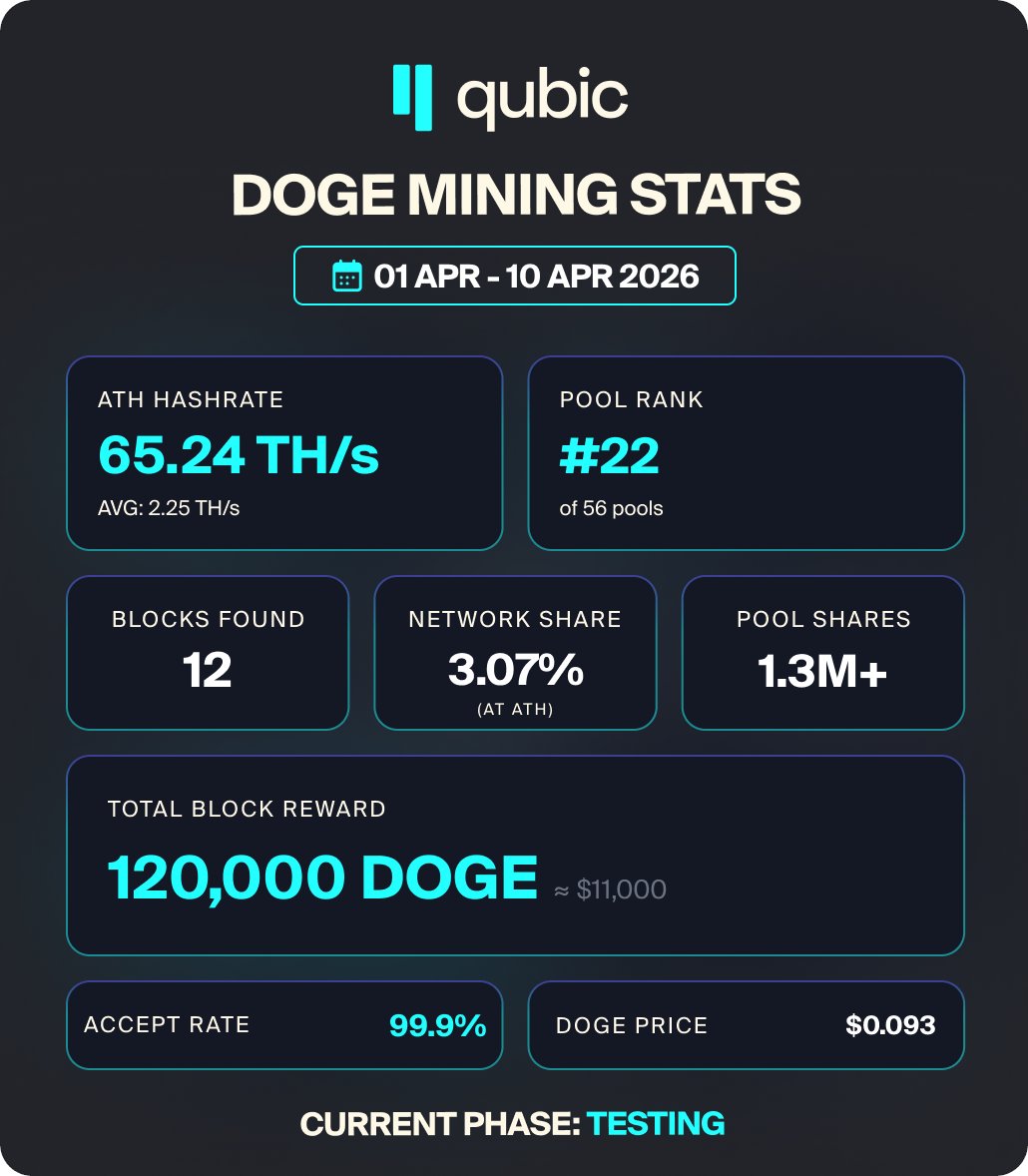
Just over a week into Doge mining. 12 Doge blocks on mainnet. 65 TH/s stress tested.
But the stat that matters most isn't in the numbers.
It’s the fact that Qubic is the first network running ASIC-based Doge mining and AI compute training in parallel.
At the same time. Both at full capacity. No trade-offs, no time-sharing between the two. That’s not a feature. That is an entirely different category of infrastructure.
Phase 1 is a stress test. Four independent pools connected. 1.3M+ pool shares accepted. 43.5K+ tasks distributed. The network has already been pushed to 65 TH/s.
No Doge topups yet, and that’s intentional.
Phase 1 exists to prove the pipeline works before real value flows through it, and it does.
Phase 2 brings the Doge topups and full computor migration, and that's when the economics kick in.
This is the stress test.
Every April Fools' Day, someone pulls a stunt.
Today, Qubic pulled a network.
DOGE mining is live. Powered by the fastest compute network on Earth.
This is not a joke.
8 days.
Idle compute shouldn’t stay idle.
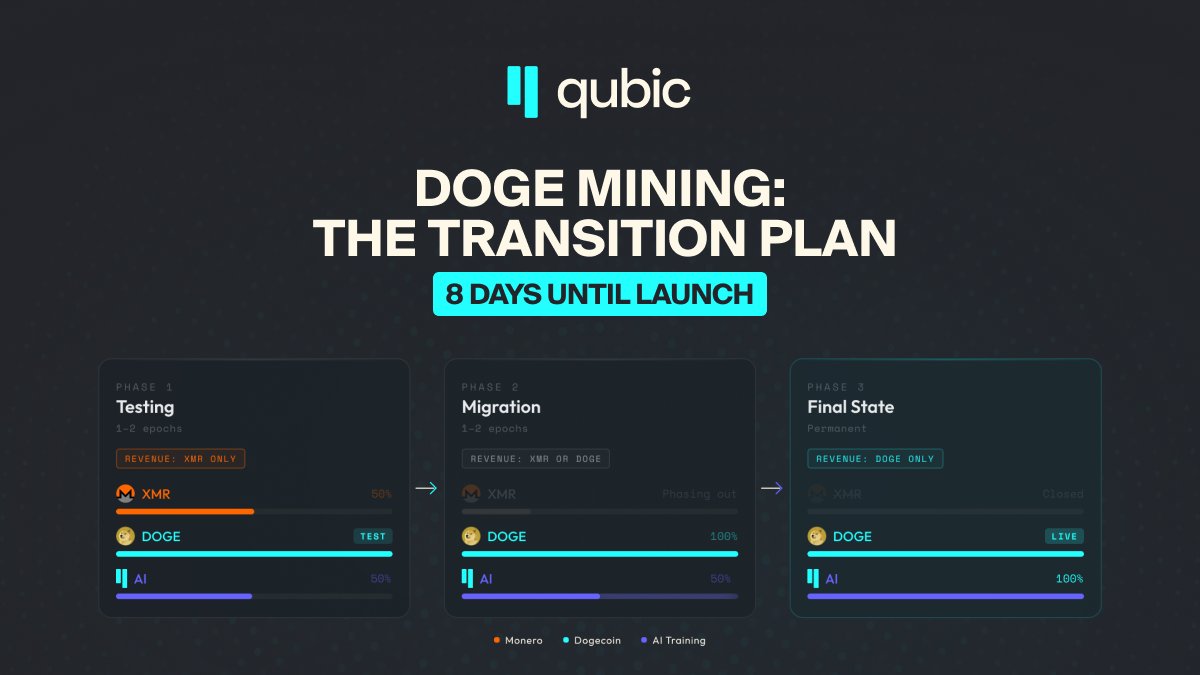
The transition from Monero to Dogecoin doesn’t happen overnight. Qubic’s core team designed a three-phase rollout. Each phase is evaluated before moving forward.
Phase 1, Testing (starts April 1st, 1 to 2 epochs):
Computor revenue stays XMR only. XMR active 50% of the time. DOGE enters test mode, active 100%, running on mainnet. AI training continues running alongside.
Phase 2, Migration (1 to 2 epochs):
Computors choose between XMR or DOGE revenue. XMR starts phasing out. DOGE phases in with top-up applied. Computors who bring DOGE are no longer eligible for XMR.
Phase 3, Final State:
Computor revenue is DOGE only. XMR dispatcher turned off completely. DOGE active 100%. AI training active 100%.
The network reaches its target: DOGE + AI, running simultaneously, full time.
No rushing. No shortcuts. Just disciplined execution.
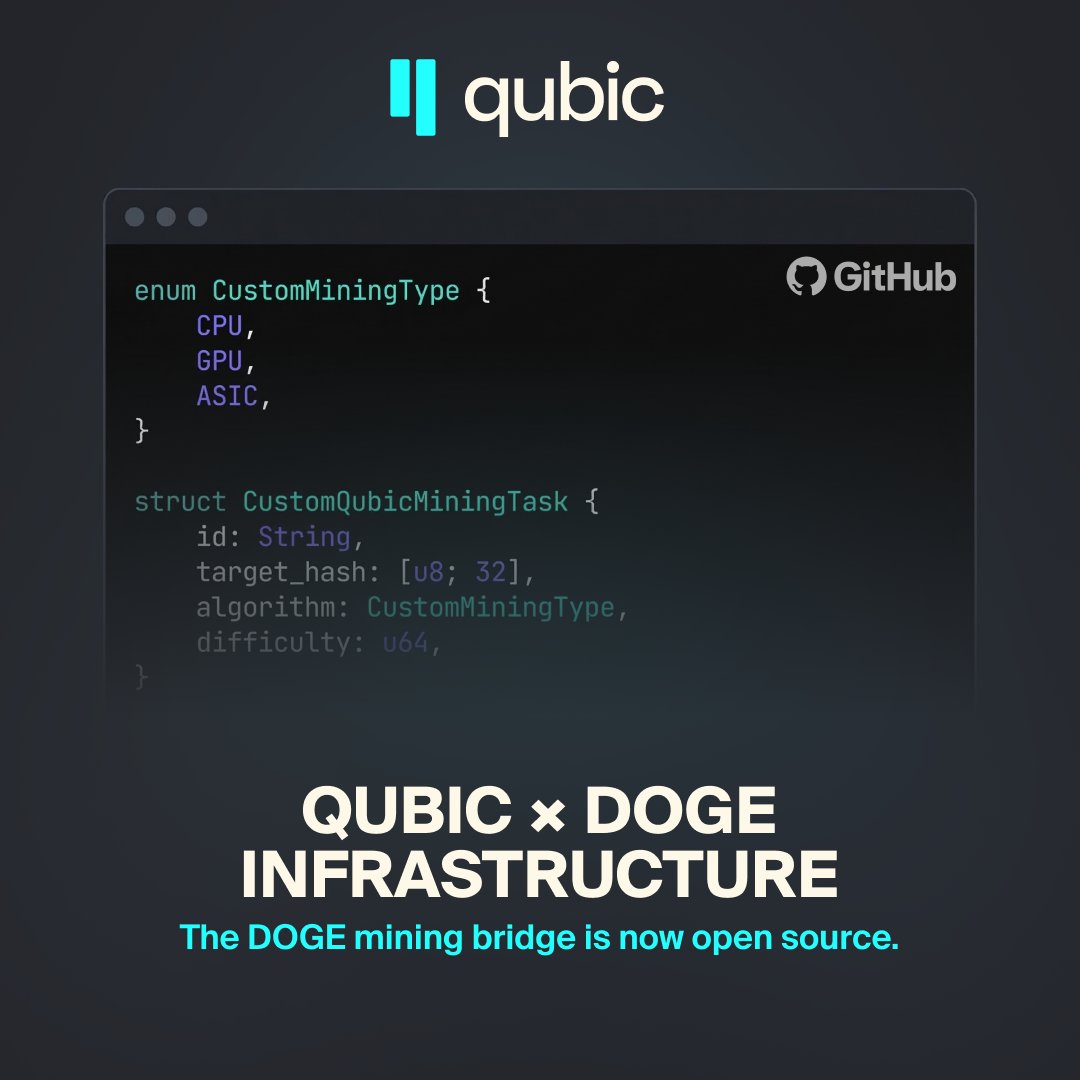
The first draft of the DOGE protocol implementation is now public on GitHub.
Doge-connect is the bridge between the Qubic network and Dogecoin mining. The repo includes:
• The Dispatcher: the custom bridge that connects Qubic’s compute network to the DOGE mining pool
• Communication structures for custom mining tasks and solutions between the Qubic network and external chains
• A testminer implementation for end-to-end pipeline validation
The architecture is designed to be extensible. The code defines generic structs that can support additional custom mining types beyond DOGE in the future.
This is open-source infrastructure, built in public.
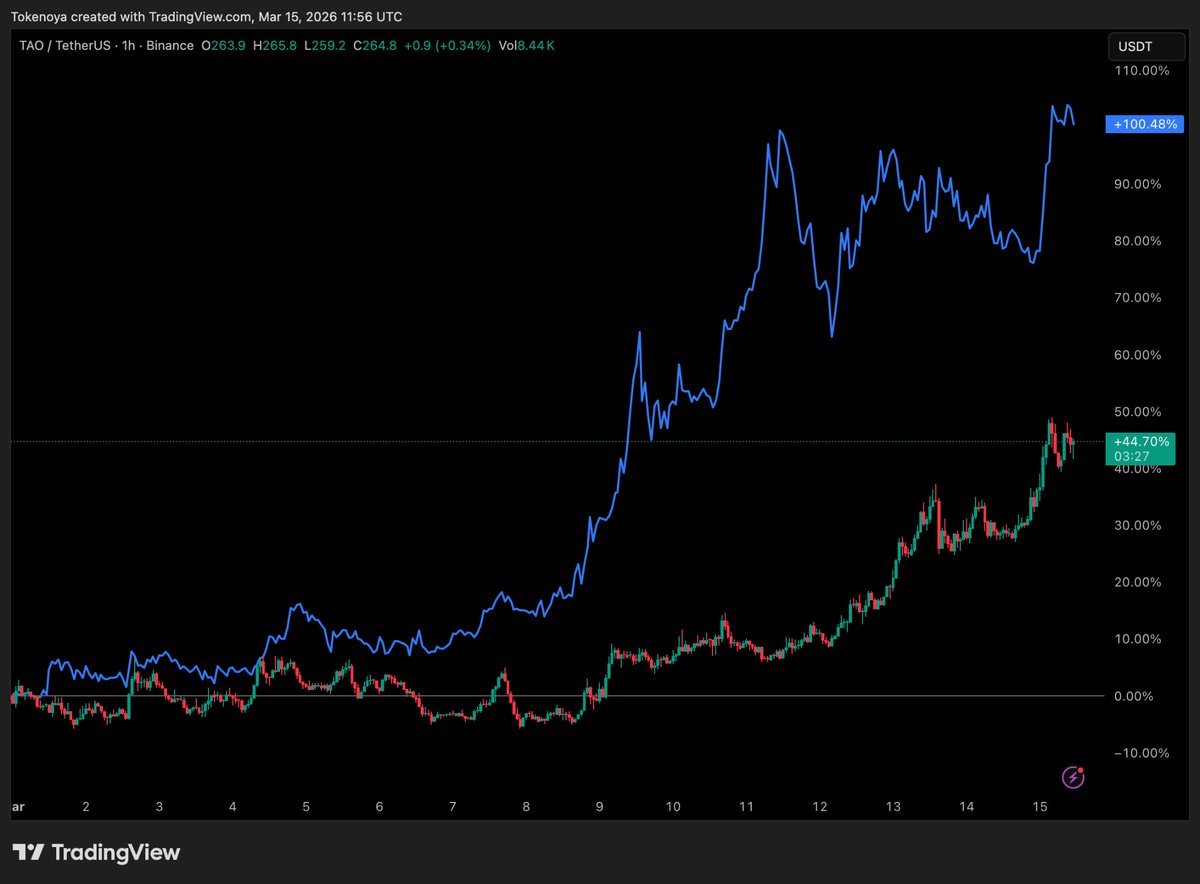
Tao vs Qubic since March 1st.
Everyone knows ai will be the lead narrative of the next cycle.
Today the leader is $TAO.
~$2.5B market cap.
$QUBIC is sitting at ~$125M.
20x smaller.
But look at the chart.
Since March 1st:
Tao ≈ +45%
Qubic ≈ +100%
Qubic is already 2.2x outperforming the AI leader.
Now do the math.
If Qubic keeps outperforming Tao at the same pace, the gap in market cap could close in ~6–8 months.
And right now the market is already signaling something.
Qubic is front-running the narrative.
Big news for $Qubic science.
Research by David Vivancos & Jose Sanchez has been accepted for publication AND presentation at #ICMLT 2026 - the 11th International Conference on Machine Learning Technologies in Berlin, Germany.
This marks the 2nd acceptance of #Qubic science into IEEE and this publication will also be indexed in Scopus, one of the world's most authoritative academic research databases.
#Neuraxon isn't just a project. It's peer-reviewed, published science.
The world is paying attention. 🧠⚡
#AGI #AI #Blockchain