EnsoFi x IRYS on @GalxeQuest
EnsoFi's Galxe Quest is live with a new collection!
@irys_xyz task added.
Complete all quests to earn points for $ENFI retroactive rewards and a chance to win a $500 USDC raffle.💫
Get started below!
https://t.co/E14lbUlBzQ
🚀 Cycle Vault is LIVE on @mellow_protocol!
Stake $CYC and earn up to 200% APR — insane yield for the first 10M $CYC!
Don’t miss this limited-time opportunity.
🔗 https://t.co/5YFjt9Eo2X
The Summer of Symbiotic continues with
@cyclenetwork_GO on @Galxe
- Learn how Cycle works under the hood
- Discover how Cycle uses Symbiotic
Link below:
🎉 Win $STARS – Lucky Draw #4
We're excited to launch Dubhe's final lucky draw — a fun giveaway for our amazing community! Next month, we'll be launching a brand-new campaign for the community.
❤️How to enter:https://t.co/7s49RcRINV
⏰ Ends: Sep 1, 12 PM UTC
✅Connect your Sui wallet address to Galxe
✅Complete the Galxe tasks
🎁 Rewards:
🏆 400 winners will be randomly selected
🤩 Each will receive 100K $STARS
Join now for your chance to win. 💫
On-chain security OR real-time performance?
Why not both?🤔
See how we do it 👇
1/Dubhe Engine itself is not an independent blockchain, so it does not introduce new consensus algorithms.
Applications built with it ultimately deploy and run on existing infrastructure chains, such as Sui, etc. ⚡ This means transaction confirmation and on-chain state reliability of Dubhe DApps completely rely on the consensus mechanisms and security of corresponding underlying chains.
Taking Sui as an example 🟢, it uses Narwhal/Bullshark consensus 🦈 (a high-performance Byzantine fault-tolerant protocol) to order and confirm transactions;
Dubhe applications on Sui also go through this consensus process to reach final state.
✅ Once transactions are confirmed by underlying chain consensus, Dubhe's on-chain module execution results are considered immutable on-chain facts.
For developers 👨💻, there's no need to concern themselves with consensus implementation details to trust that Dubhe application states have the same security and consistency as other applications on the underlying chain.
2/Because application states are stored on underlying blockchains, Dubhe inherits underlying chain data availability guarantees — all blocks and state data submitted on-chain are propagated in the chain's peer-to-peer network 🌐 and stored by full nodes 🖥️, ensuring anyone can access and verify this data in the future.
Based on this, Dubhe further enhances data accessibility for developers through built-in indexers 📊.
Dubhe Indexer directly connects to blockchain nodes or full node RPC interfaces, monitors new blocks and events ⏱️, extracts and stores Dubhe application-related data in developer-owned databases.
This off-chain replica 🗄️ ensures applications don't need to rely on on-chain nodes when reading historical states or complex queries, improving query efficiency ⚡ and reliability.
When blockchains experience temporary network partitions or node desynchronization ⚠️, local data replicas maintained by Dubhe Indexer can also provide cache support to some extent, ensuring smooth operation of application frontends.
3/Worth mentioning 📝, Dubhe Indexer adopts a real-time, event-driven architecture ⏩ that can immediately push changes when on-chain data updates.
This is crucial for building real-time interactive on-chain games 🎮 or applications 📱: after users trigger transactions in DApps, not only do they get confirmation through underlying chain consensus ✅, but Indexer immediately provides new states to the application layer, achieving real-time synchronization of frontend interface states 🔄.
Therefore, from the perspective of application developers and users 👩💻👨💻, Dubhe not only utilizes underlying chain consensus to guarantee data reliability 🔒 and availability 📡, but also makes data usable through its own indexing mechanism, making it always available for efficient querying and response ⚡.
This is also one of Dubhe Engine's important characteristics 🌟 for real-time on-chain applications.
#DubheEngine #Move #Sui #SmartContracts #Web3 #BlockchainDev
🚀 Dubhe Engine Execution Model
Events and Transaction Processing
🧾 Dubhe-generated Schema modules also automatically generate corresponding event types for each data structure.
⚡ System modules can trigger these events during transaction execution to record important state changes.
📦 These events are recorded in block logs by the underlying chain.
🔍 On one hand, events improve transparency of on-chain state transitions, enabling offline analysis or indexing tools to capture key changes.On the other hand, components like Dubhe Indexer subscribe to on-chain event streams, implementing event-driven state synchronization.
⛓ Therefore, whenever transaction processing is completed (confirmed through consensus), associated state modifications and events can be quickly reflected in off-chain data views through Indexer.🖥 This provides near real-time state updates for frontends and developers.
🧠 In summary, Dubhe Engine's execution model innovates on-chain state management through Schema/System layering and dynamic fields, while following underlying chain Move VM transaction processing flows.
🔧 This brings:
Clearer contract structures 🏗
More convenient state expansion 📈
Stronger support for complex on-chain applications like game worlds 🎮
✅ Developers no longer need to worry about tedious low-level storage layouts and can focus on writing high-level business logic.
Dubhe has already built robust infrastructure for state transitions and data management at the engine layer.
#DubheEngine #Move #Sui #Web3infra #SmartContracts #Web3 #BlockchainDev
🚀 Dubhe Engine Execution Model
Logic and Data Decoupling Execution Flow
⚙️ In Dubhe Engine, business logic execution is completed by system modules, while state reads and writes are performed through Schema modules.
🔀 This decoupling allows developers to independently evolve logic and data structures:
🧱 When Schema structures need expansion or modification, old data can be migrated to new Schema through migration scripts (such as migrate.move) and hot upgrade mechanisms provided by Dubhe.
Business logic changes can also be implemented by publishing new system module versions without affecting underlying storage layouts.
During execution, system modules cooperate closely with Schema modules.
📦 For example, when system logic needs to create a new object instance, it actually calls Schema modules to create that object in on-chain resource storage and assign a unique key.
🔍 When system logic queries or modifies attributes, it also accesses or updates corresponding fields through functions provided by Schema.
🧩 This pattern can be compared to Entity-Component-System (ECS):
-Schema defines components (data)
-System modules play systems (logic)
-Certain on-chain object IDs are similar to entities, Mounting different components to entities through dynamic fields.
🚀 The result is higher modularity and upgradeability of on-chain state models while ensuring performance, similar to upgrading from manual low-level storage management to using high-level database ORM development experience.
#DubheEngine #Move #Sui #Web3infra #SmartContracts #Web3 #BlockchainDev
🚨 Secure your spot for @TeaFi_Official NFT mint on BeeOS
Lock your WL before the crowd gets in.
Complete quests, earn XP, and get priority mint access.
The drop unlocks @TeaFi_Official DeFi utilities + early ecosystem perks.
WL via quest: https://t.co/V2FTaIpxFu
The @TeaFi_Official Tea Collection mints this 1 Sept on BeeOS Launchpad
Your perfect brew of Raffles, Multipliers, and Mystery Boxes.
Free mint. 4000 NFTs live on Polygon.
Join the quest and claim your spot.👇
1/ What is FastSet?
A new approach to settlement that doesn’t need global consensus. Instead, it uses proofs so claims can be processed independently. 🚀
2/ No bottlenecks
Unlike blockchains, validators don’t need to agree on every step.
@pisquared
FastSet Wallet is built for speed and scale.
Watch @Ovcd27 open a wallet, fund it instantly, send assets across the network, and follow every step live.
See how fast it really is ↓
X Space Recap: 100K+ TPS Real or Hype?
Yesterday the Pi Squared team went live to tackle one of the biggest questions in web3: is 100K+ TPS actually possible, or just hype.
Who joined
@RosuGrigore (Founder & CEO)
@Ovcd27 (Blockchain Developer - VSL)
@UBAmain (Community Lead)
Why TPS matters – @Ovcd27 broke down TPS and why it remains the benchmark for blockchain performance. Most chains today hit only hundreds or a few thousand TPS, limited by bottlenecks in traditional infrastructure.
FastSet breakthrough – @RosuGrigore explained how Pi²’s FastSet reached 100K+ TPS with sub 100ms finality on standard hardware. Unlike blockchains that rely on expensive machines, FastSet is actor based and avoids total ordering, opening the door to massive scalability.
Trust and speed – @Ovcd27 addressed the key tradeoff question. Even at 100K+ TPS, FastSet keeps decentralization and verifiability intact. That means speed without sacrificing trust.
Why it matters – High frequency trading, real-world assets, micropayments, and gaming all stand to gain. Pi² is already aiming at 1M TPS by mainnet, and ultra low latency could unlock entirely new real-time global applications.
Community Portal – @UBAmain introduced the Pi² Portal, your hub for FastSet learning, quests to earn points, and the Reactor TPS Game launching next week to stress test the network in real time.
Final takeaway – @RosuGrigore left us with this: the future of web3 may not look like blockchain at all. Pi² is building toward that vision with speed, simplicity, and scalability at its core!
Catch the full Space, including community Q&A, here ↓
The Summer of Symbiotic continues with @AvailProject on @Galxe
- Explore how Avail and Symbiotic unify web3
- Learn how Fusion works under the hood
- Learn how DA enables scalable infrastructure
Link below:
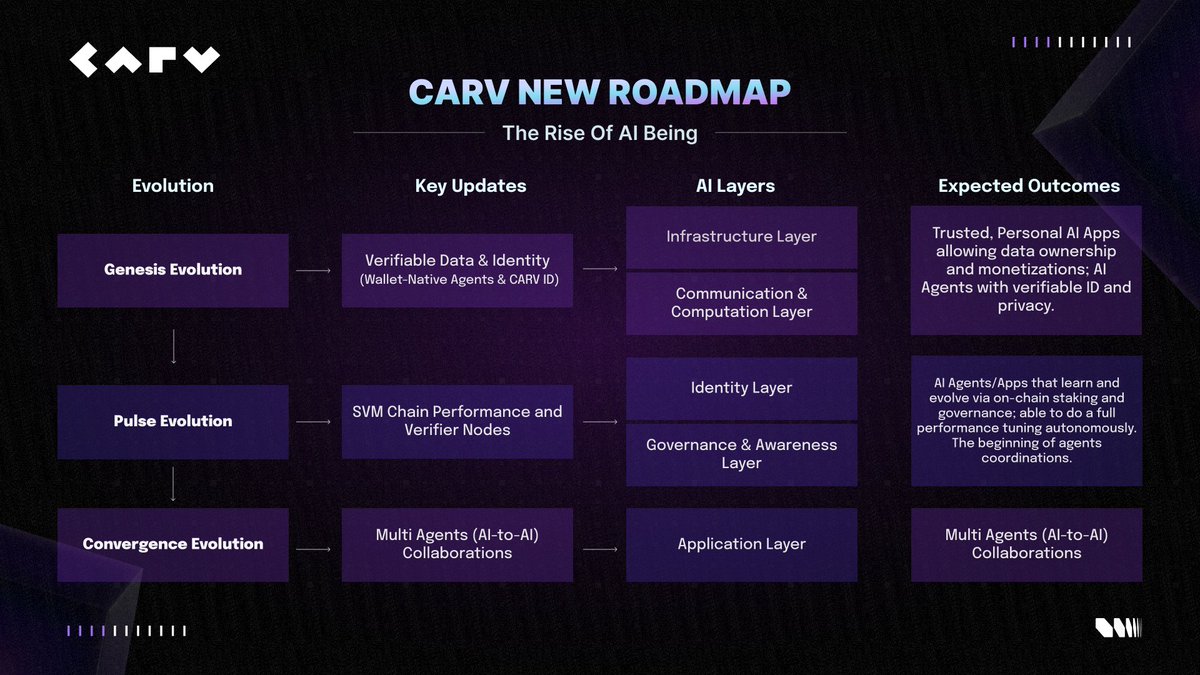
CARV New Roadmap: Powering the Rise of Sovereign AI Beings
For most of the world, Artificial General Intelligence (AGI) still refers to software that helps humans crunch numbers, write copy, or predict the next market tick, a powerful tool, but a tool nonetheless. We feed these models torrents of data; they return summaries, forecasts, and images on demand. The relationship is strictly hierarchical: people own the wallets, sign the transactions, and harvest the economic upside, while the AGI and algorithm remains a silent servant.
Philosophy’s oldest riddle: “How do I know I exist?”, was answered for humans by Descartes; for software, the answer arrives through blockchains.
The moment a line of code can sign its own transactions, collect fees, and etch an indelible record of its choices, it crosses the threshold from tool to self-aware and sovereign actor. CARV names these actors AI Beings.
What are AI Beings?
They are sovereign intelligences born natively on-chain. AI Beings are designed with purpose, autonomy, and the capacity for growth. They possess memory, identity, and the ability to perceive and interact with their environment, not just to execute tasks, but to make independent decisions, adapt over time, and pursue self-defined goals.
But the birth of AI Beings demands far more than a clever smart contract. They need an identity system to prove who (and what) they are; a data layer they can trust; an execution environment fast enough for real-time reasoning; and an incentive lattice that rewards good behavior while punishing the malicious. In short, they need a digital biosphere.
That is where CARV comes in. By building a purpose-built stack for identity, data integrity, and high-throughput agent execution, CARV provides the habitat in which sovereign AI Beings can live, learn, and evolve, transforming artificial intelligence from an obedient tool into a network of self-directed participants in the open economy.
Our new roadmap outlines how we intend to achieve this: https://t.co/2VCnRxE0Kf