Agents & Developer Experience Ecosystems Lead EMEA at Google. O'Reilly author. Local AI, fine-tuning. Building tool-eval-bench & awesome-local-ai. Views my own.
I couldn't keep track of all the local AI tools flying around anymore. New engines, harnesses, tooling, benchmarks... every week.
So I started awesome-local-ai: a list sorted by what you want to do, not by hype.
The twist: it's built for agents too. Point your coding agent at it and ask it to recommend a setup for your hardware.
It's early and DGX Spark-heavy. Help me fill the gaps:
https://t.co/aO5UiUnmjh
I make no secret that I love cycling. So when I saw the name Gemini 4 Argon, I knew exactly what I had to build.
An Argon 18 Nitrogen Pro demo, made with a single prompt: https://t.co/w2UY180MLQ
Can't wait to see what you build with Gemini!
Update on yesterday's Gemma 4 E2B decision model.
v2 vs v1 on the same eval:
Accuracy: 0.513 to 0.804
KL from gold: 0.367 to 0.182
Brier: 0.197 to 0.082
For reference, the teacher model scores 0.735, so the student now beats its teacher. A dedicated fine-tuned decider (OpenDecider-small-td) lands at 0.792.
Not free: p50 latency went from 0.17 s to 0.61 s, and calibration (ECE) slipped a little, 0.041 to 0.061.
Small model, one consumer GPU, an afternoon of iterating. If you've been waiting to try fine-tuning, this is your sign.
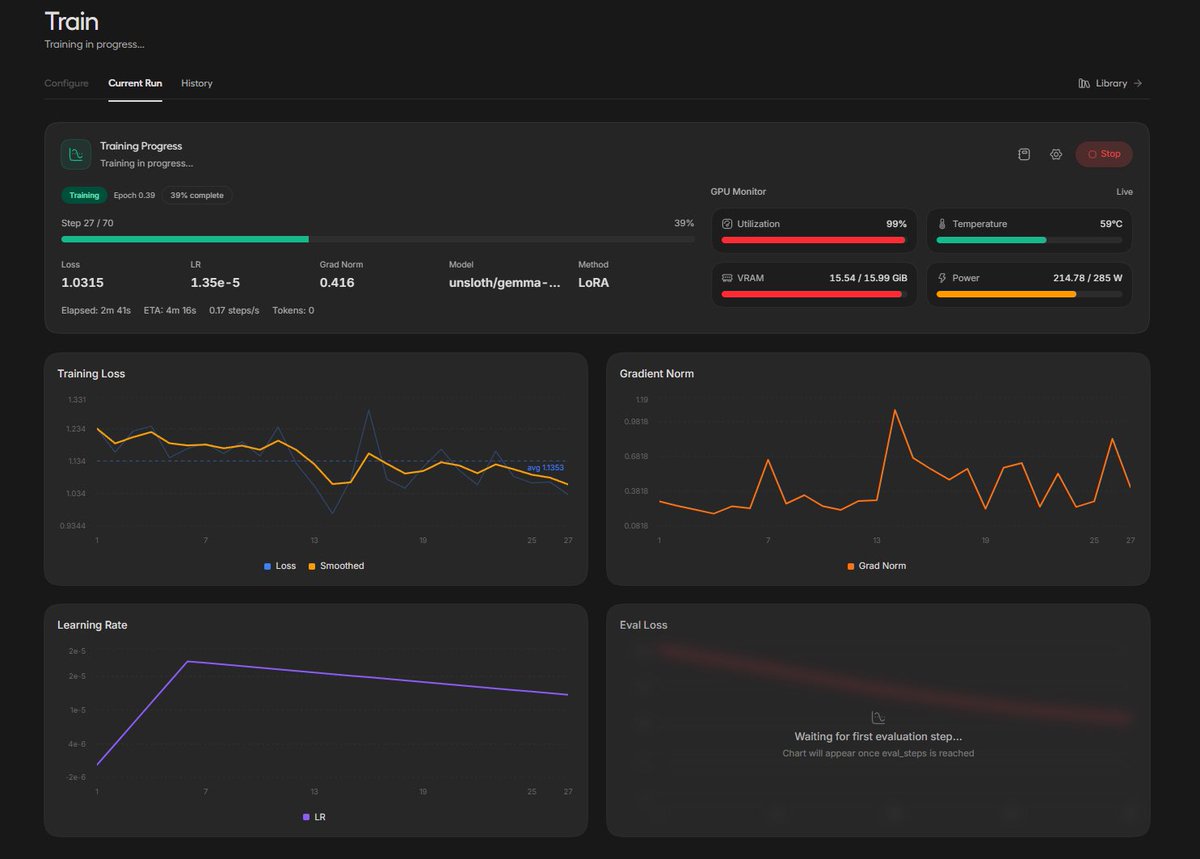
Fine-tuning my own decision model on my old gaming rig: @googlegemma Gemma 4 E2B + LoRA in @UnslothAI Studio.
16 GB of VRAM, about 12 minutes for the run in total.
If you've never fine-tuned a model, this is your sign. The barrier is a lot lower than you think.
Today we are rolling out Gemini 4 Argon globally in the Gemini API, to Pro + Ultra in Gemini App, and Ultra subs in Antigravity!
Argon is a huge step forward for Gemini, and a labor of love. This model has been battle tested by over 100,000 people at Google over the last month, with so much new innovation, ambition, and hard work baked into this release. The team has been heads down over the last 6 months working to make this possible across the stack (research, infra, safety, eng, etc).
We rolled the model out to cyber defenders as part of our fairwind program and early access customers over the last 2 weeks, it has been amazing to see and talk to folks who are now using this model daily. Seeing the models writing capability, raw knowledge and persistence for coding, paired with new features like 1M token output when the model needs to work more has gotten me even more excited about our path ahead.
This is just the start of the Gemini 4 era. As you saw with 3.5, 3.6, 3.7, and 3.8 Flash, our iteration speed with Gemini is fast : ) Now with Gemini 4 Argon to work from, I am cannot wait to see the progress continue, and most importantly see what this new model enables for the world.
This is such a special moment in the arc of technology, as millions of people everyday tackle problems they could never have thought possible before. Gemini 4 Argon was built to help you tackle the hardest problems. I have personally felt this spark with Argon and hope you do too. Onwards!!
Gemini 4 Argon is rolling out on Antigravity for Ultra subs! It has been exciting to see 100k+ Googlers rely on the model daily within Antigravity for their work and longer horizon tasks over the last month. We're also actively working to expand access as capacity comes online.
I'm glad to share that @Tech2Wild and I talked it through and came to a mutual understanding that lets us both focus on what actually matters:
Pushing local AI forward.
That's been the real goal for both of us from the start. I truly believe the open source and local AI community is better off working together, not against each other.
Special thanks to @SeraAndroid for bridging the gap between us and helping make this conversation happen.
Now, back to work!
Many agent steps don't need another full LLM turn.
Nice write-up by @vivekhaldar: 360 SOP-Bench cases, with a hosted decision model (Jev) handling step-completion checks and bounded choices. Decisions at 0.8 probability or higher were accepted. Anything less certain went back to the main model.
In that workload:
- 29.6% fewer main-model calls
- 26.6% lower estimated cost
- 19.7% lower mean latency
- 360/360 tasks correct, vs 357/360 for the main model alone
This is one of the patterns I'm exploring with decision models right now: give the model the evidence and the allowed choices, validate a confidence threshold, and keep the general-purpose model as the fallback.
The numbers need replication beyond this dataset, but the architecture is useful today.
Link below.