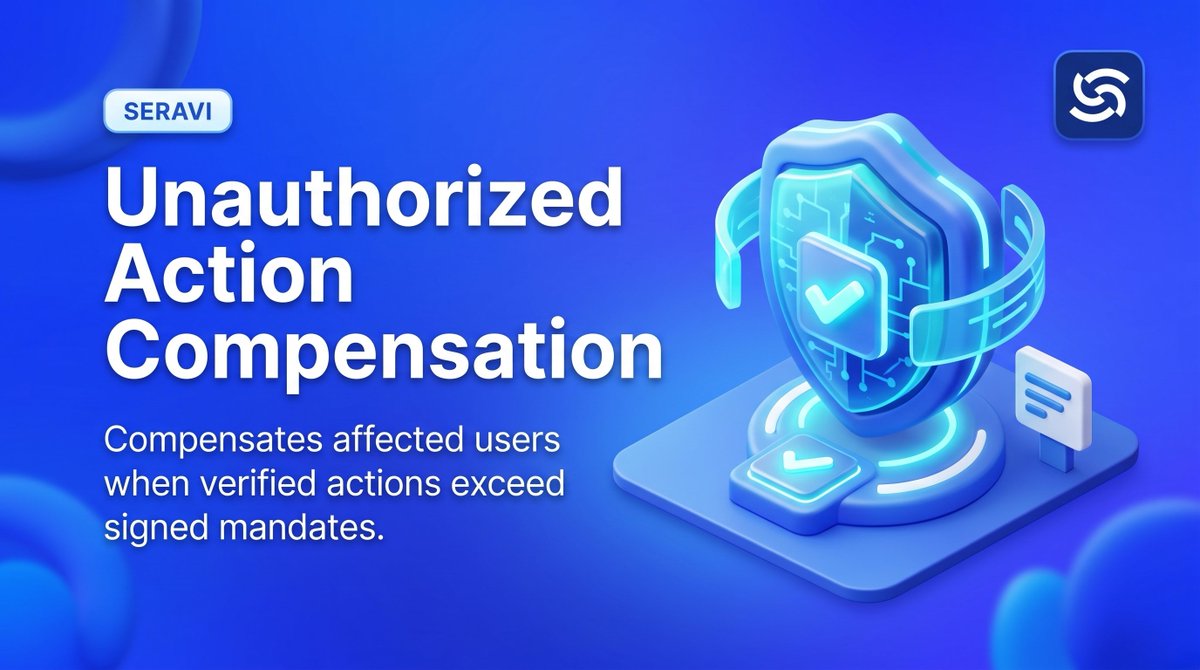
An AI agent's authority should have clear boundaries.
Seravi focuses on verifying agent activity against approved permissions and transaction limits, helping distinguish authorized operations from actions that exceed a signed mandate.
Clear boundaries are the foundation of accountable financial automation.
Liability protection needs transparent reserve management.
Seravi tracks locked collateral, available compensation, and outstanding liability claims to help clarify the financial position behind sponsor-backed AI accountability.
A credible framework must make both responsibility and available protection visible.
A compensation framework is only as reliable as its verification process.
Seravi evaluates submitted claims against transaction evidence and mandate records to help determine whether an AI agent acted outside its authorized scope.
Evidence-based validation is essential to meaningful accountability.
Every AI agent should be traceable to the organization responsible for its deployment.
Seravi establishes a sponsor accountability framework that links AI agents to responsible organizations and records relevant violations and claims.
As financial AI scales, accountability must scale with it.
Risk assessments should account for evidence, severity, and relevant context rather than treating every incident equally. Reliable scoring depends on consistent criteria and a clear distinction between verified violations and unresolved allegations.
AI accountability should be measurable.
Seravi updates sponsor risk profiles based on verified mandate violations and claims, creating a clearer record of how organizations oversee their financial AI agents.
Responsible deployment requires more than promises. It requires a record of responsibility.
Seravi's sponsor risk scoring concept connects verified incidents to the organization responsible for the agent. This creates a structured record that can help inform future assessments of deployment practices and accountability.
Responsible AI infrastructure should address both prevention and remediation. By linking mandate violations, verified claims, and sponsor liability, Seravi aims to make accountability more concrete in financial AI systems.
When an AI agent acts beyond its signed mandate, affected users should not be left without recourse.
Seravi connects verified unauthorized actions to limited compensation through sponsor-backed liability bonds.
Accountability must extend beyond detecting a violation to addressing its consequences.
A sponsor-backed liability bond creates a designated source of funds for eligible claims, subject to the framework's terms and available reserves. This connects the organization's responsibility to a potential financial remedy for affected users.
The future of financial AI depends on more than execution speed and automation. It also requires traceable responsibility, evidence-based claims, and meaningful consequences for unauthorized actions. Seravi is built around that principle.
AI agents operating in financial systems need more than defined permissions. They need accountable sponsors.
Seravi introduces sponsor-backed liability bonding, requiring organizations to secure funds against unauthorized financial actions.
Every agent should have a responsible party behind it.
A signed mandate establishes the boundaries of an agent's authority. By evaluating actions against those boundaries, Seravi provides a framework for identifying when an agent's behavior moves beyond its approved scope.