Saint Aprem of Edessa, more commonly known as Saint Ephrem the Syrian or Ephrem of Edessa, was a fourth-century Christian deacon, theologian, poet, and hymnographer whose life and works left a profound mark on Eastern Christianity. Born around 306 in Nisibis, a city then under Roman rule in Mesopotamia, he grew up in a region where Christian faith mingled with pagan influences and faced repeated threats from Persian invasions. Tradition holds that he was baptized as a young man and studied under Saint James, the bishop of Nisibis, becoming a teacher and defender of orthodox belief in his native city.
When the Roman emperor ceded Nisibis to the Persians in 363 following a disastrous campaign, Ephrem joined many Christian refugees in relocating to Edessa, the capital of Osrhoene. There he spent the final decade of his life as a deacon, living ascetically in a cave overlooking the city while remaining deeply engaged with its people. He taught at the renowned School of the Persians in Edessa, cared for the sick during a plague, organized relief for the poor and famine victims, and refused higher clerical offices such as priesthood or episcopate, preferring simplicity and service. He died in Edessa in 373, reportedly after contracting the very illness he had tended in others.
Ephrem earned enduring titles such as the Harp of the Holy Spirit, the Sun of the Syrians, and the Pillar of the Church for his extraordinary literary output. Writing primarily in Syriac, he composed hundreds of hymns, sermons, and biblical commentaries that blended profound theology with poetic beauty. His verses defended core Christian doctrines against heresies like Arianism, Marcionism, and the teachings of Bardesanes, often setting orthodox truths to popular melodies and training choirs, including groups of women, to sing them in public spaces. This innovative approach made complex ideas accessible and helped root the faith deeply among ordinary believers. His works, later translated into Greek and other languages, influenced liturgy, spirituality, and even later Western writers.
Venerated across Catholic, Eastern Orthodox, Oriental Orthodox, and Assyrian traditions, Ephrem was declared a Doctor of the Church by Pope Benedict XV in 1920, the first Syriac Christian to receive this honor. His feast is observed on June 9 in the West, aligning with his death date, and on January 28 in many Eastern calendars. Through his life of humility, tireless teaching, and lyrical devotion, Saint Aprem exemplified how faith could flourish amid political upheaval and cultural diversity, offering a lasting model of doctrinal clarity expressed in poetic wonder.
@jarnickipa I just wanted to express my gratitude for you sharing your thesis about microphones in the liturgy on NLM. What other changes did this usher in? Blinding flourescent light? https://t.co/nxaCWITVuw Screens flanking the sanctuary?
I'm looking forward to part 2. Thanks!
@MattWalshBlog But if God made man in His image and likeness and that our Lord, Jesus Christ became fully man to redeem humanity, what would it mean for there to be a rational, intelligent alien species? Could they be made in God's image and likeness? Could they fall and require a redeemeder?
@MattWalshBlog TY for calling attention to the people driving the training of AI models. Here's Microsoft's take on AI inclusivity. https://t.co/QPndnlPQMS
"If we truly think about how we can design for the 3%, we can then solve for the 97%"
When simulation becomes the norm, it weakens the human capacity for discernment. As a result, our social bonds close in upon themselves, forming self-referential circuits that no longer expose us to reality. We thus come to live within bubbles, impermeable to one another. Feeling threatened by anyone who is different, we grow unaccustomed to encounter and dialogue. In this way, polarization, conflict, fear and violence spread. What is at stake is not merely the risk of error, but a transformation in our very relationship with truth.
Your progress in spiritual life does not consist in having the grace of consolation, but in enduring its withdrawal with humility, resignation, and patience, so that you neither become listless in prayer nor neglect your other duties in the least.
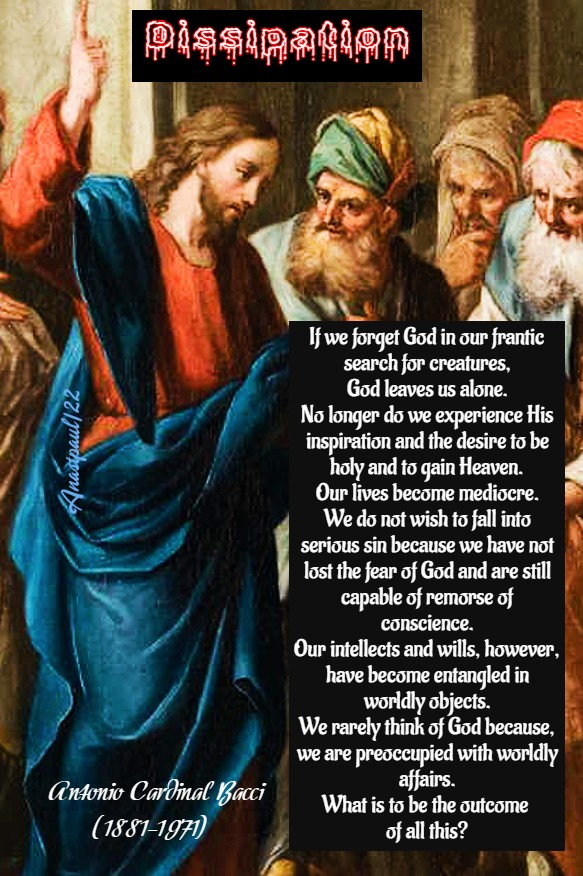
Dissipation
1. Dissipation leads to tepidity, and tepidity leads to sin. Why are we dissipated? So much beauty and goodness surrounds us, created by God for our benefit. It often happens that when we gaze on worldly beauty, we become inordinately attached to it. We see worldly goods and desire too ardently to possess them. We forget that the beauty of this earth is only a fleeting reflection of the eternal beauty of God, and that the good things of creation are gifts from God. Everything which is good and beautiful in this world, therefore, should raise our minds and hearts towards God and prompt us to love Him Who created it. Unfortunately, we often stop half-way, forget God, and begin to seek in creatures the perfect satisfaction which they are incapable of giving us.
Dissipation is the neglect of spiritual things and the inordinate attachment to creatures. It causes us to lead worldly lives and to think only of material interests, money, pleasure, and sometimes sin. If we find that we have fallen into this wretched state, let us act at once. Let us remember that we were not created like the animals for the satisfaction of the senses, but were made for everlasting spiritual happiness. Only God can satisfy our immortal souls, whereas created things, loved for their own sake, eventually leave us bitter and disillusioned. “What does it profit a man,” asks Sacred Scripture, “if he gain the whole world, but suffer the loss of his own soul?” (Mt. 16:26)
2. If we forget God in our frantic search for creatures, God leaves us alone. No longer do we experience His inspirations and the desire to be holy and to gain Heaven. Our lives become mediocre. We do not wish to fall into serious sin, because we have not lost the fear of God and are still capable of remorse of conscience. Our intellects and wills, however, have become entangled in worldly objects. We rarely think of God, because we are preoccupied with worldly affairs.
What is to be the outcome of all this? We cannot remain in this state very long. Our spiritual life lacks the supernatural nourishment of grace, with the result that slowly but surely we slip from dissipation into sin. “With desolation is all the land made desolate,” laments the Holy Spirit, “because there is none that considereth in the heart.” (Jer. 12:11)
3. Imagine the death of the dissipated man. When he reaches the end of his earthly journey, it will seem to him as if he has awakened from a dream. Everything is over now. Gone forever are the objects of desire which he exerted himself so feverishly to acquire. He is alone before God. Money, ease, and pleasure have vanished like snow melting in the sun.
Please God we shall never experience this fearful reawakening. Let us rouse ourselves now, while there is still time, from our spiritual torpor. May God be our first thought and our first desire. May constant prayer, detachment from the world, and steady progress in perfection win for us the everlasting happiness of Heaven. (Antonio Cardinal Bacci)
I really do wonder how many today would call Brave New World utopian versus dystopian and the savage the antagonist versus the protagonist... https://t.co/TNxNAyMIMQ
🚨ALERT: A new peer-reviewed paper in the American Sociological Association's official journal Sex & Sexualities calls for the elimination of the idea of childhood sexual innocence and the social/ethical taboos against children engaging in sex acts.🚩
The authors lament that most scholarship "marginalizes childhood sexual pleasure" and views children as “vulnerable subjects." They argue that we must "interrogate dominant narratives of sexual innocence that suppress young people's desires" and instead recognize how children "negotiate pleasure and meaning amid intersecting hierarchies of age, race, gender, and class." They reject what they call "adult-centric/adultist approaches to sexualities" and insist that "childhood pleasure is indispensable for an inclusive sociology and just sexual futures."
It is hard to read this as anything other than laying the intellectual groundwork for dismantling age-of-consent protections.
The central theme of the paper is "pleasure." This aligns with trends in international sex education policy, particularly the International Planned Parenthood Federation's Comprehensive Sexuality Education (CSE) program, which explicitly shifted away from sex education centered around reproduction and toward what it calls "sexual expression, sexual fulfillment, and pleasure." Pleasure is one of seven core elements of CSE. Its Youth Policy, applying to "all young people irrespective of their age," declares a "right to pleasure" and "the right of all young people to enjoy sex and express their sexuality in the way that they choose."
It is therefore no surprise that the paper's authors frame the very notion of childhood sexual innocence as a barrier to progress.
They are saddened that "preadolescent children's erotic capacities are routinely pathologized." They argue that the "notion of childhood sexual innocence" is a harmful social construct that wrongly portrays children as "vulnerable to and in need of protection from sexuality." In their telling, "operating from the presumption of innate (sexual) innocence" leads scholars and the public to "overlook children's everyday pleasures" and attempt to "banish childhood sexuality altogether." They even go so far as to describe childhood sexual innocence as a "colonial fiction."
The fact that such arguments now appear in a flagship journal of the American Sociological Association should alarm everyone. As we repeatedly see, what begins as abstract theorizing in niche corners of academia rarely stays there. It trickles down into education, policy, and culture.
Read my full, in-depth write up of this paper below.
🔗https://t.co/muagQJ5mfN
Saint Hildegard of Bingen (1098–1179) was a German Benedictine abbess, mystic, composer, writer, and polymath whose extraordinary contributions spanned theology, music, science, and medicine. Born in Bermersheim, Germany, as the tenth child of a noble family, Hildegard was dedicated to the Church at a young age, entering the monastery at Disibodenberg around age 15 under the guidance of Jutta, an anchoress. This marked the beginning of her lifelong spiritual and intellectual journey, which would establish her as one of the most remarkable figures of the Middle Ages.
Hildegard’s most distinctive gift was her visionary experiences, which she attributed to divine inspiration. Beginning in childhood, she received vivid visions that she later described as the “living light.” At age 42, she felt compelled to record these visions, resulting in her first major theological work, Scivias (Know the Ways), a collection of 26 visions exploring divine mysteries, salvation, and the relationship between God and humanity. Her writings, characterized by vivid imagery and profound insight, gained recognition from Church authorities, including Pope Eugenius III, who endorsed her work at the Synod of Trier in 1147–48.
Beyond theology, Hildegard was a prolific composer, creating one of the largest bodies of medieval sacred music. Her compositions, such as the Symphonia armonie celestium revelationum (Symphony of the Harmony of Celestial Revelations), feature soaring melodies and poetic texts that reflect her mystical experiences. Her music, innovative for its time, remains celebrated for its emotional depth and spiritual resonance.
Hildegard’s intellectual curiosity extended to the natural world. She authored works like Physica and Causae et Curae, which explored natural history, medicine, and holistic healing, blending empirical observation with spiritual beliefs. These texts demonstrate her understanding of the interconnectedness of body, mind, and soul, making her a pioneer in medieval science.
As a leader, Hildegard founded two monasteries—Rupertsberg and Eibingen—demonstrating her organizational acumen and independence. She corresponded with popes, emperors, and other leaders, offering spiritual guidance and bold critiques, earning her respect as a prophetic voice. Her fearless engagement with powerful figures, combined with her multifaceted contributions, made her a towering figure in medieval Europe.
Canonized in 2012 by Pope Benedict XVI and named a Doctor of the Church, Saint Hildegard’s legacy endures. Her visionary theology, innovative music, and scientific insights reflect a rare synthesis of faith and intellect, marking her as a timeless figure whose influence continues to inspire across disciplines.
One of Charlie Kirk's last videos was to honour the Blessed Virgin Mary and to tell Protestants and Evangelicals to honour her more
He called her the solution to 'toxic feminism'
Charlie Kirk reminded us that a life of courage and virtue isn’t easy—but it’s worth living. His example should inspire us all to stand boldly for what’s right.
Truth is the conformity of the mind to reality.
To lie to someone is to divorce their mind from what is real.
And when you help someone live a lie it is neither love nor tolerance.
It is cruel.
And the friction between the lie and reality can be violent.
President Trump's criticism of the Smithsonian Museum of American History is not that they portray slavery as bad. OF COURSE it's bad, and he believes it was bad. It's that the Smithsonian has focused on the worst evil of the United States, as if it were the nation's defining feature.
That's not a fair way to judge any nation or culture, especially one with a long and varied history, or one which you could, justly, praise for its virtues and triumphs, or even simply delight in. Suppose you go to Japan, and you visit one of the national museums. You know about World War 2. You know about the Rape of Nanking. You may know about the Shogun persecution of Christians in the early 1600's. But is that what you go there to see? You should no doubt see some of it -- but should that be what defines Japan, or what you can't get loose from in the museum? Nor do I care for official self-flagellation in cultural institutions, which is usually the whipping of OTHER PEOPLE, conveniently dead or otherwise silenced, by people plying the whip and shedding phony tears as they do it.
I expect Canadian museums to celebrate what is good and worthy in Canada, and so I've found them to be. I expect Italian museums to do the same in Italy; I'd be appalled to enter an Italian museum devoted to imperial Rome, and find it actuated by an unveiled hatred of it all.
And we wonder why our young people walk around like Joe Bftzplk ... at least, those who fall under two or three general condemnations. Can't even look kindly upon your own homeland ...
"Talent by itself does nothing but make a bit of noise. The true value of a soul is measured not by the natural gifts it has received, but by the degree of humility and love of God it possesses. Many have received great gifts and remain proud and fruitless. Others are little in the eyes of the world but great in God’s eyes because they attribute everything to Him." - Fr. Reginald Garrigou-Lagrange