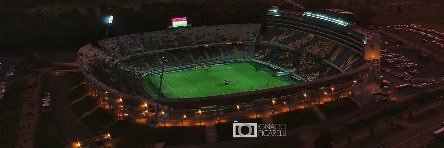
Let's talk about Peñarol.
Yesterday I visited one of the biggest clubs in Uruguay and in South America. A club founded by British railway workers in Montevideo, with a fanbase that proudly embraces its working-class roots.
You can read a banner behind one of the goals that says: "Working-Class and Popular Origins."
The iconic black-and-yellow stripes were inspired by the Rocket, one of the earliest successful steam locomotives built in England.
Peñarol has more than 50 Uruguayan league titles and 5 Copa Libertadores trophies.
Peñarol vs Nacional, "El Clásico Uruguayo", isn't just Uruguay's biggest match. It's one of football's oldest rivalries, dating back to 1900.
The rivalry between Peñarol and Nacional goes beyond football. Peñarol considers itself to have been founded on 28 September 1891 as the direct continuation of the Central Uruguay Railway Cricket Club (CURCC). Under that interpretation, it is the oldest football club in Uruguay and therefore El Decano, "the oldest".
Nacional rejects that continuity, arguing that CURCC and Peñarol are different institutions. Founded in 1899, Nacional instead claims to be the oldest club founded by Uruguayans.
Peñarol has been home to legendary players such as Alberto Spencer, the all-time top scorer in Copa Libertadores history; Fernando Morena, the club's all-time leading goalscorer; Pablo Bengoechea, one of the greatest #10 in Uruguayan football history; and Pedro Rocha, the brilliant attacking midfielder from the 1960s who was admired by Pelé.
More recently, the club has produced players such as Diego Forlán, Darwin Núñez, Federico Valverde and Facundo Pellistri.
For a club from a country of just over three million people, that production line is extraordinary.
A new generation is already emerging, with players such as centre-back Nahuel Herrera (2004), attacking midfielder Leandro Umpiérrez (2004), striker Brandon Álvarez (2007) and right-back Brian Barboza (2008), all of whom are attracting interest from clubs abroad.
Yesterday, in Peñarol's 3-0 win over Cerro Largo, another young talent stood out: 20-year-old Leonel Jaime, who is on loan from River Plate.
Under Diego Aguirre, a club legend as a player and a coach with experience in Brazil and Mexico, Peñarol lined up in a 4-2-3-1 that often became a 4-4-2 in possession, with two strikers: Matías Arezo (23), recently re-signed from Gremio for around €3 million and still a player with considerable upside, alongside veteran forward Abel Hernández (35), formerly of Hull City.
It's not common for Peñarol to play with two strikers, as they usually operate in a more traditional 4-3-3.
Peñarol currently sit top of the overall league table and have also added experienced striker "Cabecita" Rodríguez (33), formerly of América, Cruz Azul, Benfica and Deportivo de La Coruña.
There are also rumours that Flamengo attacking midfielder Nicolás De La Cruz (29) could return to the club in the coming days.
One final curiosity: Peñarol play at the Campeón del Siglo stadium. On rainy days, the area surrounding the stadium often turns into mud, and it's almost impossible to reach the stadium without getting your shoes dirty.
Rival fans use it to mock the club, but many Peñarol supporters embrace it as another symbol of their working-class identity and origins, almost as if "coming from the mud" reflects the values they are proud of.
Today I'll be visiting Uruguay's other historic giant: Nacional.
Adriano 🇧🇷 tuvo su partido despedida en el Maracaná. En la pantalla del estadio alguien le mandó un saludo: su papá, quien falleció en 2007. El video fue realizado con la ayuda de la inteligencia artificial.