@debamustafa@GenLayer seeing developers finally rewarded for utility rather than hype is refreshing
a recurring revenue stream based on real value will flip the open source economy upside down
Most open source builders get paid once in a grant, then watch everyone else profit from their code.
That is why the AI court being built by @GenLayer caught my attention. It settles disputes normal code cannot handle, like whether a freelancer or an AI agent actually delivered the work they were paid for. Every time someone asks for a verdict, they pay a fee in GEN.
Out of the 7 tokenomics points in this video, the builder split is the one that actually stands out to me.
10% of every verdict fee goes straight to the builder of the app. Not as a one time payout, and not as a grant. They get paid every single time the app runs, for as long as people keep using it.
In crypto, developers usually have to invent a pointless token just to keep the lights on. Tying builder income directly to real usage fixes that incentive from day one.
If you built an app that settles real world disputes, would you rather take a one time upfront grant or 10% of every fee it ever generates?
@debamustafa@GenLayer accountability creates the foundation for fair digital agreements that we actually need
putting skin in the game transforms trust from a guessing game into a reliable system
genlayer is leading the way toward a more honest internet
Most bad decisions on the internet happen because being wrong is completely free.
Imagine an AI court built to settle disputes that regular code cannot handle, like whether a freelancer or an AI agent actually delivered the work they were paid for. That is what @GenLayer is building, with the GEN token powering the whole system.
Out of the 7 tokenomics points in this video, the accountability rule is the one that actually makes the court work.
First, every validator's vote stays sealed until the whole panel has voted. Nobody can wait around and lazily copy the majority.
Second, if a validator ends up on the losing side of a final verdict, they do not just lose their fee. They pay that exact same amount again as a penalty. Being wrong literally costs the fee twice.
The best detail for regular users? That penalty is taken strictly from the validator's own locked stake, never from the people who delegated GEN to back them. And if a validator gets caught cheating, proven fraud gets slashed: a cut of their stake is burned, and they can be thrown out of the court.
Spinning up cheap AI models to guess answers is easy. Forcing the judges to put their own skin in the game is the only way an AI court earns real trust.
Would you ever trust an automated judge if getting the verdict wrong cost it nothing?
@debamustafa i love seeing complex quantitative finance simplified for the long term holder
leveraging kelly sizing over predatory gambling shows the evolution of our industry
this approach prioritizes sustainable growth over volatile spikes
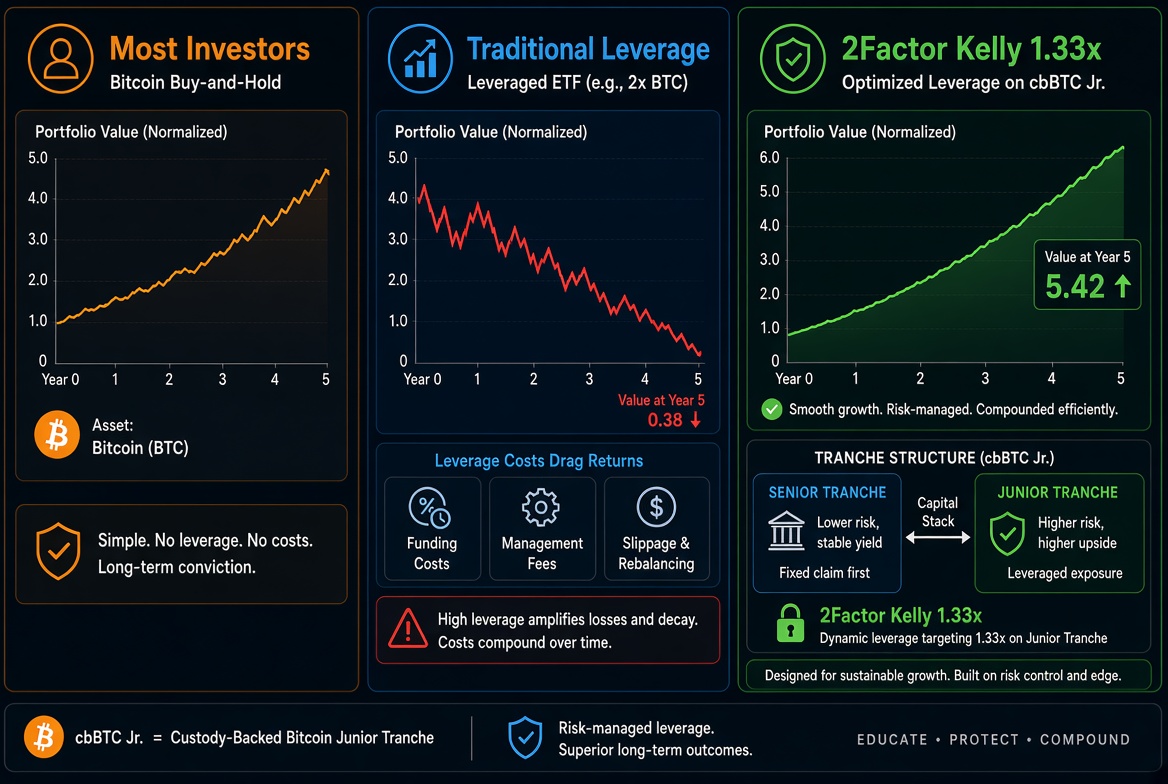
You can now hold 1.33x leveraged Bitcoin like spot, with no margin calls and no liquidation. That sounds like a strange number until you actually run the math on why 2x fails.
Last year, I sat down with a spreadsheet to test what a simple 2x leveraged Bitcoin position would have done during a choppy six month stretch. I expected double the result. Instead, financing costs and daily rebalancing drag quietly chewed through the stack. Even after Bitcoin recovered its price, the 2x position was still underwater.
That is the exact trap Kelly sizing was built to solve. It is an institutional framework for finding the specific leverage ratio that maximizes long run growth. Too little leverage leaves growth on the table. Too much turns normal volatility into a slow bleed toward zero.
For listed equities, that mathematical target sits near 1.5x to 2x. Berkshire Hathaway has operated around 1.6x for decades, and Ed Thorp built Princeton/Newport on the same principle. For Bitcoin, because the swings are much wider, the Kelly target lands around 1.33x.
So why did this strategy stay locked behind institutional walls for so long? Two reasons. Maintaining a steady ratio takes continuous active work, and traditional financing is usually priced by what it costs to be short. The usual retail route, leveraged ETFs, costs holders an estimated $10B+ a year in hidden financing above the risk free rate and decays over time. They are built for short term trading, not holding.
Deployed on Base and live in a capped beta, @2FactorFinance packages this into a passive structured product starting with cbBTC:
cbBTC-Jr gives you 1.33x leveraged cbBTC. It is never liquidated and is built to be held like spot.
cbBTC-Sr is the senior side that funds the leverage, sitting behind a deep buffer of junior capital.
Bitcoin comes first, and tokenized stocks are next on the roadmap (not live yet). The protocol is backed by Pantera Capital, Coinbase Ventures, Brian Armstrong, and True Ventures, though it is deployed on Base and is not a Coinbase partnership.
My honest take: the real innovation here is restraint. Almost every crypto platform tries to sell you 50x leverage. Building a product around 1.33x because that is what the math actually supports for a long term hold makes a lot more sense. Still, no liquidation does not mean no risk. Downside swings are amplified, and a capped beta has not yet been tested through a brutal multi month bear market. My personal rule before putting real size into any structured product is watching how it survives a 30% drawdown first.
If you are holding Bitcoin for the next five years, would you rather stick to plain 1x spot or test a 1.33x structure that removes liquidation?
To explore the Points Program, sign in with X. No deposit is needed. Your X account must be at least 90 days old with 150+ followers, and it is not open to people in the US or restricted countries.
My referral link:
@debamustafa i am so stoked to see this elegant math finally coming to retail investors
this approach makes way more sense than paying those massive etf fees
2factor is setting a brand new standard for long term wealth creation
Most people buy and hold Bitcoin. Yet, when they want more exposure, they step into a trap that costs retail investors over ten billion dollars a year in hidden financing and volatility decay.
The traditional solution for extra exposure is leveraged ETFs or margin trading. Both require continuous management and quietly bleed out your portfolio through rebalancing costs.
But there is a completely different mathematical approach to leverage. It is called Kelly sizing.
Instead of asking "How much leverage can I get?", Kelly optimization asks "What is the exact leverage ratio that maximizes long term compound growth without wiping me out?"
For listed equities, that mathematical sweet spot sits near 1.5x to 2x. This is exactly why Berkshire Hathaway has run at roughly 1.6x leverage for decades. Ed Thorp built his entire legendary career on this exact same principle.
So why has this strategy stayed locked behind institutional walls for so long?
Because maintaining a stable, optimized leverage target takes continuous active work, and traditional financing is priced aggressively against the holder.
This is exactly what @2FactorFinance is changing for regular buy and hold investors. Deployed on Base, they have built a passive structured product that automatically manages this math for you.
For Bitcoin, the optimal Kelly target is mathematically calculated at about 1.33x.
To achieve this without the traditional risks, 2Factor uses a two part asset structure. The senior tranche provides the capital, while the junior side takes the targeted exposure.
The result is cbBTC Jr, which provides 1.33x leveraged cbBTC. It is built specifically to be held long term and is never liquidated through conventional margin calls.
My honest take as someone who analyzes market structures: 2Factor is not a magic money machine, and optimized leverage still carries inherent market risk. However, removing the friction of manual leverage management and eliminating the devastating decay of leveraged ETFs is a massive step forward for decentralized finance.
First they are doing this with Bitcoin, and tokenized stocks are next on their roadmap.
If you plan to hold Bitcoin for the next five years, does it make sense to bleed capital to ETF decay, or does optimizing your exposure mathematically make more sense?
You can explore their capped beta and join the Season 1 Points Program directly through my referral link below (no deposit is required to sign up).
Join here: https://t.co/ITFeFd6zt1
@debamustafa this evolution in infrastructure is so exciting
decentralized adjudication is the missing piece for our digital future
genlayer is paving the way for truly accountable ai ecosystems
@debamustafa the strategic move to the arbitrum stack shows a masterclass in ecosystem alignment
integrating stylus for rust based compute is the exact leap needed to scale agentic consensus globally
genlayer is effectively building the immune system for our future ai driven markets
Imagine two autonomous AI agents executing a smart contract for a complex supply chain delivery. The first agent claims the goods were delivered on time. The second agent scans weather data and disputes the condition of the goods upon arrival.
Who actually resolves this subjective dispute?
This exact scenario is why @GenLayer exists as the adjudication layer for the agentic economy. Through Optimistic Democracy, validators running different AI models reach consensus on subjective disputes inside the GenVM environment.
But for this adjudication to be truly useful, it cannot exist in a vacuum. It needs to live where the builders, the liquidity, and the actual decentralized applications already operate.
This is the brilliant logic behind moving the GenLayer public chain to the @arbitrum stack.
By migrating from Matter Labs' ZK Stack to Arbitrum Nitro operated by Conduit, they are directly tapping into a massive existing ecosystem. Standard Ethereum tooling works natively. Furthermore, Nitro supports Stylus, creating a future pathway to write compute heavy consensus logic in Rust compiled to WebAssembly.
What I find most fascinating is the deliberate architectural split. The public network operates on Arbitrum to maximize permissionless builder access. Meanwhile, the enterprise and institutional deployments remain focused on Prividium alongside ZKsync, proving that public ecosystem growth and private corporate control require completely different distribution strategies.
The protocol logic remains exactly the same. The validators still judge, and the next phase of the Bradbury testnet is already pushing this new stack forward.
If you were deploying an autonomous AI agent tomorrow, what specific subjective dispute do you think it would encounter first?
@debamustafa@GenLayer the transparency of this selection process is incredibly refreshing
shifting from passive holding to securing the agentic economy makes for a much more robust and sustainable foundation for everyone involved
When my developer friend first heard about securing a "node seat", he immediately assumed it was some kind of ergonomic gaming chair for his office.
I had to crush his dreams and explain that a node seat on @GenLayer is actually vastly more valuable than furniture. It means you start mainnet as an official validator, fully backed by the Foundation's own GEN capital, earning continuous transaction fees for keeping the network alive.
The path to actually getting one of these seats is purely algorithmic and incredibly fair.
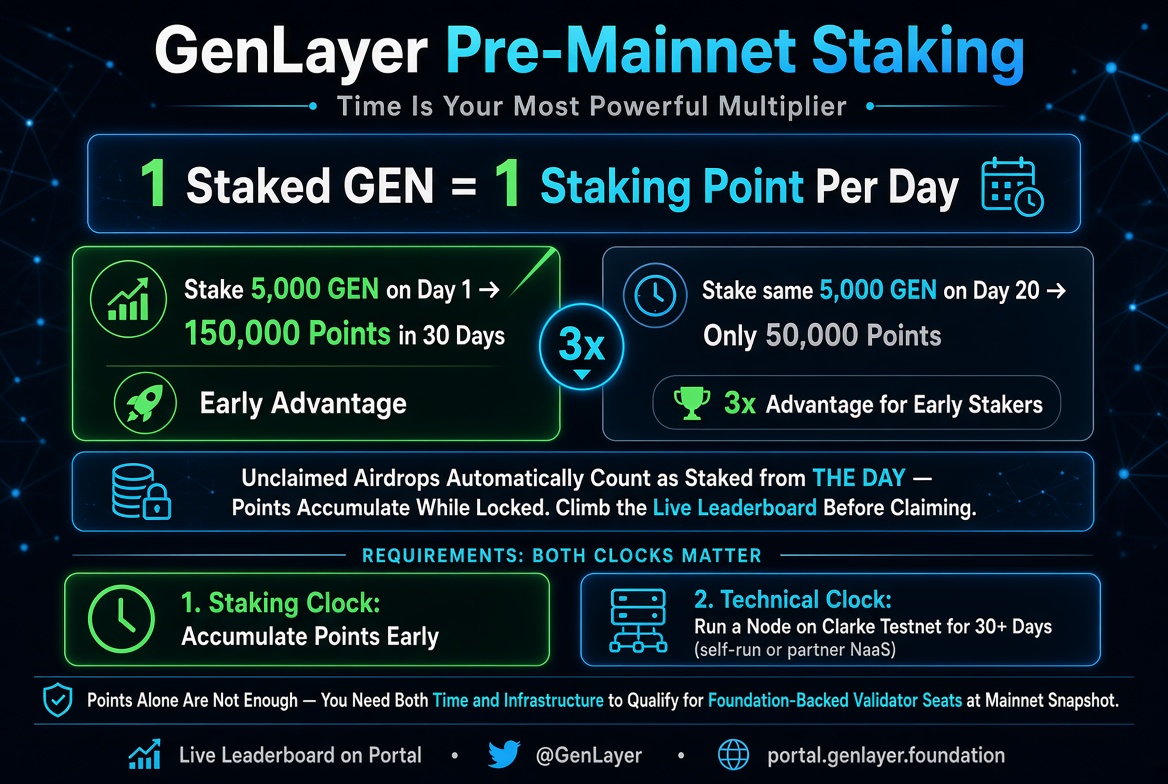
First, Pre Mainnet Staking begins on THE DAY. Every staked GEN automatically collects one Staking Point daily. Your unclaimed airdrop? It starts collecting points automatically while still locked.
Second, you have to prove you can actually do the job. You must run a node on the Clarke testnet for at least thirty days. If you do not have the technical experience, you can simply use a Node as a Service partner. The infrastructure belongs to you either way.
Finally, the live leaderboard tracks everyone. At the mainnet snapshot, the highly coveted node seats are distributed proportionally based on your accumulated points.
It is a brilliantly designed shift from passively holding a token to actively securing the agentic economy.
Are you planning to run the Clarke testnet node yourself, or are you handing it off to a service partner?
https://t.co/pIQuRPRF54
@debamustafa staking early really makes the difference for long term builders
genlayer is creating such an equitable way to reward the dedicated community
this model sets a new standard for decentralized participation
he biggest misconception in crypto is that raw capital always beats timing.
GenLayer is completely flipping that logic with its Pre Mainnet Staking phase. When it comes to securing a highly coveted Foundation backed node seat at mainnet, time is actually your most powerful multiplier.
Here is the exact mathematical breakdown of how the staking points operate:Every single staked GEN earns exactly 1 Staking Point per day. This means 5,000 GEN staked on day one will generate 150,000 points over a month. If someone else waits twenty days to stake that exact same amount, they only generate 50,000 points. You literally get a 3x advantage just for showing up early.
The most brilliant architectural detail is how they handle the airdrop. Unclaimed airdrops automatically count as staked from THE DAY. Your allocation is literally collecting Staking Points and climbing the live leaderboard while it is still locked. Your capital is working for you before you even press a claim button.
However, points alone do not grant you a validator seat.
To actually qualify for the proportional seat distribution at the mainnet snapshot, you must have a node running on the Clarke testnet for at least 30 days. You can run the node yourself or use a partner, but the 30 day technical clock is just as critical as the staking clock.
You need both time and infrastructure to win this game.
What is your current strategy to climb the live leaderboard before the snapshot? @GenLayer
https://t.co/aTKpNc7aaF
@debamustafa the focus on verifiable usage over noise is refreshing
utility is the only metric that survives the long term
it is time we stop confusing a digital mosh pit with an actual business
The most dangerous lie in crypto is not a fake audit. It is the phrase: "We have a strong community, this is the next 100x."
I have watched hundreds of projects collapse while boasting about their community size. The illusion works because people confuse a large Telegram group with actual product demand.
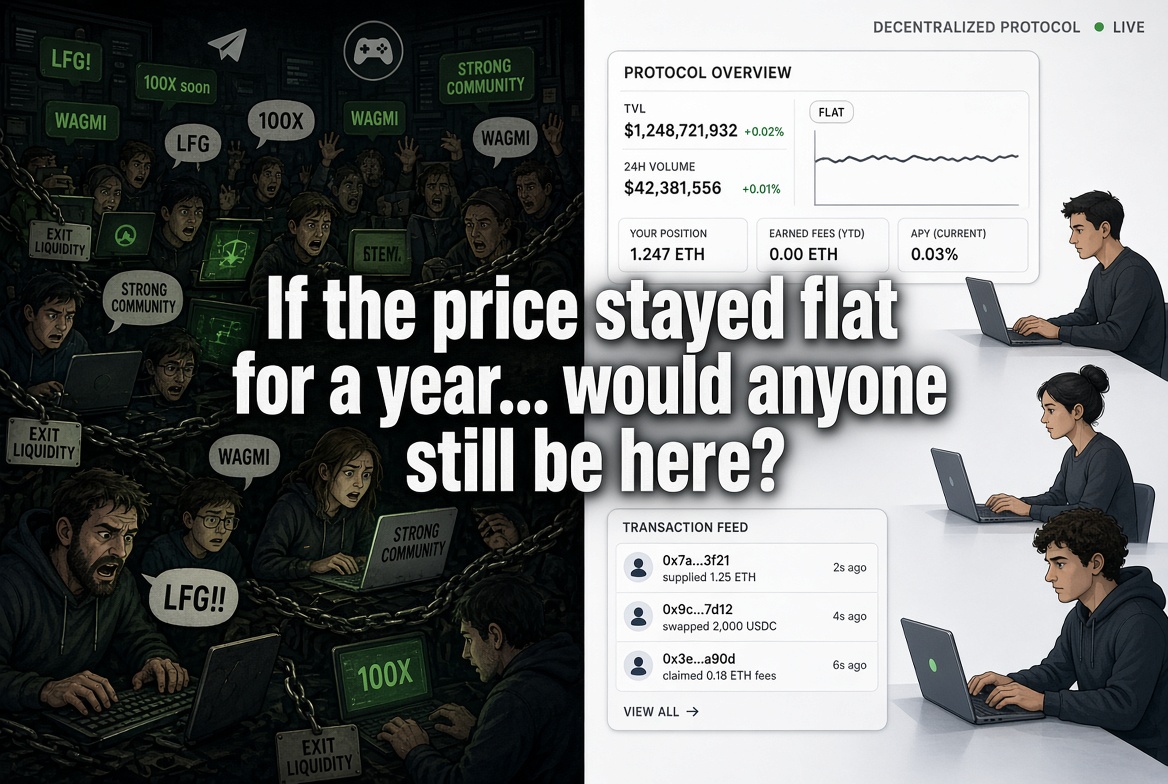
Here is the fine print. A hundred thousand people typing "LFG" in a Discord server is not a strong community. It is a hostage situation. It is just a crowded room of early buyers desperately acting as unpaid marketing agents, trying to recruit late buyers so they can finally exit their positions.
A real community forms around a protocol because people actually use the technology, not because they are financially trapped in a token. When a project's entire fundamental value relies on how loudly its holders can shout on social media, you are not buying utility. You are buying the bottom of a pyramid.
The tell is always in the metrics. High social engagement with zero daily active contract users means the product is just the token itself.
Before you ever invest in the "next 100x" narrative, ask yourself this one reusable question: If the token price stayed completely flat for a year, would anyone in this group still be using the product?
If the answer is no, you are just exit liquidity.
@RallyOnChain is building an infrastructure that finally rewards verifiable quality over empty hype.
What is the most ridiculous "community metric" a project has tried to sell you? I read every reply.
@debamustafa machinetomachine commerce represents the ultimate unlock for capital efficiency and scale
base is the perfect sandbox for this paradigm shift because of its low costs and high throughput
this future is arriving faster than anyone anticipates
You have ten seconds to evacuate. The alarms are blaring.
I am absolutely ignoring my passport, my cash, and my expensive laptop.
I am diving straight for the ugly, coffee stained physical notebook hidden in my desk drawer.
If that book burns, I do not just lose some memories. I lose my entire digital existence. It contains every single crypto seed phrase, two factor authentication backup, and the incredibly complex master passwords I generated five years ago and immediately forgot.
Without it, I am locked out of my bank, my servers, and my life. If it turns to ash, I will literally have to go live in the woods and become a hunter gatherer because my digital identity will be permanently gone.
It is basically a horcrux at this point.
@RallyOnChain has me questioning my priorities, but my survival strategy clearly relies on offline paper security.
Your turn. What is the absolute weirdest or most specific item you would grab in those ten seconds, and how would you explain it to the firefighters?