If a distance is Euclidean,
exp(−λ d²) becomes a valid positive-definite kernel.
Since dK isn’t Euclidean globally,
kernel tricks don’t automatically apply to all strings.
But for finite subsets? They do.
Kolmogorov complexity isn’t just information theory,
it has geometry.
What if “distance” between objects wasn’t geometric…
…but based on how hard it is to transform one into the other?
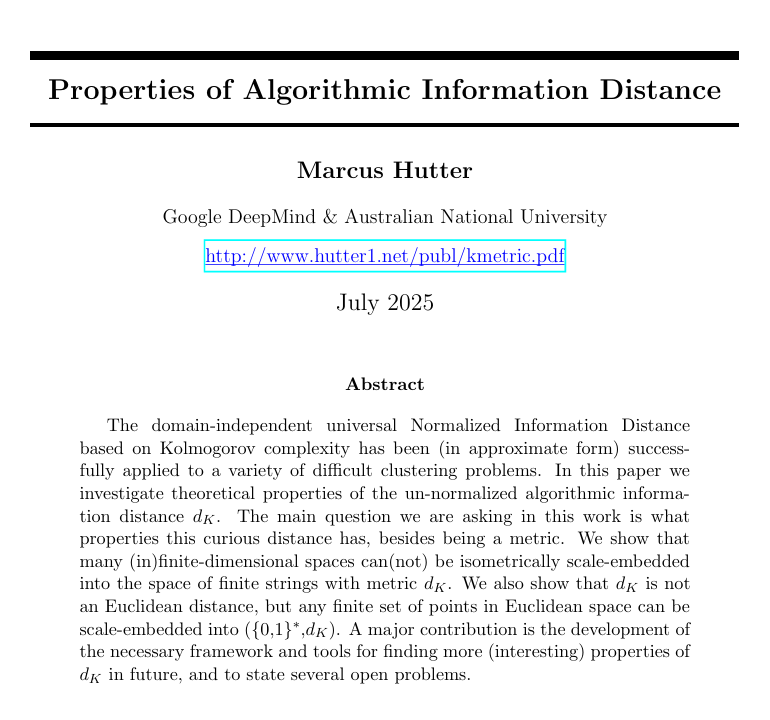
Marcus Hutter studies the geometry of Algorithmic Information Distance — and the result is surprising.
Is it Euclidean?
1. dK is not Euclidean globally.
You cannot embed all of (B*, dK) into ℓ2.
2. But any finite Euclidean point set can be scale-embedded into dK.
3. Many infinite-dimensional spaces cannot embed into it.
So dK is constrained, but expressive.
This paper proves something important:
Bigger embedding models aren’t inevitable.
With:
• Better initialization
• Direct embedding-space distillation
• Quantization-aware training
You can win on efficiency and quality.
That’s production-focused ML.
Everyone keeps scaling embedding models to billions of parameters.
Google DeepMind did the opposite.
They built a 308M parameter embedding model that:
• Tops MTEB multilingual
• Competes with models 2× its size
• Survives 4-bit quantization
• Runs efficiently on-device
Full dataset accuracy:
GraphSAGE → 98.59%
With 24 missing nodes:
GraphSAGE drop → 8.8%
CNN drop → 29%
Bayesian drop → 39%
Key takeaway:
Inductive GNNs + local graph reconstruction > global deep models for infrastructure systems.
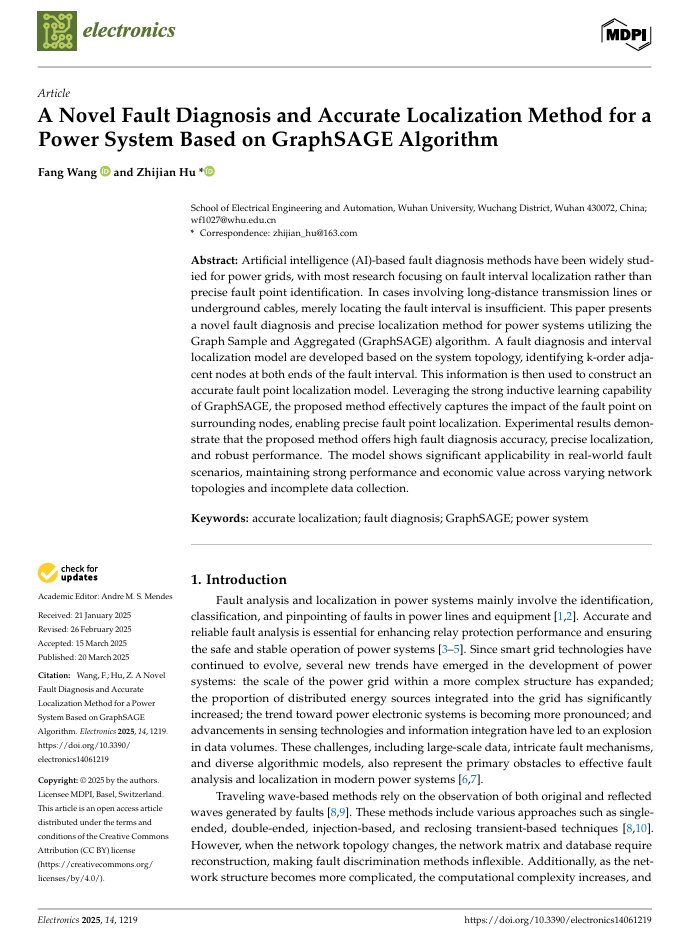
Most AI papers on power system faults stop at interval localization.
This one goes further:
It diagnoses the fault and pinpoints the exact fault location using GraphSAGE.
Here’s the core idea.
Using the entire graph for precise localization doesn’t work well.
So they rebuild a small subgraph using k-order adjacent nodes near the fault.
This:
· Reduces noise
· Forces local feature learning
· Improves regression accuracy
It’s structured inductive bias.
Most RAG systems don’t need re-rankers.
Before adding cross-encoders:
• Fix chunking
• Use hybrid search (BM25 + semantic)
• Improve embeddings
• Let your LLM filter
Add re-rankers only when precision actually matters (legal, medical, citations).
Read about a startup which was spending $15K/month on RAG rerankers.
They didn’t need them.
Here’s what most ML engineers misunderstand about cross-encoders and why it’s costing real money.
Stage 2 — Cross-encoder
• Query + document fed together
• Full transformer pass per document
• Better relevance scoring
Precision jumps (~60% → ~85%).
But here’s the tradeoff:
You now run a full model 100 times per query.
That’s where your infra bill explodes.