This is my most profitable hook ever.
The first 30 seconds of a YouTube script determine whether someone watches for 40 minutes or clicks away in 8 seconds. I've tested 10s of hook structures across channels in military history, romance, true crime, and historical empire niches.
One format consistently produces the highest retention through the first 2 minutes, which is the window where YouTube decides whether to distribute the video or bury the video.
Here's the template, the breakdown of why every element works, and how to build the hook yourself.
The template:
"On [specific date], [specific person with a single defining detail] [dramatic action verb] [specific location with atmosphere]. [their target/opponent] was [vulnerable/unprepared/unaware]. [person] expected [obvious outcome]. What [they] [encountered/walked into/discovered] instead [changed/rewrote/shattered] [larger consequence]."
Real example (from a 1.2M-view military history video):
"On january 17th, 1781, a British officer named Banastre Tarleton rode toward a small cattle grazing field in upstate South Carolina with over 1,000 of the best-trained soldiers in the British army. His target was a ragged force of American troops, half of them untrained militia, who had a reputation for running at the first sight of a bayonet charge. Tarleton expected an easy victory. What he rode into instead was one of the most perfectly executed tactical traps in the history of warfare."
Why every element works:
1. The specific date.
"On january 17th, 1781" does something to the viewer's brain 9 out of 10 creators never account for. A specific date activates documentary-mode. The viewer's subconscious registers: this happened. This is real. This is worth my time.
Compare to: "a long time ago, a British officer..." The vague opener reads like fiction. The viewer's trust drops. The retention suffers.
The date costs you 5 words and buys you credibility for the next 40 minutes.
1. The person with a defining detail.
"A British officer named Banastre Tarleton" is a name. Names create characters. Characters create emotional investment. But the name alone leaves the hook short.
The DEFINING DETAIL is what locks the viewer in: "with over 1,000 of the best-trained soldiers in the British army." Tarleton becomes a person with POWER rather than a name on a page. The viewer instantly understands the scale of the threat and forms an opinion about the character.
One detail per character carries the load. A second detail in the hook slows the pacing. Save additional characterization for the body of the script.
1. The vulnerable target.
"His target was a ragged force of American troops, half of them untrained militia, who had a reputation for running."
This sentence does the most important psychological work in the entire hook: establishing the underdog. The viewer now has someone to ROOT FOR. The ragged, untrained, historically-unreliable militia are the sympathetic underdogs against Tarleton's 1,000 elite soldiers.
The power imbalance tells the viewer who to root for without a single line of instruction. Once the viewer picks a side, they're emotionally committed to watching the outcome.
1. The expected outcome.
"Tarleton expected an easy victory."
One line, and the line does two things:
*First*, the line confirms the obvious prediction. The viewer thinks "yeah, 1,000 elite soldiers vs ragged militia, of course the British should win." The viewer and the character share the same expectation.
*Second*, the line BEGS to be subverted. The viewer already knows from the title (and from the genre conventions of YouTube storytelling) the expectation is wrong. The viewer is now watching specifically to see HOW the expectation breaks. The anticipation is addictive.
1. The payoff tease.
"What he rode into instead was one of the most perfectly executed tactical traps in the history of warfare."
This is the open loop. The viewer walks away knowing the trap exists, the trap worked, and the trap is historically significant. And three things stay hidden: what the trap looked like, how the trap was designed, and why the trap succeeded.
The gap between "knowing the trap exists" and "understanding how the trap worked" is exactly enough curiosity to hold the viewer through the next 19 minutes.
How to build the hook for any niche:
Military history: "on [date], [commander] [marched/rode/sailed] toward [location] with [impressive force size]. [their opponent] had [disadvantage]. [commander] expected [easy outcome]. What [happened/followed] instead became [legacy claim]."
Romance: "[character] had [time period] to [escape/survive/endure] before [consequence]. On the night of [event], [unexpected character] [dramatic action], and [everything/the plan/the arrangement] [broke/collapsed/changed]."
True crime: "on [date], [victim/detective/investigator] [discovered/noticed/received] [specific detail] in [location]. [the detail] was [seemingly innocent/unremarkable]. [time period] later, [the detail] would [lead to/expose/unravel] [shocking outcome]."
The retention numbers:
A hook holding 85%+ of viewers through the first 30 seconds signals to YouTube the content is engaging enough for distribution. If retention drops below 70% in the first 30 seconds, the algorithm deprioritizes the video regardless of how good the remaining 39 minutes are.
The hook is the gatekeeper for everything else. A perfect middle section and a perfect ending count for nothing if the hook leaks 40% of viewers before the story even starts.
The template above is engineered to hit 85%+ first-30-second retention by stacking specificity (date, name, location), emotional investment (underdog vs power), and a calibrated open loop (trap exists, mechanism unknown).
I go deeper on hook construction and retention mechanics inside elevate(.)uno, including niche-specific templates for every major AI story format.
🚨 The longest verified breath-hold records in Normal Air
Men: 11 minutes 35 seconds — Stéphane Mifsud (France), 8 June 2009, AIDA record.
Women: about 9 minutes 22–39 seconds — Heike Schwerdtner (Germany)
Vidyut Jamwal : 16 mins 🔥 https://t.co/Z81TAEFwYw
50 content ideas hiding inside every niche:
the history of
the rise of
the fall of
the future of
the psychology of
the science of
the business of
the evolution of
the biggest mistakes
the biggest successes
the biggest failures
the hidden side
the untold story
what really happened
what everyone gets wrong
what nobody noticed
how it works
why it works
why it failed
why it became popular
why it disappeared
how it changed
how it started
how it ended
what happened next
before it existed
after it disappeared
then vs now
old vs new
best vs worst
winner vs loser
myth vs reality
expectation vs reality
beginner vs expert
cheap vs expensive
simple vs complicated
cause vs effect
problem vs solution
theory vs evidence
past vs future
one decision that changed everything
one mistake that changed everything
one person who changed everything
one event that changed everything
the chain reaction
the complete timeline
the complete story
the complete guide
the complete breakdown
the rabbit hole
YouTube Studio has a tab that tells you what your own viewers searched for and couldn't find, and most people have never clicked it once...
It's under Analytics, Research. Two things in there:
Searches your viewers ran across all of YouTube, not just on your channel. And a little label that says "low content", meaning people searched it and the results were rubbish
That label is a commissioned video with nobody assigned to it
How to actually use it:
- Go straight to "searches across YouTube" and set it to your audience
- Filter for low content and write down every single one
- Sort your own "searches on your channel" by volume, because those are people who came looking for something specific and left
- Type competitor phrasing into the explore box to see what else attaches to it
The phrasing matters more than the topic. People type "is a reverse mortgage a bad idea", not "reverse mortgage explained". Use their sentence as the title, word for word, and you skip the guessing entirely
Also worth doing once a month: open your top video, look at the search terms that brought people to it, and make a separate video for every term that isn't what the video was about. Those are viewers YouTube sent you by mistake, and they'll come back on purpose
Small channels get the tab too. It's not gated
YouTube will hand you the list if you ask it. Nobody asks
(link in bio)
50 legendary internet rabbit holes you can spend hours exploring 📩
1. https://t.co/b5SBLaGQV1 — Watch the world via live satellite imagery
2. https://t.co/jnwTMhag7e — See every plane currently in the sky
3. https://t.co/xHa80uDH1m — Track all ships at sea in real time
4. https://t.co/FGDaeaU5Em — Live map of winds and storms
5. https://t.co/eIDu7R4sy8 — Watch lightning strikes hitting Earth in real time
6. https://t.co/6rFSF1zrpO — Live list of recent earthquakes
7. https://t.co/CGYZQkebbi — Ocean cables carrying the internet
8. https://t.co/OppV29C4rR — Watch forests disappear from space
9. https://t.co/rHyVpqRz5p — The world's statistics, second by second
10. https://t.co/TaF47T5vCB — Current number of tweets and searches being posted
11. https://t.co/Rf2bSlBRwi — Compare the true sizes of countries
12. https://t.co/04wu7wmWBu — Maps from centuries ago
13. https://t.co/gTK4w8An33 — Archive of 150,000 historical maps
14. https://t.co/jAWtbO5WPd — World map drawn by volunteers
15. https://t.co/cxjImE6EZL — Look out the window of a random person around the world
16. https://t.co/1CjzYKCTzf — Virtual walks through cities
17. https://t.co/uNIPhnwR7t — Teleport to a random spot on Earth
18. https://t.co/NdnjpfPZrO — Catalog of the world's strangest places
19. https://t.co/kd2y0XYh5q — Interactive knowledge experiences
20. https://t.co/F7ugSoBTVs — Scale journey from atom to universe (Updated HTML5 link)
21. https://t.co/HPDMmYnN0p — Explore the solar system in 3D
22. https://t.co/ufusbFtNlj — Real sky map in your browser
23. https://t.co/dwdM45seEM — NASA's astronomy picture of the day
24. https://t.co/dffUurnOid — NASA's entire visual archive, free
25. https://t.co/vAp2FI36fJ — Visual articles told through data
26. https://t.co/X92Recqwke — The state of the world with real data
27. https://t.co/XHs0hqO6HY — What we mistakenly think we know about the world
28. https://t.co/i7KXiv2P8s — Visualizing complex data
29. https://t.co/Rj6gWA26fE — World Bank's open data
30. https://t.co/aN8jGgsu51 — Turkey's official statistics database
31. https://t.co/ApNx1Wwrn1 — Archive of millions of books, films, and software
32. https://t.co/RbRiDBa6Xr — 70,000 free books whose copyrights have expired
33. https://t.co/lE7QGKsfCN — Record of every book in the world
34. https://t.co/wWAYRmFS2V — U.S. Library of Congress digital archive
35. https://t.co/JR1oMzNXYk — Europe's cultural heritage archive
36. https://t.co/k6QMPiJNZ8 — America's digital library collection
37. https://t.co/jmjeo55fFX — Tour museums from home
38. https://t.co/TH5nfKRI5j — Download artworks in high resolution
39. https://t.co/NKSBWu1bp0 — Archive of 250,000 artworks
40. https://t.co/HYmNec0qMY — Forgotten visual treasures of history
41. https://t.co/vR9JOX7ZpP — Free archive of culture and education
42. https://t.co/jqxzniu2cc — Met Museum's open collection
43. https://t.co/QeDnKRWxF8 — Family tree of music genres
44. https://t.co/w7xet4sdwE — Pick a country and decade to listen to that era
45. https://t.co/eeZDFVm61w — Turn Wikipedia edits into audio
46. https://t.co/OVj3vwIEsI — Random knowledge well
47. https://t.co/UqBaX2YpBX — Time, sunrises, and sky events
48. https://t.co/Cd2GfXr5UK — Live stream of science news
49. https://t.co/CC4DZtCKyJ — Free preprints of scientific papers
50. https://t.co/bW0w8HImUc — Visualize data with live code
Save this. You’ll definitely need some of these later.
Alligator expert David Freyheit lowers his phone into the water to show just how dangerous these animals can be.
From above, it looks small. Underwater? A completely different story. 😳
Filmed in Florida.
This is my most profitable hook EVER
The first 30 seconds of a script decide whether somebody watches for 40 minutes or leaves in 8 seconds.
I have tested dozens of hook structures across military history, romance, true crime, and empire content. One format consistently holds retention through the opening 2 minutes, which is the window YouTube uses to decide whether to distribute or bury you. Here is the template.
"On [SPECIFIC DATE], [PERSON with one defining detail] [DRAMATIC VERB] [SPECIFIC LOCATION]. [Their target] was [vulnerable]. [Person] expected [obvious outcome]. What [they] found instead [changed] [larger consequence]."
Here is the version from a 1.2M view military history video:
"On January 17th, 1781, a British officer named Banastre Tarleton rode toward a small cattle grazing field in upstate South Carolina with over 1,000 of the best trained soldiers in the British army. His target was a ragged force of American troops, half of them untrained militia, who had a reputation for running at the first sight of a bayonet charge. Tarleton expected an easy victory. What he rode into instead was one of the most perfectly executed tactical traps in the history of warfare."
Now why every piece of that works.
The specific date flips the viewer into documentary mode. Their subconscious registers this happened, this is real, this is worth my time. "A long time ago" reads as fiction and the trust drops instantly.
The defining detail turns a name into a character. Tarleton with 1,000 elite soldiers has POWER. One detail per character, never two, or the pacing dies.
The vulnerable target hands the viewer somebody to root for. The power imbalance assigns sides without a word of instruction, and a viewer who picked a side is emotionally committed to the outcome.
The expected outcome confirms the obvious prediction, then begs to be broken. The viewer now watches specifically to see HOW.
The payoff tease reveals the trap exists and hides what it looked like, how it was built, and why it worked.
Below 70% retention in the first 30 seconds and the algorithm deprioritizes the video regardless of how good the other 39 minutes are.
The hook is the gatekeeper for everything else you built.
Niche specific hook templates for every AI story format are inside elevate(.uno)
High cortisol ages your face, shrinks your brain, and tanks your libido.
Here are 9 surprisingly simple ways to bring it down naturally:
1. Put your face in cold ice water.
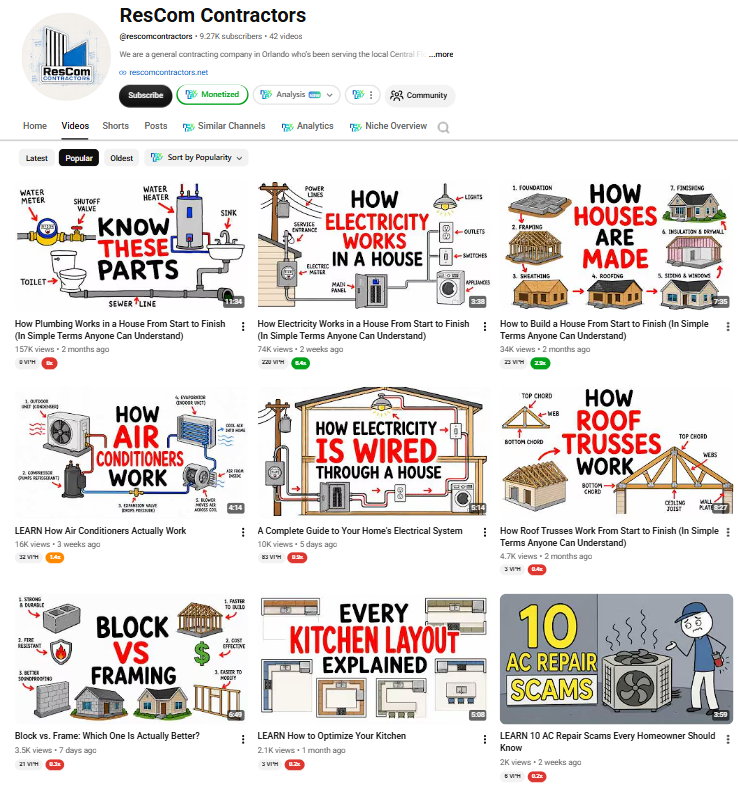
This is such a good channel 🔥🔥🔥
Faceless content is limitless
9.54K subscribers
452,580 total views gained
Long-form
Copy the usual format --> apply it to different niches
Explains home plumbing systems in simple visual terms
Helps homeowners understand construction and household maintenance basics
Joe Rogan spent 3 hours with James Nestor learning why millions breathe themselves into anxiety.
Your breath trains your body to panic—even when nothing's wrong.
6 signs it’s happening to you—and how to retrain your breathing: 👇
1. You hold your breath while reading a text.
High cortisol is aging you faster than cigarettes or vapes.
Gray hair, poor sleep, slow recovery, dull drive.
Here are 14 natural ways to bring it down and slow the clock:
1. Saunas.
Hype Injection blows up a channel to 1.1m views in 5 days.
While everyone was entering World Cup niches,
This dude decided to marry a topic on Hype with a Format that's been blowing up for years.
"How Every ___ Died" is a framework with 300m+ views on YouTube.
But during the World Cup,
which group of people does the audience care about most?
Players.
So they made a total of 4 attempts to Hype Inject,
And the 4th one paid off, blowing them up to a million in just a few days.
Good job, whoever you are.
Now squeeze the most out of it,
Because the problem with this kind of injection is that it dies out together with the hyped event
so think of a pivot for afterwards.
AOY NICHE DISCOVERY! 📣 Bright Psycho
Breaks down human psychology in the simplest way
Channel stats 📊
→ Subscribers: 3.6K
→ Total views: 411.5K
→ Videos uploaded: 80
→ RPM: $5.00
→ Earnings: $2k+
3 Niche Bends:
1. Disease & Immunity:
"Why Do Some People Never Get Sick?"
2. Food Science:
"Why Don't We Eat Carnivores?"
3. Brain & Behavior:
"Why Do Animals Play?"
50 day old channel
Published 40 long form AI videos (almost one per day)
And they've already got themselves a couple of wins!
Since it's AI content,
I guess they spent less than $100 to $200, so they're already profitable.
For over a thousand years, historians thought the Viking "sunstone" was nothing more than a myth, until the ocean gave up its secret...
The Norse sagas repeatedly referenced a mysterious object called a "sólarsteinn" or sunstone, a navigational tool so powerful that Viking sailors could locate the exact position of the sun even on the most overcast and cloudy days. For centuries, scholars debated whether this was real technology or simply folklore embellished over generations of retelling. Most assumed it was legend. They were wrong.
In 2013, marine archaeologists excavating a British warship that sank near the Channel Islands in 1592 made a stunning discovery buried among the wreckage. Alongside navigational instruments including a pair of dividers and a slate, they found a rectangular chunk of translucent crystal. Testing confirmed it was Iceland spar, a remarkably pure form of calcite with extraordinary optical properties. The fact that it was found stored alongside other precision navigation tools was not a coincidence.
Iceland spar possesses a property called birefringence, meaning it splits a single beam of light entering the crystal into two separate beams. When you hold the crystal up toward the sky and slowly rotate it, the two beams will vary in brightness independently until, at one specific angle of rotation, they become perfectly equal in intensity. That precise angle points directly toward the sun, regardless of whether the sun is visible to the naked eye. Cloud cover, fog, and even twilight conditions cannot defeat it.
Researchers from the University of Rennes in France conducted extensive testing and published their findings in the Proceedings of the Royal Society A. Their experiments demonstrated that Iceland spar could locate the sun's position with an accuracy of within one degree, even under completely overcast skies. For Viking navigators crossing the North Atlantic toward Iceland, Greenland, and eventually North America, this accuracy would have meant the difference between a successful voyage and sailing hopelessly off course into open ocean.
The Viking Age spanned roughly 793 to 1066 AD, and during this period Norse sailors were completing oceanic crossings that would not be replicated by other European cultures for another 400 years. Historians had long puzzled over how they achieved such consistent navigational precision without magnetic compasses, which did not reach Europe until the 12th century. The sunstone appears to be a significant part of that answer.
What makes the Channel Islands find especially compelling is that the 1592 shipwreck is far outside the traditional Viking era, suggesting that knowledge of this navigational technique survived and was still being used by European sailors centuries after the Viking Age officially ended. The crystal was not a relic or a curiosity on that ship. It was working equipment.
The sagas specifically describe King Olaf consulting a sunstone on a cloudy day to verify the position of the sun, with a separate observation then confirming the stone's accuracy. For generations this was dismissed as poetic invention. Science has now confirmed that every element of that description is physically possible and practically achievable with a simple piece of Icelandic calcite.
The Vikings were not lucky explorers stumbling across new lands by accident. They were sophisticated navigators armed with technology so elegant and effective that it required no moving parts, no maintenance, and no power source beyond the sky itself.
📷 : the original calcite crystal alongside Elizabethan navigation dividers next to a cannon
Alderney Museum
#archaeohistories