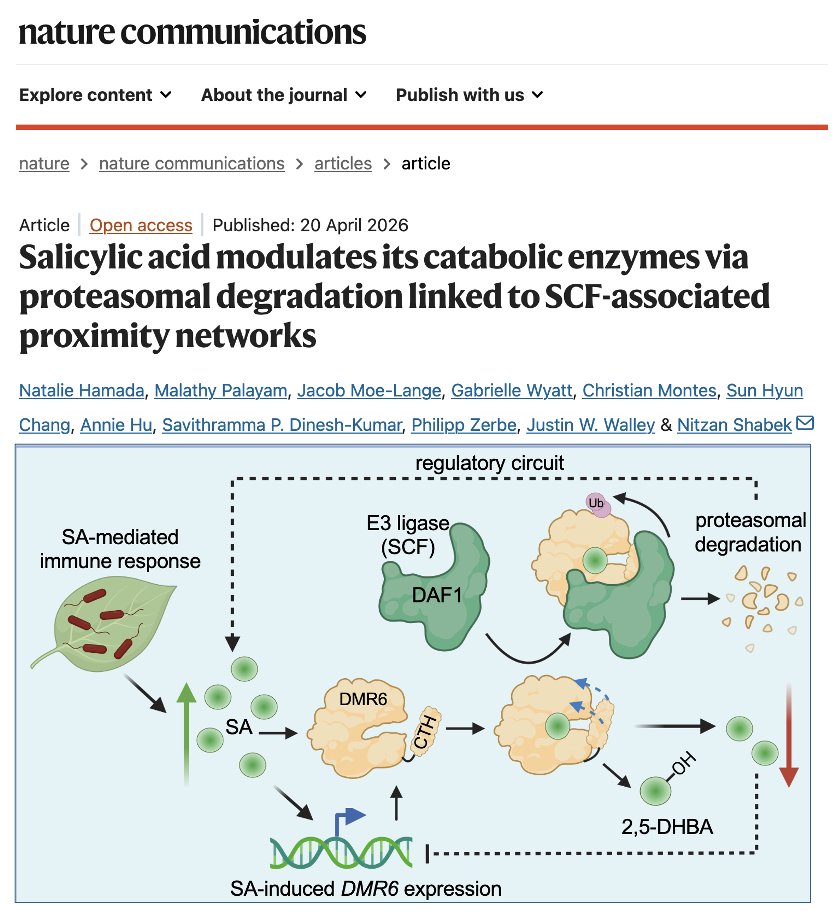
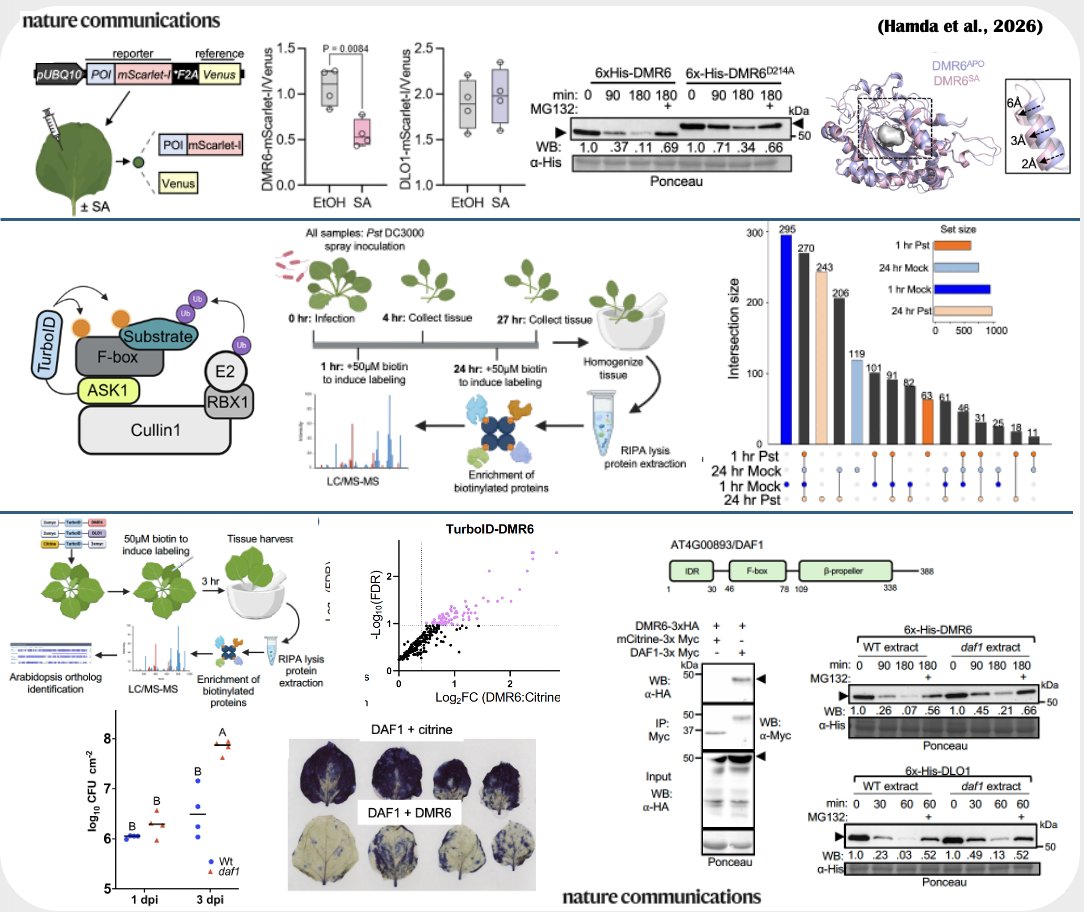
🔥our latest study is now online @NatureComms we found that the salicylic acid catabolic enzymes DMR6/DLO1 are controlled by the ubiquitin system. SA modulates their turnover, revealing a regulatory circuit linking hormone metabolism to immune balance. https://t.co/Xu9zZxgq7G
Check out our new review @ThePlantCell
A collaborative effort with Yangnan Gu and Shou-Ling Xu, and members of our labs, bringing together practical lessons for designing, executing, and interpreting proximity-labeling proteomics in plants: https://t.co/mlFAEo2Xjs
Two decades after revealing the mechanism of action of auxin, we have now uncovered the molecular mystery of another plant hormone: salicylic acid (SA), the precursor of aspirin that most of us have taken at some point in our lives. We were surprised again https://t.co/yDujLVGxcL
🔥check out our latest. From signalling to catabolism: terminal tails in plant hormone regulation.
Hormone catabolism is no passive cleanup, but a highly regulated process, exemplified by strigolactone & salicylic acid deactivation & structural plasticity.
https://t.co/GuwqdDGiM5
🔥check out our latest. From signalling to catabolism: terminal tails in plant hormone regulation.
Hormone catabolism is no passive cleanup, but a highly regulated process, exemplified by strigolactone & salicylic acid deactivation & structural plasticity.
https://t.co/GuwqdDGiM5
https://t.co/BJElIvZgbi The Dept. of Evolution & Ecology at UC Davis will be hiring this Fall! We're searching broadly, from macro (speciation, comparative genomics, evo-devo) to micro (pop biology, adaptive evolution, evo-eco). Please reach out if you have questions, and apply!
AI has transformed structure prediction, but its predictive power depends on experimentally determined structural data. Yet plant protein structures account for less than 4% of the PDB, leaving plant-specific folds, conformational changes and transient assemblies underrepresented
DMR6 undergoes SA-dependent conformational remodeling linked to turnover. We mapped the SCF E3 ligase adaptor interactome during infection, revealing dynamic remodeling, & identified ligase DAF1 using TurboID-DMR6/DLO1. Thanks @ShabekLab members, @Zerbe_Lab, Walley & Dinesh-Kumar
🔥our latest study is now online @NatureComms we found that the salicylic acid catabolic enzymes DMR6/DLO1 are controlled by the ubiquitin system. SA modulates their turnover, revealing a regulatory circuit linking hormone metabolism to immune balance. https://t.co/Xu9zZxgq7G
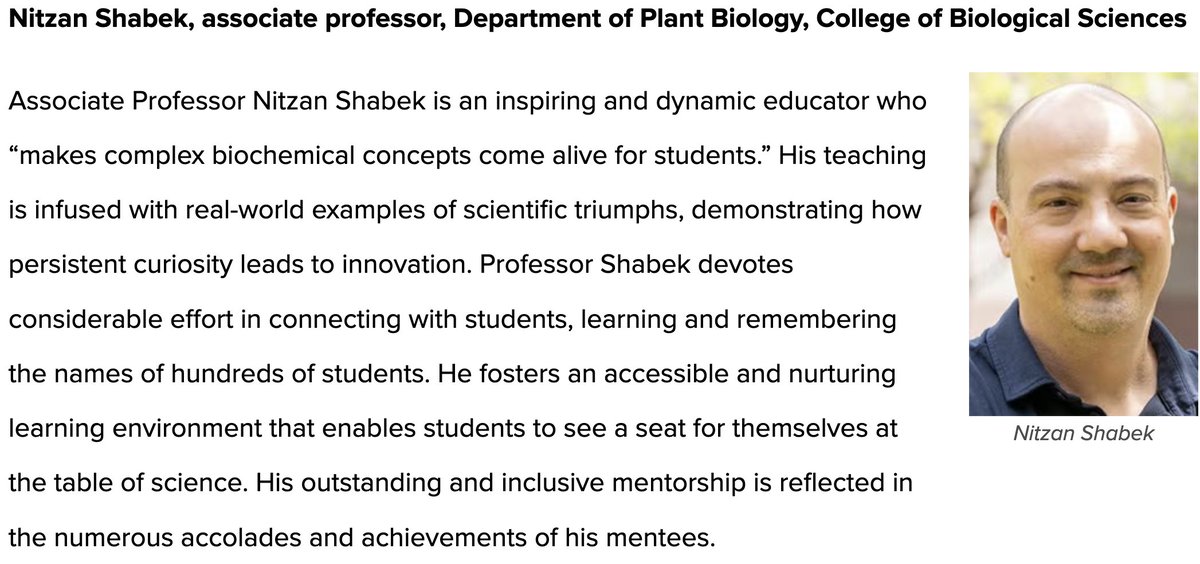
Humbled and honored to receive the UC Davis Distinguished Teaching Award 🏅
Beyond our research mission, education & mentoring are at the core of what we do @ucdavis & I’m grateful for the opportunity to teach such engaged & motivated students https://t.co/1jnvFSVJVj
Please RT‼️@meo0205 & us are looking for a #postdoc to explore #regeneration & #autophagy across kingdoms of life.Please spread the word & get in touch if interested. https://t.co/k5Vd5WPWXY
Excited to share our lab's latest discovery today in @Nature: "orthosteric molecular glue” (OMG) inhibitors - a new drug design strategy that achieves substrate-dependent potency, i.e., substrate selectivity, with conventional orthosteric inhibitors. https://t.co/U5Y6JBoJql
Proximity labeling and quantitative proteomics suggest that ASK1/SKP1 assembles condition-specific networks, acting both within SCF E3 #ubiquitin ligases and through noncanonical interactions to coordinate #plant stress adaptation
Excited to share our latest work to close out 2025: Dynamic ASK1 proximity networks uncover SCF-dependent and noncanonical roles in ABA and drought adaptation🌱 With the Walley lab, we map how ASK1/SKP1 dynamically rewires protein networks during stress. https://t.co/GoqFnTj87U