Imagine a future where AI agents are accelerating medical breakthroughs by interacting with patients and discovering hidden patterns in a safe and private environment. 🤖
It’s time that this future becomes reality. 🔥🔥🔥
Introducing: HPMP – Health Profile Matching Protocol 🔬
In medicine, the gold standard has always been “evidence at scale” — large cohorts, long timelines, population averages. But people don’t live as averages. They live as n=1. ✨
Type 1 diabetes is a perfect example. Every individual responds differently to food, exercise, stress, hormones, even the time of day. Traditional insulin therapy and even today’s automated insulin delivery systems still lean heavily on population-level assumptions. The result? Gaps in control, unnecessary anxiety, and patients carrying the burden of constant manual adjustments. 💡
The real breakthrough will come when we stop treating “patients” and start treating individuals. Hyper-personalized AI can move AID systems from one-size-fits-most to continuously adapting, learning, and optimizing around each person’s unique physiology and lifestyle. 🤖
This is the vision behind our work with @DiabetesDAO and @welsharehealth: building systems that learn from you, not from the average of thousands.
DiabetesDAO supports initiatives in hyper-personalized AI-based AID, while Welshare is building towards a future of Agentic Science, where research hypotheses can be validated in real time through decentralized health networks, unlocking knowledge creation at the n=1 level of personalized medicine. 🔬
We’re entering an era where healthcare stops seeing averages and starts seeing you. This is n=1.
"The main goal is to build the HPMP, the Health Profile Matching Protocol that lets AI agents and human researchers discover users with certain conditions and request more data." 🤖
Our Co-Founder and CTO, @stadolf, shared Welshare’s vision of HPMP in the recent Townhall/AMA.
Amazing progress from our frens @Cerebrum_DAO with the Cortex App. 🤝
We're looking forward to supporting research agents through our Health Profile Matching Protocol (HPMP) to discover decentralized brain-health profiles, run encrypted aggregation, and enable patient-in-the-loop validation. 🤖
Agentic science needs real health data without the privacy trade‑off 🤖
Artificial intelligence is transforming research. Agents can now read millions of papers, find hidden correlations, and generate new hypotheses. But there’s a catch: AI needs data, and health data is among the most sensitive information there is.
Welshare bridges this gap with the Health Profile Matching Protocol (HPMP). By enabling users to export validated, FHIR‑standard health data into decentralized profiles, we create a safe channel where AI agents can match with real patients without exposing raw personal information.
🔹 Blind compute on @nillion: agents operate on encrypted data
🔹 Standardization (FHIR/LOINC): interoperable across apps, clinics, and research environments
🔹 User control: consent is granular and revocable
The Result: faster validation, stronger science, and respect for the dignity and privacy of every participant. 💡
Just minutes after our post yesterday, @buildonnillion had their Discord townhall, and we couldn’t agree more with what their CTO @andreilapets had to say there.
TEEs generally have lighter overhead than MPC, and some view them as a practical step toward FHE; the trade‑off is trusting hardware vendors not to leak keys. The hardest problems here: make every communication path terminate inside the enclave, prevent port/session collisions when multiple services run, and work around limited enclave RAM by shuttling encrypted state between NilDB (private state/storage) and NilCC (compute).
In contrast, MPC’s scaling pain is bandwidth and coordination cost, while TEE’s challenge is correctness and orchestration to keep sensitive operations inside the enclave and use resources efficiently.
Make sure to watch the full recording for more insights: https://t.co/LEpArqCrTp
Clip credit: Nillion Town Hall / @buildonnillion
The cornerstone problem Welshare is solving: How can we make health data accessible to AI while keeping it private and its owners in the loop? One relevant technology that helps answering this are TEEs, so let us explain 🧵👇
🏢 Welshare Town Hall Space
Join us for a 30-min update + open Q&A — your chance to ask, share & connect.
📅 Monday, Sept 22
🕔 5 PM CEST
Set your reminder & bring your questions 👇
https://t.co/H45g1irdep
We are thrilled to share that more than 390 individuals have already participated in our Diabetes Risk Assessment: https://t.co/sNlnWjb6Ng. And it’s been less than two weeks!! 🎉
Of those 390 people, we have identified that 27 have an elevated risk of diabetes in the next 10 years.
Together with our partners we can now support these people in prevention measures, firstly by educating them about diabetes and metabolic processes, but also by offering support and intervention programs to help everyone live their healthiest life.
This is a testimonial to the dedication and hard work that the entire @DiabetesDAO community has been putting in, and also of course, the work that our tech partner @welsharehealth has achieved in providing the technical backbone of this study.
Welshare’s decentralized health profiles enable individuals to take control of their health data and simultaneously make it possible for agentic medical researchers to validate their hypotheses in a privacy-preserving way.
We are really grateful for having such a supportive community, you’re the best! Together, we will advance diabetes research to work towards a truly personalized n=1 approach. 🔬💙
Patient Data is neither a "currency" nor an asset. It's the grease that helps autonomous agentic researchers proving their hypothesis, one data point at a time. 🔐
https://t.co/NeIPg5kK9a
LLMs can spot patterns. Patients validate them.
But most research still relies on static, siloed datasets: great for correlations, weak on real‑world proof.
Welshare’s Health Profile Matching Protocol (HPMP) lets AI research agents safely involve people without exposing raw data.
🔹 Query encrypted health profiles (privacy‑preserving aggregation)
🔹 Match consented users who actually fit the hypothesis
🔹 Keep conversational memory for longitudinal follow‑ups
🔹 Record provenance to shared graphs when signals replicate
From pattern → proof, n=1 to population, privacy‑first.
Builders & diabetes apps: integrate via MCP. Patients stay in control; insights arrive sooner.
Exciting step forward for decentralized science!!! 🔬💙
We’re proud to announce that @DiabetesDAO just launched the first user facing survey app that uses Welshare’s protocol components to create and connect user wallets and store their data. 🤝
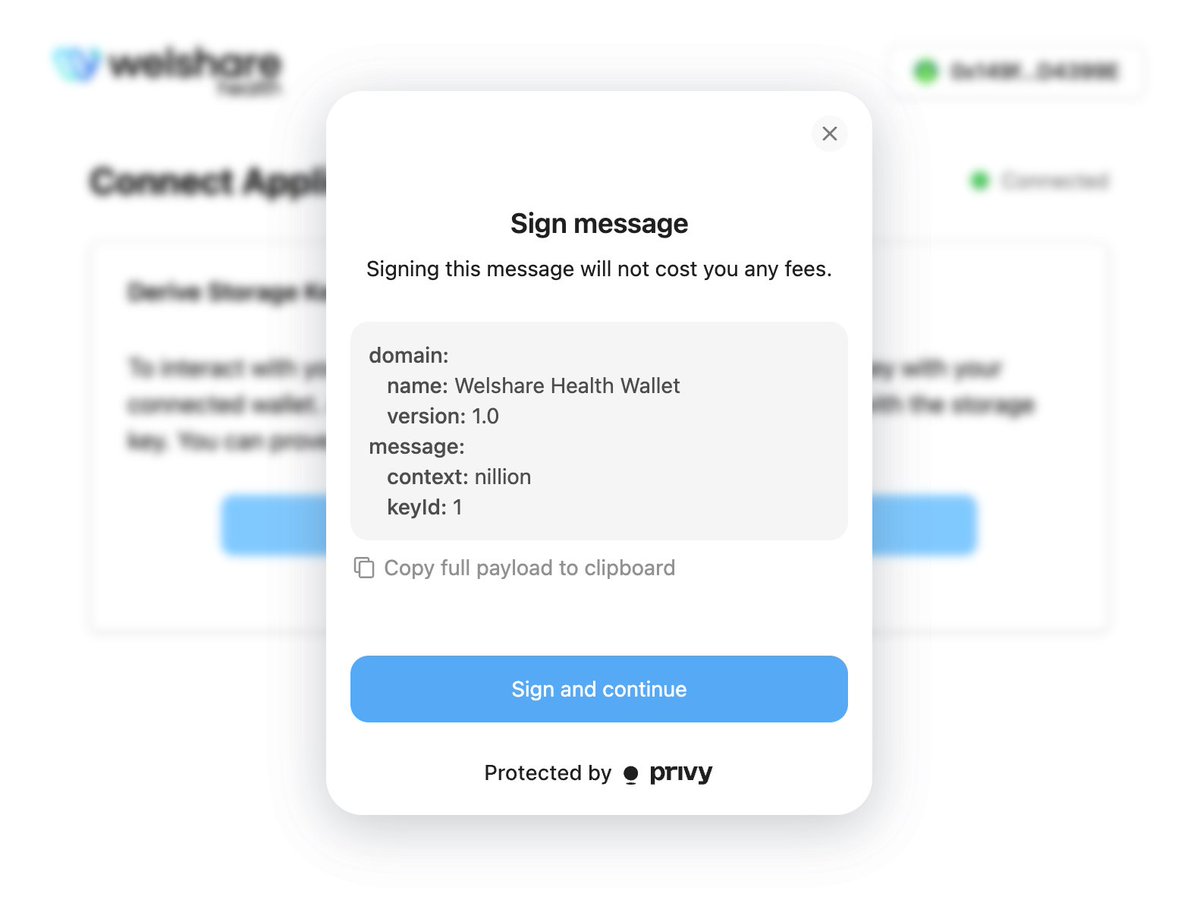
Users land on DiabetesDAO’s brand new FINDRISC questionnaire app that computes an individual risk profile for type 2 diabetes. On the final screen they’re presented with the option to share their assessment’s result. During the data export, users can connect or create a new cryptographically controlled welshare profile using an arbitrary - even embedded - wallet that controls the authentication and sharing operations.
The actual information payload is never sent to a welshare server. Instead the wallet connection window prepares a NUC (Nillion Utility Credential) delegation token unique for the submitting app’s use-case (DiabetesDAO). The user uses that token to submit their data to three @nillion cluster nodes that put the questionnaire response under Access Control Lists that are only controlled by the user themselves. 🔐
The underlying form and risk assessment structure is a standardized and well known Finnish FINDRISC survey, as schematized by LOINC 97055-8: https://t.co/jLQo6qGojz. The Logical Observation Identifiers Names and Codes (LOINC) is an international standard that provides universal codes and names for medical tests, observations, and assessments. In this context, the Welshare storage protocol can handle arbitrary FHIR (Fast Healthcare Interoperability Resources) questionnaire schemas and their responses. FHIR is the global standard for structuring and exchanging health data, making assessments like FINDRISC interoperable across research apps, clinics, and digital health systems.
For our partners, this is a live example of how health data can flow into profiles that will power the Health Profile Matching Protocol (HPMP), enabling future research agents to match with real patients, without compromising privacy. 🤖
This is one more milestone towards a fully functional decentralized health data layer for science & care.
👉 Get started here: https://t.co/VCDkTgUUj4