For the past few months, @ReadTransformer has been working with the incredible team at @NYMag on this: The AI Power List.
When NY Mag first reached out about collaborating on this, I was thrilled. Everyone knows the big names in AI: Sam, Dario, Demis, Elon, Jensen and the like. But so much of the *real* power in AI is inscrutable to the wider world. It is held by people well-known to insiders, but with little-to-no public presence — despite their outsized influence on the future of humanity.
NY Mag and Transformer profiled 26 of these powerful insiders. They're the people deciding how AI is used, developed, regulated, and thought about. They're remarkably intertwined, universally fascinating, and still have everything to play for.
These new power brokers will decide how AI shakes out, refashioning the world for the rest of us in the process.
It's time to get to know them.
AI has minted a new power structure. A handful of private companies command the might and wealth of small nation-states and are mostly left alone to self-govern. A few hundred employees are on the brink of becoming centimillionaires and considering which causes and presidential candidates they will funnel their vast resources toward.
One way to tell the story of how AI is changing our world is through some newly familiar names: Sam Altman, Dario Amodei, Jensen Huang. But an astonishing amount of power rests in the hands of a few dozen other people, some virtually anonymous.
For this year’s annual “Power” issue, we are surfacing 26 people whose influence on the AI landscape far outstrips their fame.
We partnered with @ReadTransformer, a publication with a command of the politics within transformative AI, whose team drew on its years of reporting, as well as new interviews with more than 50 high-ranking industry leaders, to help articulate what makes these people powerful.
The AI scene is small. Many are remarkably intertwined, sharing offices, homes, and funding. The list’s average age is 36. It is also overwhelmingly male. Read about the few dozen power brokers who will decide how AI shakes out, refashioning the world for the rest of us in the process: https://t.co/e93NPGZJuk
A lot of AI policy proposals at the moment rely on third-party audits: independent experts checking that companies are following their safety practices and that their models are safe.
But there's just one problem: there don't seem to be enough of the right people to do the job.
@vronirwin has the details in her great new piece:
https://t.co/1Ug1kb9AOe
“He said I believe it's SI, because these programs aren't designed to work as fast as SI is.
So when they put in a program that's able to write codes and it goes in and self-fixes, as it starts to self-fix itself it like a change order on a house.”
What the fuck is he talking about?
MULLIN ON OUTAGES: I talked to one guy in the tech industry, he asked not to mention his name, it's not Elon. I asked, what could be causing these outages? He said I believe it's SI, because these programs aren't designed to work as fast as SI is.
So when they put in a program that's able to write codes and it goes in and self-fixes, as it starts to self-fix itself it like a change order on a house.
That kind of makes sense to me.
News: Nvidia General Counsel TIM TETER has agreed to closed-door testimony with House Foreign Affairs, China, and Intel Cmttees
“We look forward to meeting with the Chairmen on December 2”-Nvidia spox
HFAC spox says negotiations are "ongoing" for TETER and HUANG testimonies
@BenBrodyDC Ah I’d missed the rest of the thread. Yes I agree threats + courts can do stuff, and that those bearish on government in general to do anything are probably wrong. (Brussels doing anything is very optimistic though, can tell you’re not from Europe 😉)
@BenBrodyDC Especially if you don’t get more warning shots on the way. I think other policy actions are feasible (eg crazy export control mania) but it does rely on gov paying attention, which …
@BenBrodyDC I think with relation to the two things Kelsey mentions here — legislation and treaties — it does seem quite hard to
imagine either happening by June 2027, which is a lot of people’s median for full RSI now!
New: A majority of voters in several fiercely contested congressional districts said AI was important to deciding their vote, though it was not their top issue, fresh exit & election eve polling commissioned by the Future of Life Institute found
🚨NEW: We just uncovered a covert influence operation using right-wing creators to promote Nvidia chip sales to China.
Earlier this year, we reported on similar campaigns, and Republican lawmakers went after Nvidia.
But the story didn’t end there. 🧵
The Commerce Department has released a major new export control rule targeting China’s access to advanced AI compute.
It’s pretty good! Here’s what it does:
(1) Restricts Chinese access to overseas AI clusters (seeks to address one of China’s largest and fastest-growing sources of AI compute)
This is a new worldwide end-use control, which we’ve previously recommended (third option in image below).
A license is required if providing cloud AI compute to Chinese or D:5-headquartered countries, or if acting as an intermediary training models for these actors.
Technical requirements are:
- Applies to any data center or group of “linked data centers” or providing more than 12 million aggregate TPP of compute (the equivalent of around 760 H100s) of AI chips meeting the current controlled thresholds.
- “Linked data centers” are defined as sharing physical or virtual computing resources, jointly balancing workloads, or replicating data as a unified whole. So this is intended to capture multi-data center training runs.
This applies everywhere except the US. It also covers existing data centers, which have a 90-day deadline to get a license.
(2) New controls for AI chips going to Malaysia, Singapore, Indonesia, Thailand, and Brazil (seeks to address smuggling of AI chips to China via third countries)
The evidence for large-scale smuggling of AI chips to China via Malaysia and Singapore is strong, and there’s also evidence this is happening via Indonesia and Thailand. Brazil, on the other hand, is a bit of a head-scratcher.
This is a case-by-case license review policy, rather than a presumption of denial (that's the policy for chips going directly to China/D:5 countries).
BIS will evaluate each license on national security grounds.
There’s an exclusion for qualifying US-headquartered recipients, subject to reporting requirements.
(3) Formally repeals the AI Diffusion Rule
This has been a long time coming. This eliminates the country-tier system, the Validated End User authorizations (VEU) for data centers, and export controls on advanced AI model weights.
However, the replacement measures above address many of the gaps created by this, and, of course, the AI Diffusion rule wasn’t actually being enforced.
(4) Tightens controls on Chinese chip designs manufactured abroad
This modifies and strengthens the Biden-era “Foundry Due Diligence” rule, which applies to foundries and OSATs.
This seeks to prevent Chinese chip designers from circumventing export controls through overseas foundries and packaging facilities. It’s an important complement to the measures above.
—
So what are the gaps? More on this to come, but from an initial read:
(1) To determine remote-access eligibility, the rule requires due diligence on direct or indirect Chinese ownership or control. However, its licensing trigger is based around company headquarters and ultimate-parent headquarters, which could allow for some shenanigans around corporate structures.
(2) The rule doesn’t prescribe how AI compute providers must verify customers' identities, or require them to identify and verify every user accessing their compute. The rigor of these checks could vary widely across providers.
(3) The end-use restrictions don’t apply when compute is used exclusively for commercial recommender systems. So this opens a path for large-scale Chinese AI compute usage. This could be fine if verifying this kind of use is possible, but this is likely outside the current technical capabilities of many AI compute providers.
(4) The end-use restrictions don’t apply to data centers in the US. So a Chinese company can still access large amounts of AI compute via US data centers.
This is an interim final rule, meaning it would take effect upon publication in the Federal Register, while allowing 60 days for public comments.
Read the full interim final rule here: https://t.co/AW2GPBfcd6
This appears to show President Trump making it clear that he will not be siding with Treasury Secretary Scott Bessent over Commerce Secretary Howard Lutnick in their feud over export controls and the sale of chips to China, at least for now.
He makes clear later on in this press gaggle he is not planning to fire Lutnick.
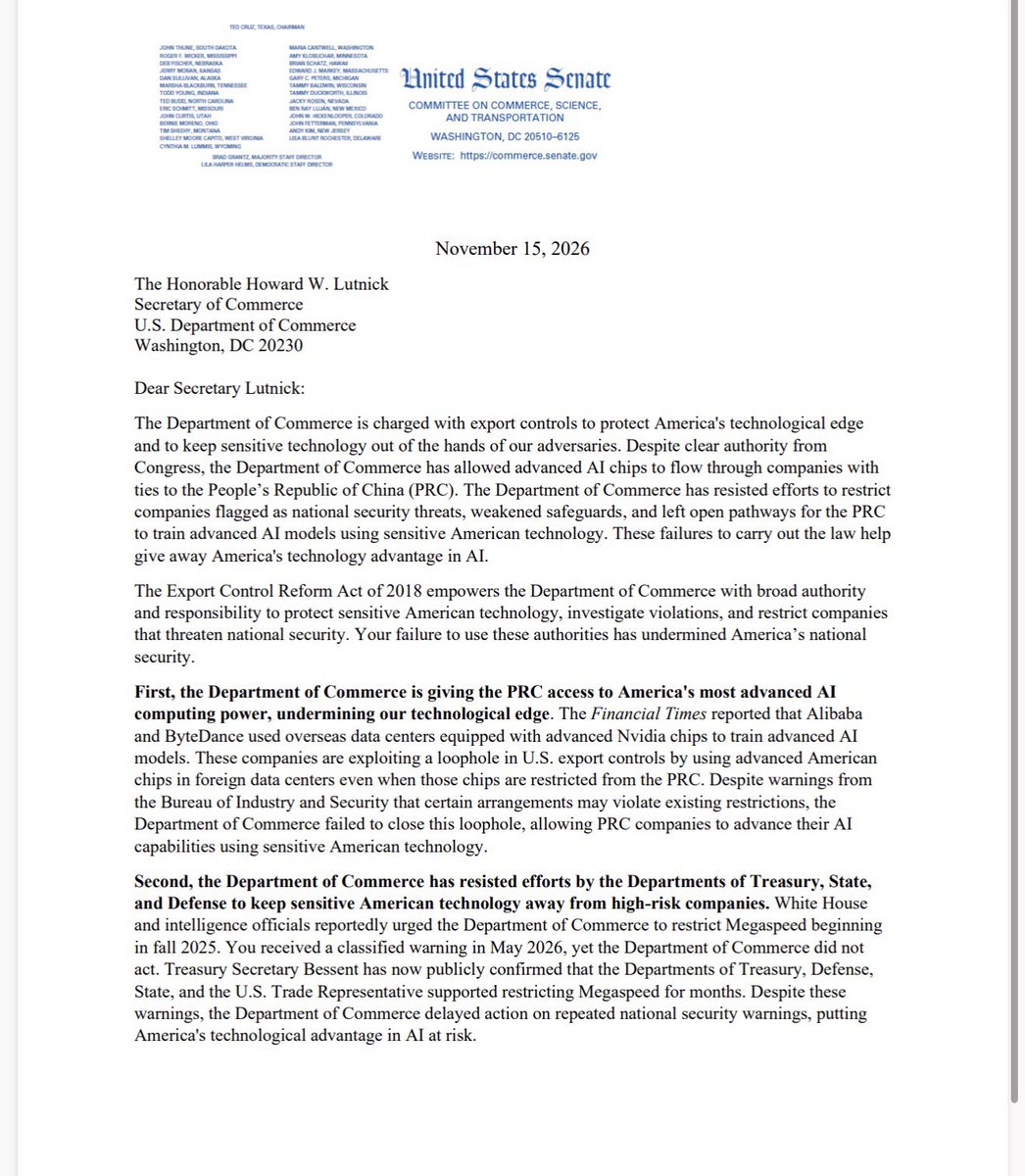
New - Sen. Maria Cantwell, who is in line to chair committee with oversight of Commerce Dept, goes after Howard Lutnick over export controls on advanced AI chips.
“Your failure to use these authorities has undermined America’s national security,” she said