This is quite something, and goes to show just how fast the German auto industry is collapsing.
Moritz Schularick, one of German's top economists and the President of the prestigious Kiel Institute (the oldest economic research institute in the country), is saying Germany should "sell [Volkswagen] to the Chinese, as long as we can still get something for it" (https://t.co/Aa8qMTsiZl).
Volkswagen which until 2019 was the world's biggest carmaker by sales volume... And is now losing an eye-watering amount of money: they just reported a net loss of $6.5 billion for Q3 2026 alone, and are speaking of firing an insane 100,000 employees (https://t.co/xk8Kj4SLfh).
Un 18 de Noviembre de 1920, el gobierno bolchevique, gracias a Alexandra Kollontai, convirtió a Rusia en el primer país del mundo en legalizar el aborto gratuito y total para la mujer, tardaría más de 60 años en llegar a países como España.
La famosa propaganda anticomunista de los "100 millones de muertos" cuenta a los bebés abortados en la URSS como parte del recuento de las víctimas del comunismo, ese es el nivel.
Kollontai fue la primera mujer que ocupó un cargo de ministra en la historia de un pais, como Comisaria del Pueblo para la Seguridad Social en la Unión Soviética, y bajo su liderazgo se conquistaron una infinidad de derechos para la mujer soviética:
-Se consolidó el derecho al voto
-El aborto gratuito y universal
-El derecho al divorcio y la manutención del padre
-Igualdad salarial
-Acceso de la mujer al mundo laboral
-Acceso de la mujer a altos cargos politicos
-Creación de guarderías estatales para acabar con la esclavitud doméstica de la mujer
-Salarios asegurados en periodos de maternidad
-Liberación sexual y fin de la cultura patriarcal católica
-Erradicación del analfabetismo y educación política
-Abolición de la esclavitud sexual de la prostitución
-Días de baja pagados por periodos menstruales para la mujer
By my own count, if one includes these latest sanctions, the EU has now sanctioned 8 European citizens for speech:
- 3 German citizens: Alina Lipp, Thomas Röper and Hüseyin Doğru
- 3 French citizens: Xavier Moreau, Adrien Bocquet and Sylvain Afoua (aka Egountchi Behanzin)
- 1 Lithuanian citizen: Ernest Mackevičius
- 1 Irish citizen: Chay Bowes
The sanctions include freezing these people's assets and making it a crime for anyone in the EU to pay them, hire them or even lend them a single euro.
They also include a travel ban, which leads to some absurd situations: Doğru - based in Germany - was invited by some members of the EU parliament to Brussels to plead his case but he couldn't go due to the travel ban. As one of the MEPs who invited him - and made 40 phone calls to try, unsuccessfully, to get him cleared to come - put it: "It really was like something out of a Kafka novel" (https://t.co/lvF0WLFtCb).
And, probably worst of all, all of this was decided without any charge, trial or court ruling - simply as a unilateral decision of government ministers. Yesterday's sanctions, for instance, were decided at the Foreign Affairs Council meeting of EU Foreign Ministers and were simply signed by Kaja Kallas alone on behalf of the Council (https://t.co/XP7zeb9ueZ).
Put it all together, and this violates at least half a dozen of what the EU keeps saying are the fundamental values and principles it supposedly fights for:
1) Separation of powers: here we have government ministers - members of the executive branch of their countries - acting as prosecutor, judge and jury
2) Presumption of innocence (Article 48 of the EU’s own Charter of Fundamental Rights): they’re punished without guilt ever being established, and without being given a chance to plead their case before the decision
3) Right to a fair trial (Article 47): there was no trial at all, let alone a fair one
4) Freedom of expression and of the media (Article 11): they were sanctioned - explicitly so - for what they said and published. For instance, in these latest sanctions, Chay Bowes was sanctioned for, among other things, the speech crime of "participat[ing] in the spreading of anti-Western and anti-Ukraine disinformation at the UN Security Council" (https://t.co/XP7zeb9ueZ). Sanctioned in part for a speech at the UN, a forum that exists precisely so that clashing views on international matters can be heard, quite the message to send from the EU...
5) Freedom of movement (Article 45): they're under a travel ban
6) Right to work and to property (Articles 15 and 17): their assets are frozen and nobody may employ or pay them
You can think whatever you want about these 8 people. But ask yourself this: even if you are pro-Ukraine, pro-EU, anti-Russia and you view these people as malignant Russian operatives... what is the EU fighting for here, exactly?
This is more profound than you may think: we're speaking about the very foundation of modern European civilization, built on the very idea that political power alone cannot decide what is true.
I'm not exaggerating. What we’re witnessing is a return to the pre-Enlightenment playbook, when monarchic or religious authorities defined the truth, deviations from it were called heresy, and heretics were excommunicated - cut off from the community, so that no one could trade with them, employ them or help them. In Europe's darkest times, heretics were even famously burned at the stake - like Joan of Arc or Giordano Bruno.
It took literal centuries of religious wars and debates, and the likes of Voltaire, Kant and Mill, to replace it with a basic idea: that no single power, however legitimate, gets to be the final judge of what is true, and that you answer for your words only before a court, under laws written via a process separate from the power that does the accusation.
You can find countless works of European literature on this very matter. Take Spinoza, excommunicated in 1656 by the Portuguese-Jewish community of Amsterdam, with a decree ordering that "no one should communicate with him" nor "accord him any favor". He went on to write the Theological-Political Treatise, one of the founding texts of the Enlightenment, with an entire chapter arguing that "in a free state every man may think what he likes, and say what he thinks." Or Mill, two centuries later in On Liberty, Chapter 2: "All silencing of discussion is an assumption of infallibility." Or Kafka’s The Trial, the story of a man accused by an authority nobody can quite locate, of something nobody will explain.
How is what Europe is presently doing anything other than going back to that very system, under new appellations? The authority: government ministers. The heresy: "disinformation". The excommunication: assets frozen, banned from travelling and nobody may pay them, hire them or lend them a single euro.
It’s basically Spinoza’s excommunication decree on EU letterhead, with a bit of Kafka sprinkled in given that the man invited to the European Parliament to contest his punishment couldn’t attend because of the very punishment he wanted to contest.
You don’t have to like these 8 people, or even care about them, to see the problem. Heck, this system was developed precisely for the people nobody likes: consensual ideas never needed protecting.
No, the real question here is this: do you want Europe to be the heir of Spinoza - or of Voltaire, or of Galileo, or of any of the countless Europeans who suffered or even died for thinking differently - or of their persecutors?
Sull’Ucraina, esempio lllumintante di “sano realismo” offerto, finalmente, dal Presidente della Finlandia Alexander Stubb, oggi in un’intervista @FT
La sintesi: è stato irresponsabile non parlare prima con Putin.
Suggerisco lettura integrale. Efficace l’illustrazione del bivio davanti al quale siamo: Yalta o Helsinki? L’ottusità dei governi europei sulla Russia ha alimentato e alimenta il rischio di Yalta.
“We have outsourced European engagement with Russia for too long and I think that is irresponsible. … Putin was “ready to engage with Europe”, even as the continent was “late” in organising itself for such talks.
#Ucraina #Russia #Europe
As I am yet again the target of another smear campaign, I will give a brief rebuttal here that I was denied by our journalists. The media argues that my comments about the detention facility for Ukrainian soldiers outside Kiev are 'disinformation' because the 14-year-old boy who was abused inside the facility was a protester and not a detained conscript. However, I never said that a 14-year-old was conscripted, which makes no sense.
The kid says he was knocked down from the wall and pulled into the facility, where he was beaten with shovels, hit and kicked, while Azov used knives to cut open his clothes (including his underwear) as they filmed it all. After spending an unknown period of time inside the facility, the boy was escorted out of the building wearing a blanket and a terrifying look of shock on his face. We do not know more, partly because our media does not want to know more, and the little coverage there has been has focused on smearing those who mentioned it.
The journalists who contacted me promised that they would also report on the boy's statement, which they predictably did not do. Why is that? Why is it not newsworthy to report on the statement from the 14-year-old boy who was abused? Nothing can get in the way of the smears and the war narratives that criminalise diplomacy and support the notion that weapons are the path to peace. I wrote an article (below) about the event and how the media would whitewash the event and smear criticism, and I even sent it to the journalists who contacted me regarding their hit pieces – yet they seem to have used my article as a manual.
My advice to academics who are critical of how Ukrainians are used by NATO as cannon fodder is to make sure to respond with few words when the journalists come to destroy your reputation. They have to contact you to tick a box as a formality for journalistic practice, although they are free to pick out what they can use from your answer in terms of what fits with the smear piece. Give them only a few short sentences to limit their ability to select a quote meant to deceive, and only give answers in writing so you can document how they mislead their readers.
Journalists got access to my employment documents at the university, and it is no longer a secret that I will soon go into exile after more than 6 years of intimidation. Thus, the attacks are now intensifying, as they only have a few more weeks left.
https://t.co/fFmFN41DbK
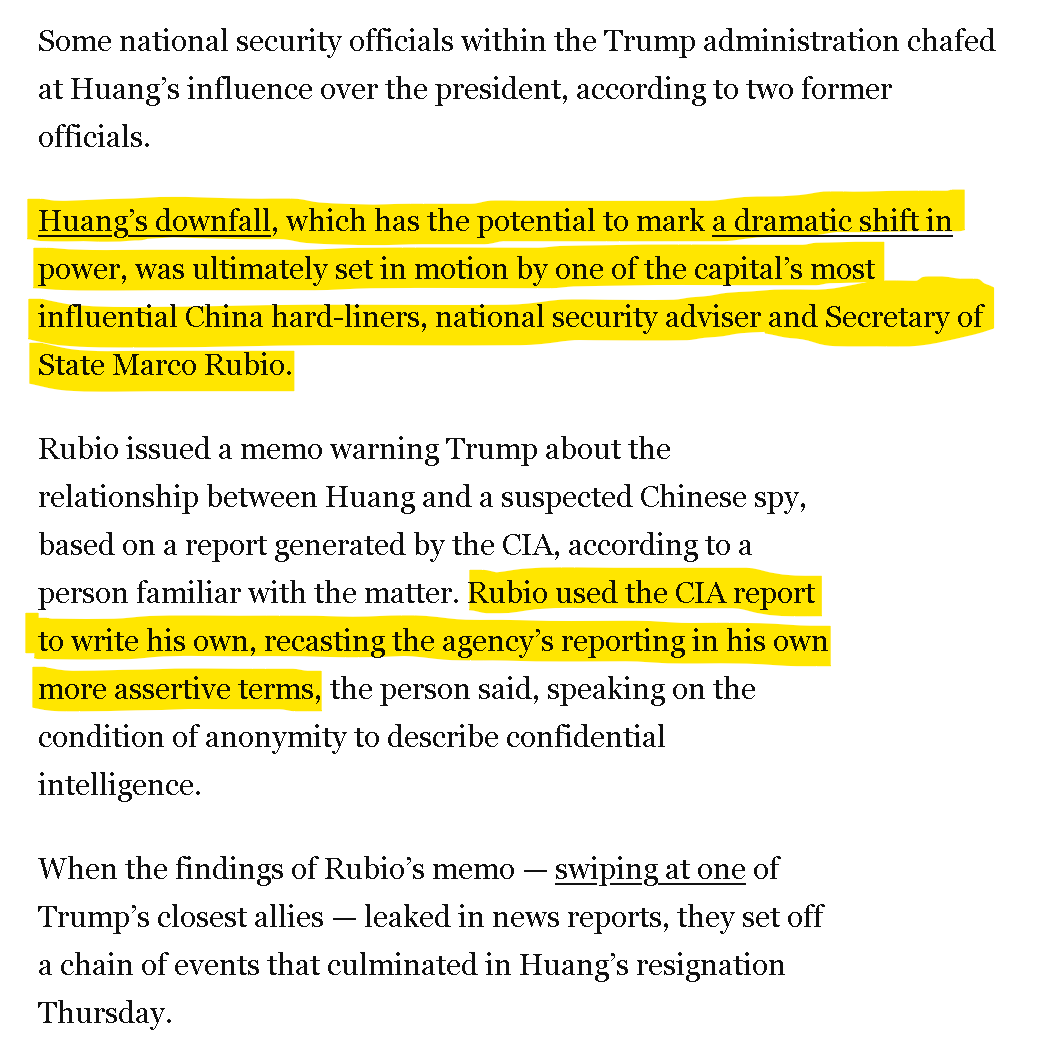
Interesting: the Washington Post says that Jensen Huang's downfall was Marco Rubio's doing (https://t.co/4YahEGer9Q), and it looks like the "spy" framing was directly his and not the CIA's.
As they write, Rubio took a CIA report and rewrote it in a memo "in his own more assertive terms."
Which fits neatly with CNN reporting that the CIA is "not yet convinced" that Alice Huang was a spy (https://t.co/Cd5PTbKqfG): if the CIA is not convinced, yet a memo rewritten from the CIA’s own report presented her as a spy, then there’s only one person who could have turned "not convinced" into "spy": the man who did the "more assertive" rewriting, aka Marco Rubio 🤷
The WaPo article also mentions the motive: China hawks like Rubio had spent years trying to "destroy the influence Jensen had over the president", and WaPo calls his ouster "a huge victory" for them as it allows them to "seize on the moment to redirect the national agenda toward tougher policies on China."
And, as a matter of fact, they’re already pushing three new chip-restriction bills into the defense bill now that Jensen is no longer around to lobby against them.
If true, it means the real "influence operation" targeting Jensen was run out of Washington, not Beijing 🤷
Il presidente che affermò che non ci sono civili a Gaza affida all'ideatore della dottrina Dahiya, che teorizza l'uso sproporzionato della violenza per raggiungere "la pace", l'incarico di formare 1 governo. Cosa potrebbe andare storto?
Spoiler: nuove elezioni nei prossimi mesi.
PEGGIO DEI FARAONI 🔺️
La disuguaglianza ha raggiunto livelli difficili persino da immaginare:
💰 Per accumulare la ricchezza dell'uomo più ricco del pianeta, un lavoratore da 30mila dollari l'anno dovrebbe lavorare per oltre 700mila vite lavorative.
🌍 12 miliardari possiedono più ricchezza dei 4,2 miliardi di persone che costituiscono la metà più povera dell'umanità.
🏛️ Se avessimo risparmiato 80mila dollari al giorno dall'epoca delle piramidi, oggi non saremmo nemmeno tra i dieci uomini più ricchi del mondo.
🇪🇺 In Europa, l'1% più ricco possiede oltre otto volte la ricchezza della metà più povera della popolazione.
📈 Negli Stati Uniti, negli anni Sessanta un amministratore delegato guadagnava circa 20 volte un dipendente medio. Oggi oltre 300 volte.
Non è un caso. Non è semplicemente produttività. Non è merito.
È il risultato logico di cinquant'anni di scelte fiscali, economiche, finanziarie e politiche che hanno concentrato ricchezza e potere nelle mani di pochissimi.
Una lotta di classe condotta dall'alto verso il basso, mentre le nostre democrazie si trasformano progressivamente in oligarchie di fatto.
È tempo di rovesciare il gioco.
#disuguaglianze #economia #politica #cultura #perte
OMBRE SU AZOV
I fatti in Ucraina che hanno fatto prima il giro di Telegram e TikTok ora sono un caso nazionale nel Paese. Una dottoressa implora di prestare servizio medico dentro quel palazzo in cui la gente sembra sparire.
Sul finale del video avanziamo un'ipotesi non proprio peregrina.
"La Nord si schiera col popolo e manifesta!"
🇮🇹 Gli ultras del Livorno hanno partecipato allo sciopero generale in Italia di venerdì 30 ottobre, criticando le altre tifoserie che avevano preso invece le parti della polizia e del governo.
Look at how Dr. Ali Shariati, the Iranian philosopher, writer, and thinker, described America so accurately nearly 50 years ago:
“America! This immense stupidity, civilized savagery, modern barbarism, violence with a label, legalized plunder, ugly happiness, vulgar freedom, stupid democracy, mass-produced individualism, and ...”
The Secretary of Defense, Pete Hegset, when discussing vital U.S. interests in the Asia-Pacific region, seemed to have a limited understanding of the topic.
- I'm very glad you raised this issue. Can you name at least one country that is part of ASEAN, and what agreements do we have with it? Just one. And by the way, how many members are there in total in this organization?
- Listen, I can't give you the exact number, but...
- Exactly!
- But I do know our allies in South Korea, Japan, and Australia, with whom we have an agreement on submarines...
- Mr. Hegset, none of those countries are part of ASEAN. None of the three you mentioned. If you're going to discuss this topic, do your homework first.
ASEAN – The Association of Southeast Asian Nations: Brunei, Vietnam, Indonesia, Cambodia, Laos, Malaysia, Myanmar, Singapore, Thailand, and the Philippines.
#Italy — Napoli ultras unveiled a banner against the government outside the Maradona Stadium before the match against Roma:
“You are taking away the future of an entire generation with price hikes and cuts to education... The real devastation is your ‘expensive’ seats!”