I’m very grateful to BrightFocus Foundation, Michael Ward, and everyone in our lab for their support. I’m excited to continue developing this project and see where it takes us!
Excited to share that I’ve been awarded a BrightFocus Foundation Alzheimer’s Disease Research Grant!
I’ll be using prime editing and high-throughput imaging to study how Alzheimer’s-associated mutations affect protein localization in human neurons and glia.
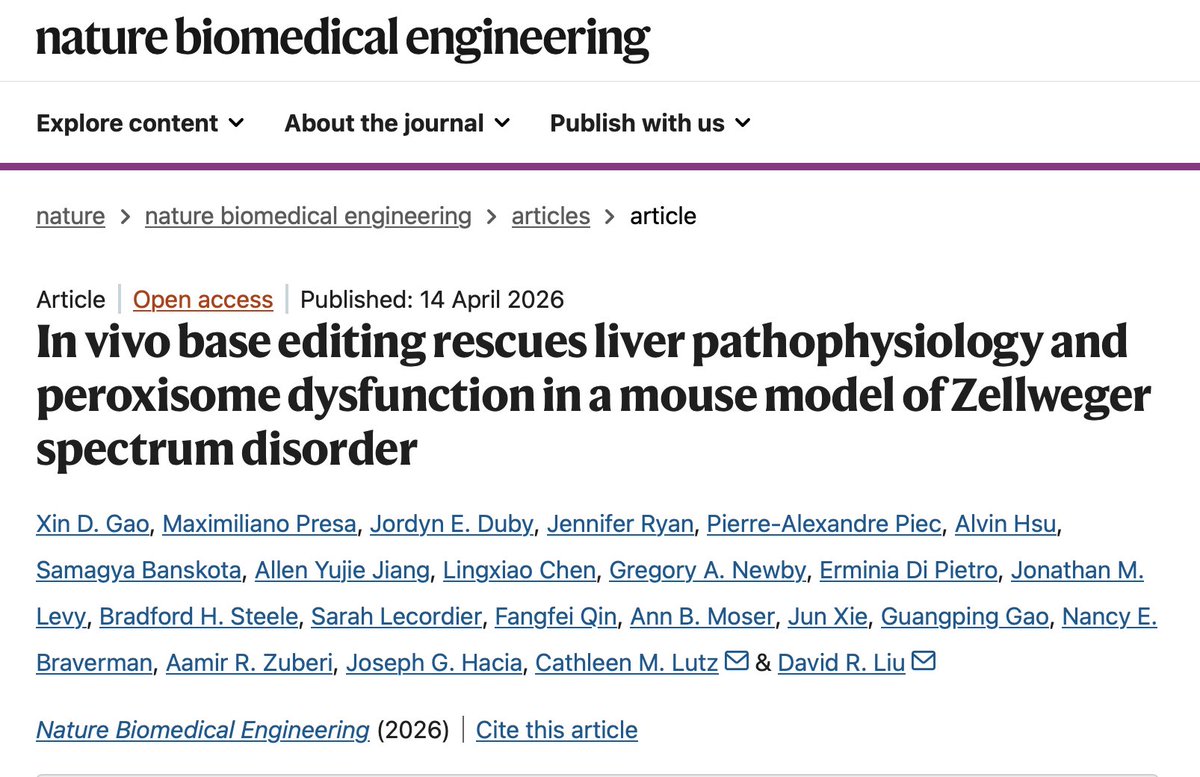
Today in @natBME we report an in vivo base editing strategy that corrects a common disease-causing mutation and rescues pathology in a mouse model of Zellweger spectrum disorder (ZSD) and restore peroxisomal function in patient derived cells. This work highlights the promise of precision genome editing for treating peroxisomal biogenesis disorders.
1/13
Excited to share a pre-print from a collaboration between my lab at NIH, Len Petrucelli's lab at University of Miami, and Shyamal Mosalaganti's lab at University of Michigan.
Immune-evasive cssDNA donors combined with recombinases facilitate kilobase-scale insertion of custom genetic cargos in human cells and mice. #NBThighlight https://t.co/opGmsUTTCp
Today in @Nature we report a new prime editing strategy that can rescue a common cause of many genetic diseases in a disease-agnostic manner. This approach converts a redundant endogenous tRNA into an optimized suppressor tRNA, enabling a single prime edit to rescue premature stop codons across different diseases.
(1/15)
https://t.co/zs0qu5bhXx
Genome editors like prime editors can rewrite the genetic code – but sometimes they incorporate undesired errors. Today in @Nature, we report how we engineered prime editors with strikingly low errors.
https://t.co/6TBqcHCaVL
#GenomeEditing#CRISPR#PrimeEditing#genetherapy
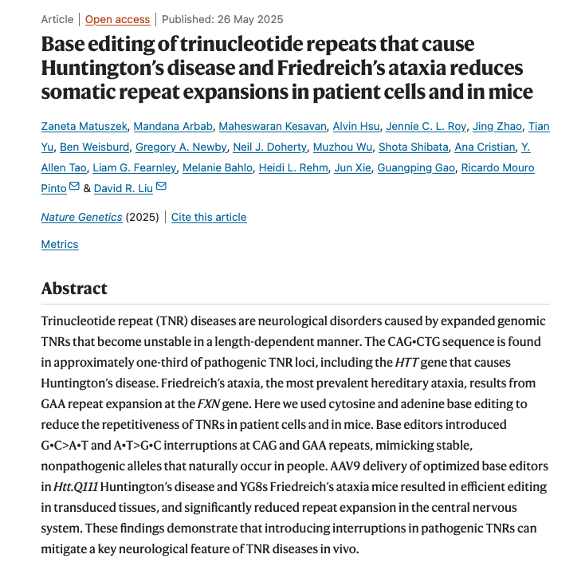
In @NatureGenet we report that base editing of trinucleotide repeats (TNRs) reduces somatic repeat expansions in Huntington’s disease (HD) and Friedreich’s ataxia (FRDA)—in patient-derived cells and in vivo—a collaboration with the Mouro Pinto lab.
https://t.co/J6MhwEAgoB
1/14
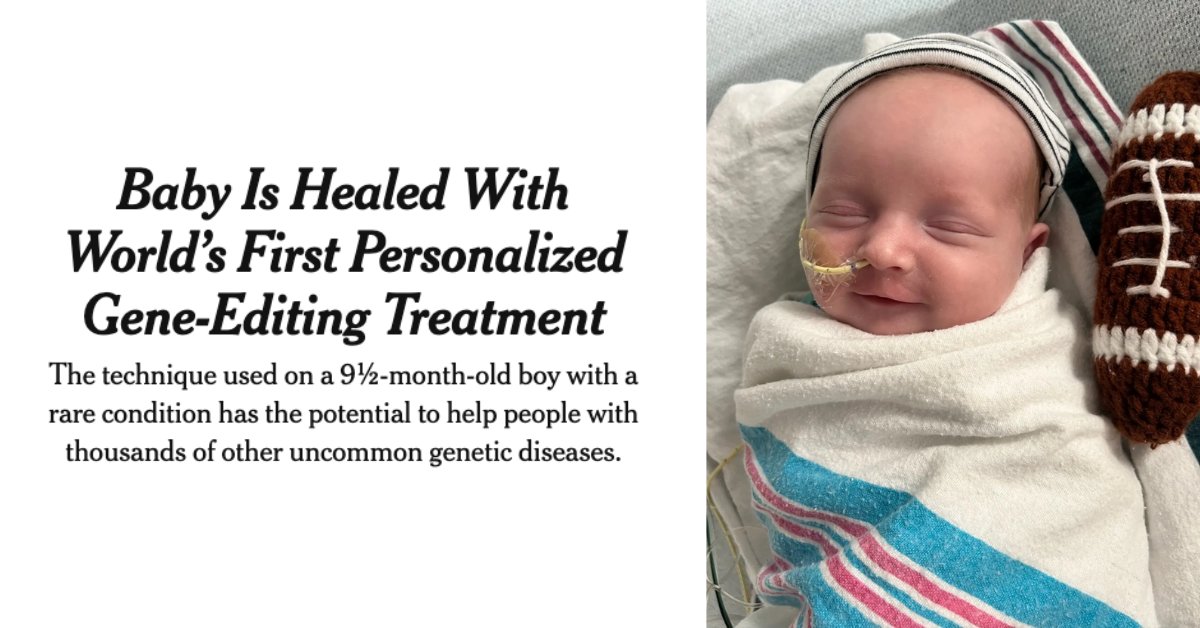
A baby named KJ, who was born with a rare genetic disorder – CPS1 deficiency – is healed thanks to doctors at the @ChildrensPhila who administered the world’s first personalized gene-editing treatment. The research team used base editing, a gene-editing method invented by HHMI Investigator @davidrliu and his lab at @Harvard University in 2016.
Earlier this year, Liu received the @brkthroughprize for developing both base editing and prime editing. These gene-editing technologies enable the correction or replacement of virtually any genetic mutation, including those that cause countless human genetic diseases.
Read more about Liu's work here: https://t.co/NlE25O7wJR
Excited to to see our collaboration with @GMBurslem lab published today! This is part of our ongoing long term goal of achieving scalable non-disruptive and direct imaging and perturbation of the endogenous proteome
https://t.co/HJX3JHvBIY
Check out our paper, now extensively revised and published in @MolecularCell! This has been a real tour de force led by @stephsansbury and @YSereb and we are very excited about the findings and future potential of this approach
https://t.co/XLpJxmzGvh
So excited to start the year w/ our new paper @CellCellPress! #proteomics spatial map of human cells + dynamics using #organelle IP at scale. 🙌 to amazing teamwork @czbiohub and beyond. Check out portal https://t.co/Gb1TvlKcCH and paper https://t.co/YskVRBUqZi. 1/n