My Intro to Philosophy from Hachette is out!
Also, this might be the first Intro to Philosophy from India since 1949! So do buy it or order it for your university library.
Those in the US can buy it off ebay for now.
https://t.co/6iV8bAEQbJ
Delighted to see Oxford and Cambridge launching this campaign called Academics Against Ageism to end the illegal practice of compulsory retirement based on age. No other university in England does this and it breaches the Equality Act as it’s not justified https://t.co/AB6yKP9pMG
I see at least two (related) concerns about this point:
1) Running activism and research together heightens the risk of politically motivated reasoning—you’re more likely to reject counterevidence if it clashes with the politics driving your research.
2) In practice, activist research is almost always partisan anti-capitalist research which dismisses many viable ways of benefiting the lives of others.
The report is also on its face not at all politically motivated. Here, for instance, is what it says about recent right-wing initiatives. The automatic assumption that the report must be politically motivated enacts exactly the scepticism about general intellectual and scholarly standards critiqued in detail by the report.
NEW: a report from Vanderbilt and WashU just dropped, taking on the "state of scholarship in the humanities and social sciences," a big topic among critics of higher ed.
Read along w/ me 🧵
Plato: “A tyrant…if he is to retain power, he must root [the bolder characters] out, all of them, till there’s not a man of any consequence left, whether friend or foe…So he must keep a sharp eye out for men of courage or vision or intelligence or wealth; for, whether he likes it or not, it is his happy fate to be their constant enemy and to intrigue until he has purged them from the state…Then…people will find out soon enough what sort of a beast they’ve bred and groomed for greatness. He’ll be too strong for them to turn out” (Republic, Book VIII, 567b – 569a)
“Our students come to us from secondary school having read no works of literature in foreign languages and scarcely any works of literature in their own language. The very years, between twelve and eighteen, when they might be reading rapidly, uncritically, rangingly, happily, thoughtlessly, are somehow dissipated without cumulative force. Those who end their education with secondary school have been cheated altogether of their literary inheritance, from the Bible to Robert Lowell. It is no wonder that they do not love what we love; we as a culture have not taught them to. With a reformed curriculum beginning in preschool, all children would know about the Prodigal Son and the Minotaur; they would know the stories presumed by our literature, as children reading Lamb’s Tales from Shakespeare or Hawthorne’s Tanglewood Tales once knew them. We can surely tell them the tales before they can read Shakespeare or Ovid; there are literary forms appropriate to every age, even the youngest. Nothing is more lonely than to go through life uncompanioned by a sense that others have also gone through it, and have left a record of their experience. Every adult needs to be able to think of Job, or Orpheus, or Circe, or Ruth, or Lear, or Jesus, or the Golden Calf, or the Holy Grail, or Antigone in order to refer private experience to some identifying frame or solacing reflection.”
—Helen Vendler, “Presidential Address 1980 [MLA]”
“The Iranian government is bad; therefore it’s OK to bomb civilian infrastructure even though this will severely harm the civilian population.” As students of logic know, that’s called a non sequitur. It’s also perverse to pretend that you’re helping the civilian population by means that actually harm it. And if you say “But it’s OK to bomb infrastructure when the Iranian military needs it too,” that’s a red herring fallacy. Trump is not threatening to bomb civilian infrastructure in order to stop the movement of tanks, the electrical power supply to military bases, and the like. He’s doing it in order to pressure the Iranian government to capitulate. But it is immoral to harm the civilian population as a means of putting pressure on the government (just as it would be immoral to harm a bank robber’s children as a means of trying to pressure him to surrender). What Trump is doing is simply contrary to just war conditions, period.
The people most committed to communism in the Soviet Union weren’t the workers—it was the educated elite.
A retrospective study conducted in the 1990s titled "Work Ethics and the Collapse of the Soviet System," examined which groups were most supportive of the Soviet system. The researchers found that, compared to factory workers and semi-skilled laborers, individuals in white-collar positions—especially those with higher levels of education—were significantly more likely to express loyalty to the Communist Party. In some cases, support was two to three times higher among elites.
In other words, the strongest support for the system came not from those at the bottom, but from those in relatively advantaged positions within it.
This runs counter to the common assumption that egalitarian or redistributive ideologies are primarily driven by the least well-off. In practice, they are often most strongly endorsed by people closer to the top of the social hierarchy—those who benefit from the system’s institutional structure, or who are positioned to navigate it successfully.
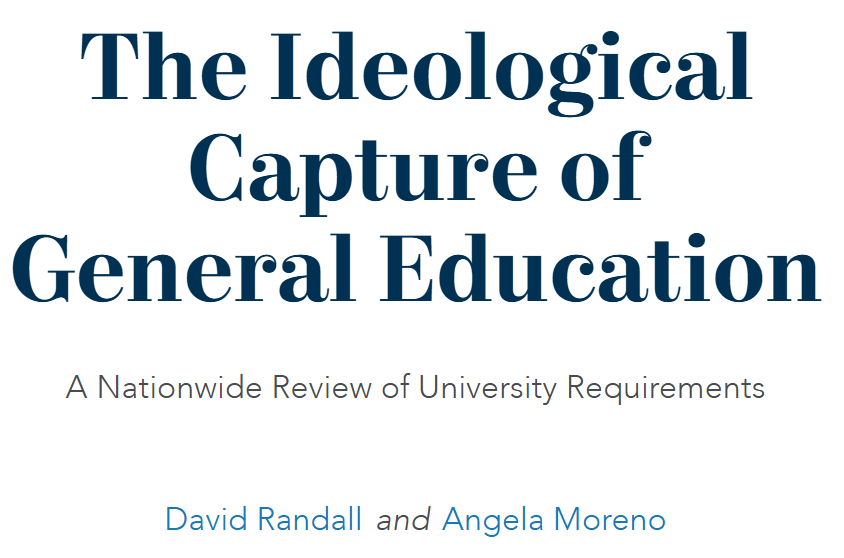
Groundbreaking new report: NAS reviewed graduation requirements at the 100 top universities. The results were stark. Substantive core curricula are out, and mandated progressive ideologies are in. Berkeley, Princeton, and countless others are pushing radical identity politics as practically a formal requirement for a degree.
An interesting brief treatment of addiction in Roger Scruton’s book Beauty. Too much discussion of this subject today overemphasizes neurochemistry. That is of course important, but it addresses only what Aristotelians would call the material and efficient causes of habituation, and not the formal and final causes. Human beings are by nature rational social animals, and as Scruton’s discussion indicates, addiction involves disorders related to both aspects of our nature.
Pleasure exists in us largely to bond us to other human beings. This is obviously true where sex is concerned, but it is even true to a large extent where the pleasures of food and drink are concerned. In human beings, food and drink are typically (even if not always) taken in the context of a meal, which is a social event which reinforces bonds of family and friendship. Addiction where sex, food, and drink are concerned is in large part a result of separating the pleasure associated with these things from the social context and making of it a kind of private entertainment, where it can be sought and gratified in a way that bears no connection to others.
As rational animals, we can also understand the ends for which pleasures exist, and follow rules (of morality, etiquette, and the like) that facilitate the realization of these ends. Because the desire for pleasure is strong in us when we are young but reason is also weaker in us at that time, we initially have to become habituated to these rules by way of parental instruction and social pressure. When such social norms are weak, and where pleasure is misunderstood as something purely bodily and animal without any essential connection to our social and rational nature – and both these circumstances obtain today – then the pursuit of pleasure is bound to become disordered, and addictions of various kinds more widespread.
This is a really interesting essay by Kodsi and Maier (and I enjoyed it more than some of their past writings on trans activism and philosophical malpractice).
They contend that "exceptionalism" -- the cognitive vice of making too many exceptions to general rules and norms -- is the "unifying feature of a wide variety of cultural and political idiocies."
Plato: “A tyrant must always be provoking war… But all this lays him open to unpopularity… So won’t some of the bolder characters among those who helped him to power, and now hold positions of influence, begin to speak freely to him and to each other, and blame him for what is happening?...Then, if he is to retain power, he must root them out, all of them, till there’s not a man of any consequence left, whether friend or foe…So he must keep a sharp eye out for men of courage or vision or intelligence or wealth; for, whether he likes it or not, it is his happy fate to be their constant enemy and to intrigue until he has purged them from the state… Then… people will find out soon enough what sort of a beast they’ve bred and groomed for greatness. He’ll be too strong for them to turn out” (Republic, Book VIII, 567a – 569a)
“The Dionysian has definitively triumphed over the Apollonian. No grace, no reticence, no measure, no dignity, no secrecy, no depth, no limitation of desire is accepted. Happiness and the good life are conceived as prolonged sensual ecstasy and nothing more.”
Theodore Dalrymple
As I keep saying, without clearly defined aims and a concrete and realistic plan for achieving them, a war cannot meet the just war conditions of there being serious prospects for success and well-grounded confidence that war won’t make things even worse. The “trust the plan” chuds dismissed all this as Ivory Tower moralism but in fact it is cold hard realism, as is becoming more obvious every day. As Plato would warn us, the disaster we’re facing is what happens when the people in charge are dominated either by thumos (Hegseth) or the id (Trump), rather than governed by intellect.
What Bernie Sanders types actually want is Sweden as it existed in the 70s and 80s under social democrats. They will never talk about Sweden's liberal reforms of the early 90s that saved its economy.


![FeserEdward's tweet photo. Plato: “A tyrant…if he is to retain power, he must root [the bolder characters] out, all of them, till there’s not a man of any consequence left, whether friend or foe…So he must keep a sharp eye out for men of courage or vision or intelligence or wealth; for, whether he likes it or not, it is his happy fate to be their constant enemy and to intrigue until he has purged them from the state…Then…people will find out soon enough what sort of a beast they’ve bred and groomed for greatness. He’ll be too strong for them to turn out” (Republic, Book VIII, 567b – 569a)](https://pbs.twimg.com/media/HIuNWgBbsAAQBj0.jpg)
![BretVDB's tweet photo. “Our students come to us from secondary school having read no works of literature in foreign languages and scarcely any works of literature in their own language. The very years, between twelve and eighteen, when they might be reading rapidly, uncritically, rangingly, happily, thoughtlessly, are somehow dissipated without cumulative force. Those who end their education with secondary school have been cheated altogether of their literary inheritance, from the Bible to Robert Lowell. It is no wonder that they do not love what we love; we as a culture have not taught them to. With a reformed curriculum beginning in preschool, all children would know about the Prodigal Son and the Minotaur; they would know the stories presumed by our literature, as children reading Lamb’s Tales from Shakespeare or Hawthorne’s Tanglewood Tales once knew them. We can surely tell them the tales before they can read Shakespeare or Ovid; there are literary forms appropriate to every age, even the youngest. Nothing is more lonely than to go through life uncompanioned by a sense that others have also gone through it, and have left a record of their experience. Every adult needs to be able to think of Job, or Orpheus, or Circe, or Ruth, or Lear, or Jesus, or the Golden Calf, or the Holy Grail, or Antigone in order to refer private experience to some identifying frame or solacing reflection.”
—Helen Vendler, “Presidential Address 1980 [MLA]”](https://pbs.twimg.com/media/HFyPyioXIAAlitQ.jpg)