1
ELECTRIC VIRUS
Potential Gradient (PG) = Measure of voltage in the atmosphere.
(HYPOTHESIS)
That atmospheric electricity affects the airborne potential of respiratory viruses.
#atmosphericpotentialgradient
Disclaimer:
*Exploratory
*Not a scientist
*Long thread
Eye problems are one of the most common after-effects of covid infections, and one of the most common issues of Long Covid - but they're not talked about much.
This is part two of my thread working through eye conditions that have become *much more common* since Covid struck.
1/3
@ukhadds
Hi professor,
Thanks for taking the time to educate us on all things aerosol both here and on your dedicated YouTube channel.
I had a question on a video explainer you did on aerosol deposition in the lung...
"Location, Location, Location: Aerosol Inhalation"
https://t.co/8Bg02aZ2v0
... which led to a lot more questions and I think my brain is now metaphorically trapped in a one μm aerosol for eternity 🤯
In your video you explained how the deposition processes of aerosols in the lung mirrors that of mask filtration, namely impaction, sedimentation and diffusion and that these methods are largely a function of aerosol size. There was one notable exception as an added feature of N95 masks - Electrostatics. But I'm wondering whether electrostatics could still play a role in lung deposition particularly for charged microbes like SARS-CoV-2.
I want to reference two other studies you led.
Dynamics of aerosol size during inhalation: hygroscopic growth of commercial nebulizer formulations (2014)
https://t.co/S3MytxEaGv
Ambient carbon dioxide concentration correlates with SARS-CoV-2 aerostability and infection risk (2024)
https://t.co/SFfg3p0LwK
I've been trying to reconcile your observations with a 2024 study from the American Chemical Society (apparently that's what I do in my spare time now 🤔).
https://t.co/jzwi8YRh8Z
(tagging @Jordi_Faraudo)
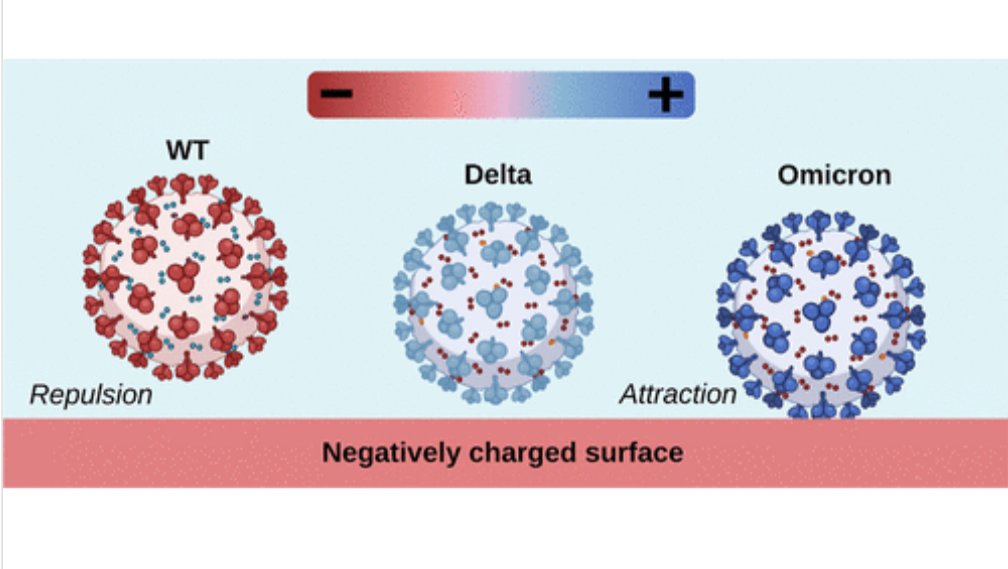
It's paywalled so I'm referencing the abstract and fully open to correction if the main paper differs. The authors say that the spike mutations attributed to Omicron "changed the game" in the electrostatic sense. Omicron's spike developed highly positive charges locally which resulted in attraction to negatively charged surfaces, unlike Wild Type and Delta variants, which were net negative and dominated by repulsion. You have stated in a previous response that a virus inside a respiratory aerosol is electrostatically screened by an ionic double layer (IDL), so it seems that the charge evolution of the virus is not necessarily relevant to the aerosol it is contained in?
Could a virus, however, influence its aerosol or be influenced by external electric fields if it maintained extreme proximity to the aerosol surface? 🧲
Most small aerosols do not contain more than one virus copy. If virions are distributed randomly in aerosols during exhalation, does a non-insignificant fraction of viruses meet the aerosol surface or near surface during the rapid dehydration that takes place under low-humidity conditions? Does the shrinking boundary collapse in and bring the air-water interface to the virus? Does dehydration also induce advection, as in large droplets, transporting more viruses outward?
The study here by Basu et al @Basulab_IISc used acoustic levitation to examine 500+ micron droplets, 100 to 1000 times larger than what would be typical for viable Sars containing airborne aerosol. As you say "aerosols are weird", and from what I hear, when it goes submicron, it all gets weirder.
https://t.co/sPf5O9rAXn
"For Peₘ ≫ 1, the nanoparticles do not diffuse but accumulate near the receding interface of the droplet."
"At D/D₀ = 0.26–0.27, the scatter from the center of the droplet may indicate the onset of precipitation, which coincides with efflorescence"
Would any of the principles observed in Basu's work apply to the size range measured for airborne SARS-CoV-2? Is efflorescence also delayed for 0.5 - 5 μm respiratory aerosols, which are substantially larger on exhalation? Would you expect that 10-20 μm hydrated droplets containing a 120 nm virus exhibit sufficient Peₘ to cause radial flow toward the receding interface before efflorescence? For micron or submicron hydrated, does a 120 nm virus occupy such a large portion of the dehydrated aerosol that it has a disproportionate chance of meeting the air-water interface? And how would typical saliva viscosity affect virus transport?
3/3 Omicron might be described as an electrostatic outlier among respiratory viruses, most seem to have net negative zetas while some Omicron variants are reported as near neutral with "highly localized" positive charges. If electrostatic interactions with charged mucosal surfaces are plausible could it add some restrictive force upon Omicron aerosols via increased URT deposition while repulsive variants deposit more in the thoracic region?
This counterintuitively would imply that even common cold viruses like NL63, which also uses ACE2, would have LRT access, even though it is URT dominant. But full access is the case anyway based on impaction, sedimentation and diffusion models and NL63 still doesn't favour severe pneumonic disease. Deposition doesn't always mean infection and this could be a function of something else like location-dependent pH or protease availability. Also, Omicron can still gain LRT access among the immunocompromised, but this might be explained by poor clearance and longer infection times with many more opportunities to "make the corner". If tidal breathing alone can transmit, could reverse flow on inhalation suspend viruses and re-deposit them deeper in the lung, establishing new infection sites especially in compromised hosts?
Electrostatics isn't actually required within known tropism dynamics. Omicron URT predominance is well explained by the protease TMPRSS2, and improved population level immunity. The switch to URT was very abrupt and coincided with an abrupt shift in spike polarity. Well proven biochemical processes and electrostatic processes are not necessarily mutually exclusive. If a significant proportion of virions can gain access to their aerosol's air-surface interface over billions of transmission events, I wonder could electrostatics (via image charge) help explain the shift from Delta alveolar pneumonia to Omicron "razor blade throat"?
Professor, I may have dug a bit of an electrostatic rabbit hole here and I have no idea if It's earthed or in wonderland. You said previously that if one of the two rings were switched off in your CELEBS setup that any contained aerosols would be shot out immediately? I'm wondering which would exit fastest, Omicron or Wuhan? Unfortunately the closest thing I have to CELEBS is the kids' bubble machine but I would be really interested in your expert view. Could electrostatics play a supplementary role in deposition and could a virus, especially one as positively charged as Omicron, influence its host aerosol's behaviour? Thanks for reading.
2/3 For viruses that do reach the interface or Debye layer, could they reorient ions or water molecules -- that patch induced image charge allows the virus to exert its localized spike charge upon its aerosol, or does the IDL screening persist at nanometer distances? Could the virus outcompete the force of image charge (repulsive to inclusions at air/water) and anchor itself to the interface via advection and hydrogen bonding?
On inhalation of the donor aerosol by a susceptible host could an image charge exert electrostatic attraction or repulsion before hygroscopic growth, prompting early Omicron deposition? Does Debye lengthening during hygroscopic growth compromise the double layer and reduce screening? Could a surface-positioned or protruding virus transiently anchor itself to new water molecules during early growth via hydrogen bonds? Would it exert its variant-specific charge upon its rehydrating aerosol (negative Wild Type/Delta, positive Omicron)? Is the virus or aerosol itself then prone to reorientation, attraction or repulsion near charged mucosal surfaces? At airway junctions in the lung, could an electrostatic nudge affect an aerosol's ability to "make the corner" as you broke it down clearly on your YT illustration?
I have a tonne of questions on this but they are almost all redundant unless the above holds water (excuse the pun). I won't expand too much but here's some quick follow ups.
▪️ Since charges are pH dependent, does CO2 protonate the virus reducing negatively charged residues and amplifying positive charges compared to lab reported zeta (ζ) potential?
▪️ Is IDL screening compromised by efflorescence or interactions with charged particles/ions?
▪️ Can an electric field persist within a particle post efflorescence?
▪️ Can a virus spike observe enhanced field gradients at spike tips due to electron migration? ("Lightning rod" effect seen in nature)
▪️ Could a near-naked virion, on inhalation into increasing ~99% RH airways, act as its own charged condensation nucleus (like CCN) and experience some hygroscopic growth? (Short range transmission)
▪️ You explained how ~0.2 μm aerosols evade deposition. Could an aerosol or inclusion with a 🧲harge alter this outcome?
▪️ In ~100% RH (dense fog), acidity aside, is the full pathogen aerosol population made viable as dehydration-prone sub micron aerosols take up suspended water?
What if immune imprinting is involved in a subset of Long Covid? nAbs are skewed toward an earlier variant or intervention so memory response is not specific to the persistent variant.
I wonder if the resulting spike blind spot sets the envelope up as a more viable target? Maybe consistent with reduced clearance and higher E titers?
Last month there was an announcement that I thought was a major advancement in world health, but it got little attention.
I thought I would tell you all a little bit about it and why it is so important.
1/25
@ukhadds There is also the disturbance of existing pollutants to consider and how they interact with the post strike electric field.
There may be multiple candidates for acidic aerosol during a lightning event but Covid/NOx (+H2O?) correlation seems to present itself in multiple studies
@ukhadds Just to note there are a lot more chemical interactions during a lightning strike. Sulfuric acid is another consequence and secondary organic aerosols can occur with interactions between Ozone and VOCs.
@matilija01 Now, just to clarify when I say non risk, l'm referring to the atmospheric effect of turbulence being advantageous.
Obviously the denser the crowd, the higher the risk regardless,
@ukhadds Hi Professor. Some brilliant and important work coming out of Bristol. I have some questions on whether certain atmospheric conditions might alter the viability of airborne viruses. Some relate to your work on CO2 and acidity but also your prior work around CELEBS tech and the suspension of viral aerosols through ionization and the importance of salts. How does all this interact with enhanced Atmospheric Potential Gradient (APG)?
Firstly, regarding radiation/condensation fog, particularly that of ~100% RH (full saturation):
Fog droplets lie in the range of 1-100 microns (typically <50) and can suspend for hours. If human respiratory aerosols are breathed into dense fog where the air is fully saturated with water droplets, what happens to said aerosols? Given that water is polar, could this lead to increased aerosol stability via coalescence or charge separation? Despite the differing composition might respiratory aerosols be held in suspension for time scales similar to fog droplets? Could larger aerosols or droplets which might normally settle quickly suspend for extended periods adding extra virions to the atmosphere? Would the RH imply instant equilibrium and deter evaporation induced decay?
Ionization is an important influence in fog formation. where the APG can significantly increase to >1000 V/m, (typically ~500V/m). Given your experience with ionization, and its anti gravity effect on aerosols, could the existence of such a naturally occurring electric field allow potential for independent ionization of respiratory aerosols or droplets. Also is there potential for naturally ionized particulate matter or aerosols to enter indoor spaces whether by natural drift or mechanical ventilation and could they affect the indoor electric field?
Fog typically coexists with extremely low or zero wind speeds. In urban locations very low wind speeds can translate to still conditions in sheltered locations where buildings and other structures act as wind breaks. Does this simulate an indoor environment where respiratory aerosols are trapped in situ, not by physical structures but a by a fog bank? Also much of the condensation nuclei of urban fog is comprised of acid pollutants. Considering your work on pH and viral decay, could any of these pollutants offer a suitable environment for virus survival?
Fog might raise another concern with it's requirement for very low or zero wind. What is the effect on indoor ventilation, considering fog can persist for hours or even days?
Secondly, with regard to lightning, particularly positive cloud to ground (CG) lightning strikes as opposed to cloud to cloud (CC) or intra cloud (IC):
Based on your experiments with CELEBS technology are there different voltage requirements for levitation of respiratory aerosols based on aerosol size? I'm not sure if the V/m was disclosed. Assuming it lies above the fair weather range of ~150 V/m and below ~100Kv/m, a threshold where the S Protein is potentially rendered impotent, I wonder if the (V/m) applied by CELEBS could be replicable by some CG lightning strikes? The logic here is that there exists a charge buildup prior to lightning storms, there are wild multi kv oscillations between +/- during strikes, there is a tapering over many kilometers of the potential gradient from the strike's epicenter and there is a post strike dissipation and return to baseline. Also thunderclouds themselves can drag the near ground electric field around with them. Though many CG strikes are reported to induce peak PG at +/- 20kv, this I believe is a limitation of testing equipment as at least 100 million V/m is achievable. It seems plausible that all voltages used in CELEBS could be induced in CG strikes since lightning achieves such a dynamic, mobile range across multiple kilometers. Could the increased APG and ionization which accompanies CG lightning suspend virus laden aerosols similarly to CELEBS technology?
@matilija01 Also the humidity in the surrounding areas of hot springs is higher than average. This might actually be helpful in winter by preventing the extreme drying of indoor air which can favour virus transmission.