Roger Waters, Keith Richards, Ian Anderson, Mark Knopfler, Sting, Herbie Hancock, Wayne Shorter, John McLaughlin and many more. I got to talk to them. Read all about it in my book: ‘Calling Elvis: Conversations with Some of Music’s Greatest’ @speakingtiger14
In 1971, George Harrison organized the historic Concert for Bangladesh at Madison Square Garden to raise funds for the refugees of the Bangladesh Liberation War. It was Pandit Ravi Shankar who had particularly inspired Harrison to do so. Harrison desperately wanted Bob Dylan on the bill, but Dylan was deeply hesitant. Did he have to perform Indian classical music? "Do I have to wear a dhoti?" a visibly worried Dylan asked Harrison.
The show featured a galaxy of stars, from Eric Clapton and Ringo Starr to Billy Preston and Pandit Ravi Shankar. The sheer scale of the event, in front of 40,000 screaming fans, terrified Bob. Right before the afternoon show, Dylan looked out at the massive, packed arena, turned to his pal Harrison in a panic, and said, "Man, this is not my scene. I don't think I can go on."
Harrison, who was already incredibly stressed anchoring the massive show, shot back, "Look, it's not my scene either! I haven't been on stage alone for years. At least you've got your acoustic guitar!"
Dylan slipped away, and up until the middle of the show, Harrison honestly had no idea where his friend was.
Then, midway through the concert, Harrison took the microphone, looked at the cheering crowd, and announced, "I'd like to bring out an old friend of us all... Mr. Bob Dylan." The crowd went absolutely berserk. Dylan emerged from backstage in a faded denim jacket with his Martin acoustic guitar. Backed by Harrison on electric guitar, Leon Russell on bass, and Ringo Starr on tambourine, the audience came alive when he started, "How many roads must a man walk down..."
That was our Bob Dylan, the man who gave us the biting, iconic protest anthems of the '60s.
Happy Birthday, Bob, on turning 85 today!
In Pic : Bob Dylan & George Harrison
Today we wish Bob Dylan a happy 85th birthday.
Listen to this excerpt from Dylan's Nobel Prize lecture where he reflects on the literary influences that shaped his songwriting. Classic works like 'Moby-Dick', 'All Quiet on the Western Front', and 'The Odyssey' informed his understanding of storytelling and human nature.
Hear the full lecture: https://t.co/cFBj6dwoff
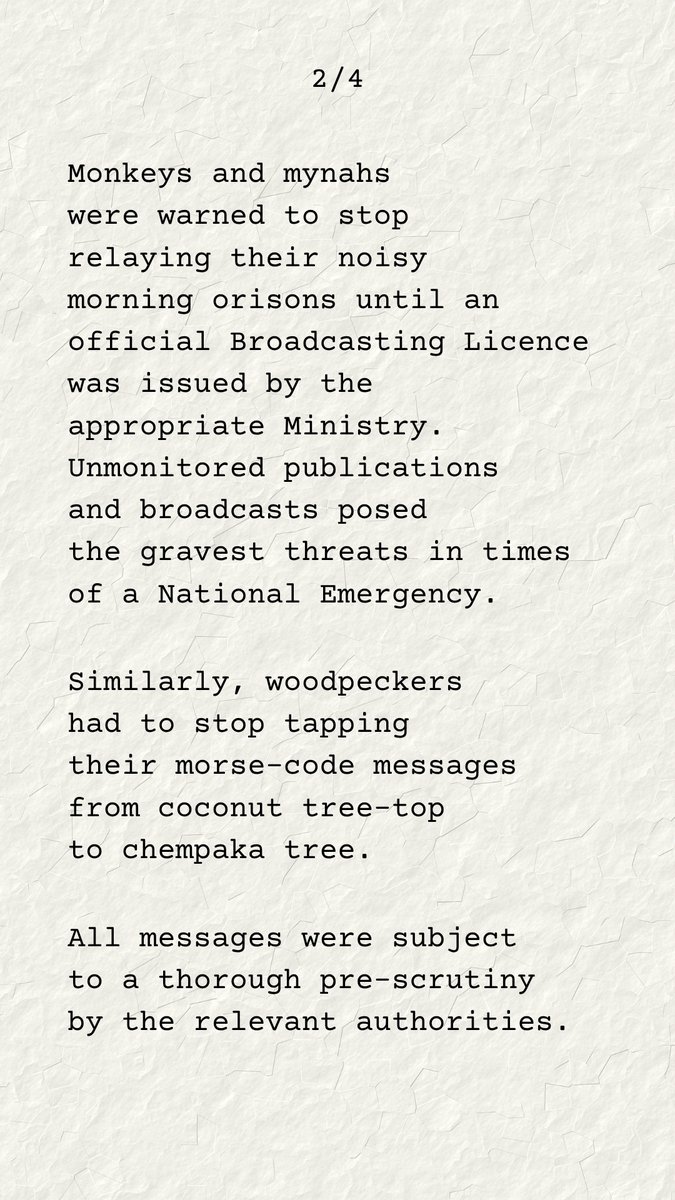
Even by the standards of a country ranking 157 of 180 nations in the World Press Freedom Index, the reaction of the authorities to the ‘Cockroach Janata Party’ is beyond extraordinary. The public response to that imaginative prank should have signalled to them a deep discontent, even distress, among young people. Instead, as The Indian Express reported, it was framed as jeopardising the country’s ‘national security’ and ‘posing a threat to the sovereignty of India.’ Decades ago, the Malaysian lawyer and poet Cecil Rajendra wrote this brilliant poem that captures the idiocy of it better than any pompous editorialising could (not that our ‘mainstream’ media would dare do even that much).
What’s damaging India’s economy & global standing is the government’s inability to take any criticism. If one doesn’t have the self-confidence to take criticism & covers up weakness with slogans, no corrective action is taken. This has a large negative fallout on the economy.
After press statements in Oslo, Norwegian press object to the PMs not taking questions as they normally do. Norway PM Store returns to do interviews with Norwegian media.
The problem is that the Government is neither willing to acknowledge the economic crisis nor ready to face difficult questions. Just listen to Indian Express Senior Associate Editor Udit Misra for 4 mins only.
There is a form of liberal punditry about the BJP which goes “you have to hand it to them…” You don’t. When you tip your hat to a poisonous majoritarianism, you amplify its aura. When you give the devil his due, you join his baggage train.
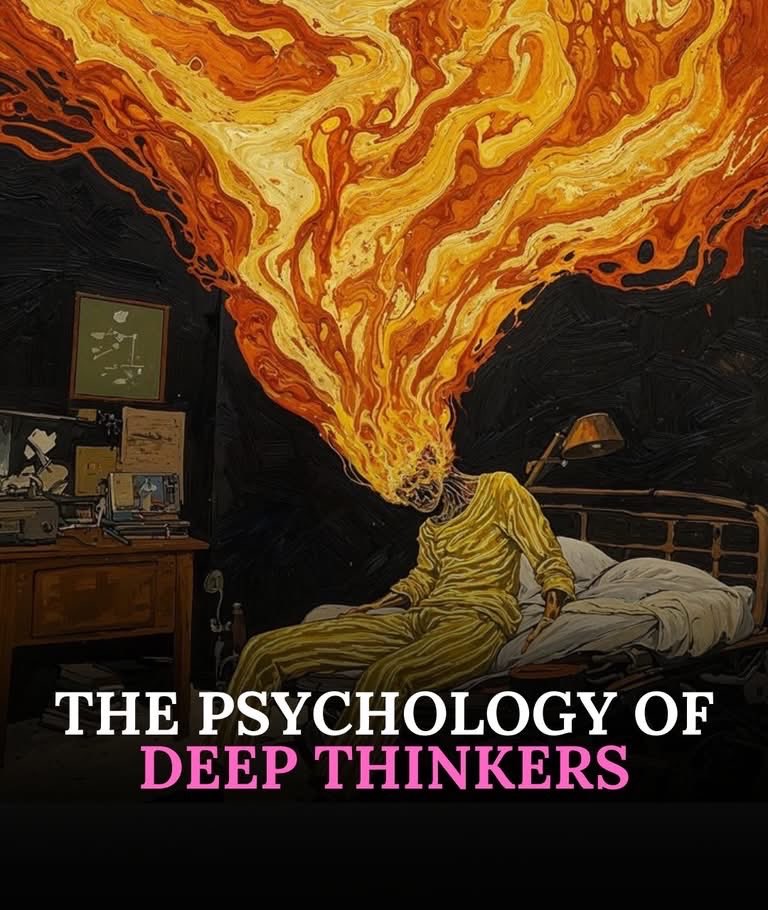
Carl Jung wrote: "The more intelligent and self-aware a person is, the more they suffer from the general unconsciousness of society."
This is not a badge of honor. It is a recognition of the weight carried by those who cannot unsee what they have already seen. This is the psychology of the deep thinker and if you recognize yourself here, this one is for you:
The architecture of alienation. It starts early. The child who asks why adults say one thing and do another. The one whose questions are always labeled as "overthinking." Nietzsche described these people as "free spirits" — essential for progress, but wandering in a wilderness everyone else refuses to enter.
Research by Dr. Elaine Aron suggests approximately 20% of the population processes information more deeply and notices subtleties others completely miss. In a world that rewards speed, this depth can feel like a disability.
The frequency of truth. Deep thinkers operate on a different wavelength, the frequency of truth rather than the frequency of comfort. Most people live without ever questioning the fundamental assumptions of their own existence. But the deep thinker has glimpsed behind the veil.
Like Plato's prisoner who escapes the cave and returns to share what he saw only to be rejected and called a troublemaker—the deep thinker carries the burden of the witness. They see the masks, the exploitation, and the pain that everyone else has agreed to ignore.
The emotional sponge. Deep thinkers do not just observe emotions, they absorb them. They feel the anxiety of a stranger as if it were their own. They perform enormous amounts of invisible emotional labor — checking in on people, listening, supporting, acting as the unofficial therapist of every room they enter. And yet the relationship is almost always asymmetric. They give at a depth most people cannot match. They live with the quiet loneliness of being the strong one, the one everyone leans on, but no one thinks to ask: "Are you okay?"
The mask of normalcy. To survive, many deep thinkers learn to wear a mask, laughing at jokes they do not find funny, feigning interest in conversations that feel hollow, modulating their intensity to avoid being too much. This is not deception. It is survival. But the cost is enormous.
Maintaining the split between the complex private self and the simple public self is exhausting. And the mask, while protective, makes true connection nearly impossible. You cannot be fully known while hiding.
The wounded healer. Jung wrote about this archetype; the person who transforms their own brokenness into a source of healing for others. The wounds of rejection and misunderstanding become sources of deep compassion. The person who has felt most unseen becomes the most gifted at seeing others. But the challenge is learning to give without emptying yourself completely, to love others without losing yourself in the process.
The alchemy of solitude. For deep thinkers, there is a crucial distinction between loneliness and solitude. Loneliness is the pain of disconnection from others. Solitude is the joy of connection with yourself. In solitude, the deep thinker finally breathes. The noise of the world falls away. The internal landscape becomes clear. Isolation transforms into introspection and that is where the real work happens.
The revolutionary act of authenticity. In a world that profits from insecurity, choosing to be genuinely yourself is a radical act. When a deep thinker chooses authenticity over performance, it creates space for others to do the same. It gives people permission to be real in a culture that rewards shallow.
If you recognize yourself in any of this, stop apologizing for your depth. You are not broken. You are not too much. You are not too sensitive. You are awake in a world that prefers to stay asleep. Your sensitivity is a superpower. Your intensity is a strength.
✨🙌🏾💫
Deeply anguished to learn of the tragic death of Nithin Raj, a young BDS student from Thiruvananthapuram, at Kannur Dental College, Anjarakandy. Audio recordings now reveal what his family has long alleged — relentless verbal abuse, casteist slurs, threats, and deliberate academic sabotage by faculty. A bright young life, extinguished by a toxic campus.
This is chillingly reminiscent of the death of Sidharthan, another young student from Thiruvananthapuram. I had visited his grieving family after his tragic passing. In his case, it was student goons who drove him to his end, while a callous management looked the other way. Different perpetrators, same criminal institutional failure.
These are not isolated tragedies. They are symptoms of a deeply diseased campus culture — one that preys on the vulnerable and shields the powerful.
Nithin's family alleges he was mocked for his caste, his skin colour, his financial background. His internal marks were allegedly slashed as punishment. His mother's surgery was ridiculed in class. And when he finally dared to stand up for himself, a system that should have protected him failed him catastrophically.
The suspension of two faculty members is a start — but nowhere near enough. I demand a thorough criminal investigation and full accountability across the college administration.
How many Sidharthans and Nithins must we mourn before Kerala — and India — find the will to truly cleanse our campuses of this poison? Our institutions must be sanctuaries of learning and dignity, not arenas of humiliation and impunity. #JusticeForNithinRaj. Not tomorrow. Now.
https://t.co/K6Dz0488dc
Respected sir maybe there was a communication issue but the way I remmeber the last 3 questions of my cross examination this evening -
Do you feel remorse - No
Are you sorry about what you said- No
If you tender an unconditional apology this matter will be looked at differently - No I can’t as the apology would not be sincere. Also it would set a terrible precedent for other artists & their freedom.
'An artiste does not exist outside his times. These are times that demand attention – when democracies are narrowing, public discourse is fragile and wars define much of our present. In such a moment, art cannot remain ornamental. It must engage, question, and when necessary, resist."
— Amol Palekar
https://t.co/iPSPkqUNhv
"You come here to clap for revolution at 7:00 PM and go back to exploit your domestic help at 10:00 PM. You are not my audience; you are my funding."
Utpal Dutt once hurled these biting words at an audience, perfectly capturing his cynical view of the "champagne socialist."
Later, while his play 𝘋𝘶𝘴𝘸𝘰𝘱𝘯𝘦𝘳 𝘕𝘢𝘨𝘢𝘳𝘪(City of Nightmares),a blistering critique of the incumbent government, was in production, the police arrived one evening and demanded he change the script or face the consequences. The playwright, director, and actor famously remarked,"I am an artist, not a makeup man for the police force." That man was Utpal Dutt,a figure far greater than a mere comic caricature or a villainous face in popular cinema. He was a revolutionary artist, fiercely anti-establishment, and a titan of political theatre in India. Today marks his birth anniversary. Tributes to this great scholar, actor, and activist 🙏🙏
There is a mythology the U.S. built around the American War in Vietnam. It goes like this:
Young idealistic soldiers were sent into an unwinnable situation by confused politicians.
They came home broken and unappreciated.
It was a tragedy. A mistake. A lesson learned.
Notice what that story does.
It centers Americans.
Their trauma. Their confusion. Their homecoming. Their feelings.
In this story, the Vietnamese people are a backdrop.
A jungle. An obstacle. An abstraction.
Three million dead Vietnamese people are the scenery for a story about American self-discovery.
They made hundreds of movies about Vietnam.
The Deer Hunter. Apocalypse Now. Platoon. Full Metal Jacket. Born on the Fourth of July. Hamburger Hill.
Count how many of them center a Vietnamese character with a full human life, a family, a name you remember after the credits roll.
They turned our genocide into their coming-of-age story.
They lost the war and still managed to make themselves the main character.
And then, with extraordinary arrogance, they put their soldiers' names on a wall in Washington and call it a memorial, as if the dead to be mourned were the people who flew 10,000 miles to do the killing.
Where is the wall for our three million?
There isn't one.
Because in their telling, we were never quite real enough to mourn.
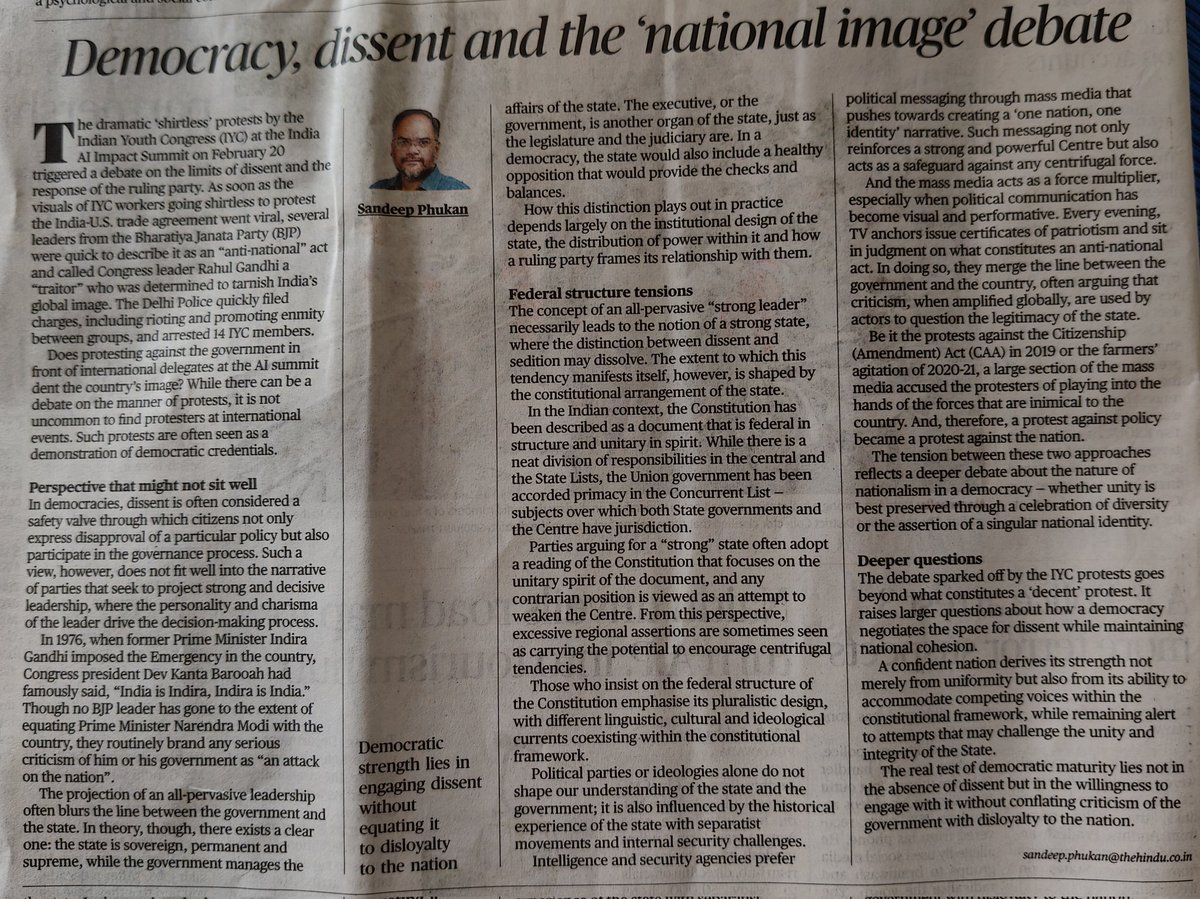
"A confident nation," writes @fewcan, "derives its strength not merely from uniformity but also from its ability to accommodate competing voices within the constitutional framework..." in this excellent piece. Only, it should have appeared much earlier. @the_hindu
A friend once warned him, "Go if you must! But the Bengalis won't let you survive there."
Vistasp’s reply was simple,"If they don’t let me stay, I’ll come back."
Back then, Vistasp, the son of a Parsi teacher in Bombay surprised everyone with his decision to move to Calcutta. He had a wife and children in Bombay and a respectable income. There was no guarantee he’d find work that paid nearly as well in Calcutta. But his friends and family knew him too well.
They remembered how, shortly after his matriculation, Vistasp ran away to Pune in search of work. He spent his days job hunting and his nights on railway platforms. After being chased away by the police, he sought shelter at Kirkee station, sleeping on wooden benches to the "lullaby" of a mosquito symphony. He eventually found a job washing horses at a military camp, but he didn’t stay away for long. Reflecting on it, Vistasp once wittily remarked, "...eventually, I returned home, just like all frustrated young men do."
When he finally reached Calcutta, the "Vistasp" shortened to just "V." Paired with his surname, he filled the city with music as V. Balsara. He often used a two-fingered "Victory" sign as a silent shorthand for his name.
He arrived in Calcutta in late May 1954, carrying nothing but a shirt and trousers wrapped in paper and exactly three rupees in his pocket. Staying at a Parsi guest house on Bow Street, he had no plan. He decided to find Pandit Jnan Prakash Ghosh and headed to the radio office. Ghosh wasn't there, but a kind gentleman directed him to the National Orchestra, where Ghosh was busy with rehearsals for a recording the next day. The group practically forced Vistasp onto the piano stool. That moment marked the beginning of V. Balsara’s journey in Bengali music.
Once, Hemanta Mukherjee jokingly gave his dear friend a bit of a "jail scare." While arranging music, Balsara was startled to hear he might end up behind bars. During a Rabindra Sangeet recording, Hemanta noticed a slight deviation from the notation and scolded him: "Hey, play exactly what’s in the notes. This is Tagore's music. If you play something else, Visva Bharati will send you to jail!" Fear of "jail" kept Balsara away from Tagore’s compositions for a long time, though later, those very songs became his greatest solace.
His life was marked by incredible discipline and quiet strength. When his eldest son passed away at just eleven years old, Balsara showed up at the studio exactly on time right after the funeral rites. Even on the day his wife passed away, he didn't cancel his scheduled performance. Instead, he dedicated "Purano Shei Diner Kotha" to his lifelong companion.
Vistasp Ardeshir Balsara gave up formal education after failing his 2nd year college exams, pivoting entirely toward his obsession with instrumental music. He was fascinated by the sounds he could coax out of glass, bottles, metal, and stone. By collecting various empty bottles, he created the "Bottlephone," followed by the "Glassophone," "Steelophone," and "Bellophone."
In his memoirs, he wrote, "Since childhood, my head was buzzing with ideas. I was always thinking of ways to pull new sounds out of a harmonium." This relentless curiosity eventually made him the undisputed emperor of instrumental music.
On this day in 2005, this true gentleman, who loved Bengal and its people deeply, passed away.
Tributes... 🙏🙏🙏