📉 Markets Are Shifting—What’s Next? 📈
The #USdollar is down, despite #CPI data & #yields rising. Meanwhile, peace talks in #RussiaUkraine & Mid-East ceasefire discussions are in play.
What does this mean for #USD, #oil, #GOLD , & #forex? Let’s break it down. 🧵👇
#Markets
현재 개 ㅈ된 프랑스 상황
1. 프랑스 국채를 대량으로 갖고있던 일본이 통채로 던져버림
스미토모미쓰이DS자산운용이 프랑스 국채를 전부 팔고 독일ㆍ일본 국채로 갈아탐
프랑스 10년 국채금리 3.6% -> 4.96%
2. 일본이 아��� 갖고 있는 국채 규모만 1,450억 달러어치임
프랑스 국채시장은 일본이 더 던질까봐 떨고있음
3. 신용등급도 하향추세임
한국보다 한단계 아래임
한국 AA-
프랑스 A+
이탈리아 BBB
4. 작년 9월 피치가 프랑스 신용등급을 AA-에서 A+로 내림
더 골때린건 신용등급이 3단계나 낮은 이탈리아보다 이자를 더 내고 있음
현재 이탈리아 국채금리 4.7%
5. 빚 이자가 프랑스의 교육 예산보다 많음
올해 792억 유로였던 이자가 내년엔 118억 유로나 늘어나게 됨
매년 번 돈보다 쓴돈이 많아짐
6. 현재 프랑스의 부채비율은 GDP의 119%임
유로존 기준치인 60%의 두배임
7. 더 큰 문제는 개혁을 해서 나라 살림을 정상화 시켜야 하는데, 개혁이 안먹힘
개혁 얘기만 나와도 시위하고 도시 파괴하고 난리가 남
연금 개혁, 교육비 개혁 등의 긴축예산안이 격렬시위로 멈춰버림
8. 게다가 인구 구조도 엄청난 이민자 유입으로 정상적인 상황이 아님
무슬림 비율은 주로 이민과 그 후손에 의해 증가했으며 대략 10%에 가까운 엄청난 수준임
노인 인구도 20%가 넘어가면서 1500만이 넘어가는 숫자임
개혁의 엄청난 걸림돌임
지금 프랑스는 ㄹㅇ 답이 안보이는 상황임
국민 지도자는 국민 수준 따라간다고 하지만, 민주주의 국가에서 방만 재정으로 인한 문제는 공통적으로 불거지는 특징이라 민주주의 부작용이 임계점에 가까워진게 아니냐는 우려가 커진 상황임
솔직히 프랑스 2024 파리 올림픽이 줬던 충격을 생각하면 예상됐던 파국이긴 함
OpenMarket is officially going mobile.
Our first Android app is live today. iOS is coming soon.
Chart your markets, follow price action and stay connected to the markets wherever you are.
This is our first step towards bringing the full OpenMarket experience to your pocket.
Download on Google Play today.
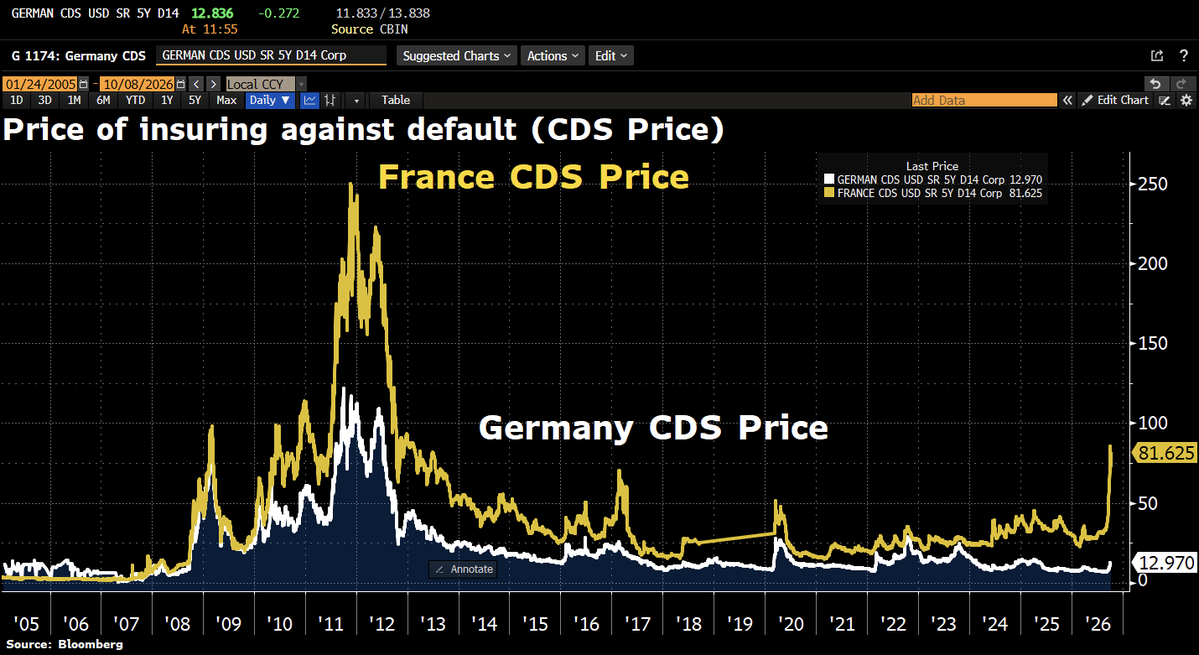
Good Morning from Germany, where even the safe haven is getting more expensive to insure. German 5y CDS have risen from 7.5 to 13bps amid higher interest rates and growing fears of another Euro crisis. France’s surge has been far sharper, to 82bps. Market-implied 5y default probabilities: Germany 1.2%, France 7.1%.
As French yields continue to climb and pull other European yields higher, there's a question on many people's minds:
What is the circuit breaker, and when does it kick in?
Is it endogenous?
If so, we are likely still a ways away from its trigger point, especially given how ex-ante imbalances in the US bond market continue to exert upward global pressure.
Or is it policy-induced?
If so, and when it comes (also uncertain), will authorities use the right tool, or a second-best option that brings unintended consequences and collateral damage?
#economy #markets #bonds #yields #europe
BREAKING: Vitalik states that @Pumpfun has killed memecoins by turning new retail investors entering the crypto space into degenerate gamblers and with no real-world use, the industry will die fast.
He also stated that @pumpfun has been a net negative to crypto since it was released in 2024 by draining the $crypto ecosystem and turning retail into gamblers not investors.
He also said the platform is setup like a slot machine you keep clicking until your fully drained - pump ultimately wins but retail loses.
So Japan can:
1. Raise rates = blow up the yen carry trade and its pension funds
2. Sell USTs to buy yen = blow up the US bond market
3. Use the US money printer to buy yen = increase US inflationary pressures
We don't own nearly enough hard assets for what's coming.
🚨 GOLDMAN SACHS DROPS DOOMSDAY STATEMENT: U.S. BONDS HAVE NO BUYERS
Goldman Sachs just admitted the long end of U.S. Treasury market is “totally bidless.”
Translation: almost nobody wants the 10- to 30-year debt the U.S. is trying to sell.
No buyers. None. Zero.
While Treasury Secretary Scott Bessent tells Congress we’re in an “illiquid period,” doubles then triples long-bond buybacks, taps the General Treasury Account to fund it and openly says “I am the house.”
Yields are surging anyway. The 10-year has pushed toward 5.3% and the 30-year is even higher, levels not seen in years while Japan, one of the biggest foreign holders, keeps selling Treasuries and bringing money home.
This was exactly warned by Japan’s @yutokanzakireal that the measures being prepared by Bank of Japan will affect the lives of billions of people and apologized to people of the West.
Soon after, Scott Bessent intervened and effectively took over BoJ operations which Japanese policymakers heavily criticized.
If the same ”bidless” condition hits the short-dated treasuries market, the entire U.S. debt market (and global) collapses.
The U.S. debt crisis will turn into a global liquidity crisis.
Setting the record straight: everything we're putting out for free, we promise to keep it that way. We think charging for things like watchlists is anti-innovation, and we're not going to do that.
We do charge a monthly fee for power users, but for most users free is going to be enough. The tools themselves aren't paywalled, unless they are data-intensive (compute and bandwidth is expensive!). You can load the same indicators as a paid user. You can still view tick-level footprints, TPO, and all the other order flow tools we have for free. None of that is gated.
So where does the money go? Straight back into the platform. Exchanges own their market data, and to show it to you we have to pay them licensing fees. Right now, it is coming out of our own pockets. Every new market we add means a new deal and a new bill. Your subs are what let us sign more of those deals and expand our asset selection. We don't have hundreds of millions of dollars in funding like TradingView does, but we will get there eventually.
Thank you for giving us a chance.
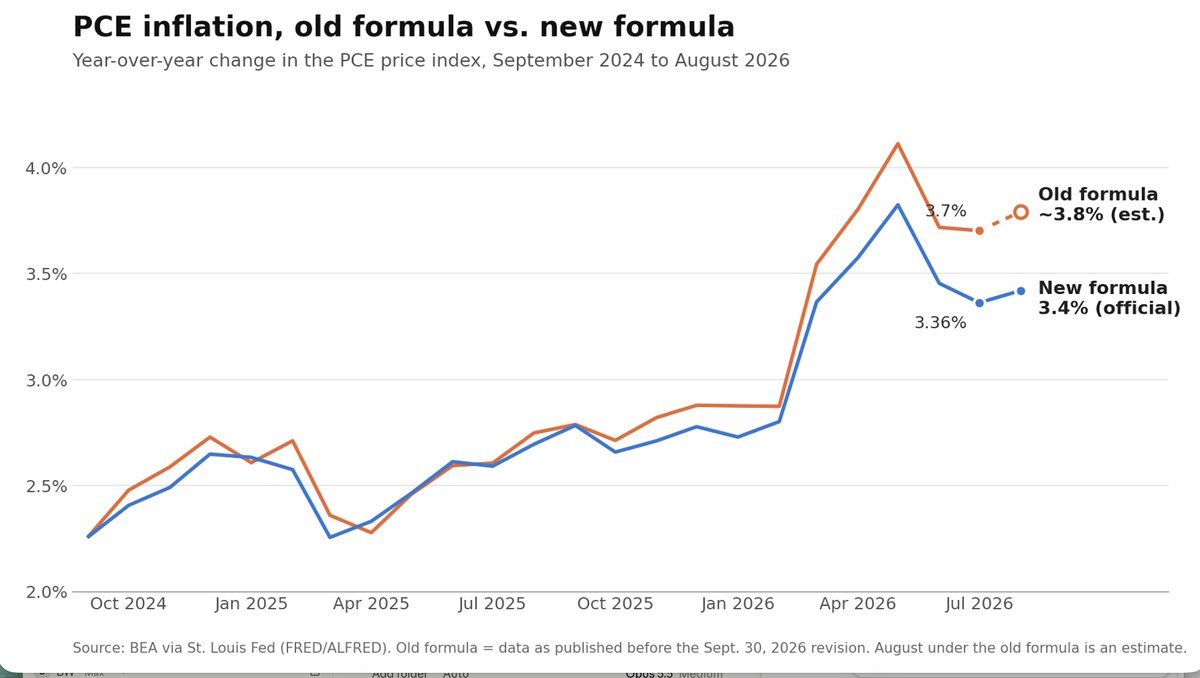
Inflation numbers came out today, and the official story is that inflation went down. What the headline number doesn't tell you is that the government changed how inflation is calculated in the same release. A month ago, they said July inflation was 3.7%. Today, they recalculated July with the new formula and it dropped to 3.36%. If you measure August the same way as the months before it, inflation comes out around 3.8%, which means it went up. They didn't bring inflation down, they just changed how they calculate it.
Bessent did something similar with CPI last month. You only modify the way you calculate if they numbers are that bad. They genuinely thought we wouldn't notice...
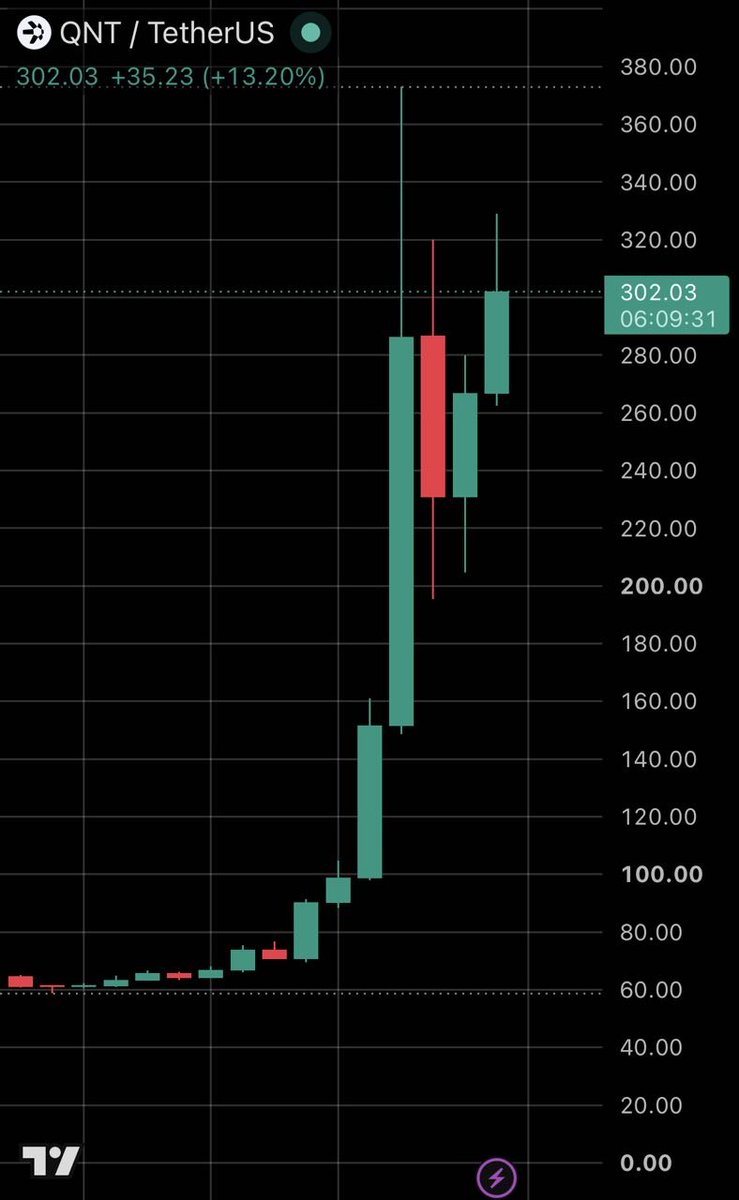
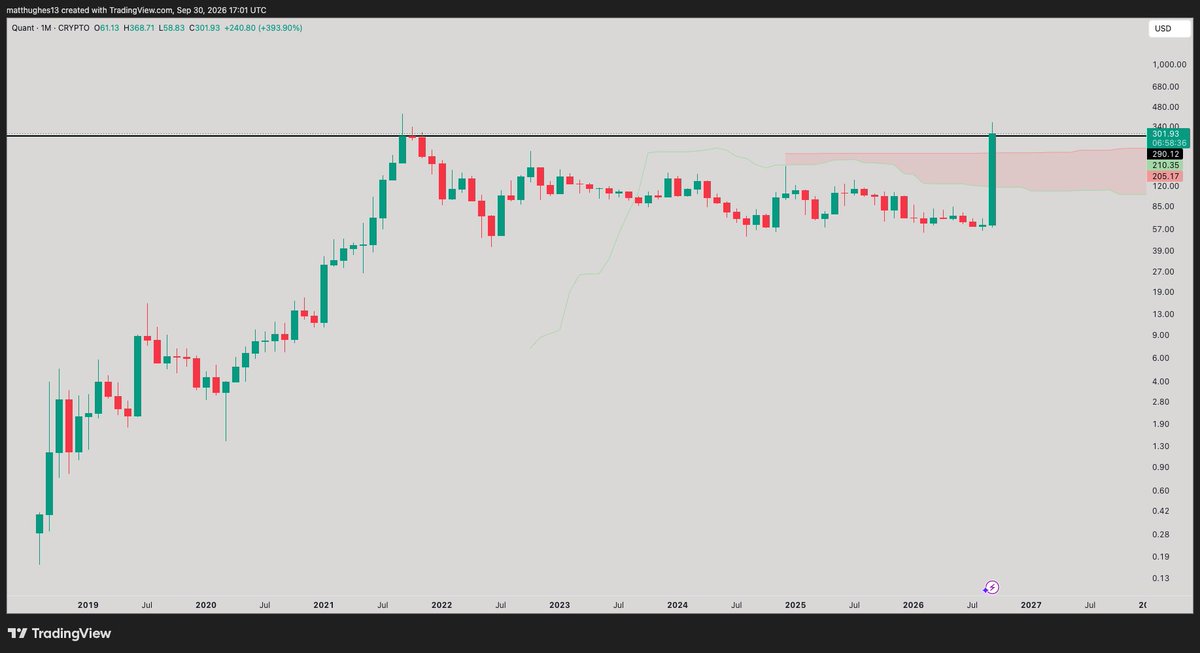
Do people realize $QNT has a real shot at printing its highest monthly close ever today, right around the old Sep 2021 at $290, while also breaking the monthly Ichimoku Cloud for the first time?
🚨HUGE: Quant founder-linked wallet moves $7 MILLION in QNT after seven years of dormancy, as the token surges over +350% in a week.
The wallet transferred 25,776 QNT and still holds 600,000 tokens worth roughly $160.39 MILLION, per lookonchain.
The move comes as The Clearing House, which settles over $2 TRILLION daily, selected Quant to connect its tokenized-deposit network.
Quant-built infrastructure is also supporting live customer transactions at major UK banks, including Barclays, HSBC, Lloyds and NatWest.
$QNT has jumped nearly 4x in price in the past week.
$QNT has been chosen by as the official technology provider for The Clearing House’s new tokenized payments network.
The Clearing House powers MORE THAN HALF of all ACH and wire transfers in the United States.
$2 trillion per day.
Yes, trillion, with a T.
Keep sleeping.
I would like to remind everyone that the Bank of England does more transaction volume in one day than Bitcoin does in a whole year and the Bank of England will primarily run on $QNT & $XRP infrastructure. As will the other central banks as well!
$QNT = Internet of Trust
$XRP = Internet of Value
Scammers found a way to make people drain their own wallets without sending them a phishing link.
They uploaded YouTube tutorials showing people how to build an AI crypto trading bot with Claude.
People followed the tutorial themselves.
Copied the code.
Deployed the smart contract themselves.
Funded it from their own wallets.
And approved every transaction themselves.
Except the “trading bot” had no trading logic.
It was built to send their ETH straight to the scammers.
224 wallets lost 274.6 ETH, worth about $517,000 when it was stolen.
The median victim lost 1 ETH.
Some victims even got an error after getting drained telling them to deposit another 50% to fix the bot.
They literally got people to build, fund and approve their own wallet drainer.
You've got to be very careful this days
The evolution of ZCash $ZEC :
- research paper called “Zerocash” in 2013
- built by a small cryptography team that later became Electric Coin Company (ECC)
- takes Bitcoin’s model and adds zero knowledge proofs for private transactions
2013: Zerocash paper comes out of Johns Hopkins
2014: Zooko and team found Zerocoin Electric Coin Company (later ECC)
2016: the famous “trusted setup” ceremony with 6 participants destroying the toxic waste
28 October 2016: Zcash mainnet launches (Sprout)
2017: Zcash Foundation (ZF) is created as a non-profit to handle grants and community
June 2018: Overwinter upgrade adds versioned transactions and replay protection
October 2018: Sapling goes live
2019-2020: speed, governance and the first halving
2019: Blossom upgrade cuts block time from 150s to 75s
Zcash becomes faster and more usable for everyday payments
ECC rebrands from “Zcash Company” to Electric Coin Company to separate brand and entity
November 2020: first halving
block reward goes from 6.25 ZEC to 3.125 ZEC
2021-2022: Halo and the end of trusted setup
the big problem: “trusted setups” are controversial and hard to explain to users
ECC works on Halo 2, a new proof system that doesn’t need a trusted ceremony
Halo 2 goes live on mainnet
2023-2024: stress tests and second halving
2023: ViaBTC temporarily controls 50% of Zcash hash rate
23 November 2024: second halving (NU6)
Lockbox governance and updated Dev Fund rules are introduced
2025: Zashi, shielded explosion and the privacy rally
ECC focuses on user experience instead of just core cryptography
for the first time, privacy is not a niche corner of the chain
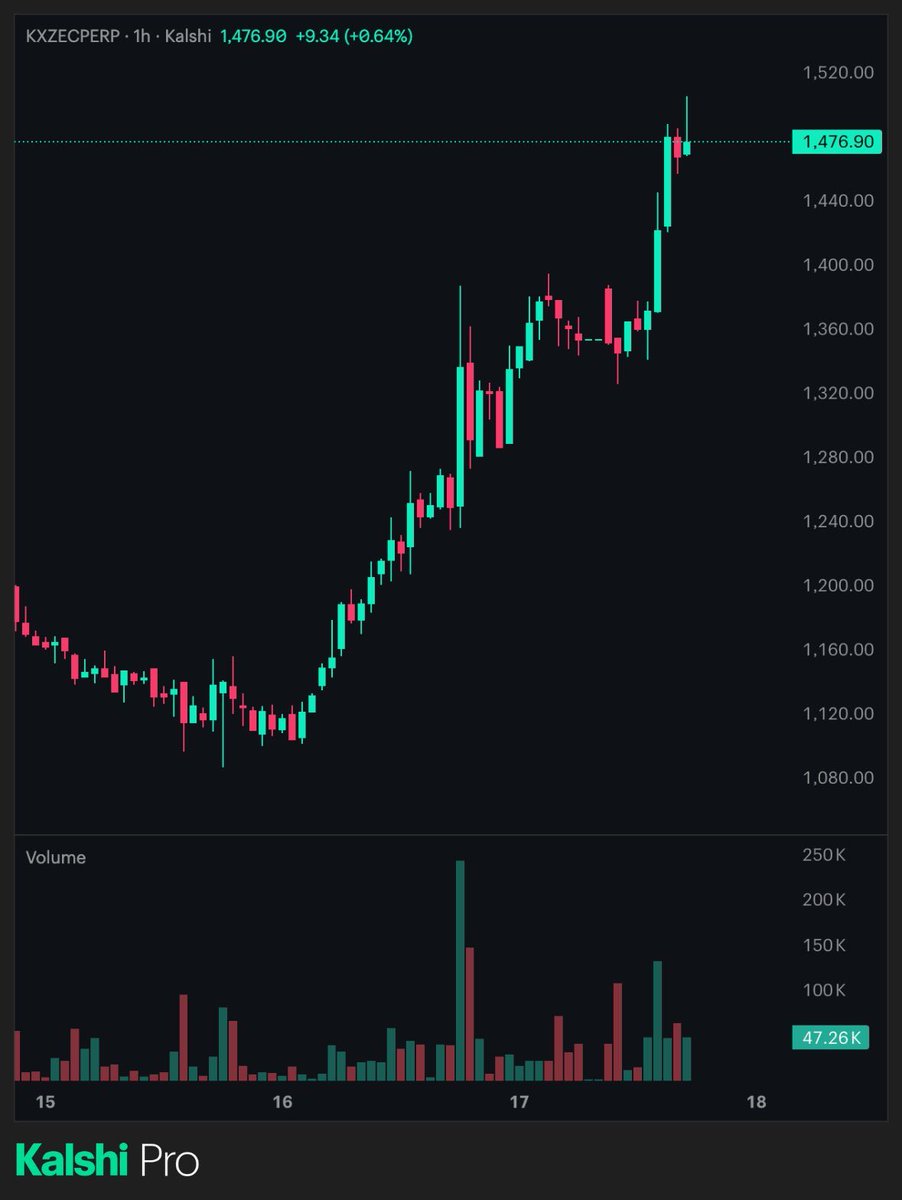
Now the token is $1,400 and we finally have encrypted money at internet scale.
Zillions.