5) How Math Broke Media
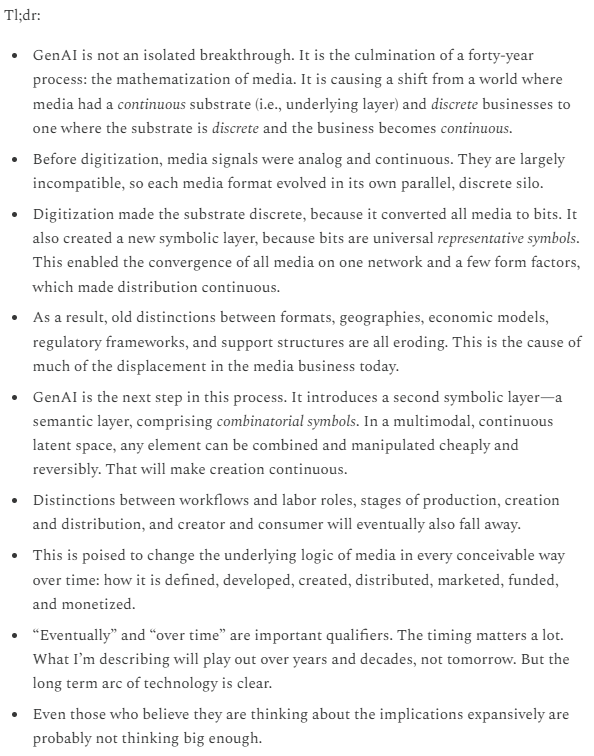
GenAI is the culmination of a process that started more than 40 years ago, the mathematization of media, and why it will change the underlying logic of media in every conceivable way.
https://t.co/LQUFOcCpWV
Thanks to everyone who helped make The Mediator a success in 2025!
As a small thanks, I’ve made 5 of the most-read essays from last year free to read for the month of January.
Like all my posts, each focuses on the structural changes that will shape the next decade in media:
I often think about the Peter Thiel X and Y framework: they represent the value you create for the world and the proportion of that value you extract, respectively. And they’re independent.
Mobile networks are a great example. The telecom companies generated a massive X and a minuscule Y.
This distribution happens because discovery on Substack is less algorithmically- and leaderboard-driven, so the positive feedback loops (preferential attachment) are weaker.
It is a little less democratic than this chart appears though, since an estimated 80% of writers have less than 10k subs
https://t.co/8LmLESVuGa
@bilawalsidhu There’s also the supposed Keynes quote “When the facts change, I change my mind. What do you do, sir?” Whether they are keeping their cards close or aren’t convinced yet, either way they will pivot at some point
@jasonkilar Hey Jason - I was being glib, but as we’ve seen from “the Netflix bounce,” their distribution can clearly change the trajectory of content. As we move toward an infinite content world, i think it will only get more important.
Instead of search, what I think you mean is that curation is 100x more important
But that could be search (active algorithmic curation), recommenders (passive algorithmic curation), agents (autonomous algorithmic curation), editorial/influencer (human curation), communities (social curation) or hybrids of any of these - we will desperately need filters, but will likely use different ones depending on the circumstances
@theadaptable1 I think the real work here is to figure out what are these new attributes and how important are they
“Novelty” could definitely be one of them…
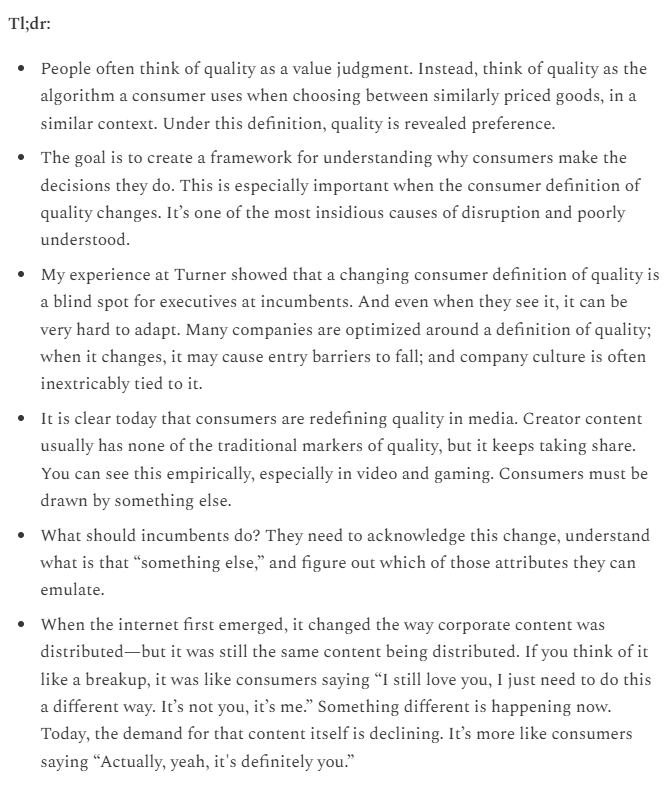
A shift is happening across media - the consumer definition of quality is changing
When the internet emerged, it changed distribution models for traditional content--but it was the same content being distributed. Now, demand is shifting away from traditional markers of quality toward new ones: authentic, relatable, low friction, digestible, social, etc.
In this essay, what it means, a framework for thinking about quality and what incumbents can do about it
28 Days of Media Slides
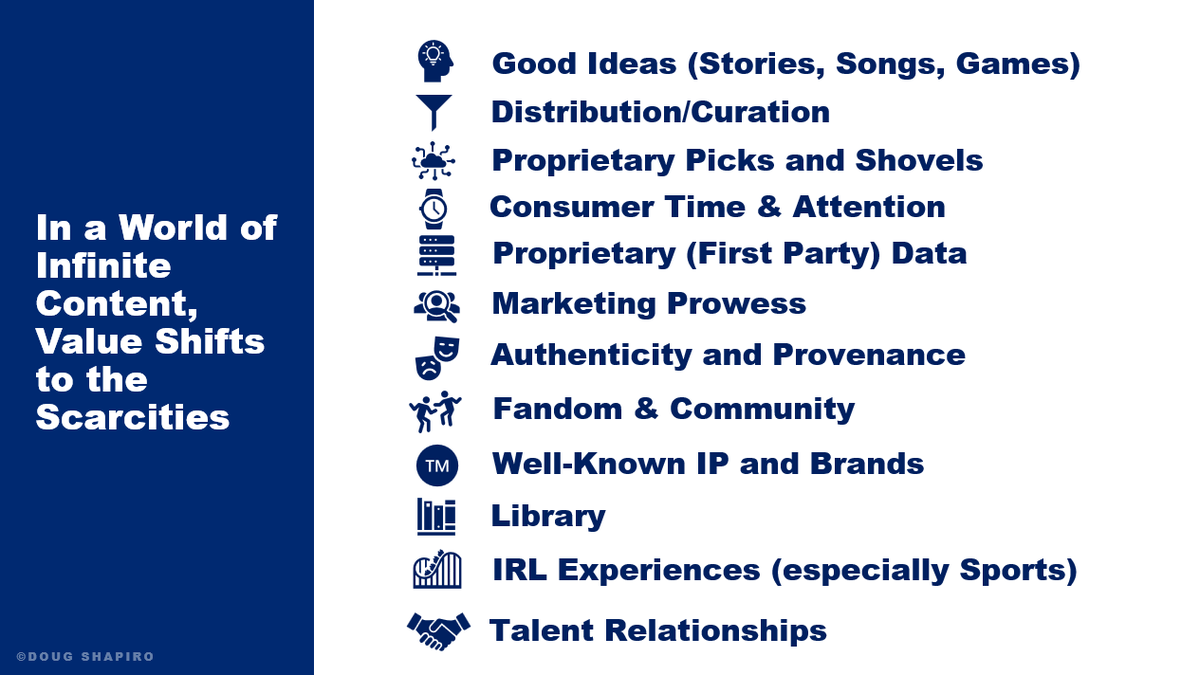
Day 28: What will be scarce in a world of infinite content?
Over the last month, I’ve painted a picture of a media industry in upheaval, especially for the traditional intermediaries:
- Time spent with media is stagnating, putting a cap on growth
- Attention is fragmenting as corporate media loses share to creator media
- Technology is disintermediating traditional intermediaries, shifting bargaining power to the top creatives and creators
- Platforms with massive scale and different profit motives are increasingly dominating the media business
- The distribution of popularity is becoming more power-law like, making the business riskier
- Maybe most important, all of this is a lagging indicator of the last disruption—falling barriers to distribution (the internet)—but another disruption is looming—falling barriers to creation (GenAI)
So, to end on a more hopeful note
The good news is that whenever one input becomes abundant, other things become scarcer and more valuable
Trying a little experiment
Each day, for the next 30 days, I'll post a slide or two about the media business
Some data-centric, some conceptual; some proprietary, some not, but all will tell a story about the future of media
Day 1: Time spent with media is stagnant, so overall media revenue is no longer growing on an inflation adjusted basis
28 Days of Media Slides
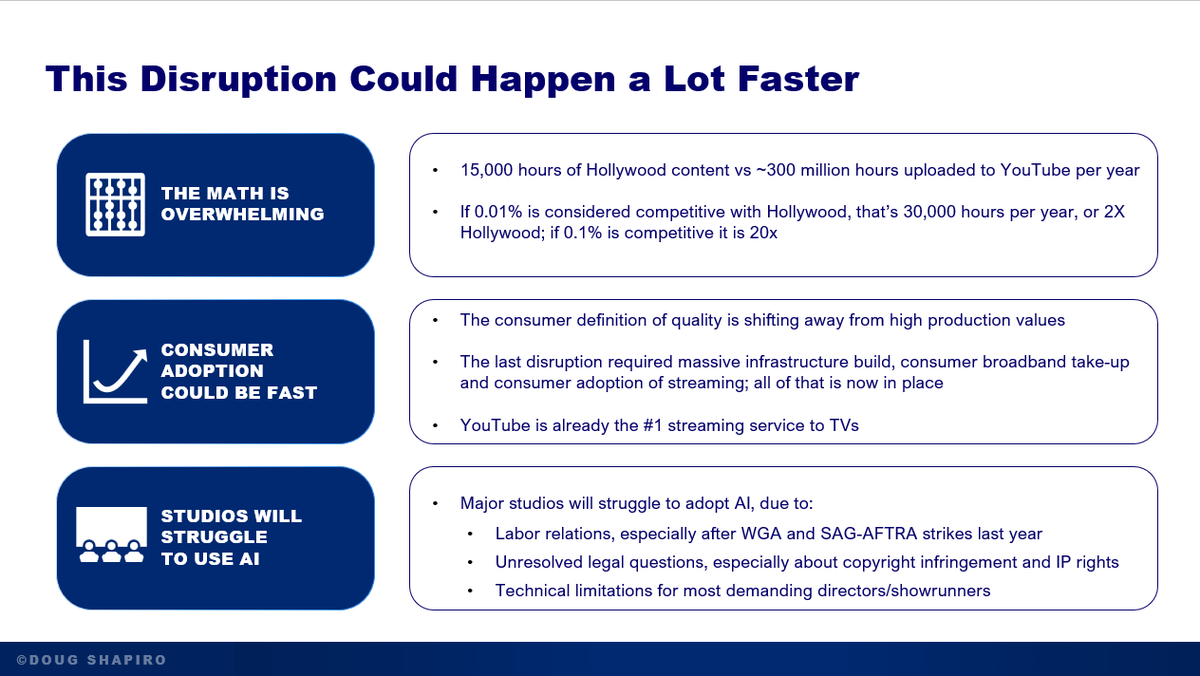
Day 27: Why the disruption of video content creation could happen much faster than video distribution
Internet scale means that a very small % of creator content needs to be considered competitive to upend the supply-demand dynamic
The disruption of distribution required a massive lift (like trenches, fiber and cell sites), but that's now in place
And incumbents will be hard pressed to respond
@VanFalk_ I think about this a lot too.
it’s a massive blind spot for most incumbents - they get anchored to a definition of quality and don’t believe it when consumers’ definition changes