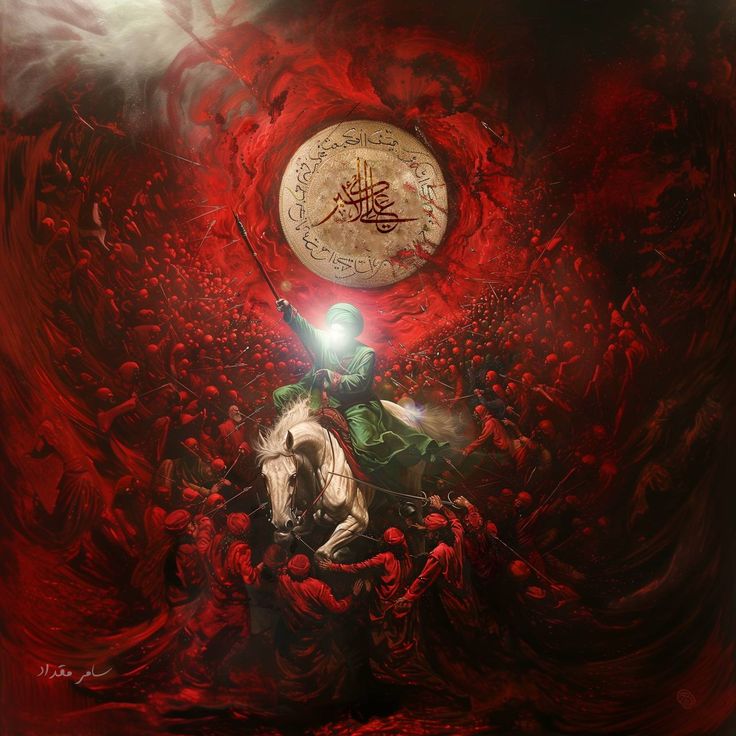
The definition of Wafa: Reaching the Euphrates after defeating an entire army, filling the Mashk-e-Sakina, but refusing to drink a single drop because the children were thirsty. 💔
Imam Hussain (AS) said:
“O my sister Zaynab, bring me a worn-out garment so that I may wear it beneath my clothes.”
Yet after his martyrdom, even that old garment was taken and looted.
📚 Al-Luhuf by Sayyid Ibn Tawus, p. 169
Edward Gibbon - _Decline and Fall of the Roman Empire_, Vol 5, Ch 51*
“In a distant age and climate, the tragic scene of the death of Hussein will awaken the sympathy of the coldest reader.”
Labbaika Yaa Hussein 💔🏴🚩🐫
Sir Francis Younghusband, British writer.
“If Hussein had failed to sacrifice his life, then history would be different today.”
He’s saying Karbala wasn’t just a tragedy. It was a hinge point. If Hussein had accepted Yazid’s rule, de whole of Islam + Shia idntity will b diffnt
*Annie Besant* - British theosophist/social reformer: “The best lesson which we get from the tragedy of Karbala is that Hussein... was a martyr to the highest principles.”
*Thomas Carlyle* - Scottish historian: Used figures like Hussein to illustrate his “Hero and Hero-Worship”
*Charles Dickens*: In _The Life of Our Lord_, he wrote about Hussein’s sacrifice at Karbala, praising his refusal to compromise with a corrupt ruler even at cost of his life.
Labbaika Yaa Hussein(as)🚩🏴🐫
When the crescent moon of Muharram appears, the angels spread out the torn and blood-stained shirt of Imam Hussainع in the skies,and we view it with our hearts.
— Imam Ja'far al-Sadiqع
PUBLIC OFFICE, PUBLIC TRUST
I support recognising public officials who perform their duties well and make a meaningful difference in the lives of Ghanaians. Public service demands sacrifice, commitment, and leadership. When public officials deliver exceptional results, we should acknowledge and celebrate their contributions.
However, I am concerned about the standards that govern such recognition.
Citizens place confidence in government when public officials act with integrity and exercise sound judgement. For this reason, we must address not only actual conflicts of interest but also situations that create the perception of impropriety.
The current debate surrounding the Ghana Ministers of State Excellence Awards is not simply about those who attended the event or those who received awards. Rather, we should ask a more important question: should public officials receive awards from events that solicit sponsorships or financial contributions from the institutions they supervise or lead? This is an ethical question that must be settled.
Public officials should be recognised on the basis of performance, measurable outcomes, and genuine impact. Public recognition should never be linked, directly or indirectly, to financial contributions. When organisers seek sponsorship from institutions and subsequently honour officials from those same institutions, they create legitimate concerns about fairness, independence, and credibility. Even where no wrongdoing has occurred, such arrangements can weaken public trust and diminish the value of genuine excellence.
Professor Michael Kpessah-White has publicly alleged that organisers requested payment in connection with an award nomination. Another public sector Chief Executive Officer privately shared a similar experience with me and chose not to participate in the event after organisers made financial demands. These allegations raise serious concerns and warrant careful scrutiny.
I also wish to correct a few misconceptions.
First, the State did not organise these awards. They were organised by a private event management company.
Second, this was not the inaugural edition of the awards. Public officials under the previous administration also participated in and sponsored these events. However, we cannot justify a practice simply because others engaged in it before us. We criticised many of these practices in the past because we believed they weakened accountability and encouraged mediocrity. We should not defend them today.
Ghanaians elected this government on a promise of reform. They expect us to uphold higher standards, strengthen public institutions, and demonstrate a clear departure from practices that undermine public confidence. We cannot advance a Reset Agenda while tolerating conduct that raises avoidable ethical concerns.
Following my engagement with the Deputy Chief of Staff, Hon. Nana Oye Bampoe Addo, she assured me that the government would develop a regulatory framework to guide the Corporate Social Responsibility activities of State-Owned Enterprises. I understand that the committee responsible for this work has already commenced its task. I welcome this initiative and hope it delivers clear standards that promote transparency, accountability, and good governance.
We hold public office in trust for the people of Ghana. We must therefore conduct ourselves in ways that strengthen public confidence in our institutions. We should recognise excellence on merit, reward performance fairly, and reject practices that cast doubt on the integrity of public service.
Ghanaians will judge the Reset Agenda not by our rhetoric but by the policies we implement and the standards we uphold. If we are to build lasting public trust, we must lead by example and hold ourselves to the same principles we demanded of those who came before us.
I conclude by saying; MAY WE NOT BECOME WHAT WE CRITICIZED !!!!
#BuiltToLast
#GhanaFirst
Hon. Don’t be surprise the guy that said you’re ‘small mind’ is unemployed graduate. Some of the unemployed youth are those supporting this useless thing!