Bitcoin and its associated L2s/sidechains have been seeing significant activity recently 🛠️
There's a ton happening in these ecosystems, especially surrounding Ordinals and scaling/expanding Bitcoin
With BTC Connect @ParticleNtwrk on the horizon, let's quickly dive into the Bitcoin developer ecosystem 👇
📊 As shown within the prior image, there are a considerable number of active developers within the BTC ecosystem.
The approximate number of recent unique committers indexed on GitHub as indicated through in-code identifiers, are as follows:
- @Bitcoin (native): 843+
- @Stacks: 232+
- @rootstock_io: 360+
- @MapProtocol: 109+
(the true numbers are larger due to the restricted data set)
This activity only seems to be growing as more developers, organizations, and users realize the potential of Bitcoin.
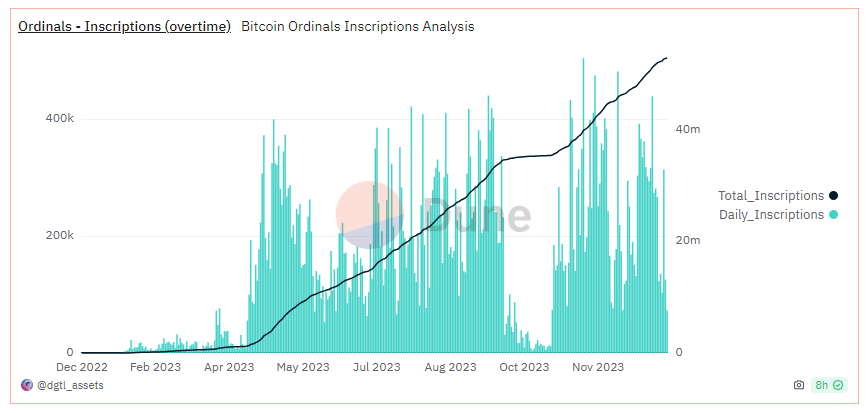
Much of this potential lies within BRC-20 and Ordinals (inscriptions) alongside the utilization of smart contract capabilities through Bitcoin Layer-2s and sidechains, thus unlocking a significant degree of possibility in terms of applications and on-chain assets.
On both sides, from the emergence of inscriptions on Bitcoin to the utilization of associated Layer-2s and sidechains, it's no wonder the Bitcoin ecosystem has seen the growth (and the potential) that it has.
1️⃣ BRC20 & Ordinals
Given Bitcoin's lack of native smart contract support, inscriptions have quickly grown as an alternative in spinning up FTs and NFTs directly on Bitcoin.
This is done through inscribing specialized metadata onto individual satoshis (sats), where the satoshi carries the value/content of the inscribed data rather than its original "blank," or rather low value. Ordinal numbers are essentially just stable identifiers assigned to specific satoshis, allowing for the tracking/transferring of individual (inscribed) sats.
Thus, through inscriptions, tokens (alongside the assignment of general data) are possible natively on Bitcoin.
2️⃣ Bitcoin Layer-2s & Sidechains
Additionally, in an effort to further expand the Bitcoin ecosystem outside of the native chain (which has limitations of course, even with the utilization of inscriptions/ordinals) solutions such as @BTClayer2, @Stacks, @MapProtocol, and @rootstock_io come into play, expanding Bitcoin past its native limitations and enabling modern functionalities, such as smart contracts, while lowering the barrier-to-entry for users or developers interested in the Bitcoin ecosystem through significantly lower fees and quicker transaction times.
For the EVM-compatible blockchains among these Layer-2s, one component can significantly increase developer and user experience:
Account Abstraction
AA (ERC-4337 AA specifically) introduces an entirely new level of account flexibility, thus allowing developers to craft targeted, user-friendly experiences.
At @ParticleNtwrk, we aim to meet this need with BTC Connect, ushering in the next stage of consumer-ready applications within the Bitcoin ecosystem, we're expanding our AA infrastructure (and a custom BTC-specific modal) to various Bitcoin Layer-2s, such as:
- @BsquaredNetwork
- @BTClayer2
- @MapProtocol
etc.
But that's not all.
In addition to this infrastructural expansion, BTC Connect will allow all existing wallets on Bitcoin to control smart accounts on Bitcoin Layer-2s (such as the blockchains listed above).
As Bitcoin (and its Layer-2s) continue to grow in developer and user adoption, the need for strong developer tooling and infrastructure also grows, thus we're committed to supporting the Bitcoin ecosystem (through BTC Connect) in building consumer-ready applications with highly flexible account and wallet infrastructure.
More information on this soon 👀