@anotherglassbox It’s city-wide. Dog owners are letting their dogs destroy the on-leash areas in High Park. Digging up the native plantings with their nails and chasing wildlife. I love dogs so much, but a lot of dog owners suck
You can steal the statue but you can’t steal the spirit of what the statue represents! Disheartening end to the stolen Jackie Robinson statue has generated a Robinson-like resolve from the public for good to overcome evil! @MLB@Royals@NLBMuseumKC RT
https://t.co/Q3pY7Ws4OH
@erikawybourn@MayorOliviaChow As a coach, parent of athletic kids, and fan, it kills me to see Mayor Chow supporting a toxic sports culture. Rob Ford is not a good role model for our children. Naming a venue after him weakens the work that many are doing to make positive change in sports culture.
12 Reasons Why Cities Need More Trees:
1. Temperature Control
One large tree is equivalent to 10 air conditioning units, and the shade they provide can reduce street temperature by more than 30%.
2. Noise Reduction
Trees can reduce loudness by up to 50%. In urban areas filled with the sound of cars, construction, sirens, aeroplanes, and music, trees are essentially the best way to block noise and keep cities — along with the homes and workplaces in them — quieter.
3. Air Purity
Trees remove an astonishing amount of harmful pollutants and toxins from the air. In urban areas air quality is often disastrously bad — with severe consequences for our health. Trees make the air we breathe much cleaner.
4. Oxygen
And, while absorbing all those pollutants, trees also put more oxygen back into the urban environment. Oxygen levels are significantly lower in cities compared to the countryside; trees help to solve that problem.
5. Water Management
Trees do more than just shelter us and our buildings from rain — which is, in fact, extremely important. They also absorb huge quantities of water, reduce run-off, neutralise the severity of flooding, and make flooding more unlikely altogether. Not to forget that their roots absorb pollutants and prevent them from feeding back into a city's water supply.
6. Psychological Health
Studies have proven what we instinctively know to be true: that human beings are significantly happier when surrounded by nature rather than sterile urban environments. Our emotions, behaviour, and thoughts are shaped by the places we spend time — and trees have a profoundly positive effect on our psychology. The consequential benefits of being happier and more peaceful — as individuals and as a society — are immense.
7. Physical Health
Beyond all the other ways in which trees improve air quality and the urban environment, much to the benefit of our health, they also encourage people to go outside. Cycling, running, and walking are all more common in urban areas with plenty of trees. A knock-on effect of people spending more time outdoors is also social integration and stronger communities.
8. Privacy
A simple point, but not inconsequential, is that trees provide privacy.
9. Economics
The total economic benefit of urban trees is hard to calculate. There are costs, of course, including the repair of infrastructure damaged by roots and maintaining the trees themselves. But the total economic benefit — a consequence of everything else in this list and more — far outweighs the expenditure. Trees make cities wealthier.
10. Wildlife
Trees are miniature cities all of their own, serving as a habitat for hundreds of different species, including birds and mammals and insects.
11. Light Pollution
Trees don't only block the light shining down, therefore keeping us and our cities cooler — they also disrupt light shining up, from street lighting, cars, houses, and billboards. Skies are clearer in cities with more trees.
12. Aesthetics
And, finally, trees are beautiful. They break up the potential monotony of urban environments — the sharp geometry, the greyscale roads and buildings, the endless rows of cars — with their trunks, boughs, canopies, and flowers.
Just think: the gold and red of falling leaves in autumn, the white and pink blossom of spring, the vast green canopies of summer, and the branches lined with hoar-frost in winter. Every single tree is a myriad of intricacy and texture, of colour and scent, of dappled light on the pavement, mottled bark, knotted roots, of clustered leaves and delicate petals and stern boughs.
Few streets would not be improved by the kaleidoscopic aesthetic delights of a tree, not to mention the many different species of tree, all over the world, whether willow, oak, lime, cherry, aspen, maple, birch, horse chestnut, dogwood, hornbeam, ash, sycamore... the list goes on.
There are some drawbacks to urban trees, most of them context-specific, and they are not — of course — universally appropriate. But it seems fair to say that many cities would benefit from at least a few more trees here and there.
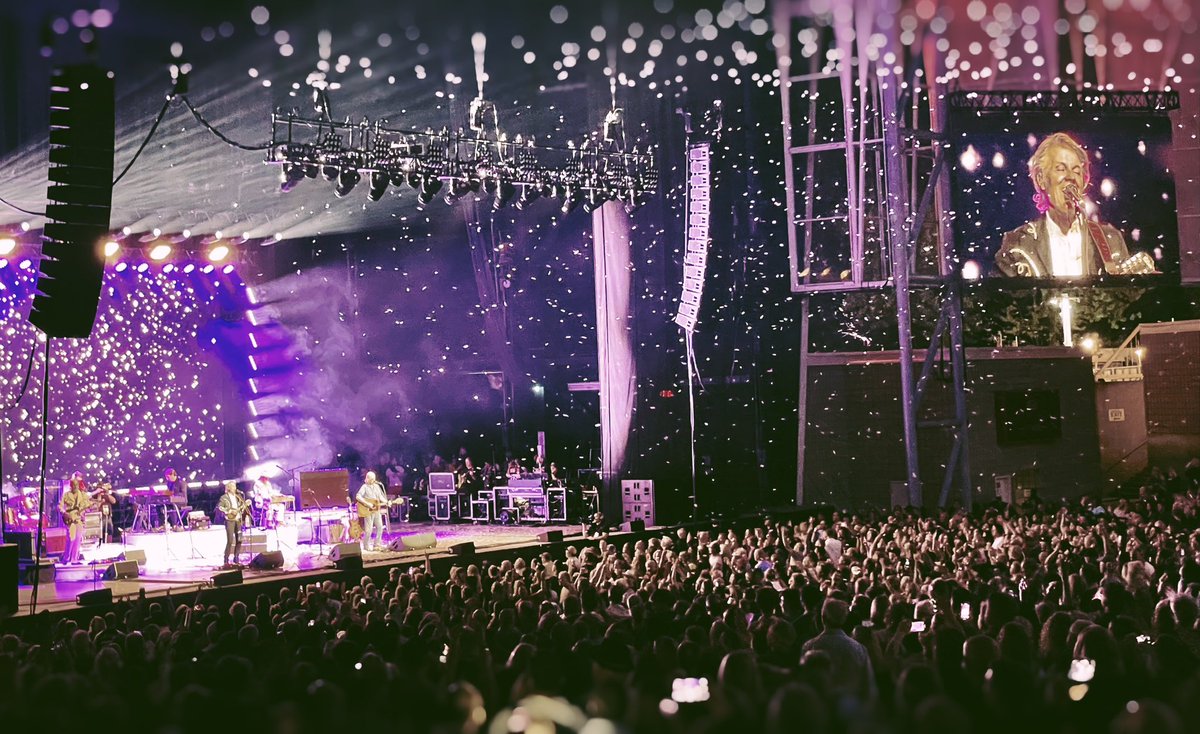
On the outskirts of summer where land meets lake, a perfect Toronto evening with Blue Rodeo. The lights of the CNE across the boulevard, a soft breeze over the water, lost together, strange and beautiful
I put my brain in neutral, was transported, and left feeling lighter. I mean—sitting inside a volcano seems like art for our times. Gets better with each repeat of its loop. If you’re a Sigur Rós fan, you’ll adore it, but it closes tomorrow. At the AGO: https://t.co/0Qh6WaHE88
Spent 2 hrs w/ this gorgeous sound installation, Hrafntinna (Obsidian) by Jónsi, yesterday. 16-channels of sound through a circular arrangement of 195 speakers. Evokes the sensation of being inside a volcano with reverberation, scent, sound, & lighting. https://t.co/gaiaXCG5fx