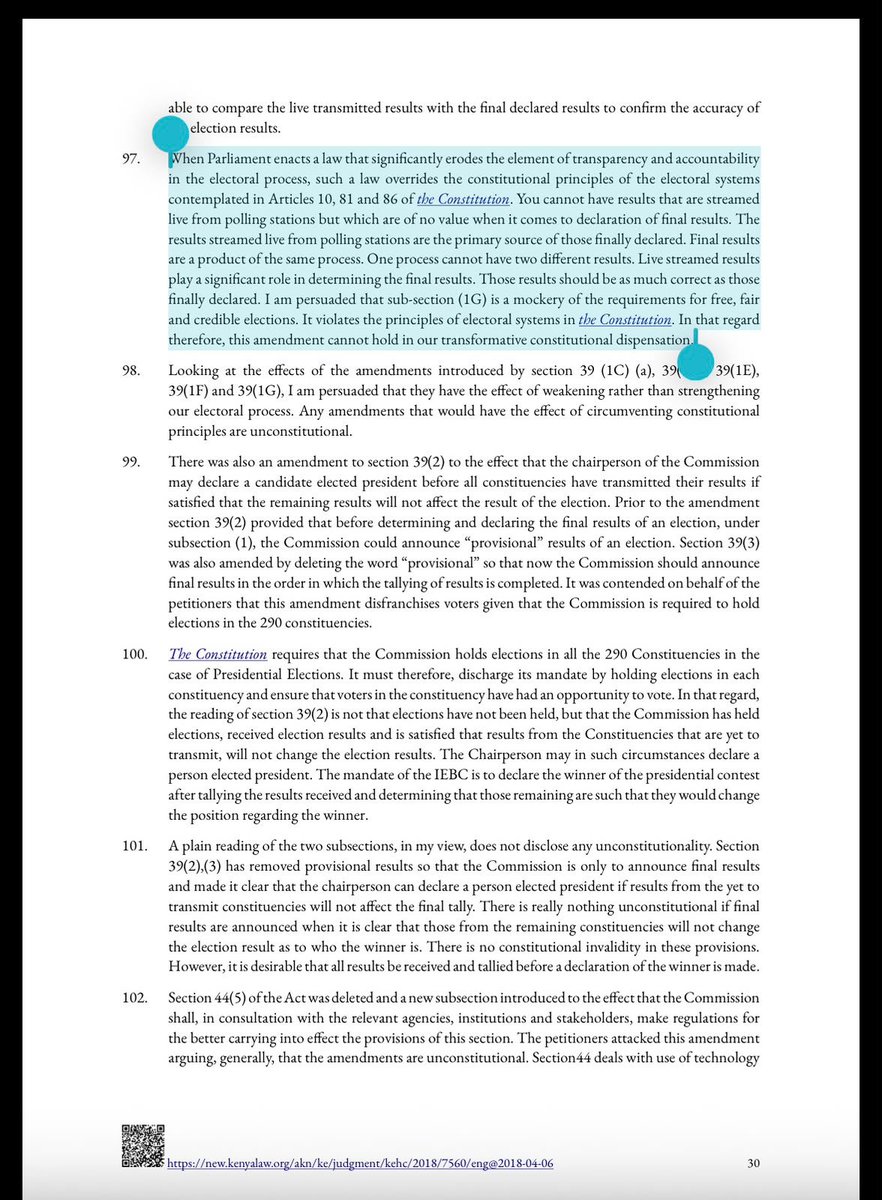
If they can tamper with electoral laws in the Constitution, what makes you think term limits will be untouchable? We may be witnessing the making of an M7 in Kenya. The warning signs should not be ignored!
Kenyans deserve to see how their votes become election results and not simply be told whom to trust. On 22 October 2026, the National Assembly passed the Elections (Amendment) (No. 2) Bill, 2024. Parliament must now publish the approved text and account for its implications for electoral transparency.
In the published Bill, Clause 22 replaces section 39 without expressly requiring livestreaming of results announced at polling stations, while retaining electronic transmission and online publication of results forms. That is not a ban on livestreaming. But sending results to election officials and allowing citizens to watch their announcement serve different purposes. Parliament must clarify whether this omission survived the amendments MPs approved.
The court history cannot be ignored. On 6 April 2018, in Katiba Institute v Attorney General, the High Court invalidated section 39(1G), which required livestreaming but confined streamed results to public information and excluded them as a basis for declaration. The Court rejected that restriction for undermining electoral transparency and accountability. It did not prohibit livestreaming. The Court of Appeal upheld the invalidation on 6 October 2023 in National Assembly v Katiba Institute. The legislative task is therefore to enact a constitutionally sound obligation and not present an already-invalidated provision as an effective safeguard.
Article 86 requires a transparent, verifiable and accountable electoral system, prompt polling-station announcements, and open, accurate collation. Ahead of 2027, Parliament should expressly secure public access to live results announcements, and the IEBC must explain how citizens will follow and scrutinise the process. Electoral reform should make every vote easier to verify, not leave transparency dependent on institutional discretion. The ballot is secret but the count must be open.
Fellow Kenyans, the Constitution is clear.
The electoral system must be “accurate, verifiable, secure, accountable and transparent”
No law is superior than our Katiba.
I will work with the People’s Coalition for Electoral Reforms @Reforms_Ke to thwart any efforts to return us to the dark era of ECK or the post election violence of 2007/08.
Between USAID and this Microsoft thing, lots of highly skilled Kenyans have lost their jobs.
If we decide to build state capacity as Estonia advised instead of outsourcing work to consultants, we can get to India levels where government bodies are winning contracts with Dangote.
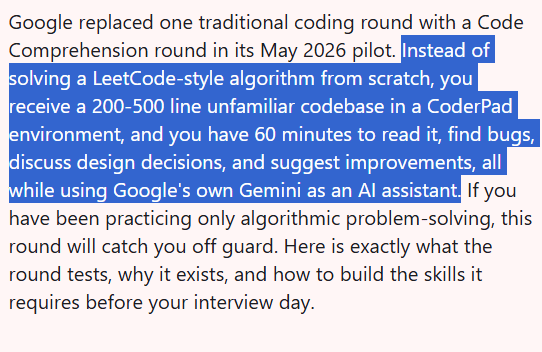
Goodbye to LeetCode? Google just updated its interview process. AI is now a part of it.
They have introduced a new round called Code Comprehension.
The idea behind this round is to drop the candidates into a 200-500-line codebase with Gemini available for use.
This round evaluates:
- Can you read someone else's code
- Are you able to debug independently before utilizing AI
- Can you catch when Gemini is wrong
It is untenable for Kenyans to shoulder a 1.5% Housing Levy, 2.75% SHIF contribution, 6% NSSF contribution and PAYE that can reach 35% while still facing exorbitant school fees, soaring rents, high fuel prices and endless medical fundraisers.
If citizens are taxed more but must continue paying privately for basic services, then the fundamental question is: what exactly are their taxes delivering?
Taxation must translate into tangible public services, not simply a heavier burden on working families.
OPPORTUNITY‼️: @nvidia will give your AI startup free training, cloud credits, and VC intros. No VC funding required, no equity, no deadline.
This is NVIDIA Inception program.
What you get:
- free technical courses and workshops
- latest SDKs, model libraries, platforms
- cloud credits from NVIDIA & partners
- preferred pricing on NVIDIA hardware
- investor exposure on Capital Connect
- GTM support and co-branded content
Who qualifies: at least one developer, a working website, officially incorporated, under 10 years old. Revenue not required.
No fees, no deadlines, no cohorts. Rolling applications.
🖇️Apply → https://t.co/QEAENI3YSw
P.S. We are building the data room that reads like a story, not a folder dump. Start yours free → https://t.co/RgOL0J0SiD
We're publishing our most detailed threat intelligence report to date.
It covers how people tried to misuse Claude—for cyberattacks, influence operations, surveillance, biology, and building weapons—and how we found and stopped them.
We disrupted every operation in the report, and used the lessons from them to strengthen our safeguards. Where appropriate, we also shared what we found with authorities and other AI companies.
These cases are not typical: we’re highlighting some of the most sophisticated misuse we’ve seen. But they’re especially important to discuss, because they show us where AI misuse is headed, where our safeguards work, and where they need to improve.
We’re publishing this report so others can spot the same activity on their own platforms, and so we can give the public a clearer view of how emerging threats develop.
Read the report: https://t.co/0EJUnYEgfz
William Ruto scored several own goals today.
First, he is presented as listening to a child who, on a normal weekday, should be in school but instead is attending a political rally dressed in a UDA outfit.
That should not be celebrated. It should concern us.
If a school-going child is at a political rally in the middle of a school day, what does that say about the state of our education system?
Education is a constitutional right, and the responsibility of government is to ensure that children are in school, learning in safe environments, regardless of their parents’ financial circumstances.
A President should be asking why that child is not in class, not turning the situation into a political moment.
And the problems raised are what the majority of Kenyans are facing. A ‘blessing’ we can thank his regime for.
Then comes the issue of healthcare.
The President pledges KSh2 million to facilitate the treatment of a sick Kenyan who has been brought to meet him in Bomet.
And you have to ask:
Kwani SHA hudo?
Hasn't this government repeatedly told Kenyans that the SHA/SHIF is the solution to the country's healthcare problems? Haven't we been told that under SHA, Kenyans should no longer be forced into financial ruin simply because they fall sick?
If a sick Kenyan has to be physically brought before the President for a personal pledge of KSh2 million before they can access treatment, then we have to ask some uncomfortable questions about whether the system is actually working.
A President should not have to become a personal medical fundraiser for Kenyans.
Government is not supposed to operate on presidential generosity. It is supposed to operate through functional institutions, policies and systems that serve citizens whether the President knows them personally or not.
This is the fundamental problem with politics built around handouts and personal intervention.
One Kenyan gets KSh2 million because their story reaches the President. What about the thousands of other sick Kenyans whose stories never reach State House, a political rally, or a presidential podium?
One child gets heard because they happen to be standing in front of the President. What about millions of children who simply need functioning schools, affordable education and a government that takes their future seriously?
We must stop confusing presidential generosity with good governance.
Good governance is when the system works without requiring a citizen to meet the President personally.
If SHA works, a sick Kenyan should receive the care they are entitled to without needing the President to personally intervene.
If the education system works, a child should be in school on a weekday instead of being at a political rally.
These are not merely isolated incidents. They expose a bigger question about the state of our institutions.
Kenya does not need a President who personally solves a few individual problems in front of cameras.
Kenya needs a government that builds systems capable of solving those problems for millions of people without presidential intervention.
That is the difference between charity and governance.
And today, William Ruto scored several own goals by inadvertently reminding Kenyans just how far we still are from a government where the systems actually work.
This guy built an entire interactive children’s book with Fable 5.1.
it reads the story out loud, the illustrations have 3D layers, and the words actually animate as the story goes.
all from a prompt.
and the fact that you can then reuse it as a template and make more books like this is kinda insane.
Apply for the Institute for AI Policy and Strategy (IAPS) Policy Fellowship Spring 2027
The IAPS AI Policy Fellowship is a fully funded, three-month program for professionals from varied backgrounds seeking to strengthen practical policy skills for securing a positive future in a world with powerful AI.
Dates: February 22 to May 14, 2027
Location: Washington D.C., London, or Remote
P.S: Applicants may choose to do the Fellowship in-person at our DC or London hubs, or remotely.
Financial Support: Senior Fellows will receive $24,000 and Fellows $18,000 as a stipend to work full-time during the three-month program.
P.S: Fellows on the DC or London track will also receive an additional $3,000 stipend.
Deadline: September 27, 2026.
https://t.co/RGuamJ6Ntg
If you’re easily incited to hate on fellow Africans, you also can be easily turned against your own neighbors, communities and tribes.
Politics of division doesn’t start and end with tribalism.