Assistant Prof and Resource Economist, Dept. of Agribusiness and Agricultural Economics, University of Manitoba. All posts are my own. Pronouns: he/him/his.
When Canadian universities unionized, it raised faculty salaries and compressed their distribution by lifting the lowest salaries, say researchers at @econuoft, @BerkeleyHaas, and @MemorialU. #Chart https://t.co/tPY4K5DzT4
I have often heard academics say something like, "in the AI era, simply being hyper-productive is no longer a useful signal. It's all going to be about the quality of the ideas now."
I think there's a nugget of truth there.
However, this take is, ultimately, incomplete. Finishing high quality research projects is still a very important learned human skill!
Our paper “Difference-in-Differences Designs: A Practitioner’s Guide” is now published in the Journal of Economic Literature. It took us a while but we are happy!
We put together a lot of material to make the paper useful in practice: https://t.co/30TbAgihlz
Hope you like!
I stumbled across a version of this during the sampling process for my job-market paper in Malawi. One sampled “village” was really an incredibly dense peri-urban slum. The census counts were off by a factor of 5. They just skipped tons of people.
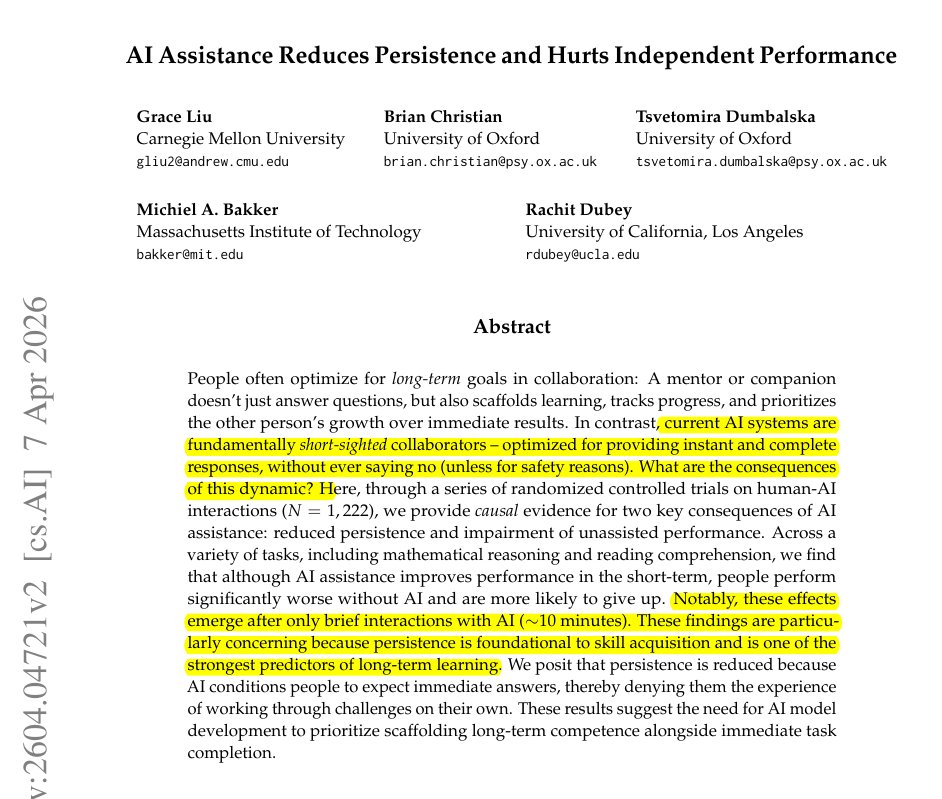
BIG claim from new MIT + Oxford + Carnegie Mellon and other top labs paper:
AI can boost performance at first and then leave people less able to think through problems on their own.
Just minutes of AI help can improve scores now while weakening independent problem-solving right after.
The interesting part is that the damage is not just lower accuracy.
It is lower persistence, which is usually the hidden engine of learning, because skill grows through repeated contact with difficulty, not just exposure to correct answers.
That's why a good teacher sometimes withholds help to preserve struggle as part of the lesson, while today’s chatbots are tuned to erase friction on demand.
Across 3 experiments in math and reading, about 1.2K people either worked alone or used a GPT-5-based assistant for part of the task.
Assisted users finished early questions faster, but after roughly 10 minutes without AI, they solved less, stalled more, and quit sooner.
That happens because hard thinking is not only about getting answers; it is also about building the habit of holding a problem in mind, testing steps, and pushing through confusion.
The sharpest drop came from people who used the model for direct answers, not from those who used it more like a hint system, which suggests the real issue is not AI exposure itself but replacing effort with completion.
The result is not that AI makes people less capable by default, but that answer outsourcing can shrink the mental effort that normally trains skill.
----
Paper Link – arxiv. org/abs/2604.04721
Paper Title: "AI Assistance Reduces Persistence and Hurts Independent Performance"
A standard tenure package request to #econtwitter:
If you taught any of my papers in your graduate or undergraduate course, could you please email me the syllabus at k.[lastname] at berkeley[dot]edu?
Forthcoming in the AER: "Labor Market Power, Self-Employment, and Development" by Francesco Amodio, Pamela Medina, and Monica Morlacco. https://t.co/hJT7NFNbqC
🐦 Just accepted 🐦 in @JaereAere:
"Infrastructure, Institutions, and the Conservation of Biodiversity in India" by Raahil Madhok (@raamadhok)
Read it here: https://t.co/Ff2gbTw1Yy
The working paper for the Many-Economists project, which got a lot of juice from this very platform, is available! The Sources of Researcher Variation in Economics looks into researcher degrees of freedom and tries to isolate which ones are important. Data cleaning!
Today the propaganda currency seems to be to cite some data from a survey that buttresses your point.
Yet, nearly everything I see today has this flavor in some form. Always ask about sample construction!
At the top of my research page (https://t.co/bHnCh34cAo), I have a "The latest five" section which I update with the most recent papers, and today this chapter I wrote on my advisor/mentor/friend Michael Kremer dropped off it and I just wanted to share it. https://t.co/u9Z5Mw5D5S
📣 Attending the EEA Conference? Join us this Sat. (2/22, 4pm) at the AERE panel: "Advancing Pedagogy in Environmental & Natural Resource Economics."
Panelists will explore strategies for engaging students in env. & natural resource econ & share teaching methods.
See you there!
📣 Apply to be AERE's Social Media Manager!
AERE is looking for a graduate student to manage our social media channels. Please spread the word to graduate students who may be interested!
Apps due March 15th: https://t.co/Wnptfy97NB
Increased news coverage of immigration in France pushed people with moderate views toward more extreme positions, says @sschneiderstraw of @UofEBusiness. We spoke with her about how the media polarizes viewers. #ResearchHighlight https://t.co/xT06O2SKDp
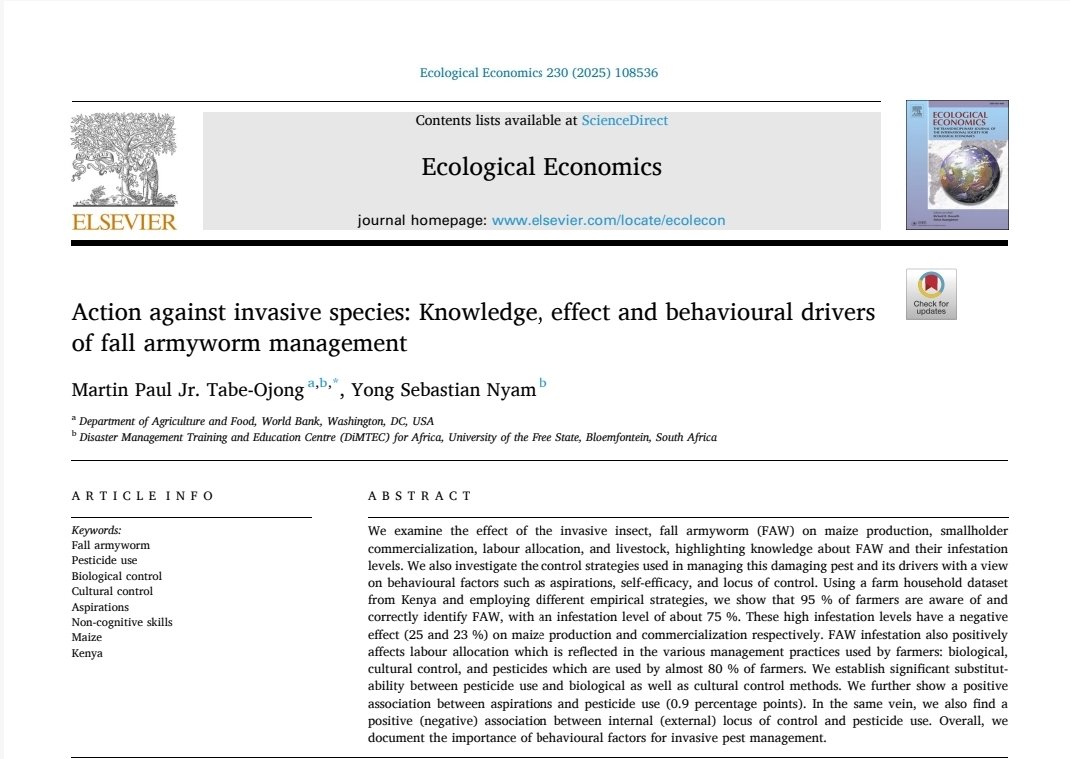
📊 In this paper, we show that the invasive insect, fall armyworm reduces maize production and commercialization. Farmers use biological, cultural and chemical methods to control the pest. Use of these are driven by behavioral factors such as aspirations & locus of control...
1/ Today's @FarmPolicy News Summary covers how the Ogallala #Aquifer, situated beneath the #Plains, saw anywhere from a half-foot decline to a 1.52-foot decline across western #Kansas in 2024.
https://t.co/kCB516vdSc