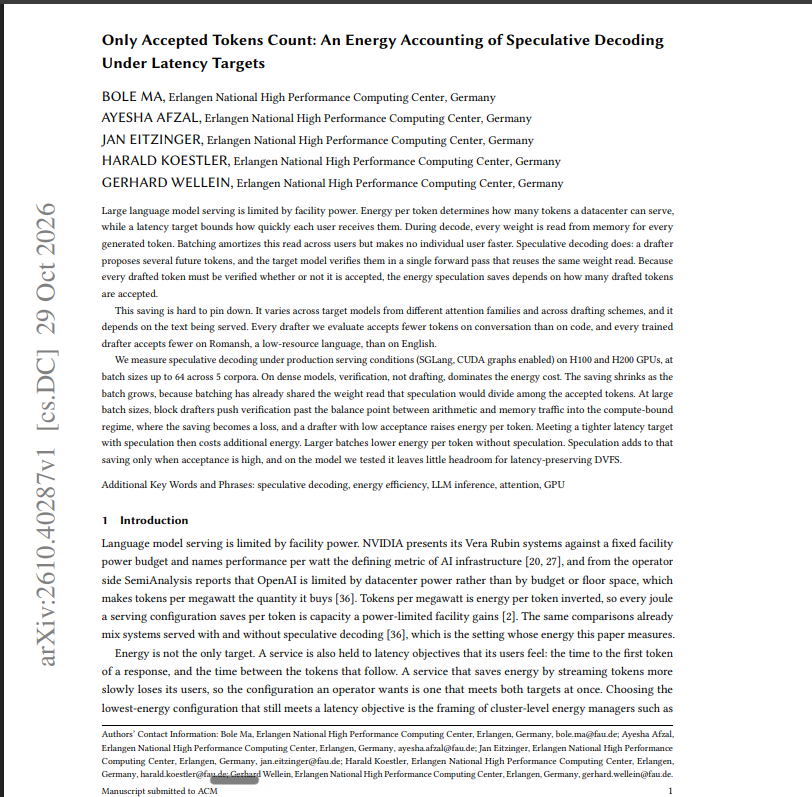
The AI speed trick (Speculative Decoding) saves 54% energy for one user, then the crowd shows up, and it turns into a token eater.
Read what happened when researchers at Erlangen (Germany) tested “speculative decoding” on 11 models: https://t.co/um7DOtIAtB
MIT OpenCourseWare has changed the lives of learners and educators around the globe. 🌏
*A student in Uganda gains access to a world-class education.
*A learner in Ukraine finds community during wartime.
*A community college instructor inspires his students.
This is the real story of how MIT's bold decision to share learning materials for free has created a ripple effect across 190+ countries. Watch now on YouTube:🔗 https://t.co/3AuxidpIcl
A paper that stays in a PDF makes very few decisions. Translating research into plain words is its own job.
@MiettinenTopi@ToreEllingsen1, you keep researching, and we handle the explaining.
https://t.co/eYYSE5YaSI
6 hours with Claude...
That's all it took to release a new @VizmayaFyi Story format.
Read the "freshest" story format in the game here: https://t.co/twFXoLDRbm
Hour 7 of course: 14.13(psychology and economics) @MITOCW
Most people treat small everyday risks with the same intense fear as giant, life-altering disasters. Stop paying money to protect yourself against small, manageable risks. Insure only against financial catastrophe.
Fuck it. I'm locking myself and won't come out until I complete 14.13 psychology and economics by @MITOCW.
Will update the progress every hour!
Stay tuned!
Hour 7 of course: 14.13(psychology and economics) @MITOCW
Most people treat small everyday risks with the same intense fear as giant, life-altering disasters. Stop paying money to protect yourself against small, manageable risks. Insure only against financial catastrophe.
Hour 6 of course: 14.13(psychology and economics) @MITOCW
The study on low-income rickshaw drivers in Chennai, India, showed that many workers voluntarily sacrificed income to adopt commitment devices enforcing daytime sobriety, which successfully increased daytime soberness.
Hour 6 of course: 14.13(psychology and economics) @MITOCW
The study on low-income rickshaw drivers in Chennai, India, showed that many workers voluntarily sacrificed income to adopt commitment devices enforcing daytime sobriety, which successfully increased daytime soberness.
Hour 5 of course: 14.13(psychology and economics) @MITOCW
We know we need rules to keep ourselves on track, but we are too easy on ourselves when we set those rules.
P.S. - Woke up at 4 AM to finish this lecture
Hour 5 of course: 14.13(psychology and economics) @MITOCW
We know we need rules to keep ourselves on track, but we are too easy on ourselves when we set those rules.
P.S. - Woke up at 4 AM to finish this lecture
Hour 4 of course: 14.13(psychology and economics) @MITOCW
By forcing your future self into a restricted set of options, you neutralize both...
- Naive procrastination (delaying hard work indefinitely)
- Sophisticated surrender (giving in to temptation early)
Hour 4 of course: 14.13(psychology and economics) @MITOCW
By forcing your future self into a restricted set of options, you neutralize both...
- Naive procrastination (delaying hard work indefinitely)
- Sophisticated surrender (giving in to temptation early)
Hour 3 of course: 14.13 @MITOCW
A naïve person convince themselves that tomorrow they will be disciplined. However, when "tomorrow" becomes "today," present bias takes over again.
Sophisticated individuals know their future self cannot be trusted; they do not rely on willpower