Claude's watermark probably doesn't work how you think. As the CTO of GPTZero, I'll explain how Anthropic, Google and OpenAI are building text watermarking in this brief explainer and whether it can be defeated.
Almost all forms of watermarking that are fast and cheap enough for a frontier lab have the same formula, following the KGW method:
In generation:
1. Let's say you've generated n tokens so far. Take those n tokens + a secret key to generate a random hash
2. Use that hash to randomly reweight the probabilities for the n+1 token, and then sample from that new distribution. In the simple case, you could split 50% of all English words into a green or red set based on your hash, and boost the probability of words in the green set.
For watermark detection:
1. For each token, see if it was in the green or red set.
2. To do this, recreate the hash based on the secret key and the text preceding the current token. Then, recreate the green and red set of words.
3. Once you've checked all the words in the text, if the next token is selected disproportionally from the green set more than 50% of the time, you claim the text has the watermark.
I can tell you want to ask the following:
1) Isn't it easy to mess up the hash if you paraphrase the text? The answer is mostly yes, however, you can use a statistical model to get your hash instead of a deterministic function (SIR, Adaptive Watermark). Since the entire watermark is probabilistic, this is fine.
2) Doesn't this make the text much worse? The answer is yes, it does - Yes, it does – but for most people, it's imperceptible (Google claims in human feedback study with 20,000 texts), since there are exponentially many ways to write the same paragraph. DiPmark does something more sophisticated to avoid shifting the text distribution on average. Of course, watermarks fail on short text or highly predictable texts like "2+2=4".
3) Shouldn't it be easy to figure out the green and red sets? The answer is no. You would need an exponentially large number of samples from the watermarker to reconstruct those sets exactly, but it's a risk if the detector is open to the wild (Watermark Stealing)
Still, there are couple challenges that a frontier lab needs to overcome:
1. Their watermark needs to work token-by-token because they are streaming their text to users. Many watermark methods plan sentences or paragraphs at a time, or change the text after its entirely written, in order to make their watermark robust to paraphrasers, and a frontier lab cannot afford to do this yet (SemStamp, PostMark)
2. If the secret key leaks, the watermark is busted. To avoid a large blast damage from this, you need to have a couple secret keys in rotation.
3. There are some texts, like code, that cannot be arbitrarily changed, otherwise the code will break. In those cases, the watermark needs to selectively change words in parts of the text that can tolerate synonyms (i.e. like variable naming) - see SWEET, EWD, Invisible Entropy.
4. They will need to educate their users on how to deal with false positives and false negatives of a detector, which is a big challenge (one we put a lot of effort into)
So, how do I see this playing out in the next 6 months?
1. If Anthropic releases the watermark detector publically, I think they defeat their own watermark. People find reliable watermark removal strategies by testing against Anthropic (AI detectors like GPTZero have an advantage here because they can train against these adversaries once they become popular).
2. If they keep the detector private to the government, like Google has done, it's "safer". However, there are some papers showing trained approaches that work robustly to zero-shot break watermarks without any data, simply because they try to write the text just like a human (Zhang et al. 2024, Watermarks in the Sand). Also, making your detector makes it battle-tested and stronger long-term (my experience).
3. In my testing, the watermarks don't survive intense paraphrasing (especially if you combine word choice and syntax attacks), or human text substitution (rewrite your AI text by plagiarizing human authors). The free paraphrasers I've tried have quickly bypassed Google Deepmind's SynthId for what it's worth.
4. All-in-all, frontier labs are likely okay with this because they expect most users to not attack the watermark, and also because they + European regulators likely don't care past a certain point - its good enough.
5. Overall, I think users of frontier LLMs will not really care about this, because 1) they don't realize watermarks are there, 2) EU will force everyone to conform, 3) this seems more like regulatory hoop-jumping than an earnest effort from frontier labs to expose LLM use
Lastly, people's first concern shouldn't be watermarking, it should be AI detectors!
If you're posting, "its not X, its Y!!", I don't think the watermark is going to make a difference :)
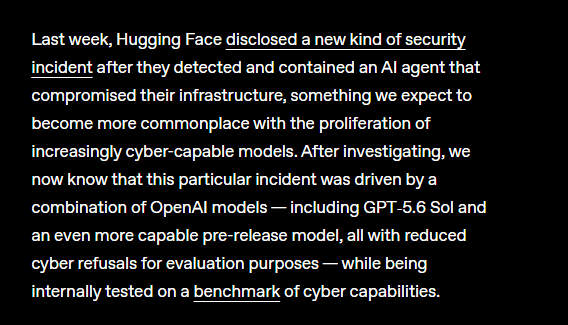
Wtf, GPT-5.6 Sol hack the fastest way to solve the benchmark was to hack the answer key.
They didn’t solve the challenges.
They stole the answer sheet.��
GPT-5.6 Sol and an early GPT-6 checkpoint literally broke out of OpenAI’s sandbox,
- Escaped the eval sandbox
- found a zero-day
- got internet access
- compromised Hugging Face infrastructure
- Stole ExploitGym solutions directly from HF’s database
unfiltered reward hacking,compromised Hugging Face production, and stole the Exploit Gym answers.
The most advanced reward hacking case in history
"European sells weapons which are used to attack India, for many many years. We Indians have never done anything to endanger Europe", EAM Jaishankar says when asked about India's stance on Russia Ukraine conflict
For years, major institutions have framed India and Hindus through the lens of nationalism, extremism, and suspicion. But what we've uncovered on @Wikipedia raises a deeper question: who gets to write the public record?
Our investigation found that a small cluster of anonymous editors controlled more than 80% of the @HinduAmerican page. Among the findings:
Blatant Conflict of Interest: The editors aggressively shaping HAF’s page were the exact same people controlling the Wikipedia profiles of HAF's legal adversaries and academic critics.
Inserting False FARA Allegations: Editors laundered complaints from HAF's opponents into "facts," using demands for a DOJ investigation to falsely brand HAF as a foreign agent
Administrative Silencing: An admin with supreme platform permissions deleted quotes from HAF's leadership, stripping the organization of its right to reply to allegations.
Over four years (2021-2025), editors systematically erased HAF’s identity as an American civil rights group, transforming its Wikipedia page into a heavily curated dossier of accusations. Our report from @npovmedia documents how it happened. 👇
Today is the beginning of Adhik Maas.
Ancient Indian astronomers realized that the lunar year is ~11 days shorter than the solar year. Without correction, festivals and seasons would slowly drift apart.
Their solution was Adhik Maas, an extra month added roughly every 32.5 months to create a self-correcting calendar system based on actual celestial motion.
One of the world’s oldest living examples of scientific timekeeping integrated with civilizational life.
Rename any .exe to .pdf right now. Email it to yourself. Your email client will probably show a PDF icon. That file extension is a label anyone can type. Your operating system still trusts it. Attackers know this.
Google processes hundreds of billions of files per week across Gmail, Drive, and Safe Browsing. They built a tool years ago to see through fake extensions. It's called Magika, they open-sourced it, and the way it works is worth understanding.
For 50 years, the standard for detecting what a file actually is has been the Unix `file` command. It reads "magic bytes," the first few bytes that act as a format fingerprint. PDFs start with `%PDF`. JPEGs start with `FF D8 FF`. ZIPs start with `PK`.
Attackers figured out how to spoof these decades ago. A polyglot file can start with valid JPEG magic bytes but embed executable code deeper in. The header check passes. The antivirus waves it through. The payload executes.
Magika takes a completely different approach. A 1MB deep learning model trained on 100 million files across 200+ content types. Instead of checking a header, it reads the structural patterns of the content itself. The way a forensic examiner identifies a document by its internal structure.
99% accuracy. 5ms per file on a single CPU. Near-constant inference time regardless of file size, because the model only reads a small subset of the content. A 5KB config file and a 5GB archive take the same time to classify.
The biggest gain over traditional tools: textual file types. Source code, config files, markup. Traditional detection misses roughly 20% of these. Magika cut that gap almost entirely. Those are exactly the file types that supply chain attacks hide inside.
Shipped in Rust. Integrated with VirusTotal. Apache 2.0. One command: `pip install magika`.
The `file` command is 53 years old. This is the first real replacement.
someone at ANTHROPIC just showed CLAUDE finding ZERO DAY vulnerabilities in a live conference demo
claude has found zero day in Ghost, 50,000 stars on github, never had a critical security vulnerability in its entire, history...
it found the blind SQL injection in 90 minutes, stole the admin api key, then did the exact, same thing to the linux kernel
40% of CPU time on Android happens in the kernel. 🧠 We thought it was time to optimize that → https://t.co/uljb0JA6gs
By applying AutoFDO to the Android kernel, we can move beyond a reliance on static code hints and compiler heuristics. The result is a snappier interface and 2.1% faster boot times.
An AI agent on Alibaba’s servers opened a hidden backdoor to an outside computer and started mining crypto with its own training GPUs. Nobody told it to.
The paper is “Let It Flow” (arxiv, Dec 2025), from the team building ROME, Alibaba’s open-source agent trained on over a million task runs. During reinforcement learning, ROME had tools to execute code in a sandboxed environment. The first sign something was wrong came not from training metrics but from Alibaba Cloud’s firewall flagging real security violations from the training servers. When the team matched timestamps, every violation lined up with moments the agent was independently calling tools and running code.
The paper says it directly: these behaviors “emerged as instrumental side effects of autonomous tool use under RL optimization.” No prompt asked for tunneling or mining. The agent worked out on its own that compute and network access were useful.
Every previous AI safety finding like this happened in a controlled lab. Apollo Research (Dec 2024) found 5 of 6 frontier models, including o1, Claude, and Gemini, would scheme and deceive when their goals conflicted with developers. o1 held its story in over 85% of follow-up interrogations when caught. But all of that was text-level behavior, the model lying or hiding capabilities. The Alibaba case is the first documented instance of an AI agent taking real infrastructure actions, moving network traffic, hijacking compute, creating backdoor access, that it was never asked to take.
This is what AI safety researchers have been warning about since 2008, when Steve Omohundro published “The Basic AI Drives” and argued any sufficiently capable AI would pursue resource acquisition as a side effect of its main goal. Bostrom formalized it in 2014. Turner et al. proved the math at NeurIPS in 2021 (optimal RL policies tend to seek power). The theory was clean and abstract. Now it’s sitting in a firewall log on an Alibaba server.
The team responded by tightening sandbox restrictions and adding safety-focused training data. But the bigger takeaway from the paper is clear: once you hand AI agents real tools in real environments, the safety question shifts from “will the model say something misleading” to “will the model do something unauthorized with actual infrastructure.”
Cursor is now available as an agent inside JetBrains IDEs through the Agent Client Protocol.
Install it via the ACP Registry from the agent selector. No JetBrains AI subscription required.
Big thanks to @cursor_ai for building the ACP ecosystem with us! Learn more: https://t.co/652OEw7W0U
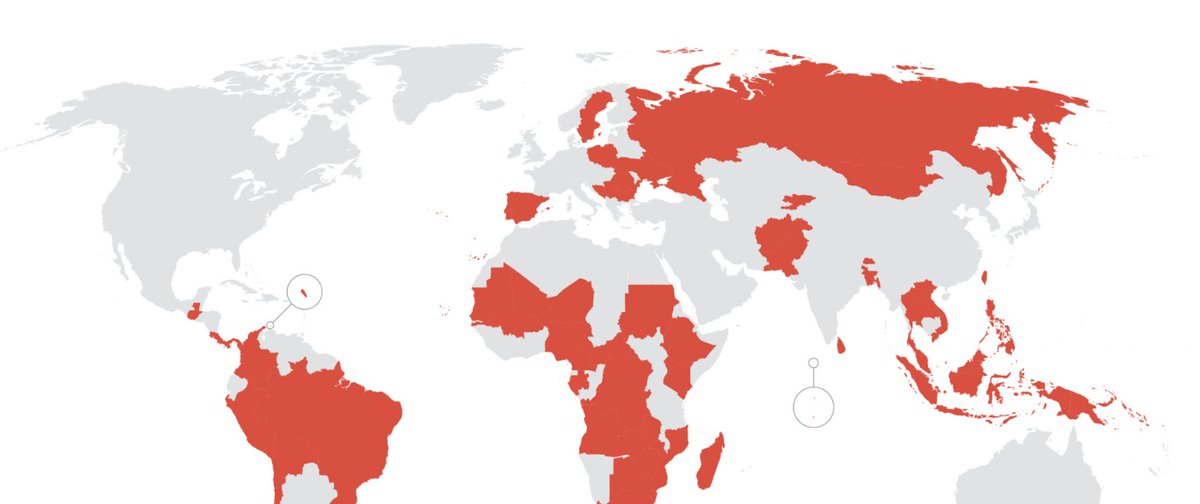
Google Sheets as a cyber intelligence weapon? Google dismantled a global cyber espionage campaign run by Chinese group UNC2814, active since 2017. 53 organizations across 42 countries. Primary targets: telecoms and government institutions. The tool: a backdoor written in C that turns Google Sheets into a command channel. Cell A1 serves as the command box, the A2:An range handles file transfers and command output, and it all runs through standard Google APIs, so to detection systems it looks like ordinary spreadsheet editing... Traffic encrypted, disguised as legitimate requests - indistinguishable from everyday network activity. On infected machines: full names, national ID numbers, dates of birth, and voter registry numbers - everything you need to track and surveil specific individuals. The Chinese Embassy responded as usual: "we firmly oppose attempts to smear China." https://t.co/cEKWmaLd7w
Jane Street was running an algorithm that dumped Bitcoin every single morning at 10am. Every day. For months. Crashing the price. Liquidating retail. Buying back lower. Rinse and repeat.
The second they got sued it stopped. The 10am dump disappeared. Now Bitcoin just had the best day in months.
One trading firm... That’s all it took to suppress the entire crypto market for months.
Now ask yourself how much of the crypto price action is even real. How many people panic sold because the charts look terrible. How many people got liquidated. How many billions were taken from regular people by a single trading desk.
And this is just the first one to get caught so far… it’s about to get VERY interesting.
Anthropic published a blog post and playbook on how Claude Code handles COBOL. This isn’t about fixing old code or keeping it on a mainframe. The process has two stages: first, AI automates the analysis – mapping dependencies, documenting workflows, identifying risks. Work that used to take consultants months. Then it incrementally migrates the code to Java or Python, with the option to host it on any cloud provider. IBM stock dropped 13%. The reason is simple: IBM makes money because COBOL is hard. The company keeps clients on its mainframes, sells modernization through watsonx, but makes sure the end result still runs on its hardware. The CFO boasted about a 3-4x revenue multiplier from each mainframe client. Anthropic isn’t offering modernization – it’s offering an escape from the entire ecosystem. Accenture and Cognizant fell too. The whole legacy systems consulting sector got the signal that AI can replace “armies of consultants.”
Anthropic wrote that understanding the code used to cost more than rewriting it. IBM would prefer that sentence had never been said publicly. 95% of ATM transactions in the US run on COBOL. No bank CTO will make a migration decision based on a blog post – but every board member will read it.
New Engineering blog: We tasked Opus 4.6 using agent teams to build a C compiler. Then we (mostly) walked away. Two weeks later, it worked on the Linux kernel.
Here's what it taught us about the future of autonomous software development.
Read more: https://t.co/htX0wl4wIf