@crimetimechron I think we all know that once you become a professional boxer or boxing trainer, you’re expected to carry yourself professionally, and that includes keeping the fighting out of the streets. That’s what rings is for. She is trying to become a professional boxer.
My family never talked about being African. They always told us we were Indian. They moved from Mississippi to Michigan, and that’s the history I grew up hearing. I didn’t even think of myself primarily as just a human being until I started school. In our family, we were taught that we’re spiritual beings first. That was our foundation, so I never heard anything about African ancestry growing up. They did warn us about the white man and how they may move to harm us.
Our ancestors didn’t simply “lose” a language or culture overnight. Wars, forced displacement, massacres, slavery, and assimilation policies disrupted families and communities for generations. Many elders, leaders, and knowledge keepers were killed, and traditions that would normally be passed down were intentionally broken.
Black/indigenous Americans adapted because they had to survive. Culture isn’t only what remains unchanged; it’s also what people preserve and rebuild under oppression. The fact that some languages, customs, or histories were lost doesn’t mean they never existed; it reflects the impact of violence, forced assimilation, and generations of separation from ancestral traditions.
Actually, ‘copper-colored’ wasn’t invented by FBA. It appears in early historical writings to describe the Indigenous peoples of the Americas, and in some contexts people of mixed or African ancestry. Historical descriptions used many color terms; copper, tawny, brown, black, and red long before modern census categories existed. ‘African American’ is a modern identity, but that doesn’t erase older historical descriptions or names people were called centuries ago. It’s possible to discuss historical terminology without pretending it never existed.
FBA stands for Foundational Black Americans, people who identify as descendants of Black Americans who were enforced and whose families have longstanding roots in the United States.
You can’t really say that publicly because people have been conditioned by a dominant narrative that shapes how they understand history and reality. There were already melanated people in America before later arrivals, and the historical record is more complex than many discussions acknowledge. That’s why it’s important to examine the evidence carefully instead of assuming a single narrative tells the whole story.
How do they reconcile the claim that people were being killed on a massive scale with the claim that large numbers of those same people were also being transported across the Atlantic? I’m asking how those events and timelines fit together and what evidence supports that explanation.
these people do not have the capability to think…
Oh no, I’m not arguing with you at all. For those lynchings, what do you think we should actually do about them? What kind of plan do you think we should have to prevent something like that from happening again? If we truly want to make a difference, what role do you think we should each play?
Because if African countries become stronger and more stable, they can build more resources and opportunities for their own people. That could also create a better foundation for cooperation and mutual support between Africans and Black Americans. Am I wrong friend?
I hear what you’re saying, but you can’t effectively help everyone else if you haven’t first established and protected your own foundation (FBA). When you don’t know who you are or fail to define your own identity, people can redefine it for you and benefit from your confusion. That’s not unity; that’s vulnerability. Helping others shouldn’t come at the cost of erasing your own history or identity. My point is simple: secure your own house first, then you’re in a stronger position to help everyone else.
Everybody should be able to help themselves first. That includes African nations, which have billions of people and their own challenges to address. There’s nothing wrong with supporting one another, but there’s a difference between solidarity and expecting another group to carry your burden while they’re still trying to establish and protect their own identity and community. A strong foundation starts at home. Plus, I haven’t seen many Africans come here to build a connection with Black Americans. From what I’ve seen, there’s been more conflict than unity.
My perspective is that “Black” is an identity rooted in American history, shaped by generations of people who built a distinct culture and experience here. That’s why I don’t identify with the term “African American.” Until we come together and decide what best represents us, I believe our identity should reflect our own history.
Likewise, I don’t believe Africans should be called Black simply because of race. Africans are who they were long before modern racial labels; their tribes, nations, cultures, and homelands define their heritage. Stand on that identity. Be proud of where you come from rather than adopting an identity that was shaped by a different history.
I ain’t trying to argue with you friend, but it’s time for Black Americans to stand on business; even if it means challenging our own people. Identity matters, and if we don’t define and protect our own history, someone else will. Destiny swapping is a real thing. We’ve seen it happen before. Let it stop here.
the term Foundational Black Americans (FBA) is used is to describe the descendants of Black people who were enslaved in the United States and who built multigenerational communities there before more recent other melanated immigrations. From that perspective, the term emphasizes a distinct historical lineage, with experiences shaped by slavery, Reconstruction, Jim Crow, segregation, the Civil Rights Movement, and the long-term development of American culture, institutions, and politics. Logically, the idea is that ancestry and historical continuity can form a unique ethnic identity within a broader racial category, much like different ethnic groups can exist within the same race. At the same time, it’s worth noting that not everyone uses or accepts the term in the same way, and there are differing views about its scope and implications.
#blacklivesmatter #blackhistory
That’s because many people want to be seen and heard, but Black Americans have spent generations fighting battles that shaped this country’s history and identity. We endured discrimination, challenged unjust systems, and pushed this nation toward change. I believe Black Americans have been too willing to soften our voices when it comes to protecting our own history and identity. There comes a point when respect for our legacy requires firmness, clarity, and confidence. If we want a different future, then we have to start thinking differently and standing unapologetically for ourselves. Something has to change.
You’re mixing two different issues: how the government currently classifies race versus how and why those labels came into existence. Nobody is denying that the U.S. Census classifies “Black” as a racial category today. The question is when and why people began identifying with those labels.
Historically, many Africans identified primarily by their ethnicity, kingdom, or nationality (Yoruba, Igbo, Akan, Wolof, Kikuyu, Ghanaian, Nigerian, etc.), not simply as “Black.” Likewise, Black Americans were called many different names over time; Negro, Colored, Afro-American, Black, and later African American.
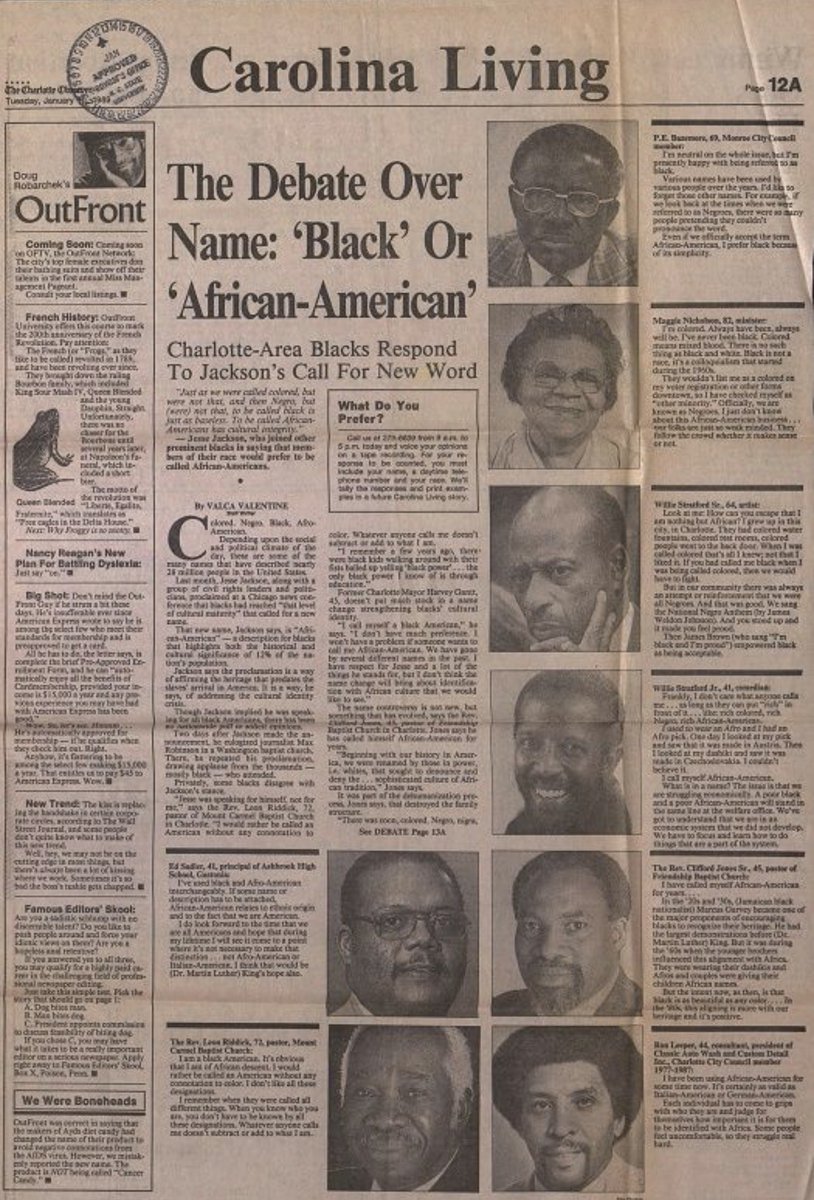
The documents I posted show that in the late 1980s Jesse Jackson advocated replacing “Black” with “African American” because he (believed) it connected descendants of enslaved Africans to a shared historical and cultural identity. That wasn’t just my opinion, it was a documented public (debate).
Today, “Black” functions as a broad racial category in countries like the U.S., U.K., and Canada. But that doesn’t erase the history of how those labels evolved or why many people preferred one term over another. Current government classification doesn’t rewrite the historical development of those identities.
And nobody said Africans are “the problem.” The point is that race, ethnicity, nationality, and culture are different concepts. Saying everyone the government classifies as Black shares the same history ignores the distinct histories of Black Americans, recent African immigrants, Afro-Caribbeans, and others. They may share a racial classification today, but they do not all share the same historical experience. Y’all are forcing that identity onto y’all because of black Americans Impact
what…. many Africans identified first by their tribe, ethnic group, or nation, not by the label “Black.” In the United States, “Black” became a shared identity through a unique historical experience shaped by slavery, segregation, and the civil rights movement. That’s different from simply checking a race box on a form.
So my question is: if “Black” has a specific historical and cultural meaning in the American context, how does that relate to people who didn’t share that history but now identify with the same label?