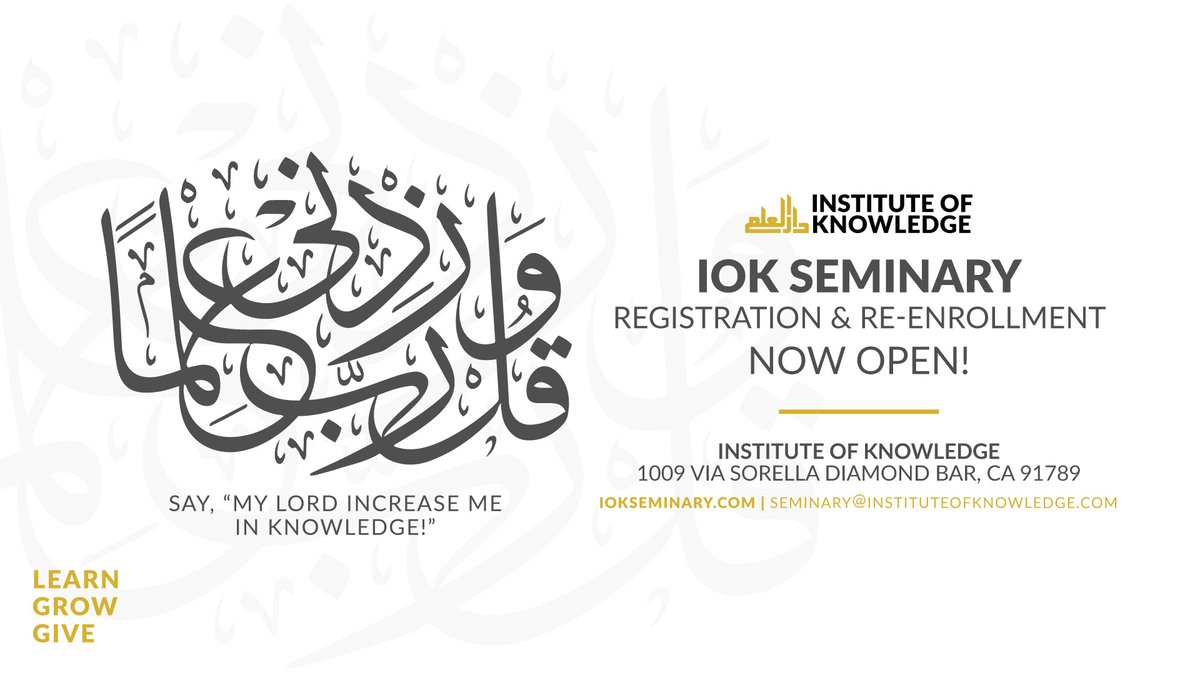
📚 Serious About Seeking Knowledge? 🌿
Are you ready to deepen your understanding of Islam and commit to a life of study and service? The IOK Seminary provides rigorous Islamic Studies programs, blending traditional learning with modern application.
🔹 One Year Diploma in Arabic & Islamic Studies
🔹 Associate Degree in Arabic and Islamic Studies
🔹 Bachelor's Degree in Arabic and Islamic Studies
🔹 Master's Degree in Islamic Law and Tradition
👉 Join the next cohort! Visit https://t.co/6c1Sw5hO2G to apply.
A Heartfelt Appeal to My Fellow Scholars, Imams, Duʿāt, and Students of Knowledge
Eid Mubārak! May Allāh ﷻ accept from all of us our fasting, prayers, charity, and sincere efforts throughout Ramaḍān.
Now that the dust from the moonwars has settled, I’d like to offer a humble, heartfelt appeal to myself and my respected peers: Let’s stop. Let’s stop arguing and debating over an issue of subsidiary fiqh, where there exists a long-standing, valid difference of opinion among our scholars. Let’s stop presenting this as if it’s a litmus test of someone’s īmān, commitment to Islam, or love for the Sunnah.
Our approach—often rigid and combative—has led to confusion, division, and disillusionment. When we present our position as the only legitimate truth while dismissing others, what do we really gain? Are we actually persuading anyone? Or are we simply reinforcing our own echo chambers, indulging in intellectual chest-thumping?
If a scholar, masjid, council, or institution chooses global sighting, alḥamdulillāh. If they choose local sighting, alḥamdulillāh. If they follow calculations, alḥamdulillāh.
All three positions—global, local, and calculation-based—have been supported by qualified scholarship and are rooted in serious ijtihād. These are not wild opinions or innovations; they are part of our rich juristic legacy.
Each of these methods is grounded in a sincere attempt to follow the Qur’ān, Sunnah, and the principles of fiqh. They differ not because one side is deviant and the other righteous, but because this is the nature of ijtihād. Our predecessors disagreed, yet they maintained respect, humility, and harmony.
And if someone is following a valid opinion—just let them. There’s no need to critique them, correct them, or make them feel like they’ve betrayed the faith. Not everything needs a comment. Not every disagreement is a battle.
Just because someone follows a different opinion than ours doesn’t mean they’re wrong, lenient, ignorant, or compromising the religion. We must cultivate an attitude of acceptance and inclusivity when it comes to matters of legitimate scholarly difference. No one should be rebuked, reprimanded, scolded, "advised," or made to feel guilty for following a sound, valid opinion within our tradition.
The Shāfiʿī scholars expressed this principle beautifully:
“Issues of ijtihād are not rejected with force, and it is not allowed for anyone to compel others to follow their view in such matters. Rather, they should be discussed respectfully, using sound evidence. If one view appears stronger to someone, they may follow it, but whoever follows the opposite opinion—there is no blame on them.”
Unfortunately, what we see today—particularly among those in religious leadership—is a lack of adab al-ikhtilāf, the manners and ethics of scholarly disagreement. The tone, rhetoric, and condescension from some “scholarly” voices around moonsighting have become disheartening and harmful. And let’s be honest: part of the blame falls on our own shoulders, for continuing to perpetuate this narrow-mindedness in our communities.
As students and carriers of knowledge, we are obligated to be academically honest and spiritually mature. After years of study and training, how is it that we still struggle to practice basic adab when it comes to differing opinions in matters that are mujtahad fīh?
I recently came across a powerful principle in Muftī Taqī ʿUthmānī’s notes on Jāmiʿ al-Tirmidhī under the chapter of Abwāb al-Libās. He quotes:
الإنكار على غير منكر، منكر بنفسه
“Censuring something that is not impermissible is, in and of itself, impermissible.”
This should serve as a wake-up call.
It is time—long overdue—for us to rise above these endless debates. Our unity, mutual respect, and love for one another must be greater than our differences over moonsighting. This isn’t about who’s more correct—it’s about how we model prophetic character when we disagree.
Let us embody the humility, maturity, and integrity our community needs. And let us lead not just with fatāwā—but with wisdom, patience, and grace.
ibn al-Qayyim wrote, “There is nothing more beneficial and salvific for a servant of Allah, in this life and the next, than pondering the Quran, meditating on it for long periods of time, concentrating one’s thoughts on the meanings of its verses.”
https://t.co/9ZfwlWjpId
When I was 13 my mother sent me to study Islam as she wanted her eldest to become a scholar. I come from a family of entrepreneurs, not scholars, so the entire world of ilm was new to me and the financial concerns were worrying to my family, but this was my destiny, Alhamdulillah
In 1995 my father was murdered by robbers. He was only 29, I was 8, the eldest of 4 kids. May Allah reunited us with him in the Afterlife.
In 1996, my mother started a school and named it after him. She continues to serve the community through it 30 years later, Alhamdulillah.
I am just an orphan from a small corner of South Africa whose first job was a school transport driver.
I don't even know how I got to where I am. It is all a blessing from Allah, Alhamdullilah.
Scattered Thoughts on Imams, Sincerity, and Compensation (part 2)
When we look at the ahādīth of the Prophet ﷺ, we find a narration that states, “The thing you most deserve to take payment for is the Book of Allah.” Based on this, scholars like al-Imām al-Shāfiʿī (RA) argued that it is entirely permissible to receive payment for teaching the Quran. However, other narrations warn against accepting money for teaching the Quran, leading some scholars to initially hold the view that it was impermissible. The Ḥanafī school of thought, in particular, adopted this position, especially because, historically, the state would provide imams, scholars, and teachers with stipends that allowed them to live comfortably.
But as time went on, the stipends and financial support diminished, and eventually disappeared. As a result, the position shifted, and it is now universally accepted that it is permissible for imams, scholars, and teachers to be compensated for their time. If we do not compensate them for their work, who will be responsible for teaching, researching, serving the community, and preserving the religion for future generations?
Some argue that scholars should work in other fields and teach for free. While that sounds ideal, most scholars would love to be in that position. But how much time can they devote to teaching while working a full-time job? How can they find time for research, building relationships with the community, self-learning, or spending quality time with their families? How can they handle the duties of counselling, mediating disputes, performing marriages, managing divorces, attending funerals, consoling the grieving, supporting parents and children in need, visiting the sick, and so much more? How can they build and nurture institutions, train and mentor future religious leaders, and ensure the continuity of Islamic knowledge?
Scattered Thoughts on Imams, Sincerity, and Compensation (part 1)
A troubling trend has emerged, particularly within the Muslim American community, where the intentions, sincerity, and motives of scholars and speakers involved in daʿwah—especially those who are compensated for their time and efforts—are being questioned. I've heard accusations that these individuals are merely businessmen, selling the religion, or in it for the money, along with other unfounded, damaging, and reckless statements. One of my teachers once said that scholars and imams are often caught between a rock and a hard place; they’re criticized no matter what they do. If an imam is struggling financially, living in poverty, and struggling to make ends meet, people criticize him, saying, “He should have gotten a secular education, pursued a career, or started a business—he must not be intelligent.” On the other hand, if an imam or scholar is well-off, living comfortably, people accuse him of “selling the religion” and profiting from his knowledge.
My teacher was speaking about this dynamic in Pakistan, but it applies to many post-colonial Muslim countries, and unfortunately, these sentiments have found their way into our communities as well. This kind of discourse needs to stop. We do not have the right to question the intentions or sincerity of anyone, let alone someone who has dedicated their life to studying and serving the Muslim community. Do we really believe that someone would sacrifice their career, spend years abroad separated from family and comfort, living a life of hardship, just to earn a minimal wage as a resident scholar or imam? Let’s be honest—if they were after wealth, they would have pursued careers in medicine, law, IT, or business.
Scholars who spend their days and nights studying, teaching, researching, and imparting knowledge are often seen as having “nothing better to do.” But the truth is, they could be out building a luxurious lifestyle for themselves or starting their own businesses, but they choose not to. They’ve devoted their lives to the service of Islam, and the least we can do is provide for their basic needs. These individuals aren’t chasing after the dunya (worldly life)—they’re pursuing the hereafter. We, as a community, need to understand that there is absolutely nothing wrong with a scholar or imam being compensated for their time and effort. In fact, they should be compensated appropriately.
We should choose our friends based on faith, character, morality, and ethics along with common interests, and personalities. In terms of priority faith, īmān, and character come first. When the Prophet ﷺ was asked what type of friends we should keep he replied, “The one who reminds you of Allah ﷻ when you see him, and adds to your knowledge when he speaks, and reminds you of the hereafter when he acts.”
من ذكركم با لله رؤيته، و زاذ في علمكم منطقه، و ذكركم بالآخرة عمله.
Even if we ourselves aren’t up to that level, just hanging out with good people has a huge effect on us.
In another ḥadīth, the Prophet ﷺ gave us a beautiful example of good and bad company.
عَنْ أَبِي مُوسَى ـ رضى الله عنه ـ عَنِ النَّبِيِّ صلى الله عليه وسلم قَالَ " مَثَلُ الْجَلِيسِ الصَّالِحِ وَالسَّوْءِ كَحَامِلِ الْمِسْكِ وَنَافِخِ الْكِيرِ، فَحَامِلُ الْمِسْكِ إِمَّا أَنْ يُحْذِيَكَ، وَإِمَّا أَنْ تَبْتَاعَ مِنْهُ، وَإِمَّا أَنْ تَجِدَ مِنْهُ رِيحًا طَيِّبَةً، وَنَافِخُ الْكِيرِ إِمَّا أَنْ يُحْرِقَ ثِيَابَكَ، وَإِمَّا أَنْ تَجِدَ رِيحًا خَبِيثَةً ".
“The example of a good companion and a bad companion is like that of the seller of musk, and the one who blows the blacksmith’s bellows. So as for the seller of musk then either he will grant you some, or you buy some from him, or at least you enjoy a pleasant smell from him. As for the one who blows the blacksmith’s bellows then either he will burn your clothes or you will get an offensive smell from him.” Meaning that good company will always benefit you, whereas bad company will always harm you even though you yourself aren’t involved in that bad act.
A short piece before the end of Rabīʿ al-Awwal on the final days of the Prophet ﷺ and some lessons we can learn from it.
From the Chaplain's Desk - Reflecting On The Final Days Of The Prophet This Rabi-ul Awwal https://t.co/xRNpSZMgkk via @MuslimMatters
🚨This will be the last post we share here.
We believe there is no point in telling our human stories anymore; everyone has grown accustomed to seeing us killed. It's no longer worth the risk to send our voice out to a world that is content with mere solidarity. Even many of our human stories no longer interest people (even our voice is being ignored).
It's time to stop waiting for a savior and to help ourselves survive.
Please try to keep us in your prayers.
ibn al-Qayyim writes, “If a person uses the healing with al-Fātiḥah properly, he would see some great effects in the process of healing. I resided in Makkah for a period where I was stricken with some illness but was unable to find a doctor or medicine. I simply treated myself
Do not despair. The people who have the greatest right to despair cannot afford you quitting. If the only thing we get from this is that the people of Gaza know that WE still see them, are praying for them, standing with them, and fighting for them…then it’s worth it.
In Episode 3 of Footsteps of the Faithful, Ibrahim عليه السلام takes a bold step to challenge the idolatry of his people: he shatters all the idols . . . except for one. When the people return
https://t.co/Ok3LKLfvjp
I would like to thank my parents for laying the foundation for what I turned out to be in life.
May Allah accept this effort and make it a means of connecting hearts to the Quran!