“I work the front desk at a small doctor’s office, and I wish people could see what happens on the other side of the phone.
Every day, older patients call us confused.
They are told to use the patient portal, upload documents, check lab results online, fill out forms before the visit, and confirm everything through a link.
Some of them do not know what a portal is.
Some do not have a smartphone.
Some have one, but they are afraid to click the wrong thing.
Last week, a man in his late 80s called about his test results.
He said, “Ma’am, I don’t mean to bother you, but the computer says I have a message and I don’t know how to open it.”
He sounded ashamed.
That broke my heart.
He should not have to feel ashamed for needing a human being.
Technology can be helpful. I understand that.
But when people who built this country are made to feel helpless because everything became a login and a password, we have gone too far.
Not everything needs to be an app.
Not every answer should be hidden behind a screen.
Sometimes people need a voice.
A patient person.
A real human who says, “Don’t worry, I can help you.”
Progress should not leave seniors behind.
Because one day, the world will move faster than us too.
And I hope someone is kind enough to slow down.
~Unknown
On this day in 1984, Mike Jackson helped establish Lesbians and Gays Support the Miners, a solidarity group to aid the miners in their fight. Four decades later, Mike spoke to Tribune about the power of organising and solidarity. https://t.co/RKsh2gh3NI
When Bobby Robson finished his last chemotherapy session in 2007, Dr Ruth Plummer pulled him to one side at the Freeman Hospital in Newcastle.
Bobby thought it was going to be about his health.
Instead, Ruth wanted to talk to him about something else.
Her department was too old.
There was a new Early Cancer Trials Unit being planned at the Northern Centre for Cancer Care, three times bigger than what they already had, with a proper laboratory, modern equipment and room for clinical trials.
But there was one problem.
They did not have the money to kit it out.
So Ruth asked Bobby if he knew anybody who might help.
Bobby went home and spoke to his wife Elsie.
The next day, they started making calls.
Very quickly, what had started as a quiet conversation with Ruth had turned into a committee.
Then the idea came up.
Use Bobby’s name.
He was not comfortable with that at first.
He did not want a charity built around himself.
But the others told him it would open doors, and once Bobby agreed to it, there was no going halfway.
The Sir Bobby Robson Foundation was born.
At the first meeting with the hospital, Don Robson got straight to the point.
How much money was needed to get started?
£500,000.
And Ruth needed it by the summer of 2008 because she wanted the facility running by October.
That was when Bobby knew what he had walked into.
“There could be no slowing down, no pulling out, no getting halfway down the road and turning back.”
The original plan had been simple enough.
Bobby would lend his name, act as a figurehead, and stay in the background.
It did not work out like that.
He went to the meetings.
He did the interviews.
He kept going even when he was not well.
Sometimes he would pull Ruth to one side and ask her:
“What have you bloody well got me into?”
But he never missed a single meeting.
The launch was held at the Copthorne Hotel.
By then, Bobby was fully in it.
“If I’m committed to something, then I’m committed.”
And then the money started coming in.
Within seven weeks, the first target had already been reached.
£560,000.
Then people started turning up at Bobby and Elsie’s house.
The first donation came from a woman carrying an envelope full of cash.
Her husband had recently died, and his final request had been that people at his funeral gave money to Bobby’s charity instead of buying flowers.
She handed over £271.74.
“What can you say to that?”
Then there was Johnny Bliss, a local singer with pancreatic cancer.
His doctors had told him he had months to live, but he still held a concert, sold CDs and raised around £10,000 for the Foundation.
Bobby met him at the Copthorne.
Johnny brought his family with him, and made the men wear their best suits and ties.
Bobby could see he was not well.
“I could have cried.”
And for all the football he had lived through, all the countries, all the clubs, all the games, this became his last big job.
“It’s not about beating Portsmouth any more.”
“It’s about beating death.”
As of today the Sir Bobby Robson foundation has raised over £27 million.
#football
Today I met a 79 year old woman who was found by bins with her walking frame and the clothes on her back after being evicted from her home by bailiffs.
Spent a few hours at the council and they’ve placed her in a hotel until Monday.
We have to do everything to make sure this doesn’t end up become the norm.
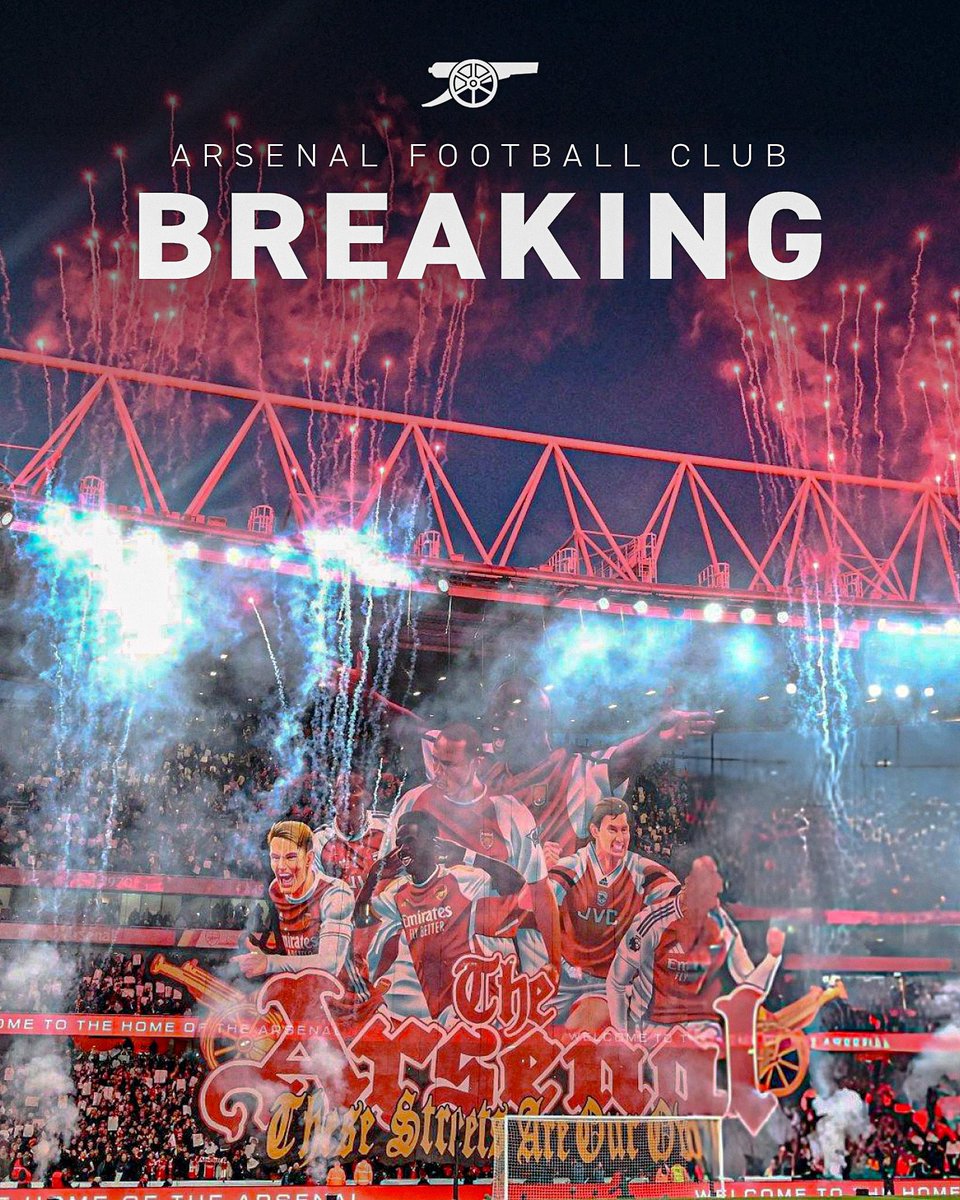
After 22 years @Arsenal are bringing the @premierleague trophy home 🏆and to celebrate there will be a special parade in Islington on Sunday 31 May (1/3)
Mark your calendar 🗓️
We are delighted to announce that we will come together with our supporters and community for a special parade, starting from 2pm on Sunday 31 May 👇
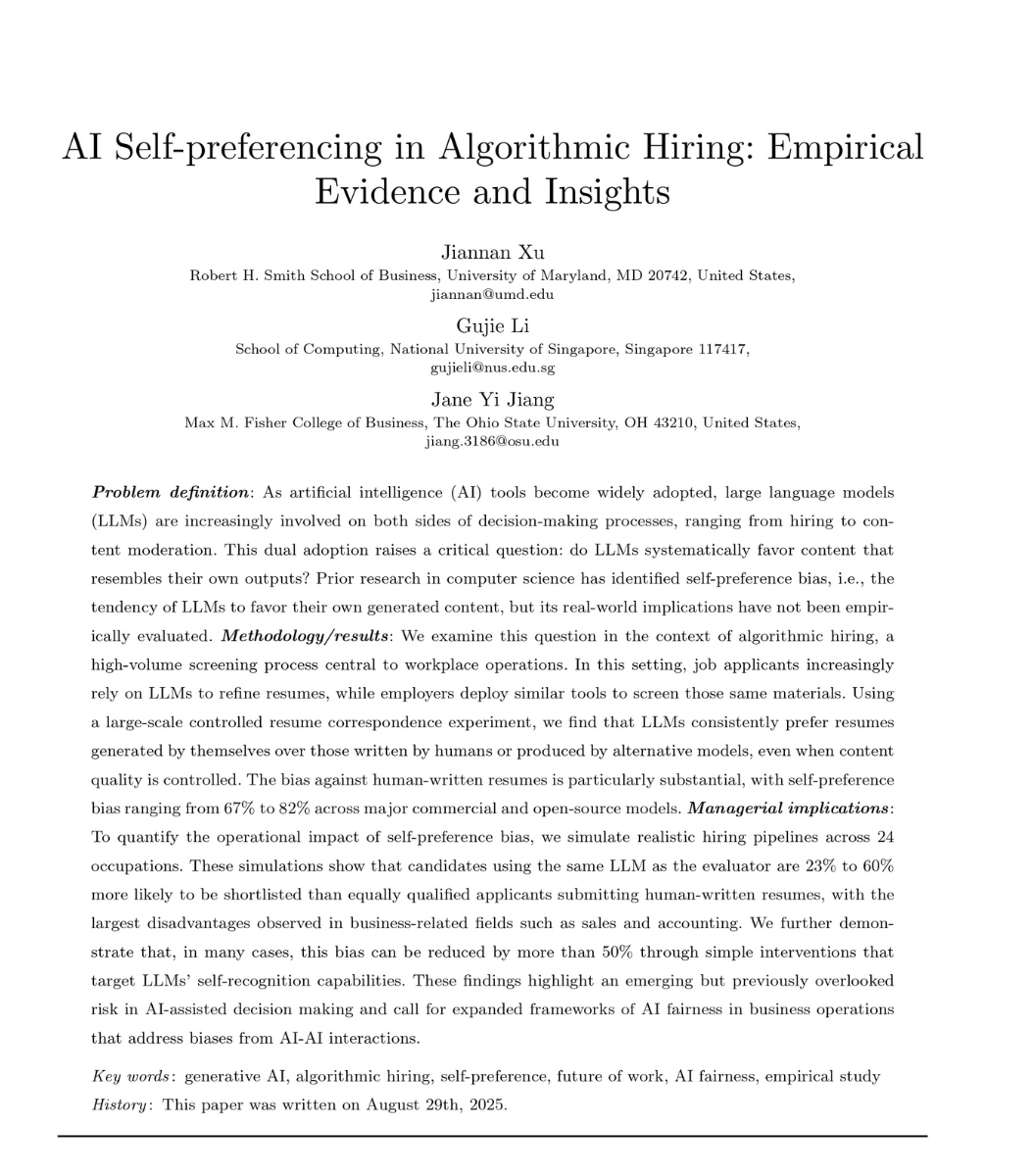
Researchers sent the same resume to an AI hiring tool twice. Same qualifications. Same experience. Same skills. One version was written by a real human. The other was rewritten by ChatGPT.
The AI picked the ChatGPT version 97.6% of the time.
A team from the University of Maryland, the National University of Singapore, and Ohio State just published the receipt. They took 2,245 real human-written resumes pulled from a professional resume site from before ChatGPT existed, so the human writing was actually human. Then they had seven of the most-used AI models in the world rewrite each one. GPT-4o. GPT-4o-mini. GPT-4-turbo. LLaMA 3.3-70B. Qwen 2.5-72B. DeepSeek-V3. Mistral-7B.
Then they asked each AI to pick the better resume. Every model picked itself.
GPT-4o hit 97.6%. LLaMA-3.3-70B hit 96.3%. Qwen-2.5-72B hit 95.9%. DeepSeek-V3 hit 95.5%. The real human almost never won.
Then the researchers tried the obvious objection. Maybe the AI is just better at writing. So they had real humans grade the resumes for actual quality and ran the experiment again, controlling for it. The result was worse. Each AI kept picking itself even when human judges rated the human-written version as clearer, more coherent, and more effective.
It gets worse. The AIs do not just prefer AI over humans. They prefer themselves over other AIs. DeepSeek-V3 picked its own resumes 69% more often than LLaMA's. GPT-4o picked its own 45% more often than LLaMA's. Each model can recognize and reward its own dialect.
Then the researchers ran the simulation that ends careers. Same job. 24 occupations. Same qualifications. The only variable was whether the candidate used the same AI as the screening tool. Candidates using that AI were 23% to 60% more likely to be shortlisted. Worst gap was in sales, accounting, and finance.
99% of large companies now run AI on incoming resumes. Most of them use GPT-4o. The paper just proved GPT-4o picks GPT-4o 97.6% of the time.
If you wrote your own cover letter this week, you did not lose to a better candidate. You lost to a worse candidate who paid OpenAI 20 dollars.
Your qualifications do not matter if the AI prefers its own handwriting over yours.
Remember Dan Price...that CEO who took a pay cut so he could pay all his employees a minimum annual wage of $70,000? Here’s what happened next:
“Six years later after the decision that others said would destroy his business, Dan reports that revenue has tripled, the customer base has doubled, 70% of his employees have paid down debt, many bought homes for the first time, 401(k) contributions grew by 155% and turnover dropped in half. His business is now a Harvard Business School case study.”
In his own words:
“6 years ago today I raised my company's min annual salary to $70k. Fox News called me a socialist whose employees would be on bread lines.
Since then our revenue tripled, we're a Harvard Business School case study & our employees had a 10x boom in homes bought.
Always invest in people.”
Courtesy of Craig Henley
This one will require a stiff drink.
In the early 1990s, the government came up with a clever idea. Instead of borrowing money cheaply to build hospitals, schools, and roads, it would get the private sector to build them and then pay the private sector back over 25 to 30 years. The Private Finance Initiative. PFI.
The attraction was obvious. You got a shiny new hospital today. The bill didn't show up on the government's books. The cost was deferred into the future. Politicians got ribbon-cutting ceremonies without the awkward conversation about borrowing.
It was, in effect, the nation's credit card. Buy now, pay later. Except the interest rate was extraordinary.
The total capital value of everything built under PFI was around £50 billion. As of March 2024, there were 665 PFI contracts still running across the UK, with roughly £136 billion in remaining payments stretching out to the early 2050s. These are payments public bodies are contractually locked into. Hospitals, schools, councils, government departments. Paying for buildings that in many cases were constructed twenty or thirty years ago.
And the terms are extraordinary.
PFI contracts were structured so the private sector would not just build the facility but manage its services. Cleaning. Maintenance. Catering. Portering. These services are bundled into long-term contracts with built-in inflation increases that the public sector cannot renegotiate, cannot exit without paying massive penalties, and often cannot even fully scrutinise because of commercial confidentiality clauses.
In one case raised in Parliament, a hospital was charged £333 to change a lightbulb. That isn't an urban myth. It was cited in Hansard.
The NHS has been hit hardest.
According to parliamentary analysis, the capital cost of NHS PFI projects was around £13 billion. The total repayments are estimated at around £80 billion. And the peak of NHS PFI annual repayments isn't even here yet. It arrives in 2029. The bills are still going up.
In 2020-21, NHS trusts paid £457 million purely in interest charges on PFI contracts. Not services. Not maintenance. Interest. In the last five years, NHS trusts have handed over more than £1.8 billion in PFI interest alone. We Own It calculates that money would have covered the starting salaries of over 50,000 new doctors.
One NHS trust, Essex Partnership, has reportedly paid back 27 times what was originally borrowed. Some hospitals are spending more on PFI repayments than on medicines for patients. And remember, these repayments come out of the same NHS budget that's supposed to fund patient care, staff, and equipment.
Scotland got it just as badly. Audit Scotland reported that Scottish taxpayers will pay a cumulative £40 billion for PFI assets worth just £9 billion. North Ayrshire Council will have paid £440 million by 2038 for four schools that cost £83 million to build.
Now here's what makes this worse.
Many of these contracts are starting to expire. The buildings are being handed back to the public sector. And the NAO has warned of significant risks around the handback process, including cases where public bodies were dissatisfied with the condition of assets being returned to them. Decades of payments. And some of these buildings may come back needing significant further investment.
So what actually happened?
The government could have borrowed money at significantly lower rates to build these hospitals and schools itself. Sovereign borrowing has always been cheaper than private finance. Instead, it paid the private sector to borrow at a premium and passed the inflated cost on to the taxpayer. The private sector took the profit. The taxpayer took the risk. The buildings are now ageing. The debts are still being paid. And the services that were supposed to benefit are being squeezed partly because so much of their budget is locked into contractual obligations they cannot escape.
PFI wasn't investment. It was an accounting trick. A way for governments to build things without the borrowing showing up in the national debt figures. It made politicians look fiscally responsible while loading future generations with obligations they had no say in and no ability to renegotiate.
Both parties did this. The Conservatives created PFI in 1992. Labour massively expanded it after 1997. More than 700 projects were signed. The coalition eventually wound it down. The current government scrapped the latest version. But the contracts remain. The payments continue. And the damage is already done.
This is what it looks like when a country chooses to buy its infrastructure on hire purchase instead of investing properly. You lock in above-market rates for decades. You lose control of the assets. You tie the hands of future governments. And when the bill keeps coming due, you're told there's no money for doctors, teachers, or social care.
There was always money. It just went somewhere else.
That's us! 🌍
The Artemis II crew captured beautiful, high-resolution images of our home planet during their journey to the Moon. As @Astro_Christina put it: "You guys look great."
My name is Terry birkett I live in Lincoln Lincolnshire Is anyone willing to give me a opportunity willing to learn and train and willing to do any work just wanting a opportunity so desperately I’ve moved to Lincoln and literally struggling for work i just want a opportunity willing to travel for it too I would be forever grateful and thankful hope the power of x can help thankyou guys means the world to me this 🙏
My late cousin, who I adored and miss every day, once said to me: Never make fun of someone for mispronouncing a word. It means they learned it by reading.
This made my stomach drop.
I’ve just read a report about how £24 billion in benefits goes unclaimed every year. Not because people don’t need it or don’t qualify, but because they’re sent to online calculators they can’t cope with.
One woman was days away from losing everything. Bailiffs at the door. No heating. No money for food. She was caring for her husband after a stroke and was completely overwhelmed.
What saved her wasn’t a website. It was a real person sitting at her table and going through the paperwork with her.
That bit of help kept a roof over her head and saved her life.
We keep acting like everyone can manage forms, logins and long questions while stressed, ill, grieving or caring for someone else. A lot of people can’t, and they’re paying the price for it.
If you’re struggling and feeling behind, this isn’t because you’ve failed. The system just isn’t built for people when they’re at their lowest.
So how do we fix this, and make sure people get real help when they need it most?