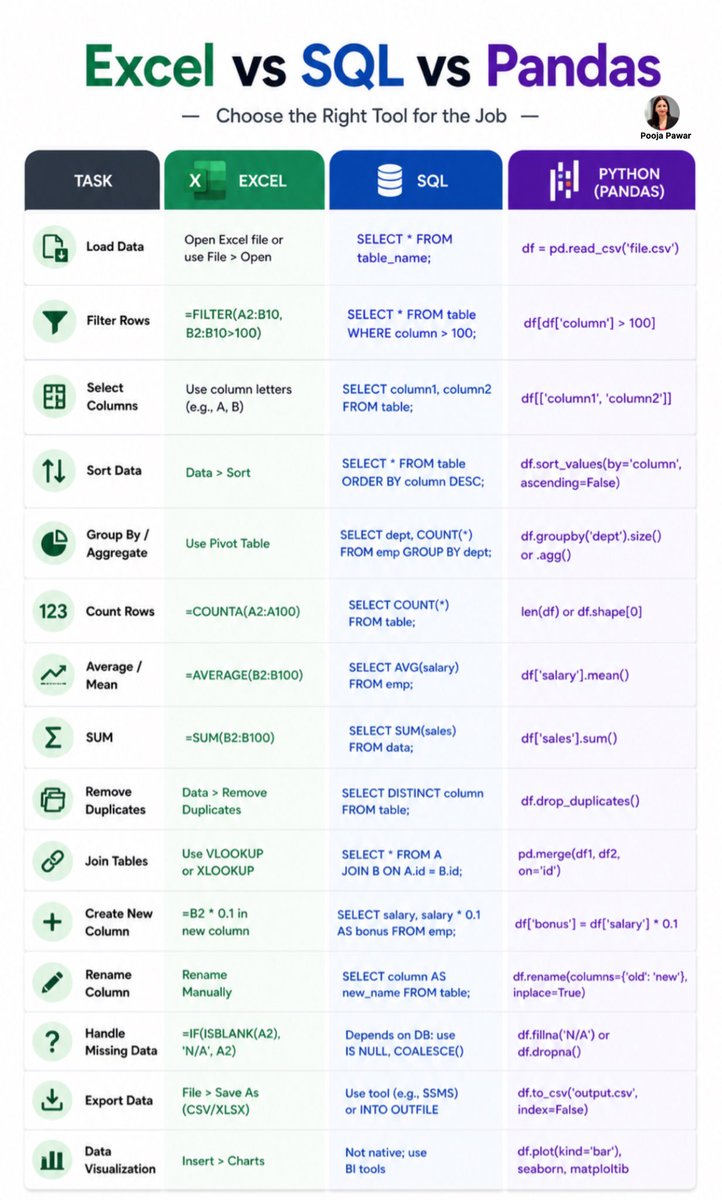
SQL, Python, R, and Excel all solve data problems, just differently. Knowing when to query, script, model, or spreadsheet is what makes a strong analyst. Tools change, fundamentals do not. #SQL#Python#RStats#Excel#DataAnalytics#DataSkills
Git is essential for version control, collaboration, branching, debugging, and managing code efficiently. Understanding commonly used commands helps developers track changes, work in teams, maintain clean repositories, and streamline workflows. #Git#GitHub#Programming #SoftwareEngineering #DevOps
Lists are the most popular data structure in Python. They’re mutable, ordered, and can hold different types (int, string, list). With methods like .append() and .sort(), plus indexing and loops, lists make data handling simple yet powerful. #Python#Coding#Programming #LearnPython
Python libraries cheat sheet for builders: Pandas for data manipulation, Scikit-learn for machine learning, Matplotlib and Seaborn for visualization, Flask for APIs, Pygame for games, Kivy for mobile apps, and Tkinter for GUI tools. Master the stack, expand your impact. #Python #DataScience #MachineLearning #WebDevelopment #Programming
You do not need expensive courses to learn AI and machine learning. Strong fundamentals in Python, statistics, deep learning, NLP, MLOps, and real projects can be built using high-quality free resources from MIT, FastAI, Hugging Face, Kaggle, and Google. #AI#MachineLearning #DeepLearning #Python #DataScience
Pandas is one of the most important libraries for real-world data analysis. Learning functions for grouping, merging, cleaning, reshaping, and aggregation can dramatically improve workflow efficiency and make large datasets easier to manage. #Python#Pandas#DataAnalytics #DataScience #Coding
Data Scientist Roadmap from fundamentals to impact: Mathematics and Statistics, Python and SQL, data wrangling, visualization, machine learning, and soft skills. Build layer by layer. Depth first, tools next, models after. Strategy turns learning into careers. #DataScience #MachineLearning #Python #SQL #Analytics #CareerGrowth
Data visualization is essential for effective exploratory data analysis. Python libraries like Matplotlib and Seaborn help uncover patterns, relationships, distributions, trends, and insights that support better analytical decisions. #Python#DataVisualization#EDA#DataScience #Analytics
Learning SQL becomes simple when you follow a clear roadmap: understand databases, write basic queries, filter with WHERE, sort using ORDER BY, group data with GROUP BY, apply JOINs, use subqueries, and master aggregate functions. Structure builds confidence. #SQL#LearnSQL #DataAnalytics #Database #Programming #DataScience #MachineLearning #ArtificialIntelligence #AI
Master Data Structures and Algorithms with clarity. From arrays, stacks, queues, trees, and graphs to sorting, searching, DFS, BFS, and time complexity from O(1) to exponential. Strong foundations in DSA build better engineers and problem solvers. #DataStructures#Algorithms#DSA #Coding #TechCareers
Python becomes far easier when you understand the core commands behind loops, functions, file handling, data types, and list comprehensions. Strong fundamentals make debugging, automation, and data analysis much easier in real projects. #Python#Coding#DataAnalytics#Programming #DataScience
Git is one of the most important tools for developers and data professionals. Mastering commands for branching, commits, collaboration, and version control helps teams work efficiently, track changes, and manage projects with confidence. #Git#GitHub#Programming#DataEngineering #Python
Learning every tool will not make you better. Clarity will. Start with the type and scale of your data, then align tools to your goal. Excel and SQL for summaries and dashboards. Python for deeper analysis and predictions. Focus beats overload. #DataAnalytics#DataScience#SQL #Python #Excel
AI and ML are no longer optional skills for modern tech careers. Strong foundations in statistics, Python, machine learning, transformers, projects, and AI ethics matter more than chasing every new tool. Build depth first, then scale your expertise. #AI#MachineLearning #DataScience #Python #DeepLearning
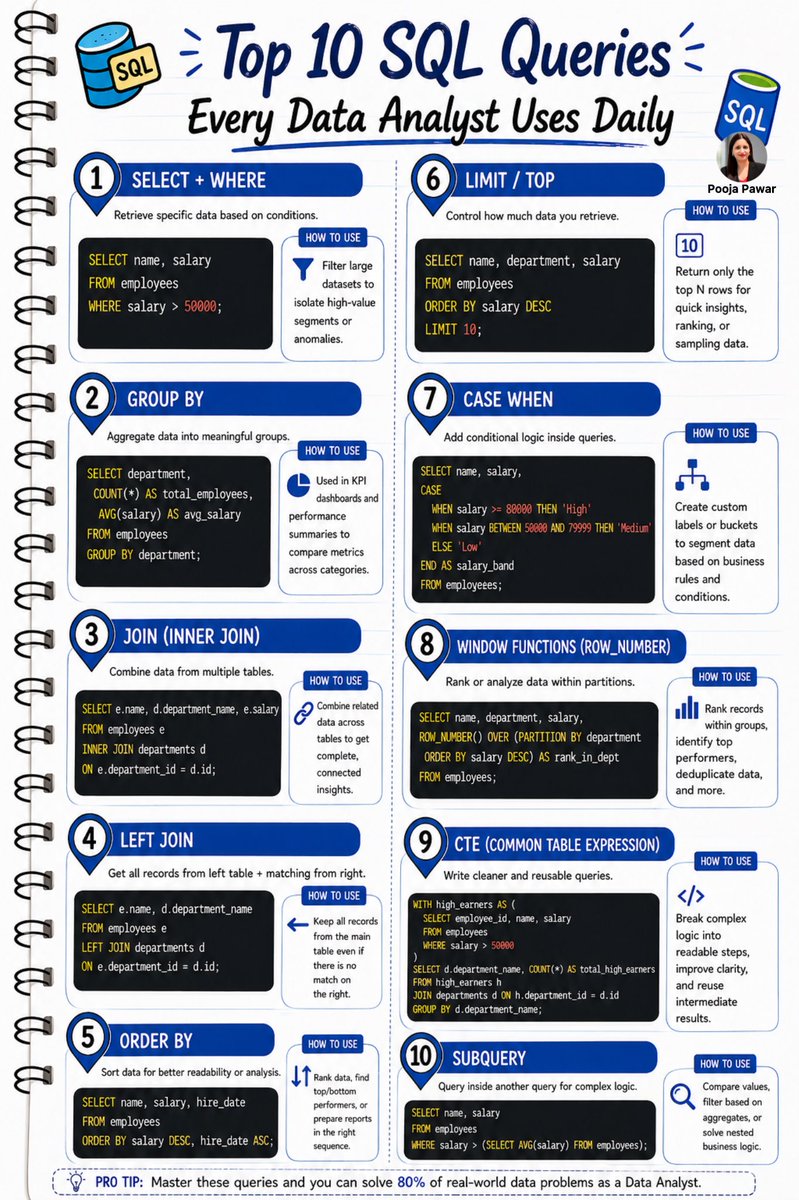
SQL becomes far more powerful when you move beyond basic SELECT statements and understand joins, aggregations, window functions, CTEs, indexing, and query optimization. These concepts drive reporting, analytics, and scalable data workflows. #SQL#DataAnalytics#Database #BusinessIntelligence #DataScience
A Python roadmap covers everything from basics (syntax, variables, functions) to OOP, DSA, automation, testing, web frameworks, advanced concepts, and data science with NumPy, Pandas, TensorFlow & PyTorch. Step by step, it builds coding mastery. #Python #Programming #Coding #DataScience
The data and AI industry is far bigger than just “Data Scientist” or “AI Engineer.”
From analytics and visualization to MLOps, AI safety, robotics, and governance, the ecosystem now includes dozens of specialized career paths. The opportunity space is expanding rapidly. #DataScience #ArtificialIntelligence #MachineLearning #DataAnalytics #AIJobs
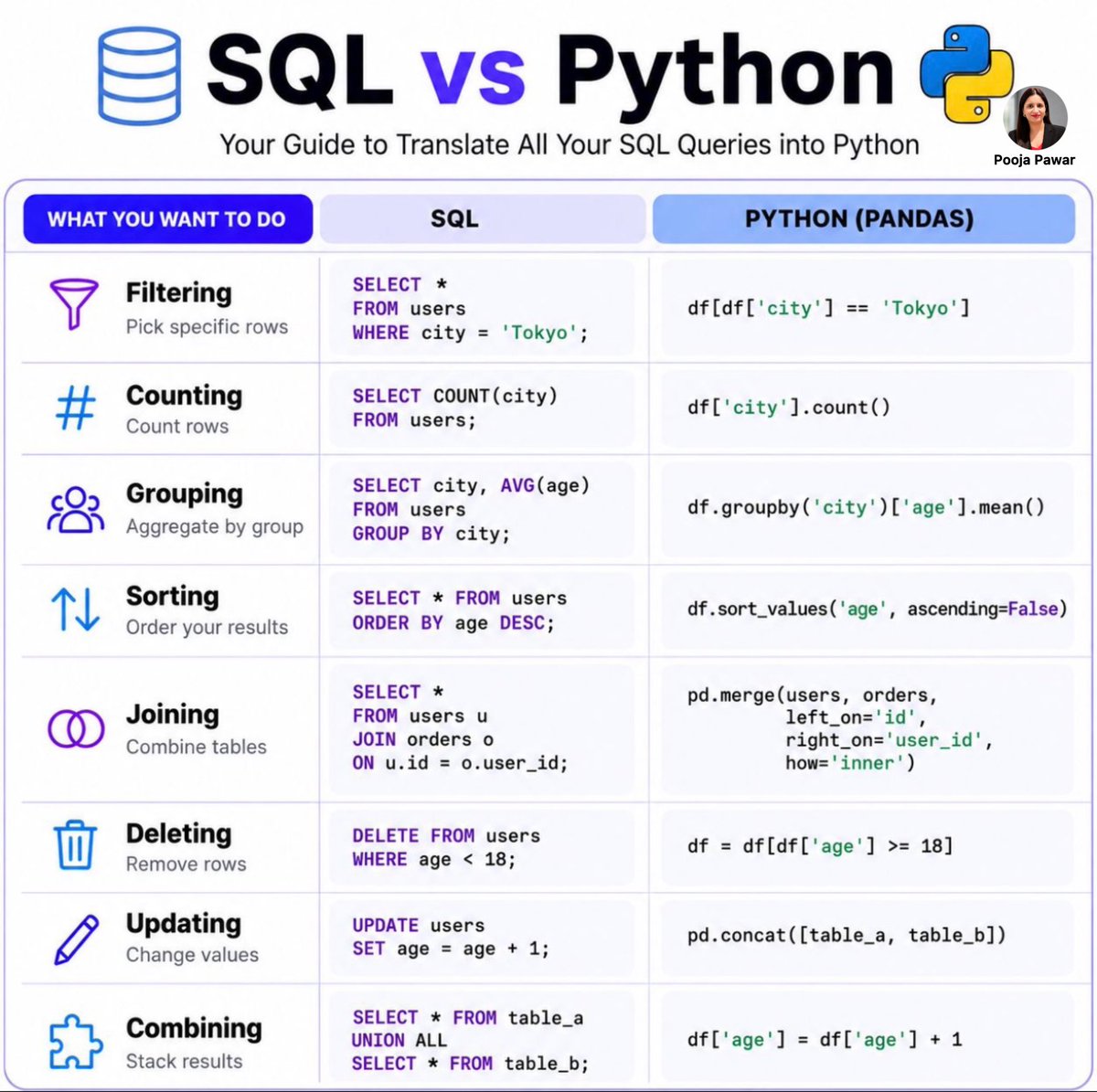
SQL teaches you how to think about data. Python helps you automate, analyze, and scale it. Analysts who combine SQL with Pandas move faster, clean data efficiently, and solve more complex business problems. Learn both together, not separately. #SQL#Python#Pandas#DataAnalytics #DataScience
Building apps is no longer limited to experienced developers. With AI coding tools like Codex, Claude Code, and Cursor, beginners can prototype ideas, debug faster, and launch projects without spending months learning everything first. The barrier to building has changed. #AI #Coding #Python #BuildInPublic #ArtificialIntelligence