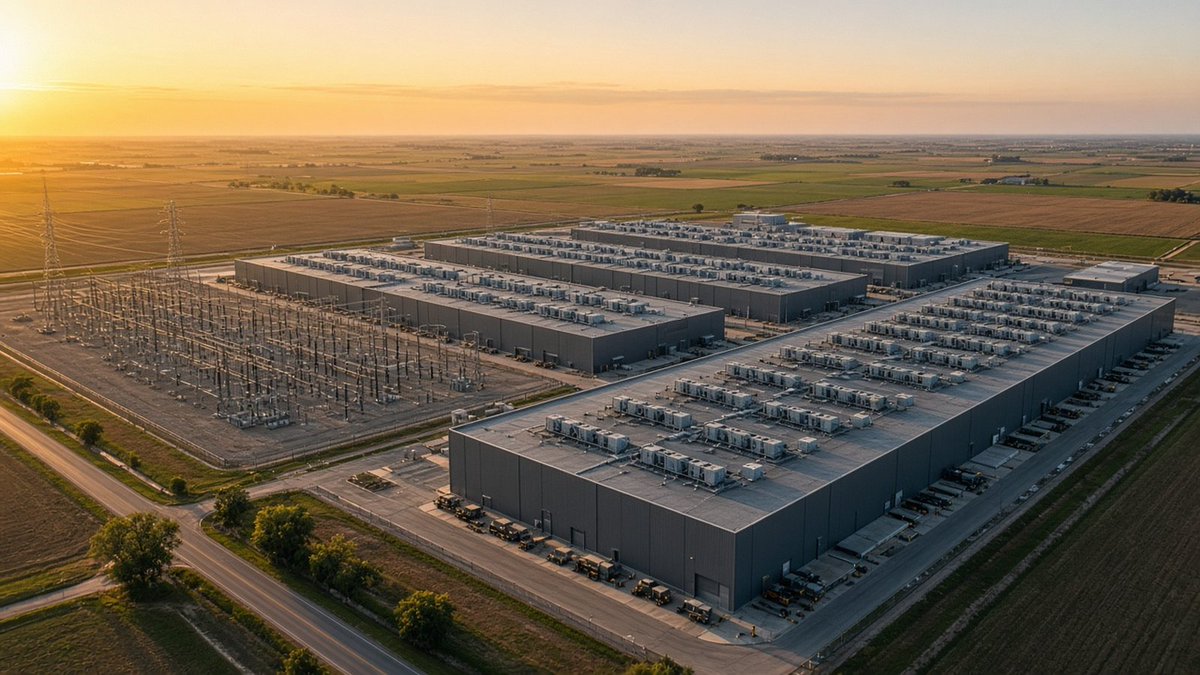
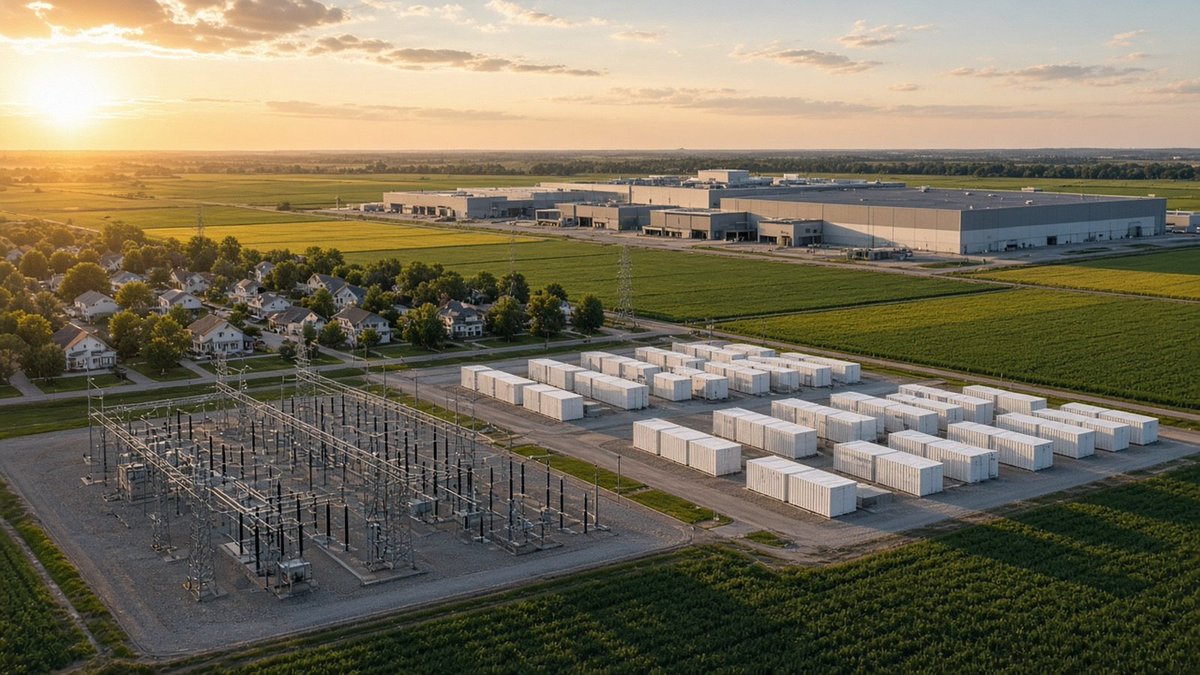
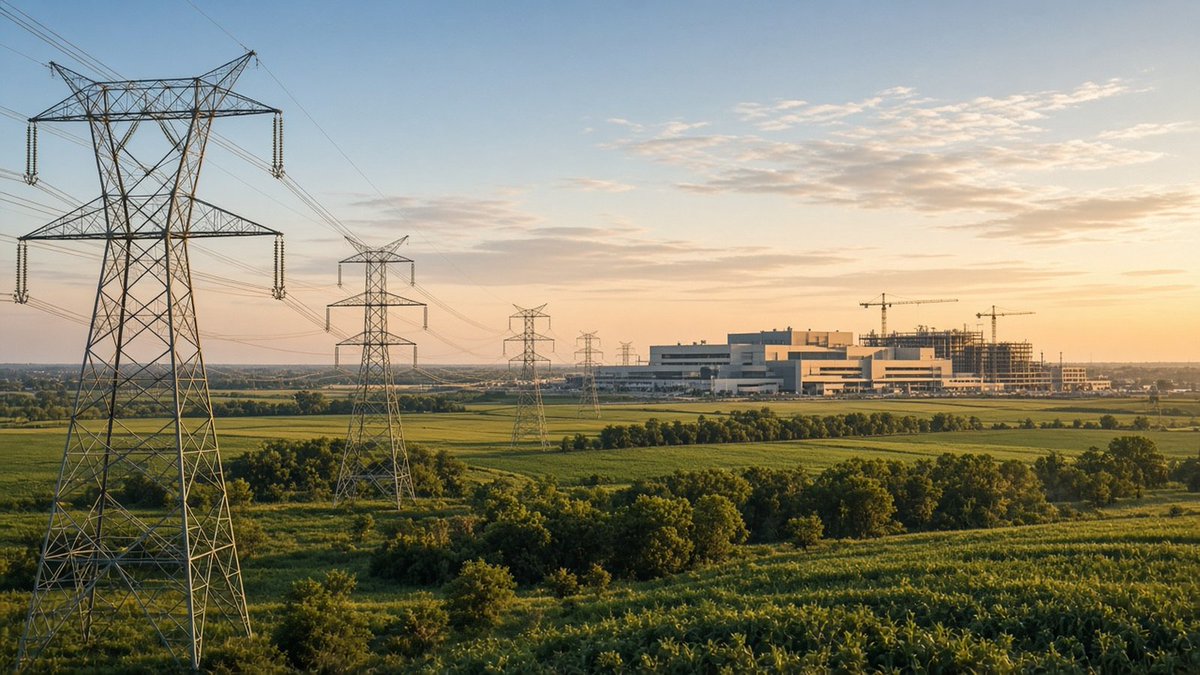
Alberta just drew a 600-meter line around big data centers. Beacon's 1,494 MW Indus gas plant was approved the day before and is grandfathered. The lesson for developers: site discipline and timing are now the moat. My take on what to do next: https://t.co/1S2EAfFiVN
@nvidia stock is down about 25% this month, yet data center revenue just hit $107.6B in one quarter, up 110%.
Demand is fine. The lesson is in @OpenAI's 457 MW @AMD deal with TensorWave: build so you can switch chips without rewriting the business.
https://t.co/MNCj1Rh92L
Amazon is selling 75.1% of 13 data centers to @blackstone for $5B and leasing back every one. 647 MW, a 7% cap rate, about $7.7M per MW.
Hyperscalers are recycling finished shells into capital for the next build. What it means for developers: https://t.co/i5D6Y5fG7N
Microsoft is funding about 1,100 MW of new generation for its Indiana campus, and NiSource expects its data center deals to save existing customers $1.75B. Paying your own way is now the price of admission for big loads. Here's how to move faster. https://t.co/LuBNhHCocf
Your next inference rack may be only half GPU.
Supermicro and SambaNova plan 10,000 decode chips to sit beside NVIDIA GPUs. NVIDIA, SK Telecom and Rebellions just signed a similar split.
Good news for air-cooled megawatts. My take and a checklist: https://t.co/XWLNOjZv9m
A co-op that peaks at 250 MW just got an application for 1,500 MW in phase one. The smart part is the terms: developer funds every upgrade, with protections if the load comes in low. Here is the template and my question for utility operators: https://t.co/VsaAJxjFA8
A data center agreed to fund $100M in winter bill credits for its neighbors.
@TeraWulfInc's 1 GW deal with @KentuckyPower: no rate discount, 90% minimum takes, about $756M in security.
With FERC pushing large loads to the states, this is the template.
https://t.co/4dKYWzDtbk
.@AnthropicAI paid $5B last quarter for compute it didn't book early enough. Now it has $895B committed.
The real lesson for builders, financiers and AI buyers is in the playbook, not the price tag. https://t.co/tcP6mxFPwt
Five nines is dead, and that's good news for builders. @OpenAI just committed up to 1 GW of its 3.2 GW Georgia campus to flex for @GeorgiaPower when the grid is strained. Duke found today's grid can fit 76 GW of new load that flexes. Here's the playbook: https://t.co/O12nL1kMXK
Ohio data centers can wait 84 months for grid power. One project found a faster path.
AEP will build three 765 kV lines for SB Energy's 10.4 GW campus, paid for by SoftBank. The first 800 MW starts on existing wires.
The speed-to-power playbook: https://t.co/8EdaxhYrcd
Alphabet just had its worst day ever. The same week, Google Cloud grew 103%.
@googlecloud, @awscloud and @Azure now hold more than $1.8 trillion in signed future revenue. The bottleneck is capacity, not demand.
The playbook for AI builders: https://t.co/NoorIwlqSE
Malaysia now trails only the US, China and the entire EU in AI compute.
The secret: power it can actually deliver. 5.65 GW of data centers are already on the grid, and they pay for their own grid upgrades.
The playbook, from new @EpochAIResearch data: https://t.co/lEEm7zzv0T
Google just found over a gigawatt of new capacity in America's largest power market. It's coming from homes and businesses, not a power plant.
Neighbors get paid. The grid gets stronger. AI gets its power.
The playbook from @Google and @voltusinc: https://t.co/ZctKq1VKql
@AnthropicAI's @JasonDClinton told security leaders to go to their boards now, for the basics, and hold on for about 18 months.
What's your real time to patch a critical, internet-facing flaw? Hours, days or weeks? #Cybersecurity#AI
Patching once a month is now a breach plan.
PHP shipped fixes for PHP2Shell on Wednesday. Five days later came the first confirmed in-the-wild exploit, on a honeypot running PHP 8.4.26. One point release behind the fix.
Then fix the system, because there will be a next one:
A 72-hour patch clock for critical flaws on exposed systems.
Patch speed written into vendor contracts.
AI pointed at your own code before attackers point theirs at it.
My take: the industry treats opposition as a PR problem. It's a product design problem.
Pauses of 9 to 18 months land right on 2027 to 2028, when much announced AI capacity is due online.
Who wins: the most GPUs on order, or whoever gets a yes? #DataCenters#AI
The biggest threat to the AI boom isn't a chip shortage. It's a Tuesday night county council meeting.
At least $260B of US data center investment has been canceled in 2026 after local opposition, per @heatmap_news. About half of it in Q3 alone.
In Japan, Hitachi, Brookfield, Hartree and Tokyo Gas are designing data centers around on-site power from day one.
The pattern: bring your own power, pay your own way, flex when the grid needs it.