Debito Arudou: Because what Japan is doing to its foreign residents is all within character, and everyone should have seen it coming long ago. #Japan#Sanseito#Racism Link: https://t.co/LaHdqvDd0M
SEPTEMBER 10 -- This week I am finishing the final corrections and the index, and I've just been told by the publisher that release day is set for September 10. You never know, but I suspect this one will sell better than my first book, being as it is a very broad modern history of Japan, written for general audiences. #Japan
SDF FIRES ANTI-SHIP MISSILES
The Self-Defense Forces (SDF) fired anti-ship missiles for the first time from Philippine soil during multinational military exercises, striking a decommissioned warship in waters facing the South China Sea.
Two Type 88 surface-to-ship missiles launched from mobile launchers at Culili Point Sand Dunes in Paoay, Ilocos Norte province, hit the target vessel, the BRP Quezon, within six minutes. The strike occurred about 75 kilometers offshore as part of the Joint Task Force Maritime Strike in Balikatan 2026, the annual US-Philippines drills.
Ground Self-Defense Force troops conducted the live-fire exercise, marking the SDF’s first combat role in Balikatan. Japan deployed about 1,400 personnel, along with warships, aircraft, and the missile systems, joining the United States, Australia, and the Philippines as full participants for the first time. More than 17,000 troops from seven nations took part in the exercises overall.
Philippine Defense Secretary Gilberto Teodoro and Japanese Defense Minister Shinjiro Koizumi witnessed the launches on the ground. Philippine President Ferdinand Marcos Jr. observed remotely via live video from military headquarters in Manila.
The Philippine military described the Type 88 system as designed to defend coastal areas and deter maritime threats. “I’m very, very proud and happy that we were able to pull this off for the first time and it will only get larger in scope with more partners,” Teodoro said.
The drill showcased coordinated maritime strike operations among allies and highlighted growing interoperability. It comes as the Philippines and Japan began talks on defense equipment transfers, including the possible early handover of Abukuma-class destroyers and TC-90 aircraft, enabled by Japan’s recent easing of restrictions on military exports. #Japan #SDF #AntiShip #SelfDefenseForces
ARTICLE 9 REVISIONS PUSHED ON CONSTITUTION DAY: Prime Minister Sanae Takaichi used Constitution Memorial Day on Saturday to reaffirm her government’s commitment to revising Japan’s pacifist Constitution, with a focus on Article 9, the clause that renounces war and prohibits maintenance of “war potential.”
In a video message to a pro-revision rally and in a Liberal Democratic Party (LDP) statement, Takaichi and the LDP declared that the Constitution, unchanged since its enactment under US occupation in 1947, must be revised, allegedly to match the current security environment. The party called for prompt drafting of amendment language in the Diet, including explicit recognition of the Self-Defense Forces under Article 9 while preserving the first paragraph’s renunciation of war.
“Constitutional revision is more important than ever,” Takaichi said, citing evolving threats in the region. The LDP, which holds a commanding majority in the lower house after recent elections, has agreed with its coalition partner, the Japan Innovation Party, to pursue changes to Article 9 and an emergency clause as urgent national security priorities.
Article 9 has defined Japan’s postwar identity as a peaceful nation. It states that the Japanese people “forever renounce war as a sovereign right of the nation” and that “land, sea, and air forces, as well as other war potential, will never be maintained.” Successive governments have interpreted the clause to allow the Self-Defense Forces for exclusive defense, but conservatives argue the forces lack clear constitutional grounding.
Opponents staged large counter-rallies, including one in Tokyo that drew about 50,000 people. They warned that revision could erode Japan’s postwar pacifism and risk entanglement in foreign conflicts. Critics from opposition parties and civic groups called Article 9 Japan’s “treasure” and urged broad public debate before any vote.
Any amendment requires a two-thirds majority in both houses of the Diet followed by majority approval in a national referendum. Public opinion remains divided, with roughly half supporting changes to Article 9 and a strong majority preferring consensus across party lines.
US CRUDE OIL ARRIVES IN JAPAN: A tanker carrying US crude oil arrived at an offshore jetty in Tokyo Bay for the first time since US attacks on Iran began in late February, marking Japan's initial alternative procurement amid the ongoing crisis.
The vessel, procured by oil distributor Cosmo Oil Co., delivered 910,000 barrels—equivalent to about 145,000 kiloliters—destined for the company's Chiba refinery. Loaded in Texas on March 22, it traveled via the Panama Canal in roughly 35 days, the Ministry of Economy, Trade and Industry said.
The shipment underscores Japan's urgent push to diversify supplies after the de facto blockade of the Strait of Hormuz disrupted Persian Gulf crude shipments, which normally account for nearly 90% of the country's imports. Officials described the arrival as a cooperative effort between the government and private wholesalers to ease supply concerns.
The volume falls short of one day's domestic consumption. Japan's daily crude needs average more than 3 million barrels. In response to the crisis, the government has released emergency reserves equivalent to 30 days of demand and freed private-sector stocks for another 15 days.
The Ministry of Economy, Trade and Industry plans to quadruple US crude imports in May from year-earlier levels as part of broader diversification. Energy analysts noted the move highlights vulnerabilities in reliance on a single chokepoint but represents only a modest buffer.
The Iran conflict, which escalated with US and Israeli strikes, has rerouted global oil flows and driven up prices. US exports have surged to meet demand from Asia and Europe scrambling for replacements.
Japanese refiners continue monitoring the situation as peace talks remain uncertain. Officials said further alternative shipments are expected soon to stabilize gasoline, electricity and logistics costs that have begun rising for consumers and businesses. #Japan #Oil #IranWar
15K followers on X! The SNA prioritized Twitter for many years in the 2010s, peaking just short of 15K in October 2022, when Elon Musk bought the platform. Since many of our followers were progressives and were antagonized by Musk's behavior, we saw a collapse of several thousand followers and were routinely encouraged to go elsewhere. We did suspend daily news coverage of Japanese politics. Happy to say, however, that 3.5 years later the SNA feed bounced back and finally reached 15K. (MP)
58 Years Ago Today: On March 28, 1968, radical students at the University of Tokyo, primarily from the medical faculty, forced the cancellation of the university's graduation ceremony through disruptive protests.
The action was part of growing campus unrest over issues including poor working conditions for medical interns, authoritarian university governance, and broader opposition to the Vietnam War and Japan's alignment with the United States.
This disruption drew sharp domestic criticism. University administrators and conservative voices condemned the students for denying fellow graduates their ceremonial rite of passage and undermining academic order. Many ordinary citizens and media outlets expressed outrage at the escalating militancy that disrupted normal university life.
Critics argued the protest tactics prioritized radical political demands over respect for institutional traditions and the rights of non-activist students, amid broader debates on the 1968 student movement—widely seen by contemporaries and later analysts as signaling deepening generational conflict and challenges to postwar Japanese authority structures. #Japan #Students #TokyoUniversity
8 Years Ago Today: On March 27, 2018, former senior Finance Ministry bureaucrat Nobuhisa Sagawa, a central figure in the Moritomo Gakuen land sale scandal, stonewalled questions during sworn testimony before the Diet, repeatedly dodging inquiries by citing fear of possible future prosecution.
Sagawa denied that Prime Minister Shinzo Abe or Finance Minister Taro Aso had ordered the falsification of official documents related to the heavily discounted sale of state land to a nationalist school operator with ties to Abe's wife. He claimed the alterations were done internally at the ministry level.
This performance drew sharp domestic criticism. Opposition parties and media outlets accused him of evasive and contradictory answers, labeling it a deliberate cover-up to shield political leaders. Public distrust in the government deepened amid perceptions of cronyism and bureaucratic opacity.
Critics argued the testimony prioritized protecting the Abe administration and ministerial interests over transparency and accountability, amid broader debates on the scandal's handling—widely seen by opposition voices and analysts as undermining public trust in democratic institutions and the rule of law. #Japan #ShinzoAbe #Transparency
101 Years Ago Today: On March 26, 1925, after a long struggle marked by decades of popular campaigns and repeated failures, the Universal Male Suffrage Bill passed the House of Peers, clearing a major obstacle in Japan's Taisho-era push for democratic reform.
The legislation, which eliminated property and tax qualifications, extended the vote to all men aged 25 and older, dramatically expanding the electorate from roughly three million to over twelve million voters.
This breakthrough drew sharp domestic criticism from conservatives and some elites who feared the influx of working-class and rural voices would destabilize imperial order. In exchange for passage, the government simultaneously enacted the repressive Peace Preservation Law to curb radical leftwing activities.
Critics argued the paired measures prioritized controlled democratization and state security over genuine expansion of political freedoms, amid broader debates on the limits of Taisho democracy—widely seen by later historians as a partial and fragile step toward mass participation that coexisted with growing authoritarian controls. #Japan #Voting #Elections
ARAGHCHI AND ME: Back in 2011, I had some news stories where I sometimes interviewed the Iranian Ambassador in Japan. He was a career diplomat named Abbas Araghchi. Today, he is the Iranian Foreign Minister and one of the most prominent members of the Iranian government.
We met maybe half a dozen times and were on speaking terms. In this shot, I met him as he entered the Japan Foreign Ministry building in Tokyo. He wondered why I was there and gave me this cautious look as he passed.
What is he like? Quiet, serious... Kind of an all-business demeanor. I wasn't surprised that he went on to be promoted. He seemed like the sort of person who was on the rise.
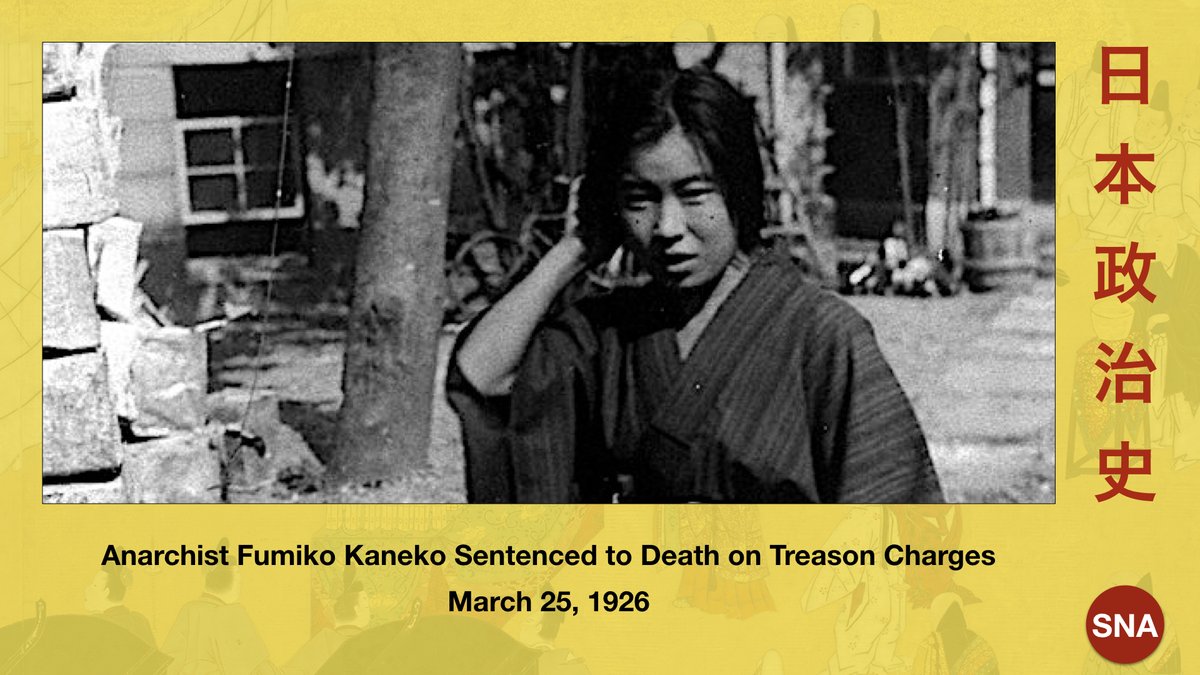
100 Years Ago Today: On March 25, 1926, Japanese anarchist Fumiko Kaneko was sentenced to death on high treason charges alongside her partner, Korean revolutionary Pak Yeol, for an alleged plot to assassinate the emperor and crown prince using bombs.
The pair, arrested after the 1923 Great Kanto Earthquake amid anti-Korean and anti-leftist hysteria, confessed to the conspiracy despite lacking any actual explosives or feasible plan. Their trial became a platform for Kaneko to publicly denounce the Imperial system and assert radical nihilist-anarchist beliefs.
This ruling drew sharp criticism from later historians and activists who viewed it as a politically motivated show trial exploiting vague treason laws to suppress dissent. Critics argued the harsh sentences prioritized state security and imperial authority over justice and individual rights, amid broader debates on the repressive nature of prewar Japan's thought control and use of capital punishment against ideological opponents. #Japan #Anarchism #Nihilism
@ShingetsuNews P.S. Note that the image is not a United Red Army incident, but the Mitsubishi Heavy Industries bomb from 1974 carried out by the East Asia Anti-Japan Armed Front, though members of the two groups did interact. Cultural memory of the militant past is messy and the incidents blur.
@ShingetsuNews It’s also not insignificant that the sentences were never carried out. All New Left convicts on death row have been left to die of natural causes. This makes the sentences performative, whereby the state can appear strong, while avoiding the politically sensitive consequences.
39 Years Ago Today: On March 24, 1987, Japanese courts confirmed death sentences for the first time against members of New Left terrorist groups, specifically upholding capital punishment for two radicals involved in the 1970s United Red Army (Rengo Sekigun) and related militant actions, including deadly attacks and prison escapes tied to the group's violent revolutionary campaign.
This development drew sharp domestic criticism. Civil liberties groups, progressive intellectuals, and opposition voices condemned the rulings as a harsh escalation in the state's crackdown on left-wing radicals, arguing that the death penalty for political violence risked politicizing justice and reviving memories of wartime repression. Public debate highlighted concerns over prolonged trials, potential miscarriages linked to coercive interrogations, and the broader suppression of dissent in a society still grappling with the legacy of 1960s-70s student movements and urban guerrilla activities.
Critics argued the confirmations prioritized state security and anti-terror measures over humanitarian principles and due process safeguards, amid broader debates on the death penalty's application to ideological crimes—widely seen by human rights advocates and legal experts as raising serious questions about proportionality and the risk of abusing capital punishment against political opponents in postwar Japan. #Japan #Terrorism #DeathPenalty
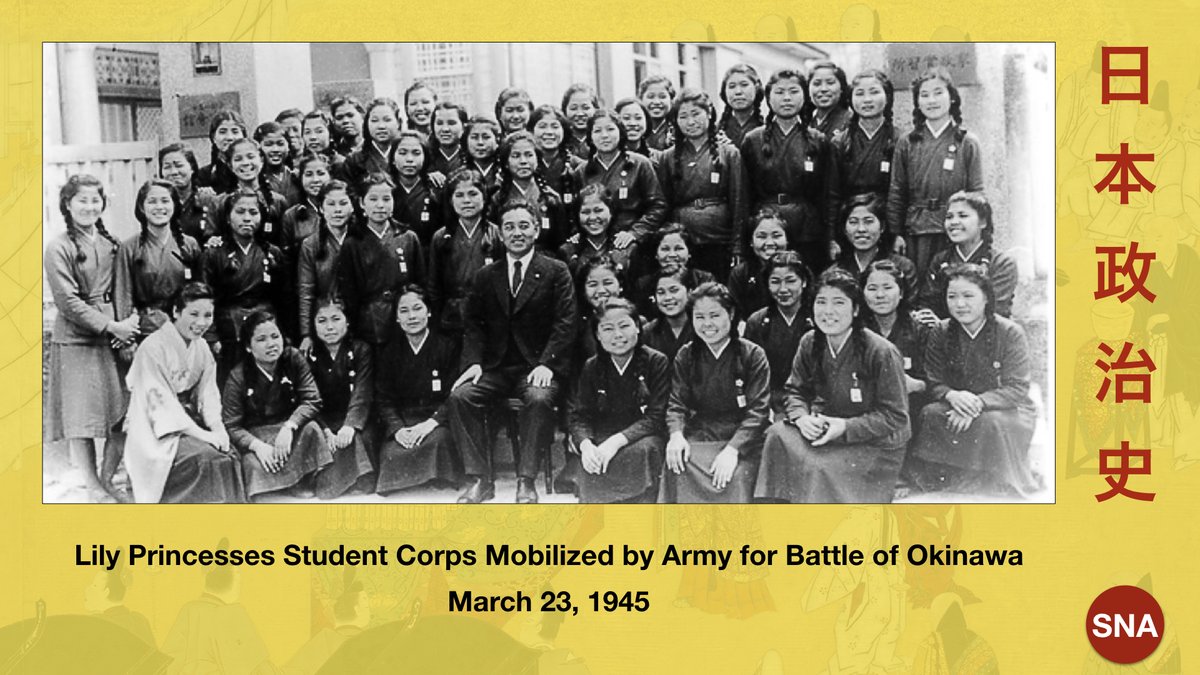
81 Years Ago Today: On March 23, 1945, the Imperial Japanese Army mobilized the Himeyuri Student Corps (also known as Lily Princesses Student Corps or Princess Lily Corps), conscripting 222 female high school students aged 15-19 and 18 teachers from Okinawa's First Prefectural Girls' High School and Okinawa Women's Normal School into a nursing unit for the impending Battle of Okinawa. Late that night, as US forces began intense air raids and naval bombardment, the young women were ordered to report to the Haebaru Army Field Hospital, believing they would serve in safe Red Cross facilities away from combat.
This mobilization drew profound and enduring criticism. Survivors and postwar accounts highlighted the deception—students were thrust into frontline cave hospitals performing gruesome tasks like amputations, burying dead, and transporting munitions under relentless shelling—exposing the military's exploitation of civilian youth, especially girls from elite schools, with no legal basis for such conscription. Public memory in Okinawa has long condemned it as a tragic symbol of wartime desperation, civilian suffering, and the human cost of militarism, fueling antiwar sentiment and resentment toward mainland Japan's policies that treated Okinawa as expendable.
Critics argued the action prioritized military survival over human lives and ethical principles, sacrificing innocent adolescents in a hopeless defense amid broader debates on the war's brutality. 136 of the 222 young students died brutally in the ensuing battle. #Japan #Okinawa #Battle
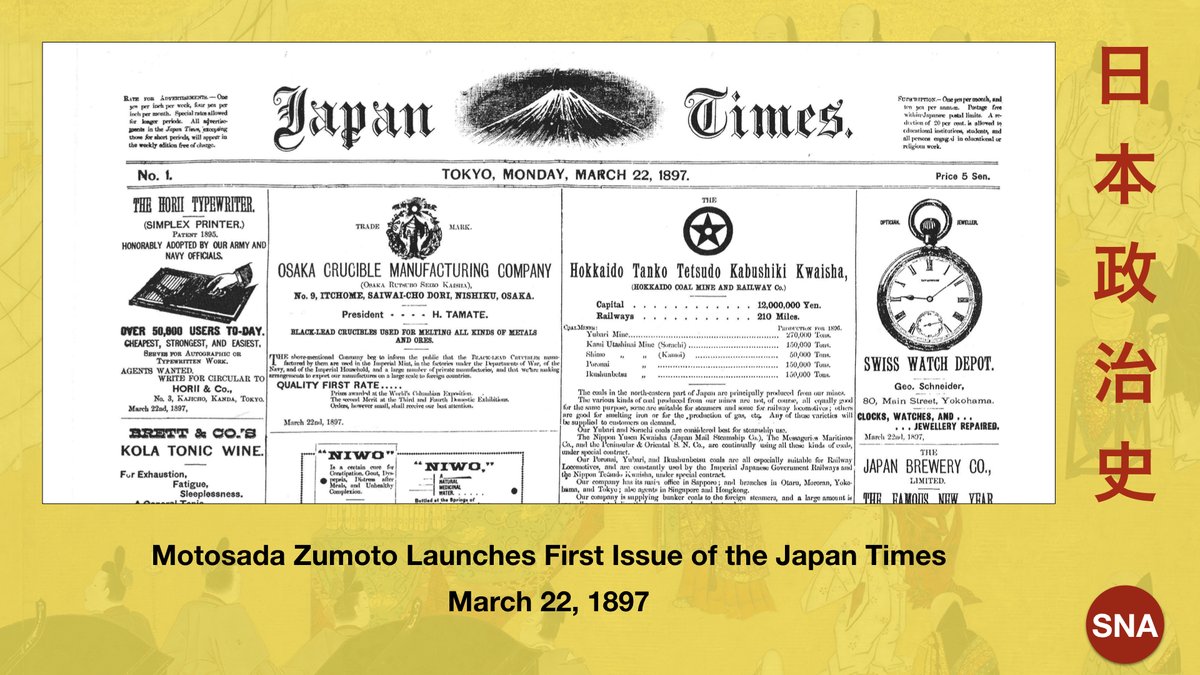
129 Years Ago Today: On March 22, 1897, Motosada Zumoto, a former secretary to Prime Minister Hirobumi Ito, launched the first issue of "Japan Times" as editor-in-chief, with Sueji Yamada as president. This marked the founding of Japan's oldest surviving English-language newspaper, aimed at conveying Japanese perspectives to Western audiences, clearing up misunderstandings between Japan and foreigners, and enabling Japanese readers to engage with global news in English amid the Meiji era's push for modernization and international integration.
This initiative drew sharp domestic criticism in some circles. Intellectuals and nationalists questioned the newspaper's semi-official ties to the Meiji government and figures like Ito and Yukichi Fukuzawa, viewing it as a propaganda tool to present Japan as a "civilized" Western-style nation-state, potentially at the expense of authentic Japanese identity or independence from state influence. Early skepticism arose over its role in shaping Western perceptions to support Japan's diplomatic goals, including rapprochement with powers like Britain, amid broader unease about Westernization's cultural impacts during rapid reforms.
Critics argued the launch prioritized strategic alignment with Western powers and governmental interests over independent journalism or traditional values, amid broader debates on media's role in imperialism and modernization—widely seen by later scholars as serving as a semi-official organ to advance Japan's expansionist ambitions under the guise of civilizational progress. #Japan #Media #JapanTimes