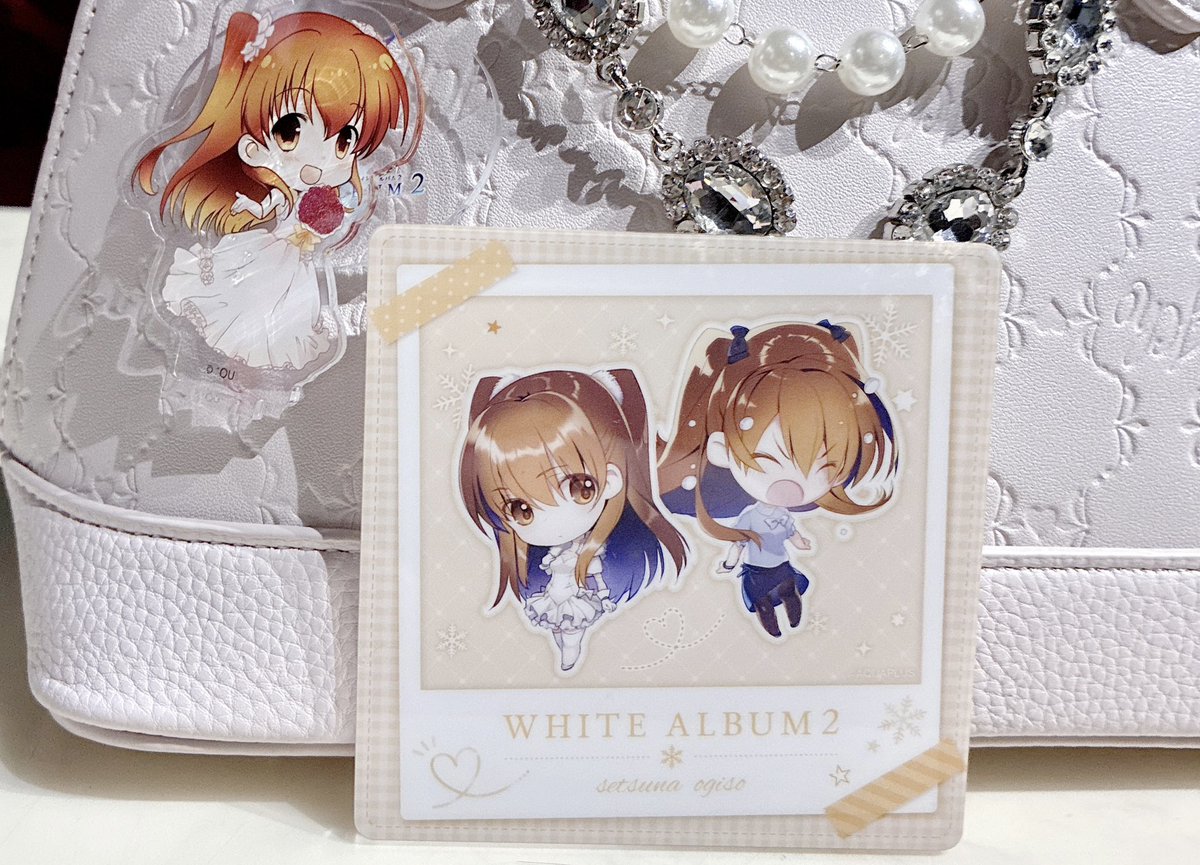
Since yesterday I wrote about Haruki × Kazusa, it would be unfair not to write about Haruki × Setsuna.
(I forgot to note this in the first post, so let me make it clear here: this isn't meant to be an in-depth analysis, so I'll inevitably miss a lot of things, especially regarding their individual characters. This is primarily about their dynamic, but even then, this post still won't cover every aspect of their dynamic.)
Haruki × Setsuna is philosophically fascinating for almost the exact opposite reasons as Haruki × Kazusa.
They aren't meant for each other. They make themselves meant for each other.
Their relationship is constructed through countless small decisions: caring for one another, compromising, apologizing, forgiving, sacrificing, failing, trying again, and ultimately deciding that the person standing before them is still someone worth choosing.
And that distinction is essential. Haruki × Setsuna isn't a story about finding the person who was always meant for you. It is a story about making someone your person.
One of the most interesting parallels between Haruki and Setsuna is that both define themselves through their relationships with other people, although they do so in radically different ways.
Setsuna is deeply relational. She comes from an intact family and has always existed within a dense network of relationships: her family, friends, social circle, and eventually Haruki. Her identity isn't something that can easily be separated from the people around her. Her relationships constitute a significant part of who she is.
This is why separation is so destructive to Setsuna. When she attempts to cut herself off from the people she loves, she doesn't become liberated. She gradually loses parts of herself.
Haruki, meanwhile, approaches identity almost from the opposite direction. He is constantly constructing himself. He wants to be responsible. Useful. Dependable. Kind. Morally correct. He wants to become the person he believes he should be.
In that sense, Haruki is deeply existentialist. His identity is not something he passively accepts; it is something he continuously creates through his choices.
And this is precisely why Haruki and Setsuna complement each other. Setsuna gives Haruki a concrete human world to belong to. And Haruki gives Setsuna someone who doesn't merely love the version of her that everyone else sees, but chooses to remain beside her even after seeing her uglier, more selfish, and more vulnerable sides.
Their relationship isn't based on some mystical compatibility where everything simply falls into place. They build it. Every apology, every compromise, every sacrifice, every act of forgiveness, every decision to try again adds another brick to the structure. They intertwine their families, friendships, futures, and identities.
Haruki and Setsuna don't discover that they were secretly perfect for each other. They become people who can be together. They don't merely fall in love. They build a life around that love. That's what makes them structurally inseparable.
Their relationship is sustained by accumulated history. They have hurt each other, betrayed each other, broken up, forgiven each other, tried again, failed again. And yet every one of those experiences becomes part of the relationship itself.
Their love therefore isn't inferior to Haruki × Kazusa simply because it lacks the latter's overwhelming natural chemistry.
It is answering a completely different question: Can two imperfect people deliberately construct a relationship strong enough to survive everything they do to each other?
Haruki and Setsuna's answer is yes.
This leads to the central philosophy of Haruki × Setsuna.
Love isn't necessarily about finding the one person who perfectly completes you. There may be no predetermined "right person." There are simply people: imperfect people with their own histories, insecurities, desires, regrets, trumas, and flaws.
The important question isn't whether two people were destined to fit together. It is whether they are willing to choose one another and build something together.
This makes Setsuna's relationship with Haruki fundamentally different from the almost instinctive attraction between Haruki and Kazusa. Kazusa and Haruki's relationship is about recognition. Setsuna and Haruki's relationship is something they construct and cultivate.
Her love is therefore deeply connected to the idea of commitment. Commitment doesn't mean believing that the relationship will never hurt. It means accepting that it inevitably will. It means knowing what the other person is capable of, knowing what you yourself are capable of, and still asking:
"Do I want to build my future with this person?"
Haruki and Setsuna repeatedly arrive at that answer.
Yes.
Their love therefore isn't the love of two people who never hurt each other. It is the love of two people who continue choosing each other after discovering how badly they can hurt one another.
This is why forgiveness is so important to their relationship.
Forgiveness in White Album 2 isn't equivalent to pretending that nothing happened.
Haruki's betrayal doesn't become meaningless simply because Setsuna forgives him. The pain doesn't disappear. The past isn't rewritten.
Instead, forgiveness means acknowledging the wound and then deciding what to do with the person who caused it.
And this is perhaps one of the most mature ideas in their relationship: A relationship doesn't become meaningful because it is free of wounds.
Sometimes its meaning comes from what the people involved choose to do after the wound has been inflicted.
The same applies to Haruki. He eventually has to stop seeing himself solely as the person who ruined everything. His guilt is genuine, but guilt can become another form of self-centeredness when it prevents someone from actually confronting the future.
Haruki has to confront the fact that he hurt Setsuna. He has to accept that he cannot undo it. And then he has to ask what he is going to do now. That is where commitment begins.
.
.
.
In Closing Chapter, after their relationship collapses. Haruki and Setsuna don't simply lose each other. They lose the ability to sustain the structure they built together. The relationship becomes frozen beneath the weight of everything they refuse to confront. Music disappears from their lives. Setsuna loses her ability to sing.
They both attempt to escape the past rather than confront it. They don't want to pay for the mistakes they made. They don't want to look directly at what those mistakes have done to them. They don't want to confront the horror of the present. So their lives freeze.
Three years pass. And that passage of time is important because White Album 2 doesn't treat time as something that automatically heals wounds. Sometimes time merely allows wounds to become scars. Sometimes it freezes people in the moment when they were hurt.
Setsuna remains trapped in the past. Haruki remains trapped in guilt. Neither has truly moved forward. The relationship isn't simply dead, it is frozen. And because it is frozen rather than erased, it can still potentially be thawed.
Music is one of the clearest motifs in White Album 2 because the characters constantly lie through words. They miscommunicate, hide things, misunderstand themselves, and rationalize their own emotions.
But their music doesn't lie. Music becomes a form of emotional expression that exists beneath all of their rationalizations.
This is especially important for Setsuna. When she loses her passion for singing, she isn't merely losing a hobby. She is losing a part of herself. Her voice is inseparable from her identity, her memories, and her relationship with Haruki.
That's why it is so fitting that Haruki eventually reaches out to her through his guitar. He doesn't solve everything with another speech. He dusts off his guitar and plays to Setsuna over the phone. They hurt each other with words. But music reaches the part of her that words cannot.
And this is especially significant because Haruki's guitar has itself become a symbol of his relationship with Setsuna. Todokanai Koi originally represented his feelings for Kazusa. But over the course of the story, the guitar gradually becomes associated with Setsuna instead. Haruki dedicating himself to playing it for Setsuna is therefore symbolic. He is taking something that was once associated with his inability to reach Kazusa and transforming it into an expression of his love for Setsuna.
And gradually, Setsuna can sing again. She can become herself again. The White Angel returns to its original radiance. And Haruki can finally move forward.
.
.
.
And then Coda Setsuna True route takes the philosophy of their relationship one step further.
They confront everything together.
They confront Kazusa.
They confront Kazusa's family.
They confront Haruki's family.
They confront the past and consequences of what happened.
Most importantly, they stop lying to each other. Their earlier relationship was built on an endless accumulation of small lies and misguided attempts to protect one another.
"A long, long time ago... Back when our bond was weak, fragile, and back when we'd make mistakes over and over again even as we were trying to be considerate of one another."
The problem was never simply that they lied. It was that their lies created more lies.
"The lies Setsuna would tell for my sake would only hurt me later on, and it would only drive Setsuna further into despair."
Every attempt to protect the other person without actually confronting reality simply postponed the inevitable. They kept piling mistake upon mistake. They made promises because they were afraid that their relationship might disappear. But those promises eventually became chains.
"And we kept piling mistake after mistake on top of each other. In order to erase those mistaken worries, we'd swear a mistaken vow instead. We made promises we couldn't afford to break in our obsessive attempt to tie each other down, because those promises would tear us apart if ever broken."
And this is where Coda resolves the philosophy of their relationship.
Their final commitment isn't:
"I promise nothing bad will ever happen again."
It's closer to:
"Whatever happens, we'll confront it together."
That's a much stronger promise. Because Haruki and Setsuna finally understand that love cannot be protected by hiding reality from each other. It has to be strong enough to survive reality.
.
.
.
In summary, Haruki and Setsuna create each other. And I think that's exactly why their relationship can survive things that should have destroyed it. You can break them apart, bury them under years of guilt and regret, and somehow they still find their way back to each other.
Because beneath all the lies, betrayals, guilt, and suffering, there is something neither of them can completely destroy: the authentic desire to be with the other.
Their unconditional love isn't contained in the absence of conflict. It is contained in their unconditional acceptance of each other. They know exactly how flawed, selfish, and hurtful they can be. They've seen the worst sides of each other, they've hurt each other, and they've both had to live with the consequences. And yet, after all of that, they still choose each other.
Setsuna and Kazusa discussing who are they gonna support in Maruto-san's new work
Setsuna: “I think I want to root for Hikari-chan…”
Setsuna: “There’s no such thing as being ‘too late’ when it comes to love…”
Kazusa: “…I’m on Ayami’s side… Ayami was there first.”
I SEE what you did there, Maruto-san😭
After 3 whole years of not being herself, Setsuna can finally sing again. Her voice is inseparable from her identity, so seeing her reclaim it feels so incredibly meaningful🥹 truly life changing route
I wanna reread Closing Chapter Setsuna route so bad arghhhh
@animelover33411 Well, in both True routes, Haruki basically comes to see Setsuna's and Kazusa's mothers as maternal figures in his own life too (tho, ofc there’s a difference between how he sees Akina and Youko)
I mean, depends on which Haruki do you talk about...
-The altruistic representative student
-The hard-working office worker
-The Haruki who "loves" Kazusa
-The Haruki who maintains an "ethical" social circle with Setsuna
Etc.
These aren't simply different sides of the same clearly defined personality. A lot of them function almost like social identities or masks that Haruki constructs around himself. He has an incredibly strong sense of what he should be, but a surprisingly weak sense of what he actually wants to be. That's why he seems to be capable of shedding one identity and taking on another.
And ironically, despite how much time we spend inside his head, a lot of his introspection is filtered through morality and responsibility rather than genuine self-examination. He’s constantly asking himself whether he’s a good or bad person, but not necessarily what he himself actually wants.
Yeah, this guy genuinely has to be one of the most complex characters ever. Haruki's paradox is best executed in Coda, so you will understand more once you read it.
she looks like a loser but that's okay bc its her appeal somehow she still got her cool aura even while wearing this lame ass outfit and that's something only she can do
she looks like a loser but that's okay bc its her appeal somehow she still got her cool aura even while wearing this lame ass outfit and that's something only she can do