$SHOEBOX is live on @Arguspad.
Books for a company wallet on Arc.
CA: 0x3c7dc69cd29daf3bc2ba8570fad5a8ad7f39b08d
X: https://t.co/unR5OIDQfl
Web: https://t.co/0sK1c3zJh5
Only trust the CA posted by this account.
https://t.co/ja9p1UU7nI
Get ready. $SHOEBOX launches on @Arguspad soon.
Turn on notifications and wait for the official CA from this account, @ShoeboxBooks. Any CA shared before we post it here is fake.
Stay sharp.
On Arc, gas is paid in USDC. Those small outflows belong in the books too.
In SHOEBOX’s example ledger, gas has its own label. Open a line and you can see why it was classified that way.
The details matter when you close a period.
A ledger should leave the screen.
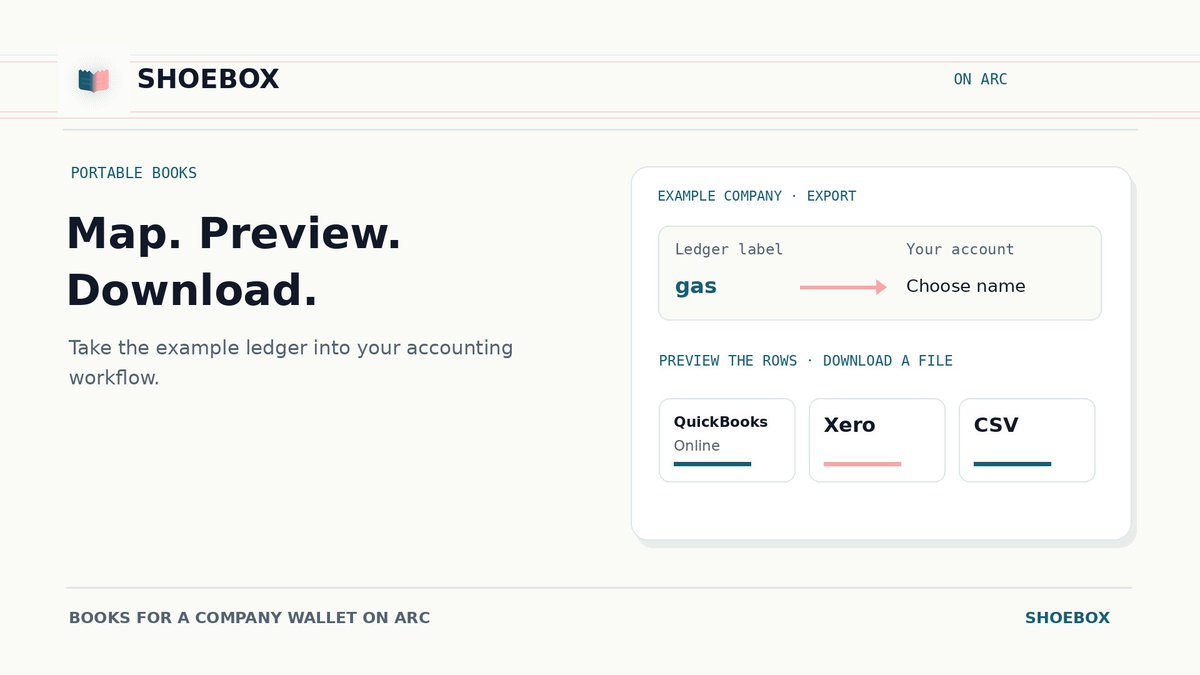
Map labels to your own account names, preview the rows, then download a QuickBooks Online, Xero or CSV file. Exports currently use the example company’s ledger.
Ask in words. See the rows behind the answer.
In the example company, SHOEBOX matches a question to a ledger query, adds the matching rows in code and shows those rows beside the result. The model does not invent the total.
A label is useful when you can see why it was chosen.
In the example ledger, SHOEBOX applies fixed rules across seven labels and shows the reason on each line. If no rule fits, the line stays unsorted.
A company wallet can hold working capital and still leave its accountant with a wall of hashes.
We built SHOEBOX to make labels explainable, answers traceable and records easier to hand over. The walkthrough, including what works today, is in the Article. https://t.co/z8xYvigd1L
A company wallet deserves books, not a wall of hashes.
Meet SHOEBOX. Read live USDC and EURC balances on Arc, then explore how a labelled ledger works through an example company. Reads only. Never signs or pays.