👏🇦🇺 Irankunda received a STANDING OVATION from the Sporting Club fans after his performance against União Desportiva da Serra!
Here are his best moments!
🇵🇹 Taça de Portugal | November 21 - May 30 | SBS On Demand 📺
🚨🇧🇪 𝐎𝐅𝐅𝐈𝐂𝐈𝐀𝐋 | Belgian club Genk have opened their new training ground! 🏠✅
It cost them €20m. It contains three training pitches, a 1,400m² gym and state of the art recovery facilities. A huge investment in the club's future. 👏
1 of the best-paid teams in the world,w best elite environments:40 personal staff,business flights,5 ⭐️hotels, private chefs N baristas n still not happy.
4 a nation that isn’t even in the top 10.
Instead of knocking game when it’s at its lowest, maybe play for pride n not greed
🌍 Piccolo atlante tascabile delle multiproprietà nel calcio mondiale.
Naturale sviluppo del modello di business o forma speculativa contro gli interessi dei tifosi, sopratutto dei club “minori”?
The headline news from today's Independent Football Regulator press conference in Manchester was that the chair, David Kogan, said he "would resign" if there was any political interference from No 10 in his role. Kogan emphasises that he would not be paying any attention to any UK trading relations in deciding whether a club owner was a fit and proper person to own a football club.
There was inevitable focus on the Manchester City story and nation states owning English clubs but, more broadly, the IFR focused on the number of English clubs on the precipice in the publication of its long-awaited "State of the Game" report. The game's in a bit of a state. Of the 116 clubs in the top five tiers of English football, “32 would not survive 30 days without owner funding. 73 would not survive 90 days”, according to the IFR.
94% of clubs made losses in 25/26. 60% of EFL and National League clubs are “technically insolvent”. 17 clubs (11 EFL, 6 NL) would be loss-making even if the players played for free. “This is an alarm call for English men’s professional football that must precipitate real and lasting change,” says the Football Supporters’ Association’s chair Tom Greatrex.
“The State of the Game report clearly highlights the unsustainable, broken model of football’s finances. How is our national game, which generates billions in revenue every year, in such a perilous condition with so many clubs living hand-to-mouth and reliant on regular handouts from owners?”
The IFR chief exec Richard Monks emphasises that “we are not saying football is about to collapse like a pack of cards. We are saying financial risk increases and action needs to be taken.” Main points from today’s press conference with Monks and Kogan at the National Football Museum…
On wages. Between 21/22 and 25/26, average player wages cost grew by 33% in the PL, 32% in Championship, 71% in League One and 63% in League Two. Salary cap? Would require Government legislation. Kogan: “We have no statutory authority whatsoever (to tell) a club how to spend its money on players or not to spend it on players.”
On growing divide between the divisions. PL revenues have grown 33 times since 1992. L2 revenues grown only 7 times. IFR: “The pyramid is being stretched between the top and the bottom. It has cliff edges.”
On the “New Deal” of redistribution of broadcast money between PL and EFL. Talks continue this week. IFR “been facilitating those conversations for the last four or five months. We have a pretty confident feel about this.” If PL and EFL don’t reach agreement, IFR “will not hesitate to use all the powers at our disposal to bring about lasting change”. ie the back-stop to force a deal through. On parachute payments. Kogan: “Our report concludes clearly that parachutes are necessary.”
On the changing nature and identity of owners. Kogan: “The type of owners has changed." Less collective. "Individual owners now trying to fight individual corners. Not on the pitch but through lawyers.”
On Manchester City situation (found guilty of financial breaches, vigorously denied, currently appealing) and whether its UAE owners are fit and proper. Kogan straight bat: “There is an appeal process going on. We don’t know the outcome of that judgement. So we can’t make any specific judgement. City will argue they have clearly right on their side, as they have argued all the way through, and that will be tested (looked at) by the new independent commission.” Before IFR can make any call.
On nation states like UAE with City and Saudi Arabia with Newcastle United owning PL clubs. Kogan: “We are governed by legislation that does not preclude state ownership of football clubs.” So the horse has bolted? Interestingly....“You never know because others in Government may now be looking at the legislation as it was originally written. We may enter a discussion in the fullness of time regarding whether our powers need to be changed in any sort of way.”
On those geo-politics, strong UK trading links with UAE and the IFR’s independence. Kogan: “The original legislation (for the Football Governance Bill) by the Conservative Government had in it a reference to ‘we have to take regard for some British trade relationships’ - that was removed from the legislation. Our independence is absolute. My independence personally is absolute. I made it very clear last year in a piece in The Times that any form of political interference on the way we operate would result in my resigning this role. I stand by that. I want to make it crystal clear that we come under absolutely no political pressure on this (City) or any other topic. And I don’t expect to in the future.”
IFR can force owners to sell if found to be unfit owners. “We have powers within the legislation that allows us to review not only owners, directors and senior executives, but also whether those owners are fit and proper people to run clubs going forward. That process is reliant on us having very detailed information that would require us to have investigation and then we would make a judgement on legal advice that we receive.” IFR can appoint a third party to sell any club.
Club licensing. From November, every club needs to go for a provisional licence issued by IFR.
Cost of Agents. “A significant and increasing cost to football clubs”. IFR working with clubs, leagues and Government to address “concerns” about agents’ fees.
Positives? Ish. Confirmation that the IFR was needed. Kogan found that when talking to club execs and owners “they all repeatedly say ‘we want regulation’. They think that at some point they are going to get into trouble. Stability is what the pyramid needs.”
Monks adds, “English football is a massive success story. We should not lose sight of the success story now worth £9 billion in terms of revenue. Most popular league in the world. Deepest pyramid in the world.” But at risk. Handle with care. That’s why the IFR, the fans’ friend, was brought in. The State of the Game report concludes... the game's in a bit of a state.
⚽ En el fútbol moderno conviven distintos modelos de propiedad. Entenderlos evita confusiones. 🧵
👥 1. Tradicional (Club Social)
El club pertenece a sus socios, que votan al presidente y al consejo directivo.
Ej: River, Flamengo, Palmeiras, Barcelona, Real Madrid, Boca.
🏢 2. SAD Deportiva
El fútbol se separa en una Sociedad Anónima.
🔒 Privada — el control está en accionistas privados y no cotiza. Ej: PSV, Villarreal, Atalanta.
📈 Pública — cotiza en bolsa / capital abierto. Ej: Ajax, Porto, Benfica, Sporting, Galatasaray.
🏭 3. Empresa privada
El club es propiedad de una empresa o grupo empresario. Puede cotizar una parte en bolsa pública.
Juventus → familia Agnelli (Exor)
RB Leipzig / Salzburg → Red Bull
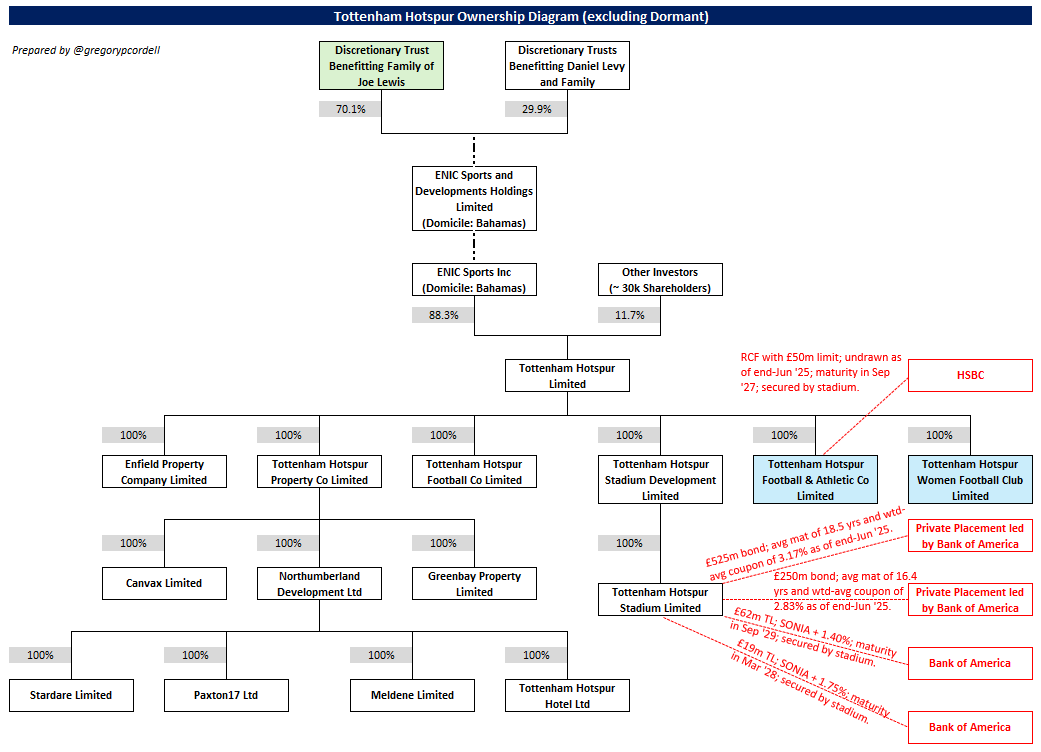
Tottenham → familia Lewis (ENIC).
America (Mex) → Cotiza en bolsa como Ollamani.
💰 4. Vehículo de inversión
Fondos o capital soberano que compran el club como activo financiero.
Manchester City → 🇦🇪 Abu Dhabi (City Football Group)
PSG → 🇶🇦 Qatar (Qatar Sports Investments)
Atlético de Madrid → Ares Management + Quantum (Idan Ofer)
Millonarios → Amber Capital (fondo con sede en Londres)
🇩🇪 El modelo alemán del 50+1 es distinto. Merece un post aparte.
Como venimos indicando: la figura jurídica importa.
Pero importa más entender quién controla, con qué proyecto y con qué reglas.
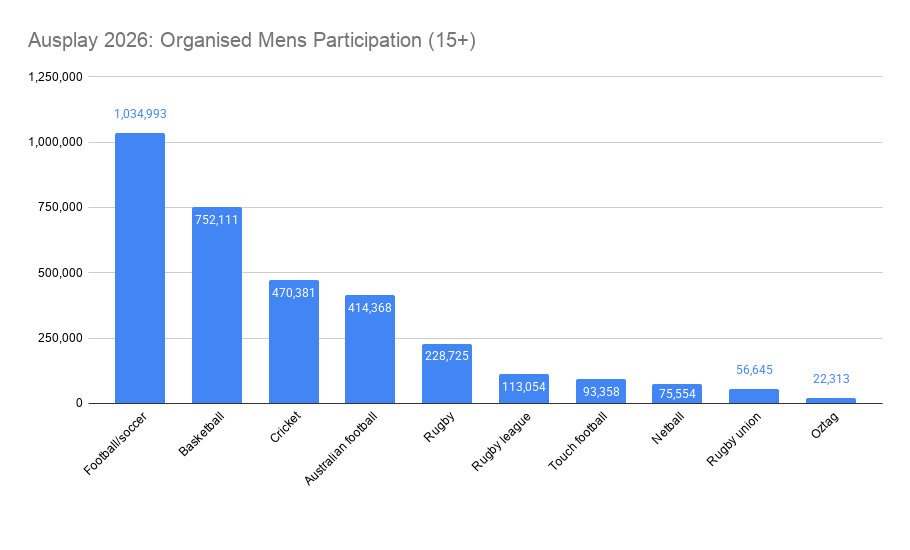
People always mention Japan when talking about building the Australian football pyramid... but what can we actually learn from the J.League? 🤔🇦🇺🇯🇵
It isn't so much about promotion and relegation.
It's how they got there and why they had to evolve in the first place.
FULL STORY: https://t.co/n8zUZ7pmTk
I’ll say it again for the umpteenth time… only Pro/Rel in a united ecosystem can ignite Australian football… uniting, inclusive & aspirational… the pathway is a national 2nd division in winter comprised of established clubs… it just needs @FootballAUS to step up. Will it?
With the recent focus on shocking football governance - FIFA, FA finances and AGM, WU debacle at AL level and in FV comps, - it's relevant to revisit FV's and FA's incompetent governance of our women's game 10 or so years ago.
In 2016, the Vic NPL Women kicked off. At the end of this post I've included our current table with all 14 teams now and a FV extract about the 8 or 9 teams, (can't remember), which started. In 2016, the comp was comprised of conjured teams Southern Utd, Geelong Galaxy, Calder, which took over from Keilor Park, Alamein from Ashburton and a Bayside new concoction from the area.
Add the National Training Centre (NTC) and only 3 existing clubs (!), close it off - no pro/rel - and hey presto, real comp erased and a silly, ideological concept was commenced. A bureaucratic nightmare, borne of some fashionable stupid idea to 'make' Matildas and ALW players, and to eliminate clubs, was launched with a whimper.
Despite being Champions in 2015 and one of the Australia's strongest clubs, SMFC was excluded, along with Lakeside stadium and its support.
Apparently its written application wasn't up to scratch! True. Let that sink in.
SMFC took legal action against FV, settled and got in a year or so later. Booroondara, the other finalist in 2015, was also left out. Why include the best teams in the top competition when you have an agenda and an ideology?
Since then, the ridiculous, damaging idea of the NTC has finally been scrapped. Galaxy and Southern disappeared into the ⚽️ wilderness they never came from and have been resuscitated into the VPL. Bayside has joined Bentleigh Men's and is a good club now. Having basically taken over from Keilor Park, Calder was successful, but was sacrificed to give the ridiculous concept which was WU a ready ALW team. Now WU has been hibernated to death, we're back to KP. A proper club.
The competition is populated by the strongest clubs and, egregiously, by AL teams while none of the clubs can play AL. But at least we have pro/rel and the strongest clubs on merit.
Allow competition and the best rise. The ill-advised confection foisted on Vic women's football in 2016 has effectively been erased but the damage it caused to clubs and players over almost a decade cannot be overstated. Driven by our thrall to 'making' Matildas and ALW players, while eliminating the role of our strongest clubs, this numnut ideology has passed. But I'm not confident it's been buried. None of the clueless administrators responsible have been held accountable. They've all gone while the clubs they tried to kill battle on. They are the central platform for our game and should be celebrated, promoted and helped. Governing bodies should resist any idea which reduces or restricts their role.
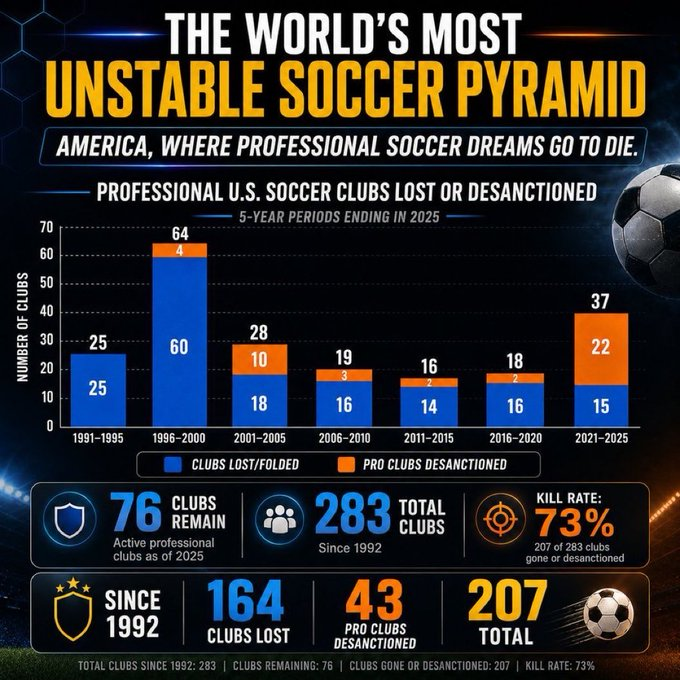
The debate over youth development in the United States is woefully incomplete without confronting the crisis facing our professional clubs.
How can professional clubs invest in the long-term development of players when 73% of U.S. pro clubs launched since 1992 have failed?
Without promotion and relegation, player development solidarity payments, and club survival stability, there is no structural incentive for teams to orient themselves around long-term player development goals rather than short-term survival. An improperly structured pyramid devolves into a short-term cash grab rather than a system designed to prioritize player development and club sustainability.
Long-term, our national teams suffer. The Title IX advantages on the women’s side are being eroded as other countries adopt properly structured pyramids that give professional clubs real long-term incentives to invest in development and stability, rather than short-term results.
Has anyone heard U.S. Soccer leadership address this? Do they care about building sustainable clubs, or only protecting MLS and the closed system? Are they not even curious about what is going on? Why is the rest of the world so much more stable than the American system?
We've been experimenting with closed soccer for over 100 years, and the failures are staggering. Why don't we try the system that's proven to work in 100+ countries where soccer is #1, instead of a system that hasn't worked to build the sport in any of them?
It is time to fully embrace the principles that made soccer the world’s number-one sport, not force the game into a cookie-cutter version of the closed American sports model that has failed our sport for a century.
@jtbatson, @cone_cindy, @thesoccerdon, @ussoccer
U.S. Soccer’s job is to protect and grow the entire American soccer ecosystem: professional clubs at every level, amateur teams, independent academies, youth organizations, players, coaches, referees, supporters and communities across the country.
MLS is just a small part of that system.
@ussoccer must govern for the whole sport, not function as the political shield or commercial partner of one league. Its duty is to strengthen open competition, protect the U.S. Open Cup, support lower divisions and create opportunities for clubs and players across the country.
I summarized Spain’s style to four things:
1) Constant support around the ball
2) Individual ability to escape pressure
3) Recognition and execution of ‘Speed Up’ moments
4) Final third quality to combine, Futbol de Plaza
In a future tweet I will outline how this is developed.
Tácticamente el primer gol de Argentina es un error garrafal de Inglaterra.
Miren lo que genera Messi que Anderson, decide perder la marca de Enzo Fernández para ir a encimarle.
This World Cup has shown how Argentinian players are just built different, and it was interesting because, in the press conferences, both managers addressed this.
First, Tuchel talks about the Argentinian value of the ball and how they protect the ball at all costs, how they manage those small spaces, and how they learn this from a young age. He references culture, and this is exactly it. A child playing in a certain environment leads to that. Not every Argentinian child is on the national team, but it raises the ceiling. It creates a certain type of style and a certain type of player.
Then Scaloni also references his culture. He sees them play without fear of losing. It comes from playing in an environment where you are constantly faced with the potential of losing and being able to play with that pressure, right? They don’t fight against it. They play with it. They use it.
And I think this is where youth football coaches should really take note. This does not mean we should copy and paste Argentinian culture into every training environment, because culture cannot just be copied. But the values within that culture can be inculcated in every training environment. The value of the ball. The courage to receive it in small spaces. The ability to protect it under pressure. The confidence to keep playing after a mistake. The willingness to play with the possibility of losing rather than constantly trying to avoid it.
Those values can become part of the environment we create every day. They can be present in the games we design, in what we praise, in what we allow players to struggle with, and in how we respond when they lose the ball. If every mistake leads to the coach stopping the session, giving the answer, or taking the pressure away, then players never learn to play with that pressure. They learn to wait for the coach.
It was cool to see how two managers, at such a big stage, reference culture and the environments that kids play in when they’re young. Because the players we see on the biggest stage were not only created by tactics or coaching information. They were created by environments that taught them what to value, how to relate to the ball, and how to play when there was something to lose.