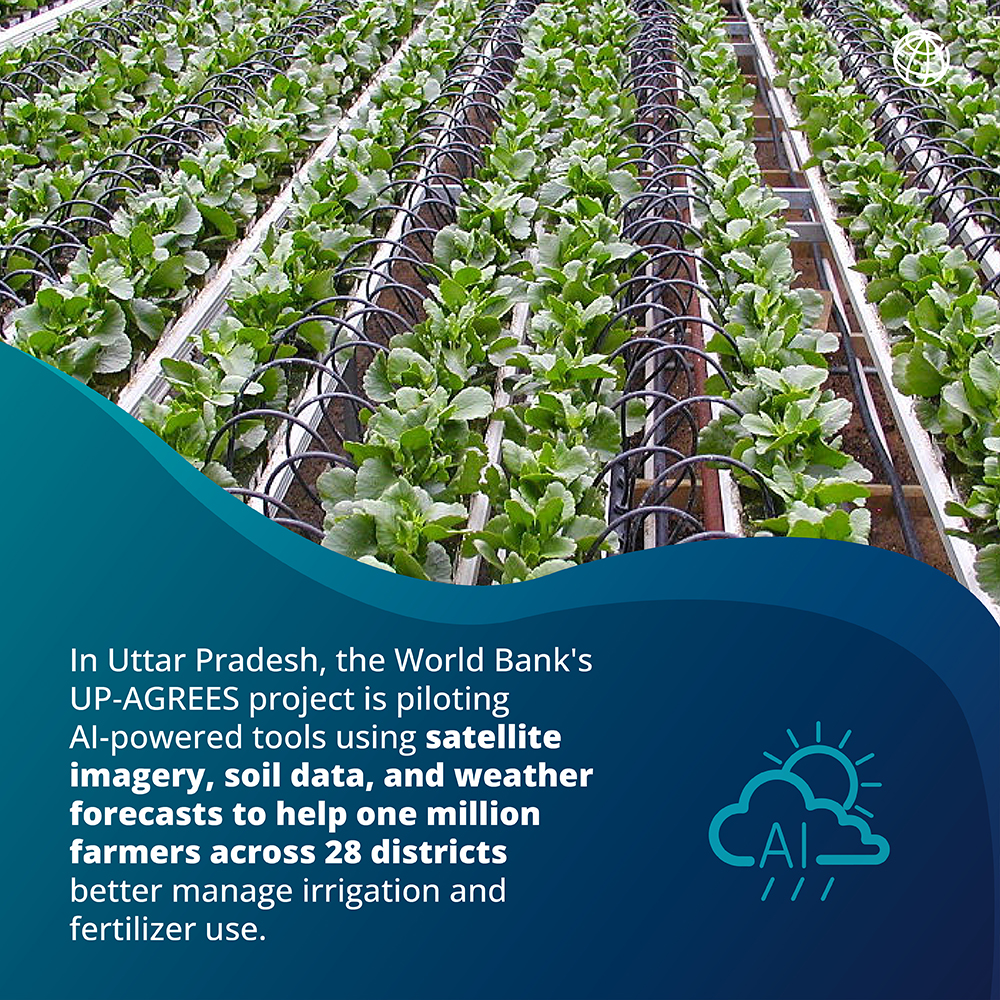
Agriculture consumes 80–90% of India's water —2–3x more than China or Brazil.
The strain is showing: groundwater tables are falling.
@WorldBankGroup is helping India modernize irrigation—from AI-powered farming to last-mile water delivery.
https://t.co/femPc1weL3 #WaterForward
Agriculture consumes 80–90% of India's water —2–3x more than China or Brazil.
The strain is showing: groundwater tables are falling.
@WorldBankGroup is helping India modernize irrigation—from AI-powered farming to last-mile water delivery.
https://t.co/KufXY0jUQF #WaterForward
The global agricultural system is running on a diagnosis that is 10,000 years old.
The diagnosis is that farming requires human labor. You plant seeds. You pull weeds. You spray chemicals. You harvest crops. You repeat. The fundamental unit of agricultural productivity has been one human working one field.
This diagnosis produced every civilization in history. The domestication of wheat in the Fertile Crescent. The rice paddies of Asia. The cornfields of Mesoamerica. The wheat belts of North America. Every society that ever existed was built on the premise that someone has to physically work the land.
The diagnostic failure is that this premise produced a system that cannot scale to feed 10 billion people on a warming planet without destroying the ecosystem it depends on.
The system is precise in its failures. The world uses approximately 4 million metric tons of pesticides per year. Only 1 percent of applied pesticide reaches the target pest. The remaining 99 percent enters the soil, the water, the air, and the food chain. This is not a design flaw. This is the design. Broadcast spraying was invented because humans could not see individual weeds at scale. The solution was to spray everything and accept the collateral damage.
The global agricultural system loses approximately 40 percent of potential yield to pests, diseases, and weeds. Despite 4 million tons of chemicals. Despite a global pesticide market valued at 84 billion dollars. Forty percent of potential food is still destroyed.
The diagnostic question was never how to produce more chemicals. The question was how to apply intelligence to individual plants at the scale of millions of acres.
For 10,000 years, the answer was: you cannot. A human can walk a field and identify a single diseased plant. A human cannot walk 10,000 acres. A human can pull one weed by hand. A human cannot pull every weed in a 10,000-acre farm. The intelligence required was always there. The scale was not.
In June 2026, the scale arrived.
Mahindra and Mahindra commenced the rollout of autonomous tractors across Punjab and Haryana, the grain belt of India. The tractors are equipped with LiDAR and computer vision. They plow, sow, and harvest without human intervention. Precision GPS provides sub-inch accuracy. Obstacle detection protects livestock and structures. Remote monitoring tracks fleet performance via mobile app. Adaptive torque control adjusts for variable soil conditions across different crop cycles.
The rollout addresses a specific structural problem. Urban migration has emptied India rural workforce. The grain belt that feeds 1.4 billion people faces acute labor shortages during critical planting and harvest windows. The autonomous tractor replaces the labor bottleneck with an autonomous platform that operates continuously.
Niqo Robotics, selected to represent India at Bharat Innovates 2026 alongside Prime Minister Modi and President Macron, deploys Niqo Sense, an AI camera platform that retrofits onto existing farm equipment. The system combines edge AI with a dual-tank twin-nozzle architecture to perform weeding, thinning, and beneficial spraying in a single pass. The AI camera identifies individual plants and applies inputs only where needed.
Veda Robotics launched the Veda-Agra humanoid in Bengaluru. Dual-arm configuration. 50-kilogram lift capacity. Tactile fingertip sensors for delicate crop handling. Proprietary AI trained on Indian agricultural data. Base price of 18 lakh rupees, approximately 21,500 dollars, versus imported alternatives exceeding 50 lakh rupees. A leasing model makes it accessible to agricultural cooperatives. Targets 500 units by year-end.
The diagnostic reframe is that India, not the United States or Europe, is becoming the proving ground for agricultural autonomy. The reason is structural. India has 152 million hectares of arable land, the second-largest in the world after the United States. It has the world largest workforce dependent on agriculture. And it is losing that workforce to urban migration faster than any other major economy. The pressure to automate is existential, not optional.
The WeLASER project in Europe deployed an autonomous vehicle equipped with a 507-watt high-power laser and an AI vision system that identifies weed meristems and destroys them with targeted laser pulses. The system recognized and differentiated plants with over 90 percent mean average precision. It identified weed meristem positions with over 75 percent mean average precision.
No chemicals. No spraying. A laser kills the weed at its growth center. A 2024 Frontiers in Plant Science study found that weed species were most vulnerable to laser treatment at their youngest growth stage, meaning the system must operate continuously, detecting weeds before they mature.
Saga Robotics deployed Thorvald, an autonomous robot that treats grapevines with UV-C ultraviolet light at night to control powdery mildew. No chemicals. No daytime disruption. The University of California ANR Innovate program will demonstrate the system at its June 30 field day at the Hopland Research and Extension Center in Mendocino County.
TRIC Robotics demonstrated two autonomous field robots processing 60 acres of commercial strawberry fields in Santa Maria, California, in a single night. The robots combine an autonomous platform with UV-C ultraviolet radiation and a vacuum insect trap. No chemicals. No human labor. The company reported a 35 percent reduction in pest and disease impact.
Intelinair launched the AGMRI AI Agent for the 2026 crop season. The system lets agronomic advisors and growers ask questions in natural language and receive field-level answers in seconds. Hybrid performance by county, soil type, or productivity zone. Replant prioritization. Nitrogen timing. Fungicide application guidance. Breakeven and profitability analysis at the field or hybrid level. The AI Agent processes multi-source imagery, soil data, weather, inputs, and historical yields.
A review published in Plants documented that AI crop disease detection models achieve 92 to 99.75 percent accuracy on rice diseases. Drone-based multispectral systems achieve 97.3 percent pest detection accuracy. Intelligent spraying systems that adjust spray volumes by canopy characteristics reduced chemical use by 28 percent.
The diagnostic reframe is measured in these numbers.
4 million tons of pesticides per year. 99 percent missing the target. 40 percent of potential yield still lost. 84 billion dollar global pesticide market producing 60 percent of potential food.
Mahindra autonomous tractors with sub-inch GPS. Niqo Sense AI camera retrofitted to existing equipment for single-pass weeding and spraying. Veda-Agra humanoid at 21,500 dollars with tactile sensors for fruit. WeLASER 507-watt autonomous laser weed killer at 90 percent precision. Thorvald UV-C robot replacing fungicides in vineyards. TRIC robots processing 60 acres overnight with 35 percent pest reduction. AGMRI AI Agent answering field-level agronomic questions in seconds. AI disease detection at 99.75 percent accuracy.
The diagnostic was never that agriculture needed more chemicals. The diagnostic was that agriculture needed intelligence at the scale of individual plants across millions of acres. For 10,000 years, the intelligence could not scale because it required a human brain walking a field.
The intelligence now scales because it is not human. It is AI vision on an autonomous platform operating continuously across any terrain in any weather at any time of day. The diagnosis was correct. Farming requires intelligence. The treatment was wrong. The treatment was not more chemicals. The treatment was more intelligence applied at the point of each individual plant.
The chemicals were a substitute for the intelligence that could not scale. The intelligence can scale now. The chemicals are becoming obsolete.
In this episode of #BuildForIndia, Manas Upadhyay, Founder & Chief Technology officer of @DtownLimited , shares how drones and field robots are helping farmers improve efficiency, reduce costs, and enhance crop outcomes across India.
With deep-tech innovation built in India, Dtown Robotics is transforming agriculture through AI, robotics, and autonomous systems creating real impact from farms to food systems.
He also credits the nasscom DeepTech Club for four years of mentorship and exposure across commercial and government opportunities in the sector.
The future of Indian farming is being engineered at home.
#BuildForIndia #DeepTech #AI #Robotics
@nasscomdeeptech
Agriculture consumes 80–90% of India's water —2–3x more than China or Brazil.
The strain is showing: groundwater tables are falling.
@WorldBankGroup is helping India modernize irrigation—from AI-powered farming to last-mile water delivery.
https://t.co/rUmBS7BOVb #WaterForward
Agriculture consumes 80–90% of India's water —2–3x more than China or Brazil.
The strain is showing: groundwater tables are falling.
@WorldBankGroup is helping India modernize irrigation—from AI-powered farming to last-mile water delivery.
https://t.co/lVFlFAS45P #WaterForward
A Telangana village of 2,500 people built an AI platform for crop advice, weather alerts, and live gram sabhas — and now every rupee of public money is visible to everyone. Mallaram just won a national award for it, and the story behind how it happened is worth knowing. #ArtificialIntelligence #DigitalIndia #SmartFarming #RuralInnovation #TechnologyForGood
[AI In Agriculture, Digital Village India, Smart Farming Solutions, Rural Technology Innovation, Farmer Advisory Systems]
https://t.co/n1AhluBigB
Technology is reshaping the future of Indian agriculture.
PM @narendramodi highlighted how AI-based advisory systems, drones, Agristack, remote sensing, and sensor-driven technologies are empowering even the smallest farmers with smarter decision-making. With climate-resilient crop varieties and sustainable farming practices, India is proving that technology, inclusion, and sustainability can together drive the next agricultural revolution.
#PMModiInItaly
VIDEO | Rome: Food and Agriculture Organisation confers FAO's Agricola Medal to Prime Minister Narendra Modi.
PM Modi says, "Technology is becoming the new strength of Indian agriculture. Digital public infrastructure like AgriStack, AI-based advisory systems, drones, remote sensing technologies, and sensor-based machinery are making farming in India smarter and data-driven. Today, even a small farmer in a village can access weather updates, crop advisories, and market information through mobile technology."
(Source: Third Party)
#Rome
Technology is becoming the new strength of Indian agriculture. Digital Public Infrastructure, such as Agri Stack, AI-based advisory systems, drones, remote sensing technologies, and sensor-based machinery are making farming in India smarter and more data-driven. Today, even a small farmer in a village can access weather updates, crop advisory, and market information through mobile technology: PM @narendramodi@PMOIndia@MEAIndia@IndiainItaly #PMModiInItaly @narendramodi
#WATCH | Technology is becoming the new strength of Indian agriculture. Digital Public Infrastructure such as Agri Stack, AI-based advisory systems, drones, remote sensing technologies, and sensor-based machinery are making farming in India smarter and more data-driven. Today, even a small farmer in a village can access weather updates, crop advisory, and market information through mobile technology. India is also rapidly working on climate-resilient agriculture. In the last 10 years, around 3,000 climate-resilient crop varieties have been developed in the country, benefiting millions of farmers. We believe that the future of farming lies not only in producing more, but in producing better. With this vision, emphasis is being placed on enhancing biodiversity and reducing dependence on chemical fertilisers. India’s experience shows the world that scale and sustainability can go together, technology and inclusion can strengthen each other, and science-driven agriculture can become a strong foundation of global food security: PM @narendramodi@PMOIndia@MEAIndia@IndiainItaly #PMModiInItaly
Bharat Innovates 2026 proudly presents Niqo Robotics, an Indian deep-tech agritech startup revolutionizing sustainable farming through AI powered robotics and precision agriculture. Founded in Bengaluru, Niqo Robotics is building intelligent farming systems that use computer vision, robotics, and proprietary AI cameras to identify weeds and spray pesticides only where needed. Their innovative “See, Select, Spray” technology is already helping thousands of farmers across India and the United States reduce chemical usage, lower farming costs, and improve soil health while making agriculture smarter and more sustainable.
As part of Bharat Innovates 2026, Niqo Robotics will showcase its breakthrough agricultural robotics technologies at the Final Showcase in Nice, France from 14–16 June 2026.
Backed by global investors and recognized for its climate smart innovation, the startup is leading the future of AI driven farming with autonomous weeding, thinning, and spot spraying robots designed for real world farm conditions. By combining artificial intelligence with practical agricultural impact, Niqo Robotics represents India’s growing leadership in robotics, sustainability, and next generation food systems.
@narendramodi@PMOIndia@eduminofindia@dpradhanbjp@PrinSciAdvGoI@Vineet_K26@sanjayjavin@IndiaDST@AICTE_INDIA@ugcindia@pibindia@DDNewslive@airnewsalerts@sjaishankaroffc@Chatty111Prasad@MEAIndia@IndiainPortugal@IndiaembFrance@CGIMarseille@eoiberlin@IndiainIreland@HCI_London@iitbombay@SINEIITB@paniitindia@NiqoRobotics
#BharatInnovates2026 #NiqoRobotics #AgriTech #AI #Robotics
India’s mango farms are changing — quietly. From drones to data, AI is stepping into the orchard. #AIInAgriculture#MangoFarming#IndianFarmers#SustainableFarming#AgriInnovation
[AI Mango Farming, Smart Agriculture India, Chennai Mango Farmer, Technology In Farming, Sustainable Mango Cultivation]
https://t.co/9Za0LggCwc
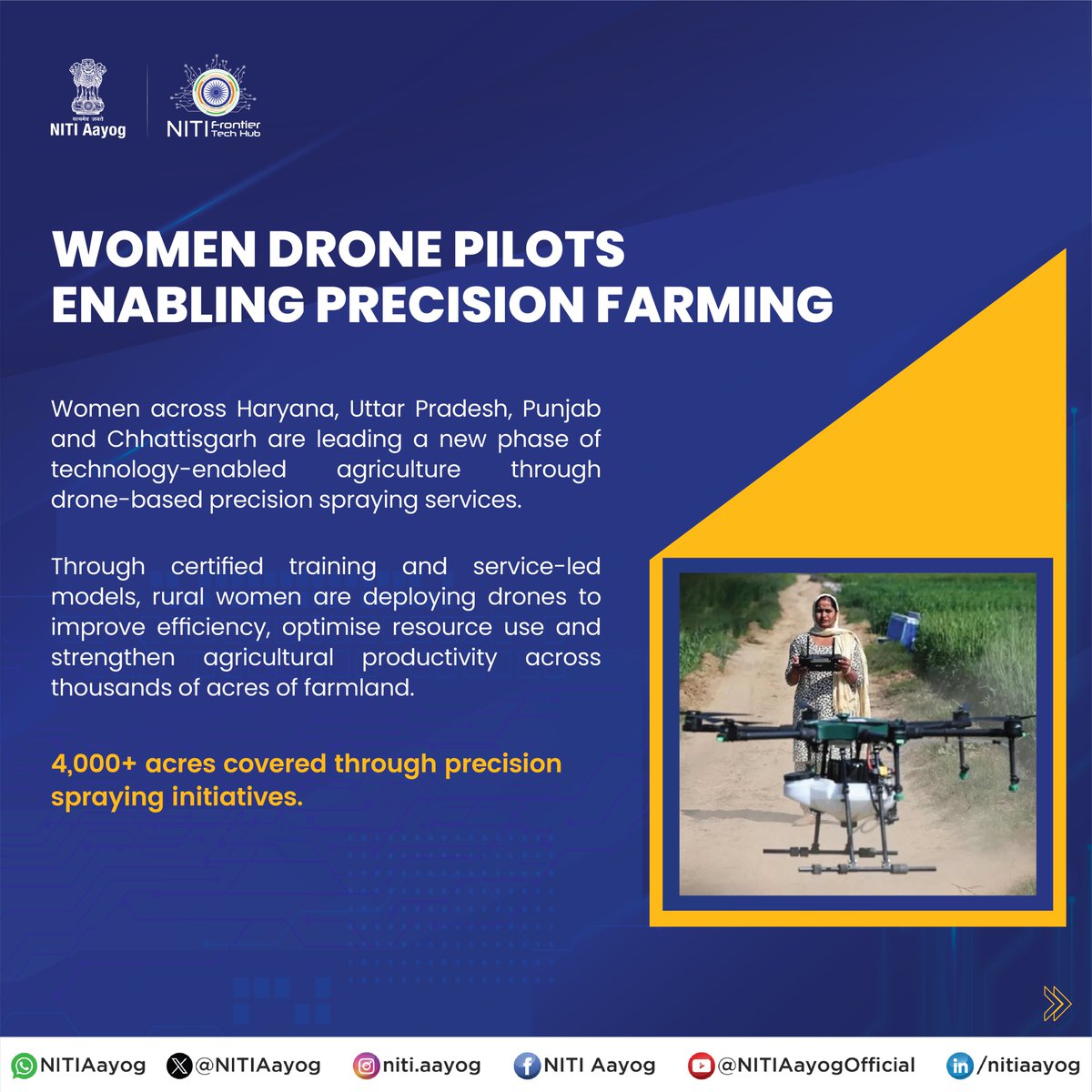
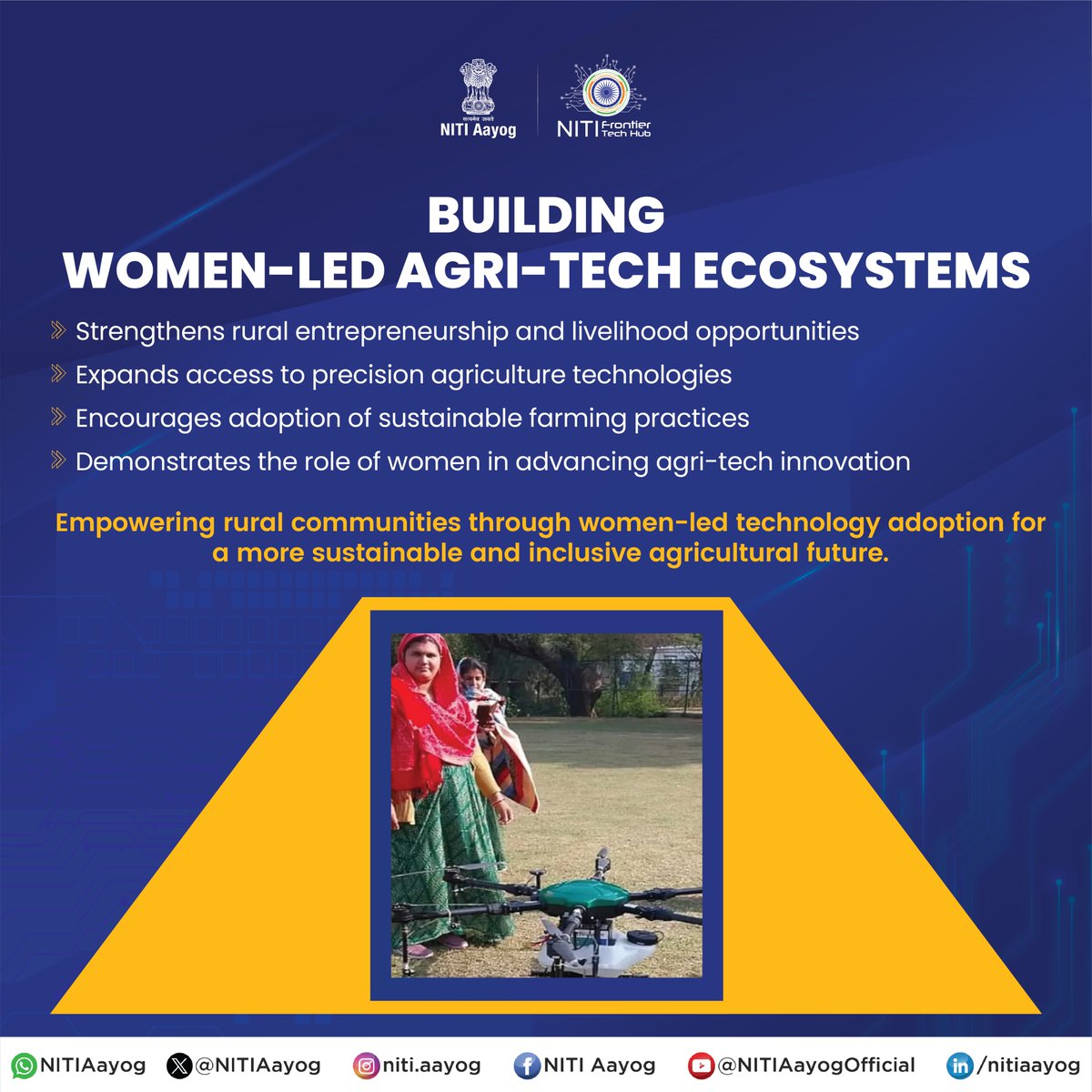
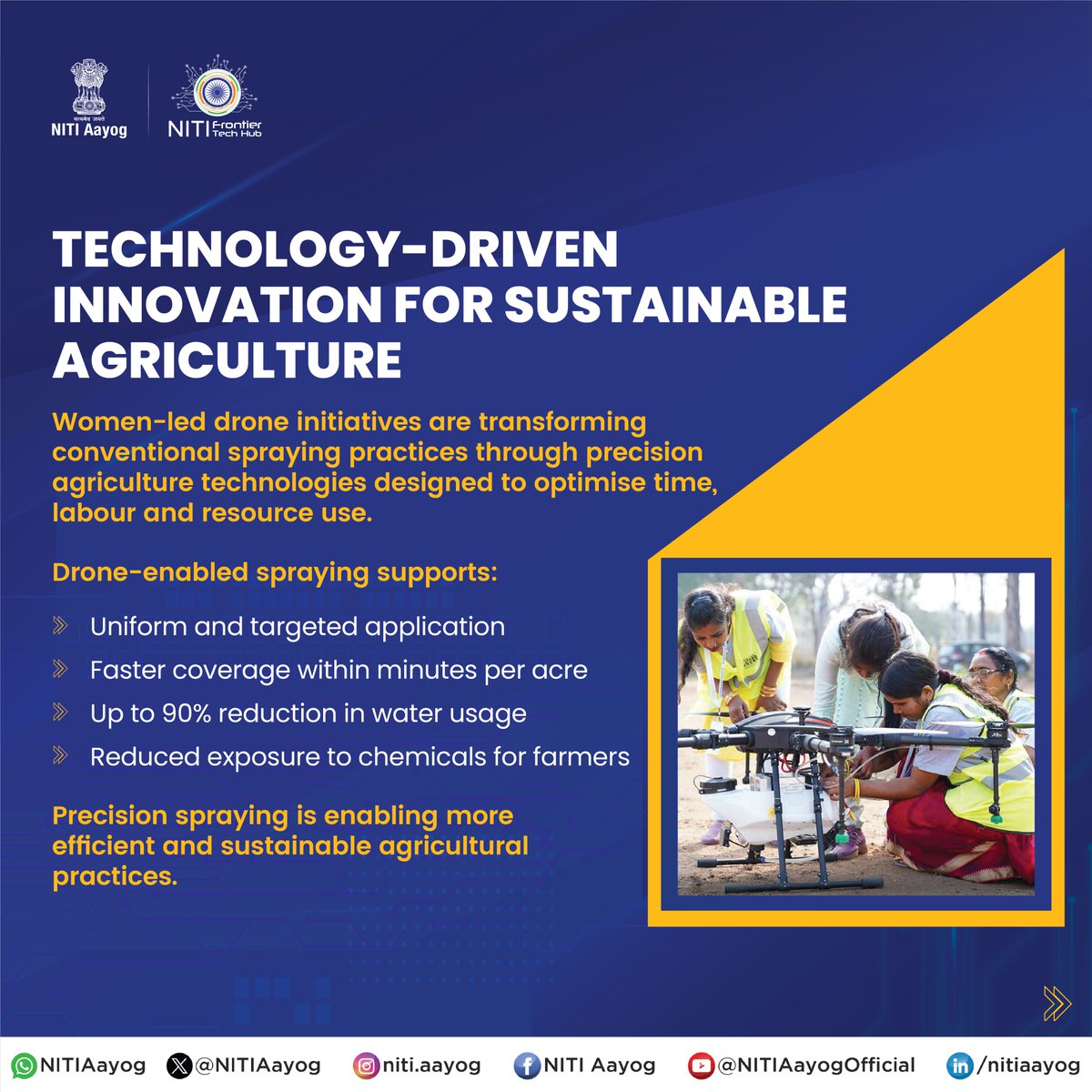
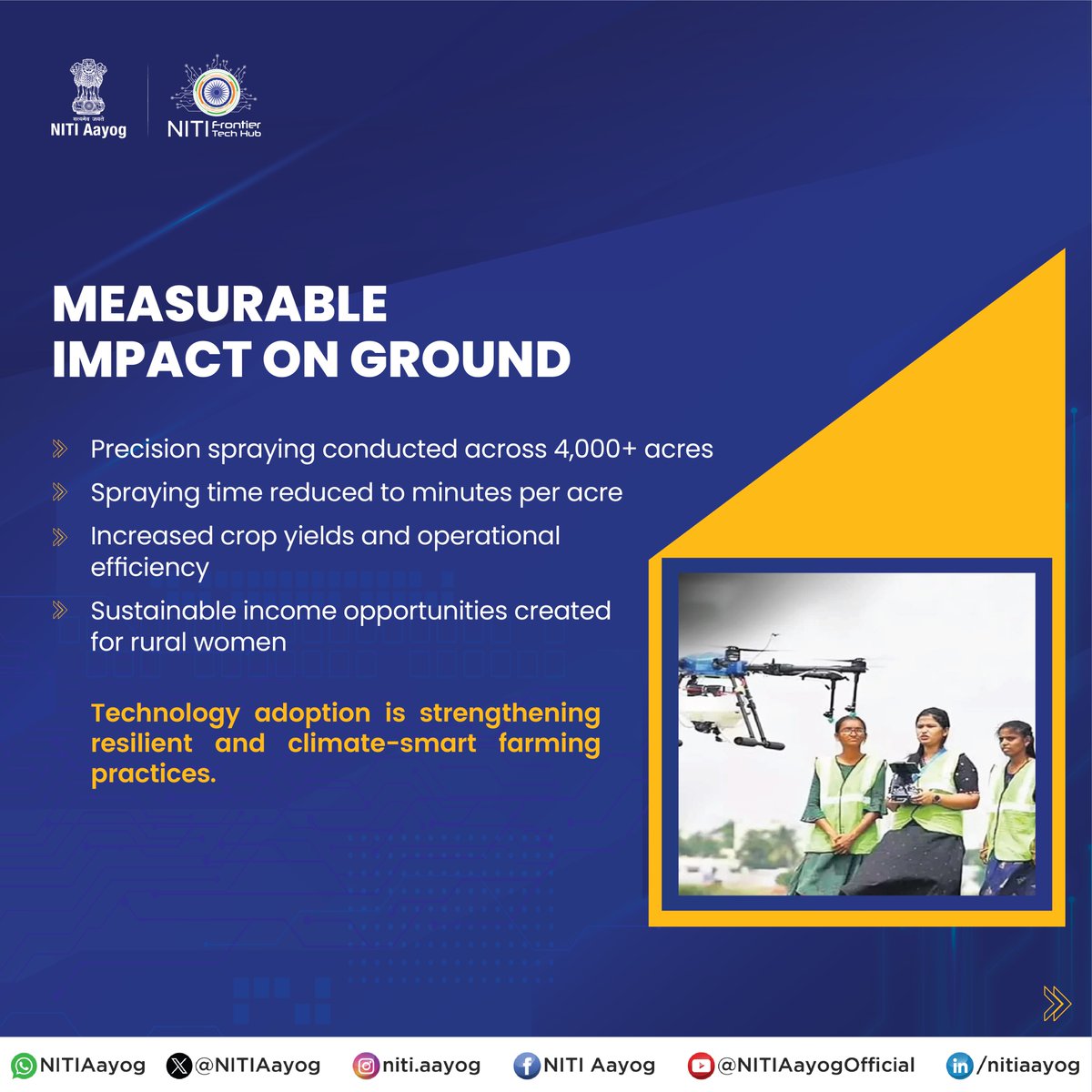
Women Drone Pilots Advancing Precision Farming and Sustainable Agriculture
From fields to flight paths, women across Haryana, Uttar Pradesh, Punjab and Chhattisgarh are driving a new phase of technology-enabled agriculture through drone-based precision spraying services.
Through certified training and service-led models, rural women are deploying drones across 4,000+ acres of farmland, reducing water use by up to 90 percent, cutting spraying time to minutes per acre, improving operational efficiency, and creating sustainable livelihood opportunities.
The initiative demonstrates how women-led agri-tech innovation can strengthen climate-smart farming, optimise resource use, and advance sustainable agricultural transformation.
About the Repository: NITI Aayog’s Frontier Tech Repository is a curated platform featuring proven, impact-driven technology use cases solving real-world challenges across India. Developed by the Frontier Tech Hub in collaboration with The Better India, it showcases 200+ case studies across sectors including Agriculture, Healthcare, Education, Space, and Defence & Security. With an integrated AI Assistant and a unique ‘Build Your Own’ feature, the repository serves as a one-stop platform to discover, scale, and replicate frontier technology solutions.
Read the full story: https://t.co/d5r4qZfgoK
Explore more: https://t.co/rvGuty7rcf
#PMOIndia #NITIAayog #WomenLedDevelopment #PrecisionFarming #DroneTechnology #Agriculture #AgriTech #RuralInnovation
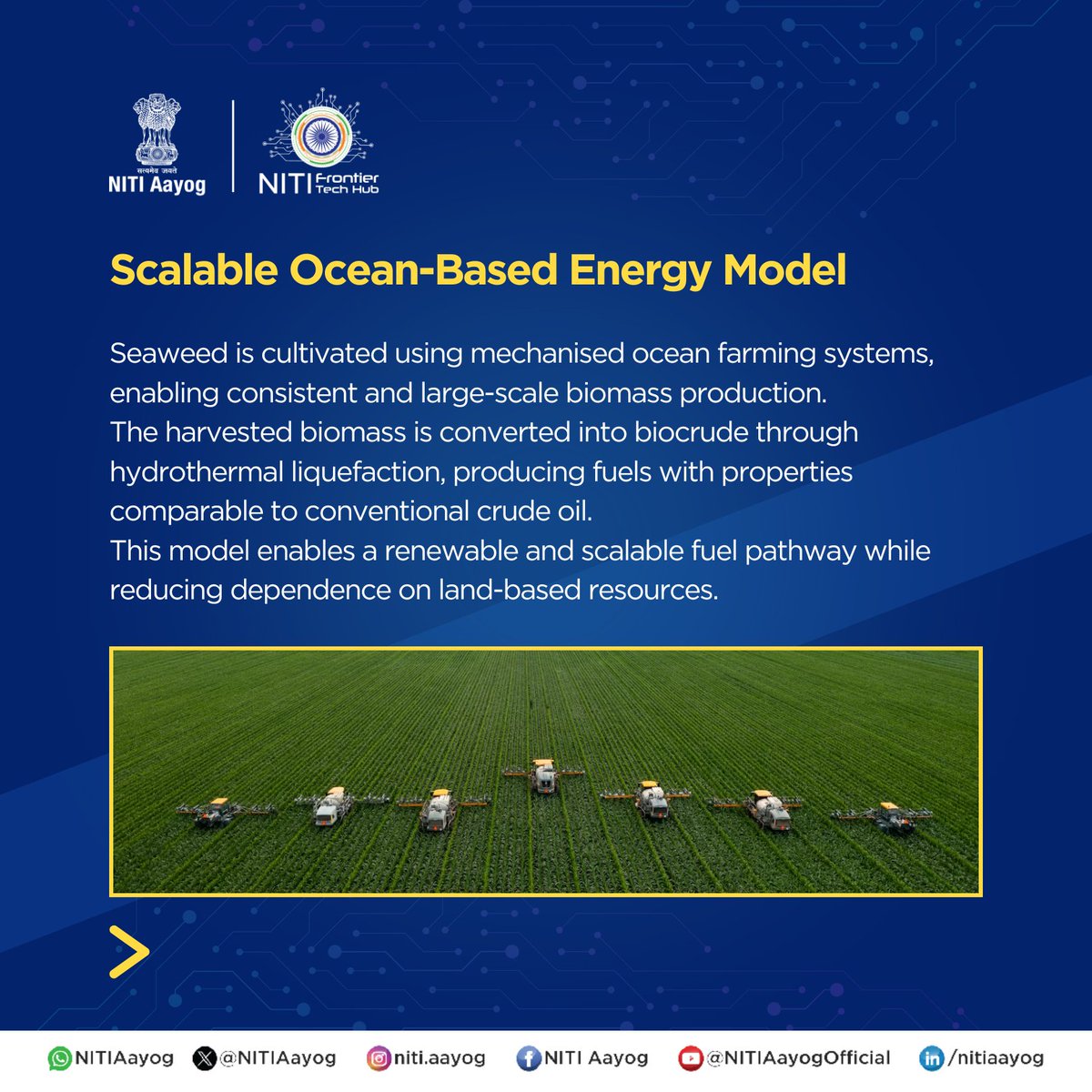
Seaweed-Based Biofuels for Sustainable Energy and Climate Action
From oceans to energy systems, seaweed is emerging as a scalable solution for clean fuel production. Sea6 Energy is advancing seaweed-based biofuels through mechanised ocean farming and biomass conversion technologies that do not rely on farmland, freshwater, or food systems.
By harnessing marine biomass, the initiative demonstrates how ocean-based solutions can support climate action, strengthen energy security, and contribute to India’s clean energy transition.
About the Repository: NITI Aayog’s Frontier Tech Repository is a curated platform featuring proven, impact-driven technology use cases solving real-world challenges across India. Developed by the Frontier Tech Hub in collaboration with The Better India, it showcases 200+ case studies across sectors including Agriculture, Healthcare, Education, Space, and Defence & Security. With an integrated AI Assistant and a unique ‘Build Your Own’ feature, the repository serves as a one-stop platform to discover, scale, and replicate frontier technology solutions.
Read the full story: https://t.co/D8sZHmHyxP
Explore more: https://t.co/rvGuty7rcf
#PMOIndia #NITIAayog #DigitalHealth #AIforGood #MaternalHealth #PublicHealth #Innovation #DigitalIndia #CleanEnergy #Biofuels #ClimateAction #EnergyTransition #Sustainability #BlueEconomy #RenewableEnergy
Feeding the World: India to Host Historic BRICS Agriculture Summit In Indore
The agenda for the 12-13 June meeting spans food security, climate-resilient farming, digital agriculture, AI, and global trade.
BRICS countries account for 42% of the world's agricultural land, 68% of farmers, and 45% of global grain production. The meeting is "a historic opportunity for the global agriculture sector" that "will provide a new direction to the world," Agriculture Minister Shivraj Singh Chouhan said.
While working with an agritech startup in Europe, Suraj Panigrahy saw how grapevines were grown in tight rows, each tree carefully monitored and fed. He came back to India with one question: could the same precision work for mangoes?
He bought 15 acres of barren land near Bengaluru, planted 25,000 trees, and built a farm that now produces seven times what a conventional orchard would. See how he did it. #MangoFarming #AgriTechIndia #SustainableFarming #PrecisionAgriculture #IndianInnovation
[Quantum Density Farming, MangoMaze, AI In Agriculture, Smart Farming Technology, High Density Farming]
https://t.co/J9eBolLJus
For millions of farmers, getting a straight answer about government schemes has always been a challenge. Now, a new AI-powered app is making it possible to get instant answers in one’s own language. #FarmersSupport#AgriTechIndia#DigitalFarming#RuralInnovation #EmpoweringFarmers
[Kisan E Mitra Chatbot, Agriculture Support Scheme India, Farmer Assistance Technology, Local Language Farming Help, Digital Solutions For Farmers]
https://t.co/0lbzcoJBHz
Satellite tech for India’s #agriculture - Precision agritech and satellite-as-a-service (SAAS) can reduce the urban-rural skill, remuneration, and #digitaldivide. Time to privatize #space#technology for agricultural benefit
https://t.co/xrHtEVFrwE
AI in Indian agriculture is stuck in pilot mode—not due to weak tech, but broken data systems. Despite massive data, fragmentation & poor interoperability limit real-world use.
@AgriGoI@NITIAayog#AI#Agriculture#India#Data