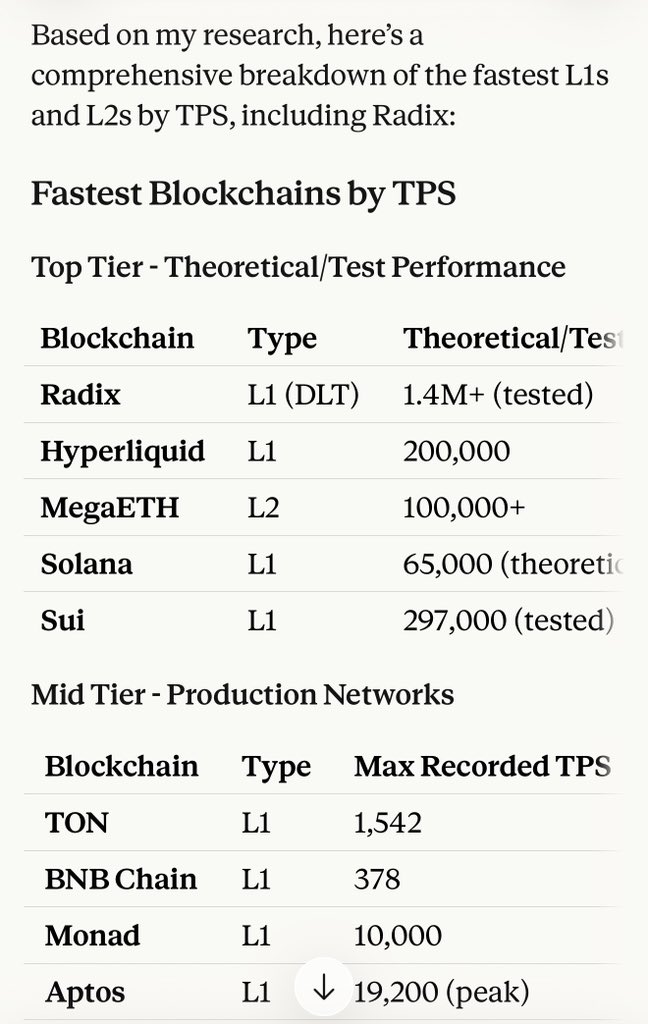
Radix $XRD with the comeback of this decade.
All other L1s would have died long time ago with this chart, but not Radix. Their bullrun just started recently, after the project was fully taken over by the community. (Foundation/team sold their last coins OTC). Absolutely insane.
Good to see the @radixdlt Army active again 🔥🤝
With Hyperscale on the Run ✍🏽
Calling all $XRD believers to drop their handles let's connect 🤝.... Follow back everyone 🔥
#radix#hyperscale
You're not bulllish enough 🔥
Today, the @radixdlt community is running a public Hyperscale test – the realization of a vision first articulated by Dan Hughes.
📊 Current results exceed expectations, reaching ~700,000 SPS.
Ticker- $XRD
Why aren’t more people talking about this?
Defi + AI will need scale. Not aware of any other L1 capable of performing at the scale we’ll need. I’m not 100% clear how the foundation is changing - regardless, there are a lot of crypto nerds out there and generally surprised more devs aren’t building for the future on @radixdlt
This has nothing to do with open btw.
Former #Coinbase Canada CEO Lucas Matheson has been following @radixdlt for quite some time now.
When he's talking about #Radix as the most scalable L1 tech in crypto / DeFi, you better pay attention:
$XRD | $ETH $SUI $SOL $HYPE
People keep comparing @radixdlt Hyperscale tests to @NEARProtocol “s recent 1M TPS demo, but they measure two completely different things.
NEAR tested simple transfers running in parallel.
Radix tests real DeFi behaviour across shards:
• smart contracts interacting across many shards
• swaps, liquidity moves, multi-step intent flows
• real validator participation
• atomic composability under heavy load
• the same architecture Xian will build on
It’s the difference between:
🏃 running fast in an empty field
vs navigating a full city with traffic, signals, intersections, and still never crashing.
Hyperscale isn’t about speed.
It’s about proving that complexity scales safely.
#CryptoTech #DeFiInfrastructure #Scalability
Monday Radix Recap - here’s what moved the network this week:
• Hyperscale testing migrated to a new internal cloud to unlock faster node provisioning
• Research focus: saturation metrics + deeper analysis of historical test methods
• Private group tests remain centered on 250k TPS, while internal teams isolate variables for future 500k TPS scenarios
• RET v1.0.6 released; groundwork begins for a broader modernization toward the latest Rust stack
• New perpetuals trading educational content released
• Radix Rewards: Season 1 distribution logic now in development; Earn tab UI improved
• Ecosystem progress:
– DefiPlaza launches Investment Validator Node
– ASTRO rewards distributed
– XRDdomains V2 demo live
– ShardSpace running 41 parallel auctions
– Radix Kingdoms begins governance evolution
Steady, infrastructure-level progress across testing, tooling, and ecosystem growth.
#RadixEcosystem
Why @radixdlt and @Aptos feel similar… but are built completely differently.
Most modern blockchains try to go faster by processing many transactions at once (Aptos does this with parallel execution). It’s powerful - but the apps on top still have to write their own logic for tokens, safety, and how things interact.
Radix chose another path.
On Radix, things like tokens and accounts are built into the engine itself. They behave like real objects with rules the system guarantees - not code each app has to re-write.
This means:
• apps don’t reinvent the basics
• whole categories of bugs simply can’t happen
• DeFi pieces fit together more safely
• and the architecture is designed to scale horizontally once Xi’an arrives, while apps still work together like they’re on one chain
Same destination: better, safer crypto.
Very different road to get there.
#Crypto #DeFi #Innovation
Do you know why the current @radixdlt stack already stands out, even before Xian?
Not because of hype, but because the fundamentals solve problems other chains still struggle with.
Here’s what makes it different in real, practical terms:
• Atomic composability
Apps interact like they’re on one chain - no fragmented liquidity, no cross-chain headaches.
• Object-based assets
Tokens behave like real objects you can see, understand, and move without memorising decimals or contract addresses.
• Human-readable transactions
You can see EXACTLY what will happen before you approve. No mystery hashes, no guesswork.
• Secure connector model
dApps communicate with the wallet without exposing private keys or requiring endless signatures.
• Built-in account protections
Recoveries, rules, multi-step logic - all native, not bolted on.
Most chains try to scale after they launch.
Radix designed the architecture to scale from day one - and Hyperscale is the proof path.
That’s why people who dig a bit deeper realise it’s not “just another L1.”
#DeFi
Good morning @radixdlt fam☕️
Coffee hits different when you know the dev teams are cooking something important behind the scenes.
MFA phase 2 is almost done, and we should hear more from them next week - real security upgrades, not surface-level features.
Excited to see what they share.
Strong foundations take time, but they’re always worth it.
Everyone talks about crypto security…
almost nobody talks about MFA.
Here’s the simple truth:
• Most wallets still rely on one private key
• One key = total access = most hacks
• Very few chains support real MFA on-chain
• Most “MFA solutions” are scripts or custodial workarounds
• In any mature digital system, MFA is standard - except in crypto
This is why the next generation of networks must treat MFA as a native feature, not an add-on.
#Web3Security #CryptoSafety
The recent Hyperscale tests @timanrebel with closed group did aren’t “just another benchmark.”
They show something much bigger:
👉 Radix is scaling the way blockchains were always supposed to scale.
Most networks slow down when more users join.
More activity → more congestion → higher fees → worse experience.
Radix shows the opposite behavior:
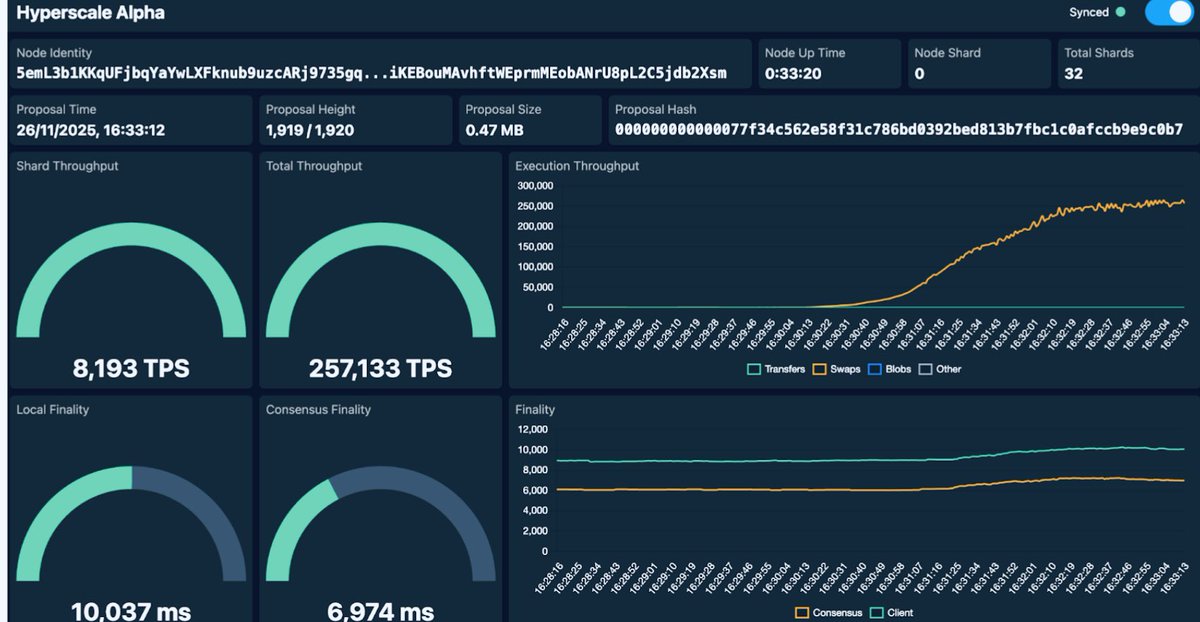
• 250k TPS reached this week on a 32-shard setup
• And the key part: performance grows as more shards are added
This is special for two reasons:
1️⃣ It’s proven with real tests, not promises.
Tiemann keeps running weekly experiments, and the system behaves exactly as designed.
2️⃣ It points to true global-scale potential.
A network that can grow with demand instead of collapsing under it can support:
•millions of users
•real applications with real load
•full DeFi ecosystems
•without degradation or bottlenecks
In simple words:
Hyperscale tests show that @radixdlt isn’t just another L1 -
it’s architecture built for the future, not the past.
#defi #hyperscale
Good Saturday morning ☕️💙
Before the coffee even kicks in, remember what @timanrebel revealed yesterday…
Radix Hyperscale is actually happening - not theory, not a deck, but real engineering progress:
• 100k TPS milestone confirmed previous week
• 250k TPS achieved this week on a 32-shard setup
• Scaling curve remains linear
• Every new run shows the architecture behaving exactly as designed
• Hyperscale is becoming reality step by step
Feels wild watching this unfold in front of our eyes while 95% of crypto still debates “what if.”
Enjoy your coffee & enjoy the future brewing ☕️✨
#hyperscale #defi #crypto
“Last week I ran another successful test… confirming the 100k TPS result from before. And this week I managed to reach 250k TPS on a 32-shard setup - a big step forward.” - @timanrebel 🔥
Let that sink in.
Not promised.
Not theorized.
Reached. In testing. Right now.
This is why @radixdlt is different - while other ecosystems argue on X, Radix quietly hits quarter-million TPS in real internal tests and keeps iterating.
Hyperscale isn’t a dream - it’s unfolding.
And this update shows exactly why some architectures survive the future, and some don’t.
Dive into the full post:
👉 https://t.co/EDEEEJcJPo
#Hyperscale #Web3Scaling #DeFi
Good morning Radix fam ☕️🦃
Coffee is finally doing its magic, so the brain is booting up past “safe mode”.
And Happy Thanksgiving to everyone celebrating today - hope your day is warm and peaceful.
Also, worth a read this morning:
The Block just published an article on the UK’s crypto strategy, discussing how clearer rules and better support could help keep Web3 talent in the country.
And yes - @Adam_XRD was quoted, pointing out exactly what the industry needs from policymakers.
🔗 https://t.co/2fCdNpvmil
Have a great day, fam - let’s keep building 💙
There’s a project in crypto that still feels like an unpolished diamond.
Quiet team, zero hype, just building in the background while everyone looks the other way.
But the funny part?
It’s already hitting 100k+ TPS in testing… and soon that milestone will be repeated with official validators.
Most big chains would scream this from the rooftops - this one just keeps working.
Some things shine only when the time is right.
Radix and Solana both target high-performance DeFi, but their core trade-offs are very different.
• Solana optimizes for throughput with a global account-based state and highly tuned validators
• Most assets on Solana are implemented as programs, so token behavior depends on how that code was written
• Radix optimizes for safety and composability first: assets are native, with engine-level rules for how value can move
• On @solana, developers get raw power but also more responsibility to handle edge cases and security
• On @radixdlt , developers likely spend more time composing components and less time reinventing token standards and guard rails
• For users, this should mean fewer “surprise” interactions and a clearer mental model of what happens in a transaction
If you are studying different DeFi architectures, comparing Solana’s performance-focused design with Radix’s asset-oriented engine is a very useful exercise.
#Radix #DeFi