Thanks Yinheng for sharing this! We are currently looking for realistic training failure cases, task contributors, and collaborators. If you’ve ever encountered a training run that looked completely normal but turned out to be wrong, we’d love to hear from you! Contributors will have the opportunity to be listed as co-authors.
"Thank you for the rebuttal. I'll keep my score."
As an AC of #NeurIPS2026 E&D track, I asked the reviewer to clarify
No response so far
How could authors expect them to respond if they don't even reply to an AC?
We should set our bar highier and treat it highly irresponsible
I don’t know man, deserved not to go to the major that’s for sure and there is no freaking excuses.
Rough months incoming but I never gave up at any point these months, but this is the lowest point of my career. I will fight and I hope I can survive this and come back.
😞
Not much to say. Filled with frustration and sadness. It's been incredibly difficult to find any consistency this year. Only having 1 player that finds his own game consistently and with our struggles, it seems incredibly difficult to have multiple people perform at the same time.
Undeserving of a major appearance.
Sorry to all the fans for this disappointing time. The hate is valid.
🎉 The @minnesotanlp has 4 papers at #EACL2026 — 3 orals + 1 findings!
🧑⚖️ [1] LLM judges shouldn't stay fixed. We adapt them at test time.
→ https://t.co/c7YBnnkflQ · Oral Session 3B · Mar 25 (led by Seungyeon jwa)
🥗🍔 [2] Can LLMs tell when Mary the vegetarian orders a cheeseburger? Mostly no.
→ https://t.co/35KVXX1Hz5 · Oral Session 4C · Mar 25 (led by Karin de Langis)
🧠 [3] LLMs: great memory, terrible executive control.
→ https://t.co/uvNcLsQ316 · Oral Session 4C · Mar 25 (led by Karin de Langis)
🎭 [4] Multimodal figurative reasoning across metaphor, irony, idiom & humor.
→ https://t.co/eeg4fkxkDJ · Findings Poster (led by Seyyed Saeid Cheshmi)
See you in Rabat!
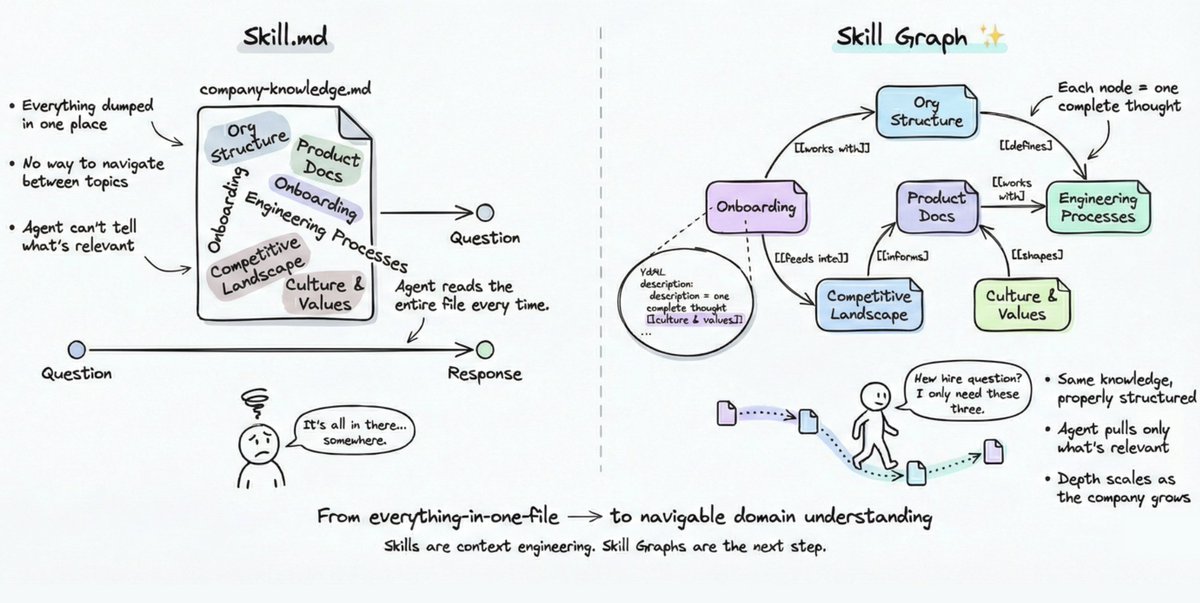
Skill Graphs > SKILL .md
Everyone's talking about skills for AI agents.
But almost nobody is talking about how to structure them.
Right now, the default approach is simple. You write one skill file that captures one capability. A skill for summarizing. A skill for code review. A skill for writing tests.
One file, one job, and it works.
But I recently came across an idea that made me rethink this entirely.
What if skills weren't flat files? What if they were graphs?
Let me explain what I mean.
Think about how a senior engineer onboards you to a large codebase. They don't hand you one giant document and say "read this." They give you a map. They point you to the right modules. They explain how pieces connect. Then they let you go deeper only where you need to.
That's the mental model behind a skill graph.
Instead of one big file, you build a network of small, composable skill files connected through wikilinks. Each file captures one complete thought, technique, or concept. The links between them tell the agent when and why to follow a connection.
Here's what changes with this approach.
The agent doesn't load everything upfront. It scans an index, reads short descriptions, follows relevant links, and only reads full content when it actually needs to. Most decisions happen before reading a single complete file.
Each node is standalone but becomes more powerful in context. A "position sizing" node in a trading skill graph works on its own. But link it to risk management, market psychology, and technical analysis, and now you have context flowing between concepts.
And suddenly, domains that could never fit in one file become navigable. Company knowledge. Legal compliance. Product documentation. Org structure. All traversable from a single entry point.
The building blocks are surprisingly simple.
Wikilinks embedded in prose so they carry meaning, not just references. YAML frontmatter so the agent can scan nodes without reading them. Maps of content that organize clusters into navigable sub-topics.
Markdown files linking to markdown files, and nothing more.
If you want to dig deeper or try building one yourself, check out arscontexta. It's an open-source plugin that sets up the structure and helps you build skill graphs with your agent.
I have shared the link in the next tweet.