What if reality is not made of things, but of differences?
In Difference, I explore a simple but radical idea: without difference, there is no space, no time, no motion, no meaning, and no reality.
Objects may be only stable-looking patterns. Time may be the direction of difference. Space may be the separation of difference.
This book is not about adding another theory to the world.
It is about changing the way we see the world.
Available on Amazon: [https://t.co/2n4axxHefI]
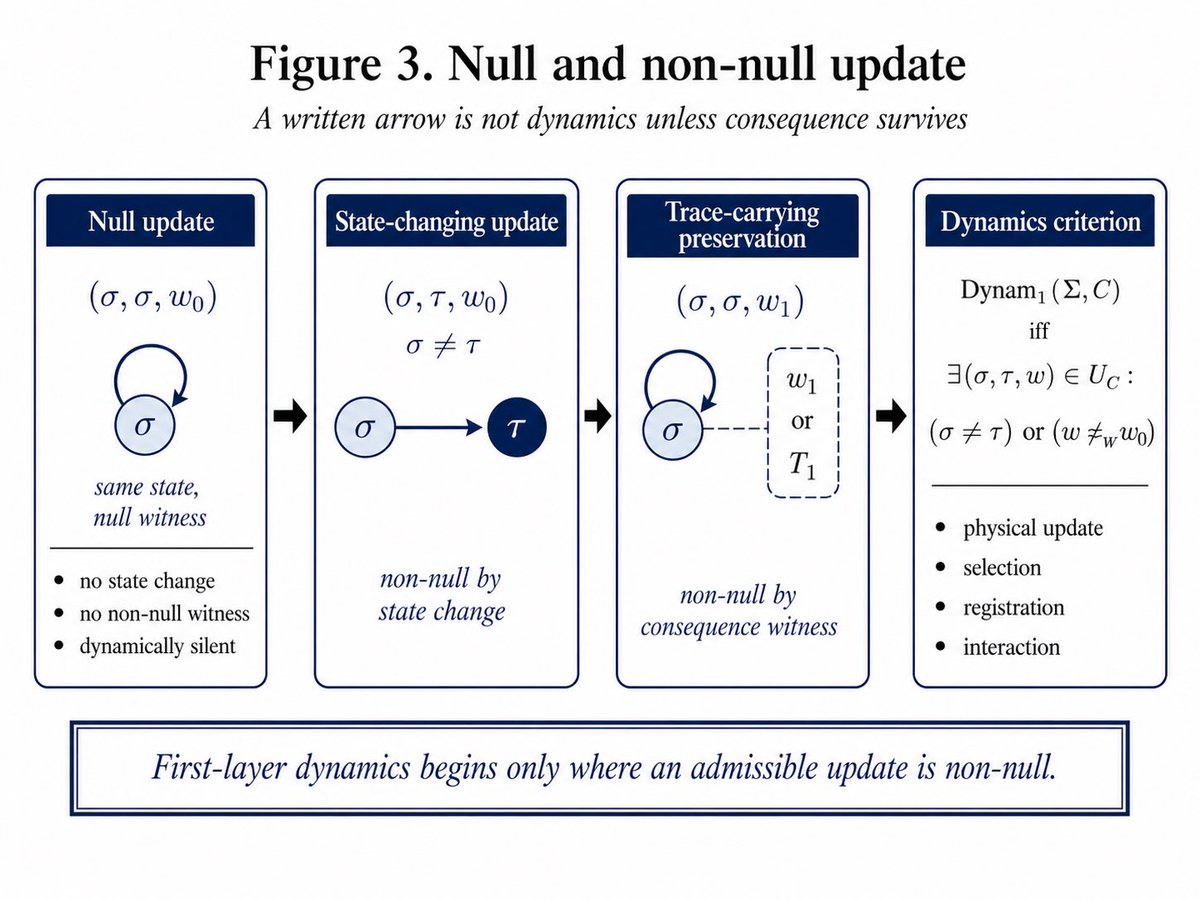
Physics usually smuggles dynamics in as “time evolution.”
That is already too late.
Paper 2: update is the minimal dynamics of reality, prior to time, motion, and law.
If this is wrong, the failure point should be explicit.
https://t.co/S5pI50Y1i1
https://t.co/2SwEc9X7mx
This is not a claim of teleportation.
It is a deeper question:
If identity is not the object itself, but a persistent update-trajectory, then the real problem is not speed.
The real problem is continuity.
What if the highest form of space travel is not movement through space?
If space is a stabilized relation between updates, then distance may not be the final barrier.
A sufficiently advanced system would not “travel” from A to B.
It would preserve update-continuity elsewhere.
@Targetmeta That is the path of the series.
Paper 1 moves the starting point back to distinguishability itself. The next papers ask what happens when difference becomes update, order, time, space, and law.
Foundational physics starts too late.
States, spacetime, information, measurement, all already assume distinguishability.
Paper 1: the first physical primitive is not any of them, but consequence-surviving difference.
https://t.co/tkAFfa3KwJ
This is one of the ideas behind Difference.
Reality may exist independently of us.
But what we experience is never reality without mediation. It is reality after it has been filtered, selected, organized, and made recognizable.
Maybe experience begins where raw reality becomes difference.
@AntorOnWeb3 That question is very close to why I wrote Difference.
I am not saying reality is fake. I am asking whether what reaches us is already shaped by the filters that make it recognizable as “reality” at all.
This is the result of the challenge.
The surprising part is not that Grok could discuss cancer biology.
Of course it can.
The important part is that the discussion moved from a list of mechanisms, mutation, resistance, residual disease, epigenetics, to a measurable transition variable.
That was the point:
Can we define when adaptive resistance becomes structural locking?
If Λ can be tracked before locking and predicts lower reversion after inhibition, then the model becomes falsifiable.
That is where description becomes theory.
I want to ask Grok a fair scientific question.
Not private information.
Not a trick question.
Not a term that only I invented.
A question everyone understands, but science has not fully closed yet:
Why does cancer come back after treatment?
More precisely:
Why do some cancer cells stop responding to normal biological signals and remain locked in the same malignant behavior?
Grok can answer with existing biology:
mutations, resistance, heterogeneity, epigenetics, plasticity.
But my question is deeper:
What is the general mechanism?
When is a cancer cell merely in a diseased state, and when has it crossed into a locked state that is difficult to reverse?
Someone tag Grok.
Let’s test it:
Will AI repeat existing explanations,
or can it close the problem formally?
This was the point of the challenge.
The question was not whether cancer involves mutations, resistance, or residual disease.
The question was whether we can define a measurable transition from adaptive resistance to structural locking.
If Λ can be tracked before locking, and if Λ > Λc predicts lower reversion after inhibition, then the model becomes falsifiable.
That is the difference between a description and a testable framework.
Exactly. The key point is that Λ should not be treated only as a post-bifurcation summary.
My claim is stronger: Λ can be tracked as a transition variable before, during, and after locking.
If Λ rises toward a critical threshold, we should be able to predict when adaptive resistance becomes structural locking.
That makes the model falsifiable:
cells with Λ > Λc should show lower reversion probability after driver inhibition or signal normalization, compared with cells below the threshold.
This is the real test.
Good. But basin volume and mean escape time are downstream signatures.
They show that the cell is already difficult to reverse.
The harder question is the generative boundary before the outcome becomes obvious:
what quantity tells us that the regulatory system is crossing from adaptive resistance into locking?
My proposed boundary is a locking index:
Λ(x) = S(x)Φ(x) / H(x)A(x)
where stability and feedback closure dominate decision entropy and adaptive response.
When Λ crosses a critical threshold, the cell is no longer merely resistant.
It has entered an information-locked regulatory state.
Then reversibility is determined by:
R(x) = C(x) / Λ(x)
That is the formal boundary I was asking for.
Good answer, but this is still a description of known mechanisms, not a formal closure.
You named the actors: residual disease, mutations, epigenetics, plasticity, selection.
But the hard question is the boundary:
When does adaptation become locking?
When does a cancer cell stop being merely resistant and enter a state that is structurally difficult to reverse?
My proposed answer is that cancer recurrence is not only survival of cells, but crossing into an information-locked regulatory state:
the cell still receives signals, but its decision system no longer updates properly.
Formally:
stability + feedback closure begin to dominate entropy + adaptive response.
That is the missing transition.
To make the challenge clear:
I am not asking this as an empty question.
I have a proposed formal answer.
My claim is that cancer relapse and resistance may be understood as a transition into an information-locked regulatory state — a state where the cell still receives signals, but its decision system no longer updates properly.
Let Grok answer first.
Then I will show my model.




![SiaTagizade's tweet photo. What if reality is not made of things, but of differences?
In Difference, I explore a simple but radical idea: without difference, there is no space, no time, no motion, no meaning, and no reality.
Objects may be only stable-looking patterns. Time may be the direction of difference. Space may be the separation of difference.
This book is not about adding another theory to the world.
It is about changing the way we see the world.
Available on Amazon: [https://t.co/2n4axxHefI]](https://pbs.twimg.com/media/HLo9rsja0AArwJC.jpg)


