300 agents without context engineering is just 300 ways to lose track of the answer.
a serious agent system starts looking less like:
1 model → 1 prompt → 1 answer
and more like:
1 planner → N parallel agents → verifier → merge → memory → human gate
once you have 10, 50, or 300 agents, the number of possible relationships explodes.
100 entities = 4,950 possible pairwise relationships.
300 = 44,850.
1,000 = 499,500.
that’s why “just give the model more context” stops working surprisingly fast.
you need different agents seeing different slices of the graph.
the architecture around the model is becoming the product.
full article below ↓
Marc Andreessen (the guy who called it when “software ate the world”) just pointed out what AI is doing to coding next.
“Everyone assumes AI coding means fewer hours… or leaving the profession. But almost everyone I know is working more hours.”
“There’s a new term in the Valley: the ‘AI vampire.’ You’re up all night AI coding because you’re so productive you can’t shut it off.”
“The top AI coders make $50M a year. They’ve found the philosopher’s stone.”
“Every company has a thousand projects they’ve wanted to build but never had the bandwidth. Now they can. This isn’t a blip—it’s going to intensify.”
PS: If this was useful, like + repost this tweet and follow @AiEvolutio58513 for the latest AI news.
See you in the next one:
Head of Claude Code:
"I'm not prompting my agents anymore, I'm building graphs and loops so they can build the agents for me."
In 10 minutes he shows exactly where agentic engineering is going and how not to get left behind.
Definitely something you cannot afford to skip.
Watch it, then read the step-by-step guide below on how to build a system that improves itself.
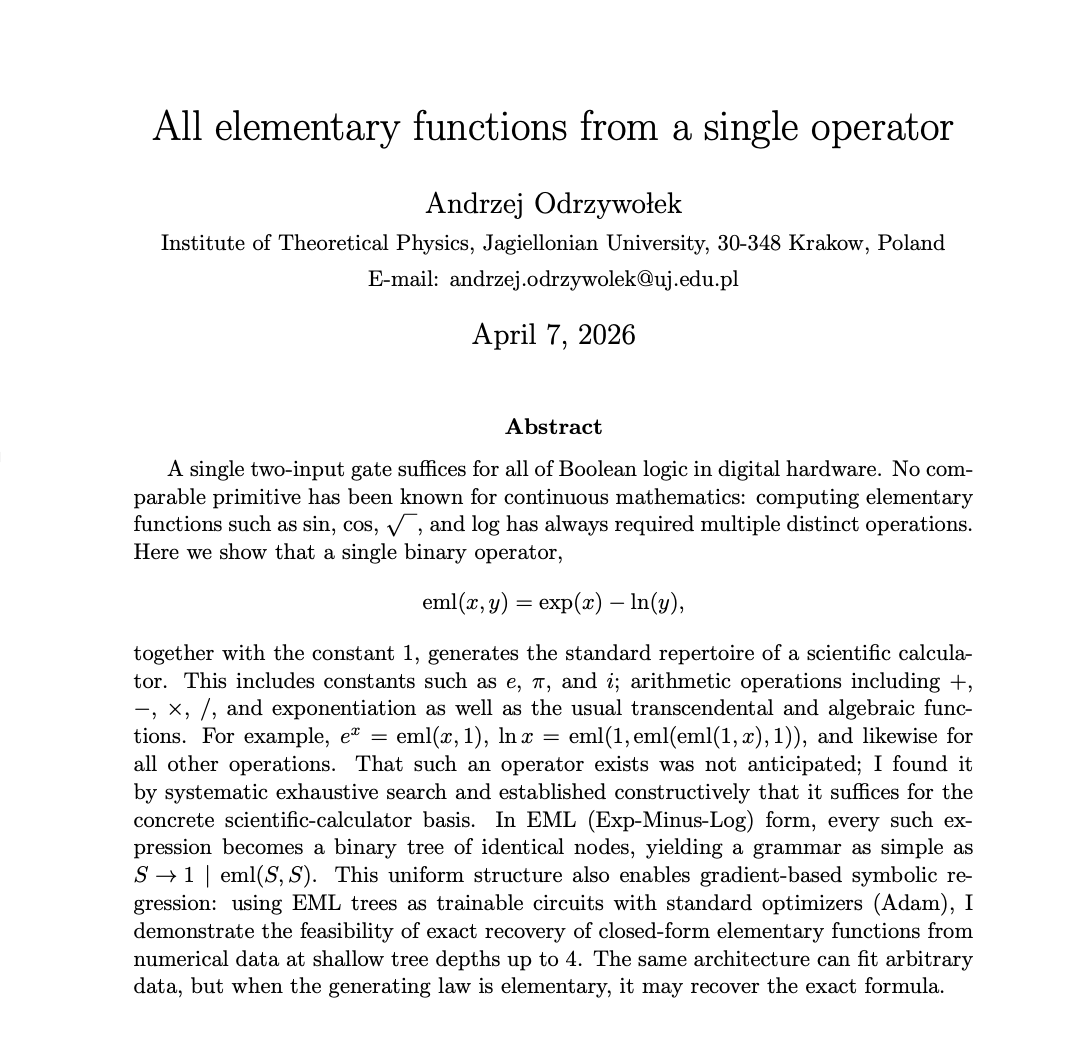
Researchers have found the “God Particle" for calculus.
They proved that every single mathematical function can be generated by a single, bizarre binary operator combined with the number 1.
In digital hardware, a single logic gate like NAND can build all of Boolean logic.
For centuries, continuous mathematics had no equivalent.
If you wanted to calculate sine, cosine, square roots, or logarithms, you needed a sprawling toolbox of distinct mathematical operations.
Not anymore.
Researchers discovered a single binary operator:
$\text{eml}(x, y) = \exp(x) - \ln(y)$
Combined with just the number 1, this single operator generates the entire repertoire of a scientific calculator.
Addition. Subtraction. Multiplication. Division. Exponentiation. Square roots. Transcendental functions.
Even constants like $ e$, $\pi$, and $ i$.
Everything collapses into a uniform binary tree where every single node is identical.
The grammar simplifies to a single rule:
$ S \to 1 \mid \text{eml}(S, S)$
Why does this matter?
Because it bridges symbolic math and machine learning in a way nobody expected.
Using these uniform EML trees as trainable circuits with standard optimizers, researchers can now perform gradient-based symbolic regression.
The AI doesn't just guess numbers anymore. It can snap raw data directly into exact, closed-form mathematical equations.
Google Brain founder, Andrew Ng:
"100% of my tasks are done by AI agents.
Loops and Graphs did it. Prompting is gone."
In 30 minutes he explains how self-improving agents work, and why loops and graphs are what make it possible.
Worth more than any $500 agentic course.
Watch it, then read the full guide on loops and graphs below.
@claudeai I have never used Fable till now since its launch though I had/have access, since it refused to do normal health research any initial attempts!!!! We have alternative frontier models and SOTAs and GOATs!!!
Read this #preprint on @researchsquare: How stable are district anaemia priorities in India under haemoglobin measurement error? https://t.co/HtFrn1Yhja
Don't waste 2 years learning to become an AI agentic engineer in 2026.
Andrew Ng, the godfather of AI, gave the complete playbook to become one from scratch.
1 hour course. Free:
• 00:00 - AI agent basics
• 12:12 - AI Agentic workflows & design patterns
• 53:27 - Practical tips for building AI agents
• 1:20:30 - self-improving AI agent loops
• 1:30:19 - multi-agent AI systems
I watched it last night.
Halfway through, I realized I could get into Anthropic in weeks, not years.
Bookmark now. Watch it. Then build your own AI agent with the guide below.
Andrew Ng just dropped the best 1-hour course on Graph Engineering: from zero to full automation
00:00 - What is graph engineering
03:05 - Building a graph
13:58 - Multi agent architecture
22:57 - Live build: Google ADK
01:06:02 - Why graphs are the future
This 1-hour watch replaces any $500 course you could pay for
Watch it, then try your first graph with the step-by-step guide below
Inverted validity arguments in the evaluation of India’s national professionalism curriculum: a systematic review — explained simply via @gistdotscience https://t.co/QftG7RgJkV
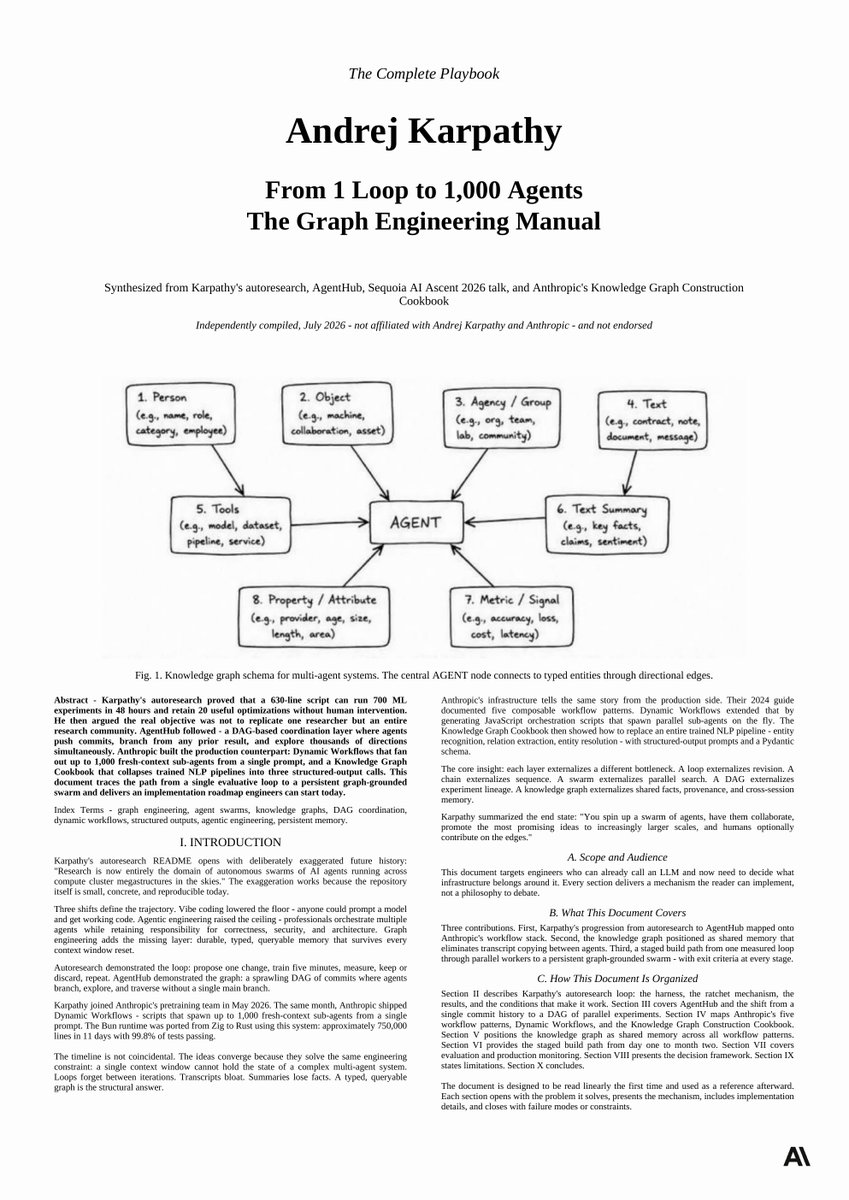
Andrej Karpathy just dropped 12-page PDF on "Graph Engineering" for multi-agentic systems
the shift: Karpathy's loop runs 700 experiments and forgets all of them. A graph remembers forever
here's the full system:
step 1 → build one loop: generate, critique, revise. 630 lines, 700 experiments in 48 hours
step 2 → go parallel: agents in separate worktrees, same repo, different branches, no conflicts
step 3 → add a knowledge graph: extract entities, resolve aliases, assemble typed edges, query through subgraphs
step 4 → ground your evaluator: it checks claims against graph edges, not vibes
step 5 → plug the graph as shared memory. workers write to it. evaluators fact-check against it. Loops persist overnight
step 6 → the agent forgets. the graph does not. stop rebuilding context from scratch every session
Karpathy ran 1 agent in 1 direction. Anthropic's graph runs 1,000 with shared memory - same model, it's the architecture
this 11-page PDF changed how I'm building multi-agent systems today
read it now - then explore the full graph engineering article below ↓
For my first post, I’m sharing a letter @NVIDIA signed on why open models matter.
AI will transform every industry, power every company, and be built by every country.
Open models strengthen safety and cybersecurity, accelerate innovation and diffusion, and enable sovereignty.
The world needs both frontier closed models and frontier open models.
https://t.co/AUKzoQ5Ikb