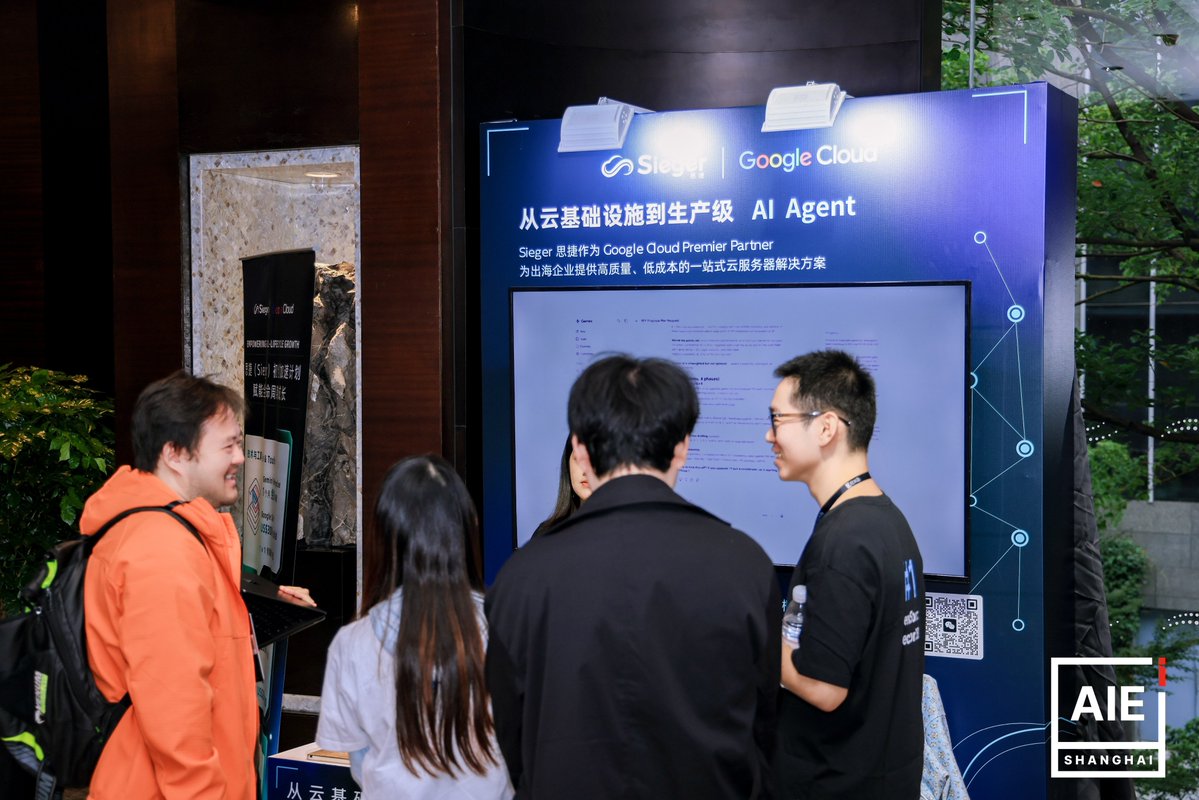
Sieger has become a Premier Partner with Google Cloud, delivering high-quality services such as virtual machines, data analytics and Content Delivery Network(CDN). Sieger has one-stop services from cloud consulting to security assurance and cost-effective cloud service solutions.
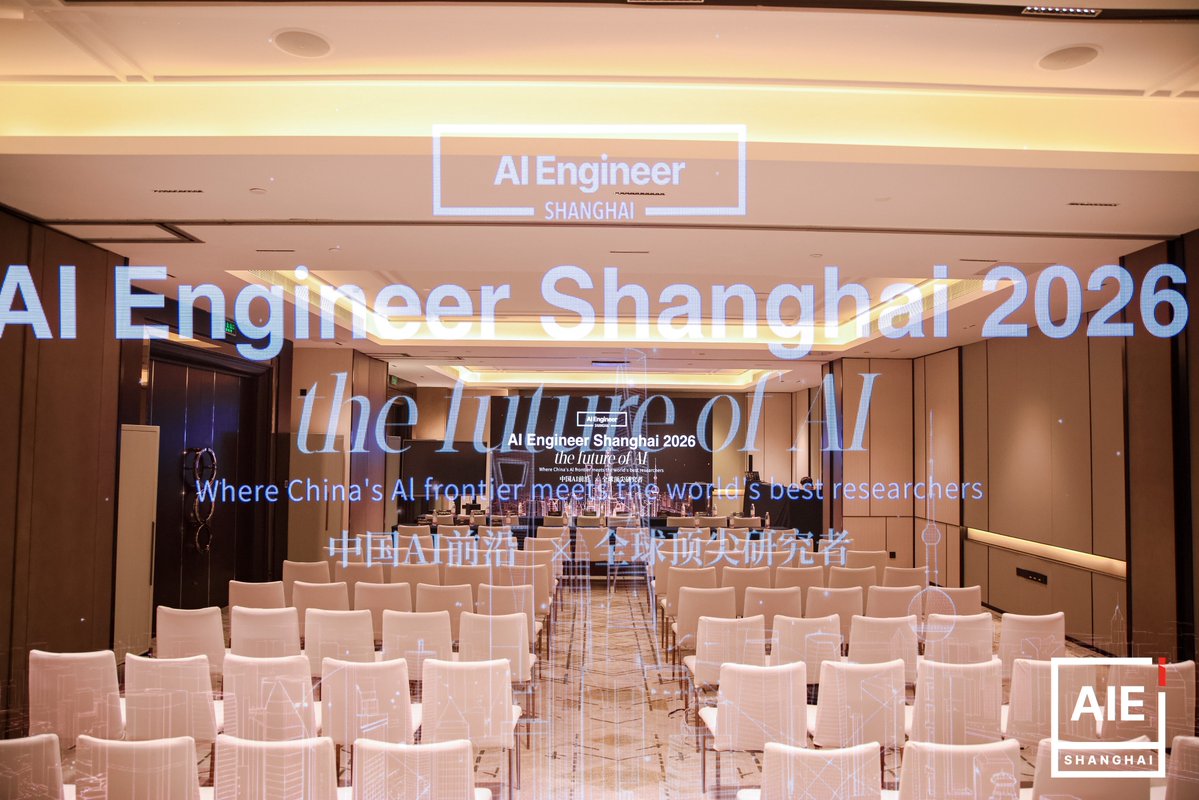
🚀 Day 1 of AI Engineer Summit Shanghai (AIE) is officially ON!
Silicon Valley’s premier hands-on AI gathering has finally made its debut in China, and the technical energy here is off the charts 🔥
No fluff or slide-reading—AIE is all about what actually runs in real-world production environments.
👋 Sieger has a booth on the show floor today, and our team is ready for you!
As a Google Cloud Premier Partner, we help forward-thinking teams build reliable cloud infrastructures, optimize GPU workloads, and put enterprise-grade AI into production.
Got questions about:
· Lowering inference costs?
· Productionizing AI agents?
· Scaling enterprise cloud architecture?
Drop by the Sieger booth to chat, bounce ideas around, and meet our cloud architects!✨
Quick heads-up:
1️⃣ We’ll be right here tomorrow (Nov 6) for Day 2 as well—make sure to swing by!
2️⃣ Can’t make it in person? Keep following us on @Sieger for upcoming closed-door salons, webinars, and hands-on developer workshops.
📍 Grand Xiangyuan Hilton Shanghai
Come say hi!
#AIEngineer #AIEShanghai #GoogleCloud #Sieger #GenAI #CloudArchitecture #TechSummit
OpenAI’s Product Moves: Tighter Account Limits, Shared Usage, LifeVal Benchmark & Grid Protectors
On November 2, OpenAI made several product and infrastructure moves that signal a shift from open-ended usage toward tighter controls, while also trying to show that its models can actually help with real-life tasks and that its data centers can be better grid citizens.
1. Paid Account Limits Per Device and Payment Card
OpenAI now caps how many paid personal ChatGPT accounts can be used on a single device or tied to one payment card.
Applies to Go, Plus, and the Pro tiers (100/200/500)
Free accounts, Business, Enterprise, and Edu plans are excluded
Hitting the limit shows “Device limit reached” — that paid account can no longer be used on the device
Logging out does not free up a slot
OpenAI frames this as a security measure. Many users see it as a direct response to people rotating multiple cheap subscriptions on one device to get more usage. Instead of allowing another subscription, the company steers people toward buying credits or usage resets (usually more expensive).
2. ChatGPT and Codex Will Share One Usage Pool Starting in December
From December, Plus, Pro, and Business users will no longer have separate limits for ChatGPT and Codex. Both will draw from a single shared allowance measured in tokens.
Key details:
· Instant chat is excluded and does not count against the shared pool
· Stronger models and more complex tasks consume more of the allowance
· Combined remaining usage and reset times will appear under Settings → Usage
When the limit is hit, options are to wait for the reset, upgrade the plan, or buy credits
Heavy Codex users will have less room left for advanced ChatGPT conversations, and vice versa. OpenAI says most people shouldn’t need to wait for resets more often than they do today, but that remains to be seen once it goes live.
3. LifeVal Benchmark: Measuring Everyday Life Tasks
OpenAI released LifeVal, an evaluation focused on practical everyday tasks rather than coding or academic benchmarks.
Tasks were selected using the American Time Use Survey, the Multinational Time Use Study, and a new survey of 3,995 people. It covers areas where people most want help: childcare, health, education, household admin, personal finances, shopping, and government services.
Reported example scores for current models:
· Finding the right kindergarten after moving: 93.1%
· Organizing flood-prep volunteers: 98.0%
· Finding a suitable home within budget and commute constraints: 100%
· Creating a meal plan for a parent newly diagnosed with diabetes: 90.4%
GPT-6 Astra scores roughly 80.6% on average, up from 49.3% for GPT-5.2. This has been an internal evaluation OpenAI has used for about a year to drive improvements. It is not yet an open, independently reproducible benchmark.
Bonus: Grid Protectors Program
OpenAI also launched the Grid Protectors Program. Future compute campuses will be designed to reduce electricity demand when the local grid is under stress (extreme weather, peak demand, etc.).
The pilot is the planned Effingham County, Georgia campus. The agreement with Georgia Power includes up to 1,000 MW of flexible demand response — roughly the average electricity use of 700,000 households. OpenAI has committed to covering the full infrastructure and electric-service costs so residential customers are not subsidizing the project.
Taken together, these moves show OpenAI tightening the freewheeling usage experience for individual users, while simultaneously trying to prove that its models can handle real-world chores and that its data centers can be more grid-friendly.
Exact token allowances and the precise December start date have not been fully published yet. Heavy users will feel the shared quota change the most once it lands.
Sources: OpenAI Help Center and official posts (LifeVal, Grid Protectors), cross-checked with reporting.
#OpenAI #chatgpt #lifeval
AI video is evolving into explorable, physical reality. Google DeepMind just unveiled Genie 4, turning passive video generation into real-time, steerable world simulations.
Key takeaways:
Native Audio & Dynamic NPCs: Real-time synchronized acoustics and emergent NPC dialogue with zero pre-scripted lines.
Granular Micro-Physics: Accurate rigid-body collisions, fluid dynamics, and aerodynamics without geometry collapse.
In-Flight Runtime Steering: Alter weather, spawn entities, and reshape the environment on the fly within 120-second continuous horizons.
The Gemini Engine: Powered by Gemini for causal planning and hierarchical reasoning, unlocking high-impact Sim2Real training for robotics and agile game prototyping.
Reach out to Sieger for more details.
#genie4 #googledeepmind #aivideo #creative
♨️ GPT-6.1 Terra Now Available on Microsoft Foundry and GitHub Copilot!
OpenAI’s GPT-6.1 Terra is officially live on Microsoft Foundry (and available via GitHub Copilot). It delivers significantly stronger visual reasoning and faster, more precise computer-use capabilities, so the agents and apps you build can see more clearly and act more quickly.
Key highlights:
· Stronger visual understanding of product photos, technical drawings, floor plans, and application interfaces
· Faster, more accurate computer use — turning what it sees into reliable actions in browsers, desktop software, and apps (not just viewing, but completing tasks)
· Clear, natural language summaries and drafting of emails and proposals
· Up to 1M input tokens, multimodal (text + image) support, adjustable reasoning effort and response detail, plus progress updates during longer tasks
🚀Ideal for everyday professional workflows that combine visual analysis with software actions: form filling, email/proposal drafting, design and technical drawing reviews, retail catalog maintenance, and video editing. It complements GPT-6 Astra — Astra handles open-ended multi-step reasoning and planning, while Terra more cost-effectively manages high volumes of vision and screen-based tasks.
As an official Microsoft Cloud partner with authorized qualifications, Sieger offers more competitive pricing and stronger multi-cloud services.
🔥Contact us today for a professional 1-on-1 technical consultation.
#Microsoft Foundry #chatgpt #GitHub Copilot