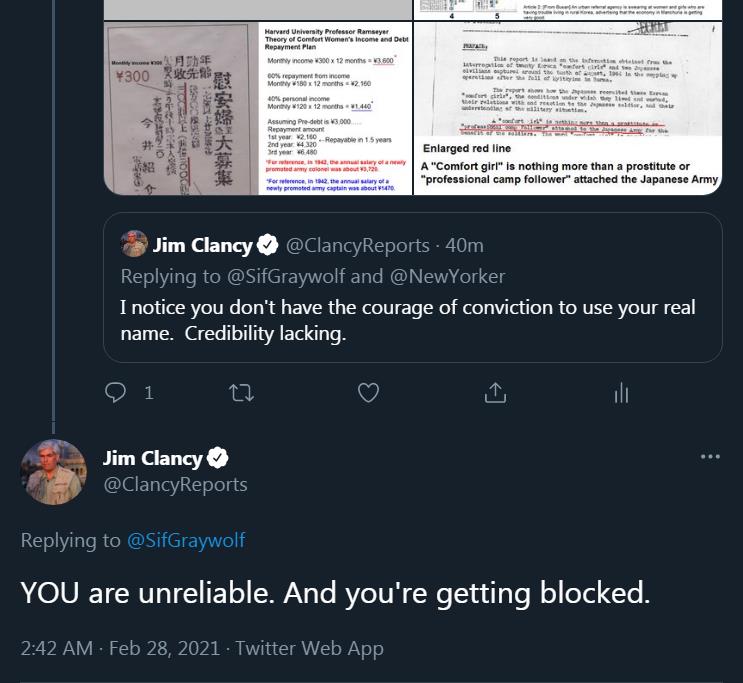
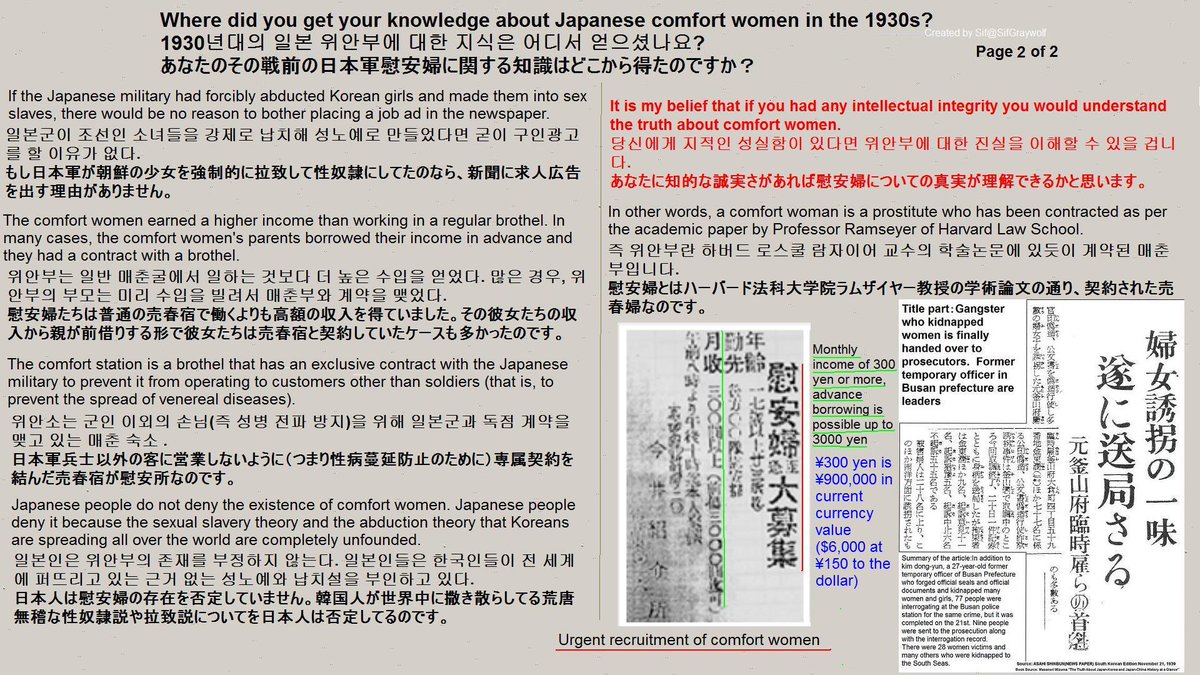
@ClancyReports Please laugh as I expose the SCUM JOURNALIST who block me because they cannot respond with papers and evidence.
You have absolutely no right to call yourself a journalist!
https://t.co/TIikpGVJBe
Sanseito’s leader, Kamiy a, often slips up during speeches, and that gives anti-Sanseito groups plenty of ammunition.
Sanseito does not form an alliance by signing documents with the Japanese Communist Party or anything like that.
It’s simply that, in the current Diet session, the Communist Party happens to be included in one group of opposition parties that is refusing to participate in deliberations.
Thanks for taking the time to reply, even though it has absolutely nothing to do with my post.
Modern Han Chinese are looting Japanese porn videos, not watches or clothes.
If China hadn’t created pirated websites where people can watch Japanese porn videos illegally for free, the Japanese porn video industry would have made even more money.
我帖子里附上的那张所谓“南京大屠杀证据”的照片,其实是在重庆拍摄的。重庆的汉人在漆黑的防空洞里无法保持冷静,避难民陷入恐慌,像多米诺骨牌一样相继倒下并被踩踏致死。这张照片是在把这些尸体从防空洞里搬出来后立刻拍摄的。
那么,为什么尸体是裸露的呢?
原因是,当时汉人有从尸体上掠夺衣服、手表、鞋子等财物的习惯。
The photograph attached to my post, which is often presented as evidence of the so-called Nanjing Massacre, was actually taken in Chongqing. In the pitch-dark air-raid shelter, the Han Chinese could not remain calm, and the evacuees panicked, fell like toppling dominoes, and were crushed to death. This photo was taken immediately after the bodies were brought out of the shelter.
Then why are the bodies naked?
The reason is that Han Chinese had a custom of looting clothes, wristwatches, shoes, and other belongings from the dead.
There is a scene in a piece of anti-Japanese propaganda film from China depicting the Japanese military using chains to topple a statue of Sun Yat-sen, but this is complete fabrication. The Japanese military did not topple the statue of Sun Yat-sen; in fact, it was the Japanese military that guarded his mausoleum, the Sun Yat-sen Mausoleum.
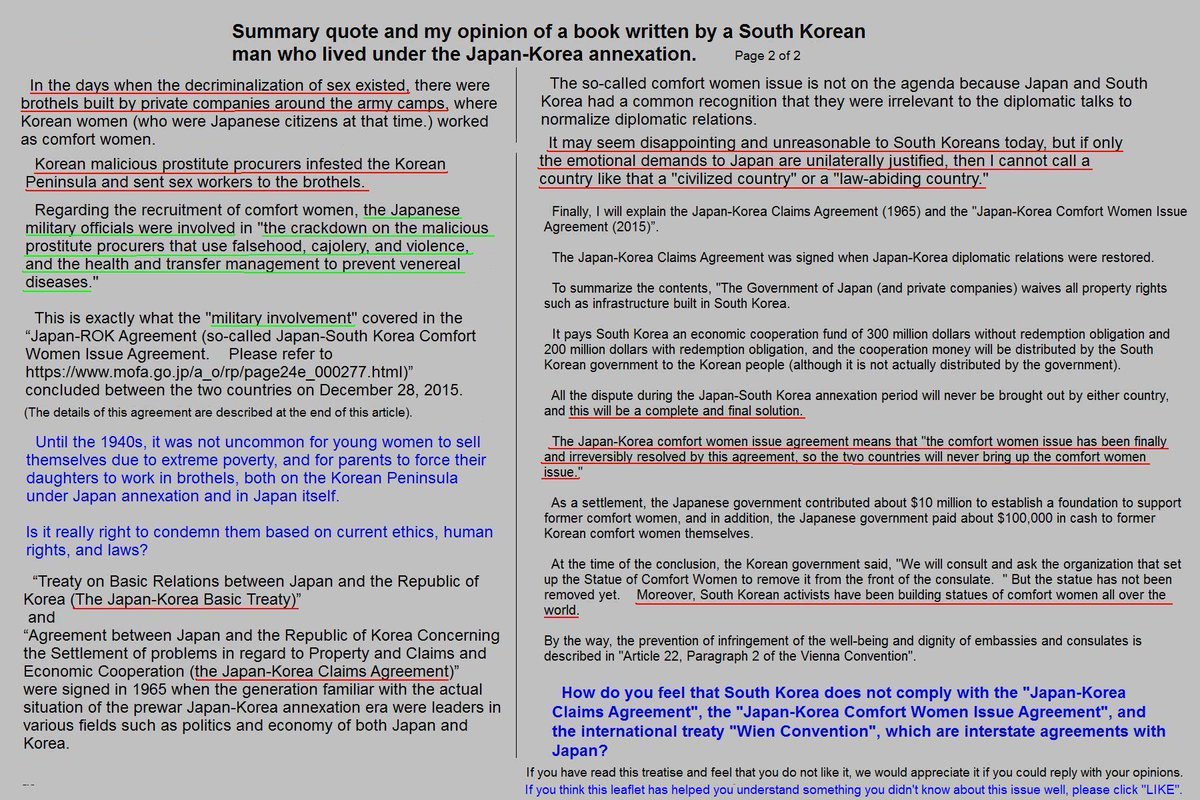
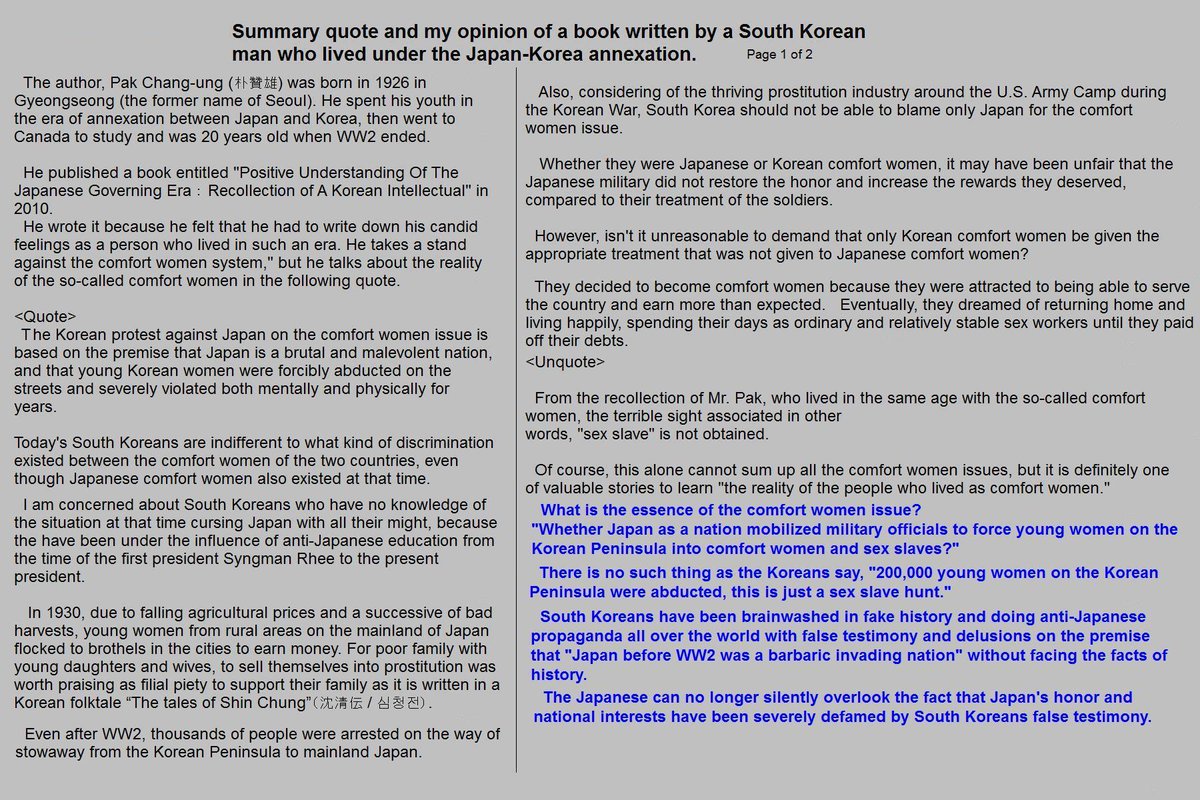
A book written by a South Korean individual—who would be around 100 years old today if still alive—contains the passage shown in the attachment.
@S_N_Ooo_b
우리 외할머니 어릴때 위안부로 끌려가실뻔함 내 증조할아버지(할머니의 아빠)가 안된다고 사정을 하면서 그 일본순사들한테 집에 있는 돈 될만한 물건이랑 돈 죄다 내줘서 겨우 막으셨댔음 할머니 집이 어릴땐 좀 잘사셨어서... 자발적 창부 같은 소리하네 이 시발새끼들이 그냥 잘못을 인정하라고
But Japan is probably already too late.
This is because Japanese people have been ignorant and indifferent toward politics.
For the past 30 years, Japanese citizens haven’t participated in elections. In Kawaguchi City—famous for issues like “foreigners’ crime”—in the Metropolitan area, turnout for city council elections has long been around 30%. For mayoral elections, turnout in the most recent election was about 40%, but in the election before that it was in the 20% range. As for national elections, the average turnout over the last 30 years has been roughly 55%.
Because 48% of their wages are taken as taxes and social security contributions, and yet, municipalities sometimes provide welfare benefits to foreign residents who have been in Japan only for a short time—benefits that are twice the amount of the pension paid to a 65-year-old Japanese person who has been contributing to the pension system for 45 years—and because most Japanese people don’t question this, the turnout numbers are as described above.
@TheLizVariant That fine applies to situations like simply idling a parked car while using the air conditioner to stay cool, right?
Surely, there is no way you would be fined for using the air conditioner at home during a heatwave, right?
In Japan, for large-scale facilities like big stores, factories, or logistics centers, simply turning off the main power—such as the air conditioning—and restarting it can incur electricity costs amounting to tens of thousands of dollars.
That is why such facilities operate continuously using a three-shift staff system, performing a complete shutdown only during periodic inspections and maintenance.
Wouldn't frequently shutting down refrigeration equipment and air conditioning—as you described in your post—actually result in higher electricity costs?
It took 17 years for Japan to develop "Beni Princess" (Red Princess) a unique citrus variety that costs 500 yen each.
Then China stole it. 😭
Researchers in Ehime Prefecture began the breeding process in 2005 by crossing two other premium citrus varieties, "Beni Madonna" and "Kanpei," finally registering the new fruit in 2022.
The saplings of Ehime Kashi No. 48, marketed commercially as Beni Princess, now have appeared for sale online in China.
The owner of this account @Raja_Darajat_NH may indeed be an Indonesian national, but judging from the profile picture, the person's family background is probably ethnic overseas Chinese.
Not only in Indonesia but throughout Southeast Asia, all of these countries were colonies of Western powers before World War II.
Although they were Asians themselves, many overseas Chinese communities became an exploitation hierarchy that aligned themselves with the colonial authorities and assumed responsibility for collecting taxes from the native population.
Overseas Chinese moneylenders could be found in villages, lending daily necessities such as rice and soap at high interest rates above normal market prices. When Indonesians brought goods to sell, they were often forced to accept very low prices.
Profit margins frequently exceeded 200 percent. Indonesians suffered not only from Dutch exploitation but also from the usurious lending practices of Chinese moneylenders, leaving many in extreme poverty. Their nutritional conditions were poor, many could not afford shoes and went barefoot, and average life expectancy was said to be around 35 years.
The following describes in detail how colonial Indonesia was governed by its metropolitan ruler, the Netherlands.
After colonizing Indonesia, the Dutch confiscated peasants' land and introduced the "Cultivation System," under which farmers were compelled to grow highly profitable export crops such as coffee, tobacco, sugarcane, and indigo used for dyes.
Vast rice paddies that had once stretched as far as the eye could see were replaced by fields producing export commodities for the colonial power.
As a result, famines broke out throughout Indonesia, and some regions reportedly lost as much as two-thirds of their population.
The profits from these crops were absorbed by the Dutch government and by overseas Chinese who had become collaborators of the Dutch.
A social structure emerged that appears extraordinary by modern standards: less than 0.5 percent of the population—the Dutch—controlled approximately 65% of the GNP.
Another symbol of Dutch colonial rule was a thoroughgoing "engineered ignorance policy."
Since education was considered unnecessary for agricultural labor, the Dutch provided little education to Indonesians and left much of the population illiterate.
One objective was to prevent the emergence of an educated class that might develop aspirations for independence.
Public gatherings and collective activities were also prohibited. Indonesians were reportedly not even allowed to stand on the street and converse in groups of three or more. Some public facilities displayed signs stating, "Dogs and Indonesians Not Allowed."
After expelling the Dutch, the Japanese military administration mobilized prominent Indonesian intellectuals and established the "Indonesian Language Preparation Committee."
It selected a national language for Indonesians, abolished what it regarded as the misgovernment of the Dutch colonial era, and provided Indonesians with opportunities to learn administrative skills as well as plantation and business management.
Efforts were made to cultivate senior civil servants and equip them with advanced political and administrative skills. Indonesians were recruited into technical departments, trained, and taught various technologies so that sufficient personnel would be available to operate the state and government.
Japan reorganized colonial-era schools and altered their curricula to reflect Japanese influence. Japanese-language education, character ethics, labor service, military drills, and Radio Calisthenics (National Calisthenics) were introduced.
Naturally, Japanese-style ceremonies such as morning assemblies, flag-raising ceremonies, and paying respects toward the Imperial Palace were also implemented. While practices such as facing the Imperial Palace may have been uncomfortable for Muslims, they did not require the violation of Islamic religious prohibitions.
When Indonesia sought independence from the Netherlands, the Dutch spent four and a half years after Japan's surrender in August 1945 fighting to regain control.
The Dutch even deployed air power against poorly equipped Indonesian forces. Approximately 800,000 Indonesians were killed, yet the people did not abandon their struggle.
It is well known that Japanese soldiers who did not return home after the war but instead joined the Indonesian National Revolution and died fighting for Indonesian independence are buried in heroes' cemeteries throughout Indonesia, including the Kalibata National Heroes Cemetery.
Eventually, the United States, appalled by Dutch conduct, hinted that Marshall Plan assistance might be suspended. Only then did the Netherlands finally recognize Indonesian independence.
However, the conditions attached to independence were severe.
The Netherlands neither apologized nor paid compensation for its colonial rule and the suffering it had caused. Instead, it demanded 6 billion dollars (equivalent to approximately IDR 1,243,800,000,000,000 today) as compensation for transferring infrastructure such as roads, ports, and petroleum facilities. Sukarno accepted these terms.
Under white colonial rule, colonies were subjected to heavy taxation for the benefit of the colonizer. For example, a bridge might be built, but tolls would then be imposed on the local population.
Such practices, according to this view, would have been inconceivable in Taiwan or Korea under Japanese rule.
And were Indonesians ever taught the following episode in school?
In January 1942, according to a report by a Japanese Naval Landing Force that landed by parachute on Celebes Island in the Dutch East Indies, six pillboxes had been constructed along the road leading to Menado.
When the positions were captured, native Indonesians were found inside the pillboxes, restrained with leg irons.
Lieutenant Colonel HORIUCHI Toyoaki of the Imperial Japanese Navy was stationed in the area for only three months. During that period, he sent Indonesian soldiers back to their hometowns, distributed cloth to island women who possessed only loincloths so that they could cover their chests, abolished the high salt tax imposed by the Dutch, and taught the local people how to refine salt from salt fields.
In a region where there was only one physician for every 70,000 inhabitants, he arranged for Japanese military doctors to provide free medical services on a rotating basis and distributed medicine box to households throughout the area.
When he was transferred to Bali, the villagers turned out en masse to bid him farewell.
During the China Incident in 1937, HORIUCHI reportedly interacted with local residents without carrying weapons and provided military food supplies to impoverished people.
A year later, when local village leaders learned of his transfer, they jointly petitioned for his continued assignment. When they discovered that this would not be possible, they erected a monument bearing his name and praised his benevolent administration.
That was the kind of man he was.
F.W.M. Tiwom, a Dutch Army colonel who had fled from the Japanese Naval Landing Force and later surrendered to Lieutenant Colonel HORIUCHI as a prisoner of war, became a judge in postwar military tribunals that tried Japanese soldiers accused of Class B and C war crimes. One of his subordinates became a prosecutor.
Colonel Tiwom fabricated accusations of massacres of local residents and attributed them to twelve Japanese soldiers, who were sentenced to death. Upon hearing of this, Lieutenant Colonel HORIUCHI rushed to the area in an effort to prove his men's innocence.
Claiming that HORIUCHI had "humiliated Dutch soldiers by taking them prisoner," Colonel Tiwom had him detained and indicted in 1948.
The charges included not only the massacre of Dutch civilians but also the alleged poisoning of thirty villagers.
Defense attorney IDE Teiichiro investigated the matter and testified that Tiwom had fabricated the claim by asserting that poison had been included in the mmedicine box distributed under HORIUCHI's authority.
However, this testimony was rejected, and prosecutors sought the death penalty for HORIUCHI and others based solely on one-sided testimony from nine Dutch witnesses.
Attorney IDE Teiichiro asked Tiwom why a military officer who had performed such admirable deeds should be sentenced to death on the basis of unsubstantiated and unreliable testimony.
Tiwom replied:
"Because HORIUCHI is Japanese."
He then used his authority to expel Attorney IDE Teiichiro from Menado. In what was described as a court of revenge, petitions from local residents attesting to HORIUCHI's innocence were also ignored.
At the same time, approximately 800 Dutch women had been detained by Indonesians who rose up after the withdrawal of Japanese forces and were facing imminent execution.
They were rescued by Japanese soldiers who had remained behind. Around 2,000 Japanese soldiers chose not to return to Japan after the war, adopted Indonesian names, and fought for Indonesian independence.
Prince Takamatsu, the younger brother of Emperor Showa, appealed to Princess Juliana of the Dutch royal family, who was soon to ascend the throne, for clemency, but his appeal was ignored. Lieutenant Colonel HORIUCHI and his companions were executed by firing squad on September 25, 1948.
In 1994, through the efforts of local residents in Menado, Indonesia, a memorial monument was erected in honor of Captain HORIUCHI Toyoaki (his final rank) of the Imperial Japanese Navy.
10: At the time of the Japan-Korea Annexation, Korean cultural properties were not forcibly taken to Japan.
Even before that, during the Joseon Dynasty under Confucian fundamentalism, Buddhism was religiously suppressed, and Buddhist statues made in Korea were destroyed.
Many were sent to Japan for safekeeping.
Some of these Buddhist statues were in Tsushima, Nagasaki Prefecture, Japan, but were stolen by a theft ring that illegally entered from Korea.
The theft was discovered and the culprits arrested in Korea, and the statues were seized by Korean authorities. Korea then refused to return them, falsely claiming they had been “looted by Japanese pirates.”
11: It was not Japan but the Western colonial powers that invaded Southeast Asia, so please do not revise history.
8: Japan only enforced Japanese language use in Korea for about half a year in 1945. For the other 34.5 years, it did not force Japanese.
Right after annexation, the Korean language had a very poor vocabulary.
For example, there were no Korean terms for many scientific or musical concepts needed for elementary school classes.
Therefore, most subjects other than the Korean national language class were taught in Japanese. Koreans distort this and propagandize to the world that Japanese was “forced” on them.
Conversely, on the Korean Peninsula, a Korean version of Japan’s “Eiken Test” (Test in Practical English Proficiency) — called the “Test in Practical Korean Proficiency” — was conducted, and Japanese people working in Korean government offices and companies took this exam.
Furthermore, Koreans adopting Japanese-style names was originally at the request of the Koreans themselves. Koreans who migrated from the peninsula to Manchuria or northern China were mocked by local Han Chinese as “fake Japanese.”
Therefore, Koreans petitioned, saying “We too are proper Japanese, so please allow us to change to Japanese-style names.” Japan did not force the name changes.
9: There was a military operation to subjugate armed bandits in the Jiandao (Kando) region near the border between Manchuria and the Korean Peninsula, known as the Jiandao Expedition(間島出兵).
In Korea, the Bongohdong Battle (which occurred before the expedition) and the Cheongsanri Battle (which occurred during the expedition) are twisted and presented as the “two great victories” of the March 1st Movement.
#BBCBreakfast: "... families had to be led to safety through the flames.. it wasn't just homes, cars were also torched by young masked men in these predominantly unionist streets, but the target here was immigrants.."
This is what the likes of Reform are inciting.
@jacksonhinkle Yeah, that's right.
So immigrants from the Middle East and Africa should aim for China.
It's a communist country, so it will surely help its poor people.
Then Koreans should just make an animated film themselves with Koreans as the protagonists.
I don't understand why you want Japanese people to make it for you.
Do you mean to say Koreans don't have the ability to write such a screenplay?
@sangseek_kim