The use of generic AI to solve *any* kind of traditional science questions (i.e. the stuff that get thrown at you on tests and exams) can be learned/achieved in a matter of minutes by more or less *anyone*. So with the advent of smarter and better AI it is getting more and more difficult to justify having to learn *anything* at all...
I'm teaching mathematics (with some programming included) in Norwegian upper secondary school, and I recently posed the following rhetorical question to a group of students:
After completion of the 140 hour course that you're currently participating in; what *specifically* should be the difference between you (i.e. a particular group of 25 students age 17-18 years) and a *random* sample of 25 people the same age on the street?!?
When let loose in the real world (with all common tools available) it most certainly is *not* the ability to find/establish answers to even super-tricky mathematical questions and exercises...
So it *has to be* something else. If not, the 140 hours of studying is a complete waste of time!
Both my games have just joined the Steam Winter Sale, and they're on a nice discount for the next 18 days 🎄🎅
There's also an additional bundle discount:
https://t.co/leAnnXDVvP
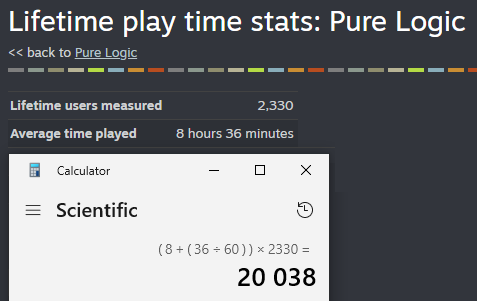
STEM-infused puzzle game Pure Logic is closing in on a major milestone: More than 2 200 players have (in total) clocked in nearly 20 000 hours of play time, becoming masters of Boolean logic while enjoying raw and pure logic puzzle solving!
Both my games just went on a 96 hours long Black Friday sale. Deepest discount ever for both of them. And on top of that there's a nice bundle discount 😀
https://t.co/leAnnXEtln
Players that complete the game will be masters of Boolean logic in the sense that they (without any prior knowledge of logic gates) will be able to solve puzzles like this, i.e. they will be able to deduce the 52 unset signals based solely on the 3 signals initially set:
https://t.co/qZtAlOZKo0
White represents TRUE/HIGH/ON/1, black represents FALSE/LOW/OFF/0, and gray represents unset/unknown signals.
Yes, all 6 "standard" two-input logic gates are included: AND, OR, XOR, NAND, NOR, XNOR
Karnaugh maps are not a part of the game 😀
16 copies of PC puzzle game Pure Logic have now been provided to the Norwegian game con "Spillmesse 2025", to be used as prizes for various contests and similar 🏆🥳😃
The game con is held in Kristiansand the upcoming weekend 🎮👍
https://t.co/4yxOW1ZBQw
@BasNorth@raysan5 The entire source code (except for raylib and other "standard" libraries included) for both my games are contained in one single .cpp file, both between 5000-6000 lines 😉 I find it easier to keep an overview of the code that way, rather than spanning it across multiple files.
It just felt natural to use the same language as #raylib is created in 😀 I had very limited experience with C before starting game dev with raylib, except for some tinkering with #Arduino.
But I spent a massive amount of time as a kid playing around with machine code and assembly programming on the Commodore 64, so I rather quickly got into (and enjoyed 🤩) the low-level programming style provided and required by C.
And that's probably also the main reason why I just love raylib❤️; the feeling of having full, nonabstract, pixel-level control of "everything" 👍🤓
@0xsnafuu@raysan5 Pure Logic and Mirrors of Epiphany are both written in plain C, except for a few lines of C++ code to deal with the Steam achievements. I'm using Visual Studio 2019 for editing and compiling.
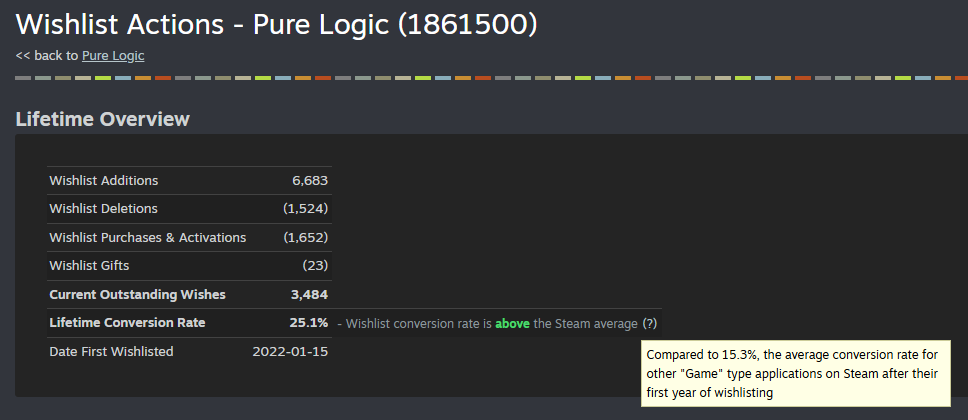
Some people *add* to their Steam wishlist, some people *delete* from their list, some people *purchase*, and some lucky ones receive wishlisted games as *gifts*.
Steam Autumn Sale has just ended, and for the first time ever Pure Logic's wishlist conversion rate has exceeded 25% 🎉🥳
From what I've understood that's a pretty decent number. (FYI; the yellow box pops up when mouse hovering the (?) in the Steamworks sales report.) 🤓
And BTW; Pure Logic is made with #raylib 👍
From James Luff's review conclusion: "Mirrors of Epiphany isn’t a game that’s going to wow you. It’s not trying to. But for what it is, a compact, calming puzzle experience, it does a commendable job."
A minimal but meditative laser puzzler, Mirrors of Epiphany delivers low-stress brain teasers wrapped up in simple charm. @SigmundHoien#MirrorsOfEpiphany#Steam#Indiegame
https://t.co/Lf3PH3hdph
My second game, Mirrors of Epiphany, has just been released on #Steam 🥳
Who will be the first to find the optimal solution to all 100 puzzles?
The game is made with the fantastic #raylib created by @raysan5 👏👍
https://t.co/ETgCKKWXuF
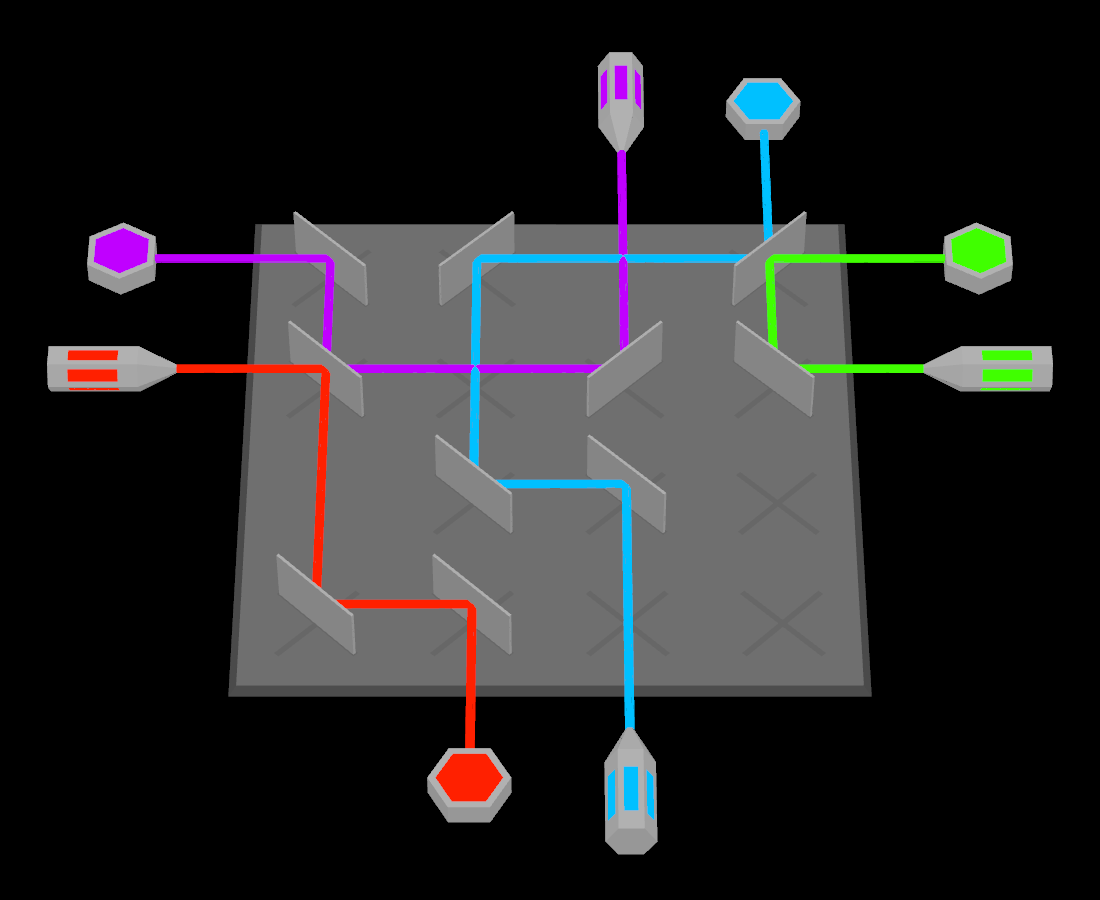
Mirrors of Epiphany launches on #Steam tomorrow. Below is one of the medium hard puzzles, showing a solution using 10 mirrors. The optimal solution uses only 6 mirrors. Can you see how to do it? (Notice the 2 empty grid squares where no mirrors can be placed.)
#puzzles#raylib
There are a few things that have surprised me both during and after the process of releasing my first game on Steam. One positive surprise is that more than 1/6 of all players actually completes all 200+ puzzles to receive the final Master of the Gates achievement 😍 A good portion of skill and patience is required to get that far 👍👏
And while talking about patience; some players have requested an option to skip the verification-of-gates-animation in the end of each puzzle. Among a few other tweaks here and there, I'm working on a fix for those who would like to have a more instant I-got-it-all-correct-confirmation. The update will be released within a few days 😀