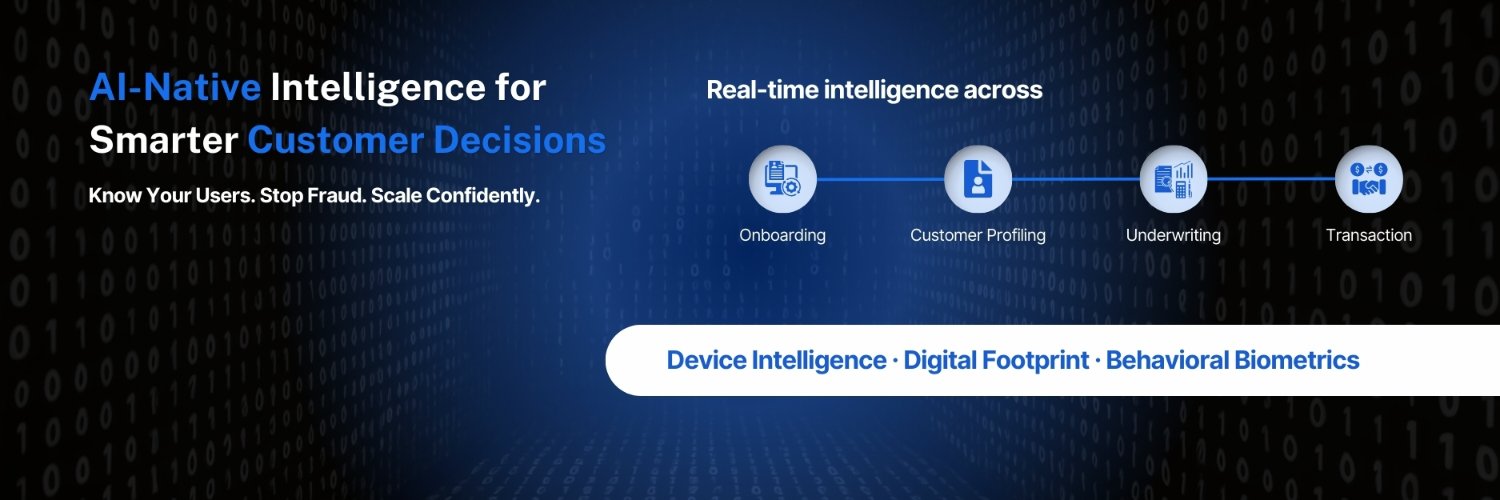
AI-native customer intelligence for BFSI & Fintech.
Safeguard your business with real-time customer insights and seamless digital onboarding.
#ScaleSecurely
Every national tool, MuleHunter, transaction monitoring, freezes, acts after the money moves.
The mule that costs the most opened cleanly and activated once.
Credentials tell you the identity is real. They can't tell you whose hands the account is in. That's the gap.
I broke this down in full on LinkedIn 👇 https://t.co/PtjUWan123
A money mule account passes every KYC check you run.
Real PAN. Real Aadhaar. A selfie that clears liveness.
Everything checks out. And it's still fraud.
Here's how it works 🧵
One week of one lender's onboarding. Every application looked clean.
Read at the device level:
→ 6% of applicants were in coordinated fraud rings
→ 80% ran on a single device
→ 503 separate rings, from one week
None of it showed in the paperwork. All of it showed in the device.
Then the account goes quiet.
Nothing to score. No alarm. Until stolen money floods through it and out, layered fast enough to break the trail.
The fraud was never in one account. It was in the links between them.
The mule is a real person who opens a real account and hands it to someone else. Recruited on Telegram for a few thousand rupees, or part of a ring running hundreds.
The KYC is genuine, so the gate opens.
India's already flagged 2.47 million of these accounts (I4C, 2026).
We built Sign3 for exactly this.
6 intelligence modules. 270+ derived signals. One API. Built for Indian BFSI.
Full state-wise breakdown with source links in our LinkedIn carousel → [https://t.co/jY6egYsNvc]
India lost ₹22,495 crore to cyber fraud in 2025.
A gang in Gujarat used Google Gemini to generate deepfake blinking videos, bypassed Aadhaar facial auth, and took loans in victims' names.
No OTP was ever triggered.
We mapped fraud across all 28 states.
Here's what we found
The fraud supply chain is more organised than most startups:
Jamtara → builds the APKs
Assam → supplies the SIM cards
UP → provides mule accounts
Bihar → provides manpower
Punjab → runs call centres
Telangana → routes the hawala
Specialised roles. Air travel coordination. Cross-border handlers.
Tamil Nadu is the loan app crisis epicentre.
887 FIRs/yr (up 8x). 600+ apps banned. Chinese-linked.
The playbook: disburse ₹2,000 → demand ₹8,500 in 7 days → morph victim's photos → create Telegram shaming groups with family contacts → 4-8 abusive calls/hour.
100+ suicides linked to this.
Assam is the sleeper story nobody's covering.
72,000 SIM cards seized, largest SIM operation in any state's history.
300+ arrested from Morigaon district. Pakistan handler links confirmed. Women's handloom centre documents used for bulk SIM registration.
This is a national security issue now.
But the Gujarat deepfake case is the one every bank needs to study.
The attack chain:
Scrape victim photos from PhonePe, GPay, WhatsApp
Generate AI blinking video via Gemini/Meta AI
- Bypass Aadhaar facial auth using compromised CSC kits
- Change linked mobile number
- Open bank accounts + take ₹25-50K loans
- 7+ arrested. ₹10-15L/year throughput.
State by state, it gets worse:
Maharashtra — 10,505 cases, ₹1,031 Cr lost in Mumbai Karnataka — ₹240 Cr scam, 9,000 mule accounts in ONE operation
Telangana — 10,626 mule account FIRs (highest in India) Delhi — 70%+ surge in digital payment fraud
Punjab — 132 arrested in a single raid
The numbers are staggering:
→ 2.81M complaints (+24% YoY)
→ 850K mule accounts found by CBI
→ 9.42L SIM cards blocked
→ 10.64L UPI fraud incidents in just 8 months
→ ₹805 Cr in UPI losses alone
This isn't a law enforcement problem anymore. It's an infrastructure problem.
8/8
The institutions positioned best are the ones who can show they read the signals standard checks miss, device, behaviour, network, before the loss, not after.If notified, July 1 is when "best placed to stop it" starts carrying a price.
More on what this means for fraud-ops stacks in our June field note.
Sign3: Device, Behavioural & Risk intelligence, built for Indian BFSI.
1/8
The RBI just proposed something that quietly changes the economics of fraud in India.Most read it as a customer-compensation update.
Look closer: it's about who carries the cost when fraud gets through.
7/8
And it lands hardest on the fraud that clears standard checks by design:The synthetic identity that passes KYC. The takeover with the right OTP. The mule account with no report against it yet.The checks pass.
The loss still happens. The fault question still gets asked.