Public filings do not protect you.
Proprietary forensic scoring does.
Everyone is reading the same EDGAR data at the same time and drawing the same conclusions. That is not an edge. That is the herd.
SignalVest is live.
We ingest 13Fs, 13D/Gs, DFAN14As, Form 4s, and Form Ds, then run proprietary scoring to surface activist intent and deal probability before the market connects the dots.
Not a terminal. Not a screener. Not another dashboard.
The analytical layer between raw filings and the decision.
Family offices. Institutions. Allocators. Activists.
The data is free. The edge is not.
Platform is live. Data is flowing.
#ActivistInvesting #13F #SECFilings #FamilyOffice #HedgeFunds
$292.8M and $0.40 adj. are fine. GTV +17% is not the same story as platform +22%. Management said existing-customer job growth slowed ~200 bps after weather/days. That’s the volume the take-rate sits on.
GAAP still lost $24.9M. Non-GAAP op income $44.4M is after ~$62M of SBC and related add-backs this quarter. FCF $50.5M is the clean number. Adj. EPS is the marketing number.
Q3 guide $285–$287M vs $293M this quarter and ~$288M Street. They’ll call Max timing and HVAC leads. Fine. Sequential down out of the seasonal peak is the tell. FY held at $1.14B. That’s not a raise.
NDR >110% keeps the account. GTV is what funds usage. Watch which one they talk about on the next call.
Your policy team confirmed in writing that our SaaS analytics platform does not require allow-listing under Financial Products and Services. Despite that clearance, every campaign we attempt is being automatically halted under the Financial Products and Services category. This has now happened across multiple campaigns and multiple posts.
Also, the Ads Manager customer service never replies.
Altman Z at 70.38 confirms zero solvency risk. Piotroski F at 4/9, barely passing. The composite risk score is only 3.2/10 because NVDA is not a distressed company. But when the revenue quality model and insider behavior diverge this sharply from the rest of the scorecard, that gap is the signal. Burry is reading the filings. The math is saying the same thing.
The Cisco comparison has quantitative backing. NVDA's Beneish M-Score sits at -1.15, flagged well beyond the -2.22 manipulation detection threshold. Insider Behavior scores 8.4/10 on a forensic risk scale while every other dimension, capital structure, regulatory, narrative, governance, sits below 2. The financial structure is pristine. The forensic layer underneath it is not.
$SNOW just beat and raised. That doesn’t settle the Databricks question.
Snowflake printed $1.49B in product revenue, +37%. Year guide to $6.07B. NRR 126%. 828 customers over $1M.
Databricks, still private, last told the market it’s running above $7B annualized, growing 80%+, NRR they last pegged above 140%, a thousand-plus $1M accounts, and a $190B mark from the August round.
Those aren’t the same kind of number. One is a 10-Q. The other is a run-rate on a press release. You can still read the direction.
Snowflake is the warehouse that learned to bill AI on the same meter. Databricks is the lakehouse/ML stack that built a warehouse ($1.5B Lakehouse run-rate, they say doubling) and an agent database on top.
A lot of enterprises write both checks. BI and sharing still lean Snowflake. Pipelines, models, agents still lean Databricks. The fight that matters is the incremental AI dollar, and that’s where Databricks has been adding distance on growth.
Two flags on the public name from today, not from the private comp:
• RPO $9.00B vs $9.21B last quarter. Consumption ran hot. Contracted pile didn’t.
• Product GM guide 74%, not 75%. Heavier AI mix costs something.
Own $SNOW if you want the listed consumption compounder. Don’t pretend the private competitor is a rounding error. Different products, different disclosure, same budget.
The beat is real. The card is incomplete.
$SNOW product +37%, year raised to $6.07B. RPO went the other way: $9.00B vs $9.21B last quarter. NRR flat at 126%. Product GM guide 74%, not 75%. Quarter FCF $84M.
Raise the year. Don’t confuse a consumption spike with a bigger contracted base.
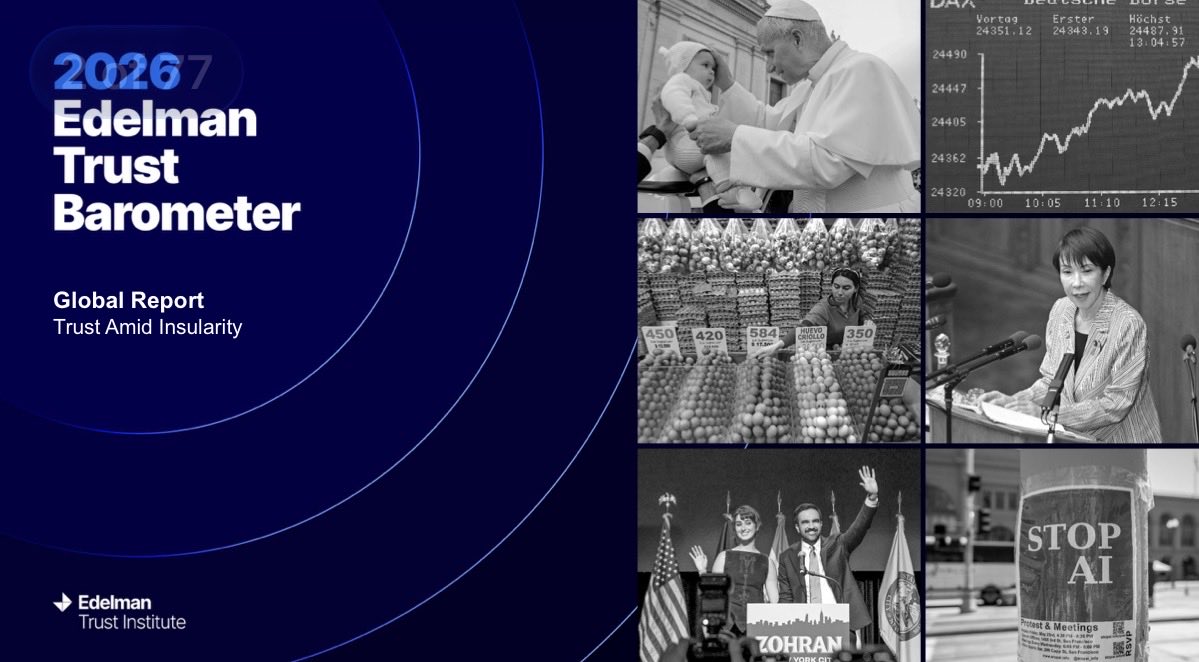
Edelman 2026 Trust Barometer (Global Report): they changed the name of the problem.
Polarization → grievance → now “insularity.” 70% globally hesitant or unwilling to trust someone with different values, facts, or sources.
Trust pulled back to the circle, my employer, my neighbors, my CEO. Institutions don’t get the benefit of the doubt. Domestic companies beat foreign ones in market after market. Only about a third still think the next generation will be better off.
That’s not a vibe survey. That’s a higher cost of belief. When the default is “people like me,” every disclosure, every cross-border deal, every AI rollout pays a tax to be taken seriously.
https://t.co/kgWitDCOUw
The $93B is real. The implication isn’t.
Nearly half is M&A. Another third is retained profits at firms already here. Inflows barely rose vs 2024. Outflows cratered, which is what made the net look like a stampede.
“Best year in two decades” skips 2007 ($125B) and skips the mix. Composition is the story. The summit is the marketing.
$MU isn’t cheap because nobody noticed the AI bid. It’s cheap because memory earnings have a habit of disappearing.
Single-digit forward P/E after a trillion-dollar run is the market saying these profits are rental, not owned. HBM sold-out and contracts through the end of the decade are the bull case. 2023’s near-zero margins are why the multiple never rerates to a semiconductor software name.
The question isn’t “why so cheap.” It’s how long the shortage lasts before the capex it funded shows up.
Bond desks aren’t arguing with the speech. They’re arguing with the follow-through.
July already showed it: hawkish words, long end sold anyway. September hike odds jumped after Jackson Hole. That’s swaps. The people who have to hold 10s and 30s are still saying the reaction function isn’t priced because it isn’t written down.
Talk moved the two-year. Action is what moves the curve.
$SLB just paid ~11x for a PE-owned cooling shop so it can sell heat exchangers next to modular data-center kits.
Not a pivot. A bolt-on. Close is 1H 2027. The oilfield cash engine is still what funds the AI slide.
The question isn’t “is cooling real.” It is. The question is whether $4.1B of thermal management changes the multiple, or just the press release.
What Forensic Scoring Reveals About the Situational Awareness LP Unwind
Situational Awareness LP held six positions across five sectors. Traditional portfolio analytics called that diversification.
Every single holding depended on the same narrative: AI requires massive infrastructure buildout. When we scored them across six forensic dimensions, five of six came back above 6.3 on a 10 point scale. The portfolio average on Narrative Fragility was 7.3.
That's not diversification. That's one bet wearing six costumes.
The insiders saw it. Bloom Energy executives sold $59.8 million in three months. IREN's board granted its co founders 18 million RSUs before the business model had matured. The structural fragility was in the filings, the Form 4s, the governance amendments. It just required a framework that reads all of them at once.
Sector labels hide narrative concentration. What's the most correlated risk in your book that doesn't show up in your factor model?
https://t.co/SVZQ8zcnH2
Tomorrow is Tim Cook’s last day as CEO of $AAPL .
Not a surprise. Not a crisis. The board priced this in April. Ternus takes the chair Sept 1. Cook stays as executive chairman, which means the org chart changes and the diplomat does not leave the building.
Fifteen years. He inherited the iPhone company six weeks before Jobs died and spent the next decade-and-a-half running the machine around it: supply chain, services, silicon, buybacks, China, and a market cap that went from roughly $350B to the $4T–$5T neighborhood.
That’s the scoreboard. The open question is the one farewell posts usually skip: whether the next era is still an iPhone compounding story with a new face, or whether Ternus actually has to change the product cadence Apple spent a decade defending.
Respect the run. Watch the handoff.
Cathie didn’t “reload” $NVDA. She rotated.
ARK bought 243,707 shares Friday, called it $53M at Friday’s close; the session after the 9% earnings pop gave back 4.5%. Same tape: she sold ~$75M of $AMD and added $AVGO.
That’s not a conversion story. Tesla, Tempus, SpaceX, and Circle still sit well above Nvidia in the book. $NVDA is still a ~2% ARKK line. A $53M ticket is large for a daily print. It is not a concentrated bet.
The number that actually moved the thesis is in the call, not the 13F. Kress guided ~70% FY28 revenue growth against a Street 44% number, then said they won’t hit the customer-forecast double because they’re supply-constrained. ARK is buying that gap. The AMD sale is what a 100%+ year looks like when the same desk has to fund it.
Headline is “Wood buys the semiconductor.” Filing is rotation inside an already crowded AI sleeve.
https://t.co/BkNtrs1CEG
Monday isn’t the print. It’s the hangover.
UK desk is dark. Month-end flows still have to clear through a tape that just repriced Warsh as a hiker. That combination is how small dislocations get treated like thesis changes.
Three things that actually matter before the open:
>> China’s official PMI. Another print under 50 doesn’t kill the AI capex story. It does tell you whether the rest of the demand tape is still pretending it doesn’t need to. If manufacturing stays soft and non-manufacturing follows, the “everything is fine except the Fed” line gets harder to hold.
>> German flash CPI. Warsh already said summer PCE didn’t move him. A hot German number is the first overnight test of whether that speech was just Jackson Hole theater or the start of a real rate path. Equities can ignore one. Duration can’t.
>> The $NVDA overhang that isn’t in the 10-Q. The Hugging Face number is still a report, not a filing. Until there’s a signed deal or a hard denial, the tape is pricing a $13B software grab on $150M of revenue and hoping antitrust stays quiet. That’s a lot of narrative sitting on an unsigned page.
What I would not treat as a signal: SAIC, NAT, or whatever else reports into a holiday book. Liquidity is thin. Month-end is louder than the calendar.
The real session starts Tuesday. ISM, JOLTS, then $DELL and $PANW have to confirm the spend that Nvidia already guided. Monday is just whether anyone gets forced out before that.
Huang can say he’s “perfectly fine” with a bigger tax on the ultra-wealthy because the economic interest was already moved years ago. Irrevocable trusts, gifted $NVDA paper, estate tax designed out of the path. Public willingness is not the same as incidence.
What the market should underwrite is not the interview. It’s whether California treats this as a permission slip, and whether other founders treat it as a reason to leave.
Narrative is generous. Structure is the 13F and the trust.
The four plants are real. The “nothing sails without them” part isn’t.
Orinoco extra-heavy either gets upgraded at Petropiar, Petrocedeño, Petromonagas and Petro San Félix, or it gets cut with naphtha and sold as Merey. A lot of what actually leaves Venezuela right now is the second one. That’s why naphtha is moving the other way.
Those four upgraders are supposed to handle about 650k barrels a day on paper. They haven’t run like that in years. So yes, they’re the kit sitting under Friday’s reserve headline. No, they’re not a hard gate on every barrel, and they’re nowhere near enough to turn 65 billion barrels into supply.
@ExnerPirot Right market, right geography, wrong timestamp.
VZ leaving China for the U.S. is the 2026 redirection, already visible in the flow data. Friday’s deal is the attempt to make that permanent.
Asia hole: real.
Gulf Coast pressure: also real.
They are not the same trade.
$NVDA dimension trend through Aug 28.
>> Capital Structure: 1.10
>> Regulatory Exposure: 1.00
>> Narrative Fragility: 1.40 ↓
>> Operational Signals: 5.40
>> Governance Integrity: 7.70
>> Insider Behavior: 8.40
The balance sheet and the regulatory file are quiet. The narrative actually tightened after Aug 7.
What has not moved: insider behavior pinned at 8.40 and governance integrity holding 7.70 after the late-July step-up.
If the composite is moving, those two dimensions are doing the work. Not dilution. Not a broken story.
The growth tape and the forensic tape are not saying the same thing.