Dichotomies are a good way of evaluating people. They serve as highly signal cleavage points based on a snap judgment. In the realm of worldly achievement, my favourite of these dichotomies is whether someone values cleverness or whether they value reps. Fundamentally, the clever person sees immense beauty in maximizing elegance. The reps guy, rather, is interested in the nobility of effort. The reps guy approaches their work like a mountain with a pot of gold at the summit. It is up for grabs to whoever applies with the most herculean effort. There is no uncertainty or unsolved puzzle; it is simply a matter of effort and competence. The clever one wonders if there isn’t some larger pot of gold hidden somewhere that can be stumbled upon with no more effort than a pleasant stroll, so long as they know where to look.
Neither is better than the other. Both camps have many successful ambassadors, though the world-historical level outliers tend to embody their fair share of both. Rather, they are two fundamentally different ways of looking at the world. One values effort and one wit. To one success is glorious because of the hard work and to the other, it is glorious despite it. I believe whether one values reps or wit is largely innate, there is just something so obvious to them that one is better than the obvious. There are correlates, those who are high energy tend to value reps and those who don’t largely value wit. One guy thinks that he is more deserving because he worked harder than everyone else, the other guy thinks everyone else is stupid because he got the pot of gold by barely lifting a finger.
The best rep worker I know is obsessed with finding opportunities where he can outwork everyone else. Where the inputs and outputs are known and the reward is certain but rare because of the effort required. To him everything is a question of brute force and a question of taking his set amount of it and choosing the best linear path to apply it towards.
The most clever worker I know is obsessed with something he calls finding “mate in one”. This term comes from chess and describes when, no matter what move an opponent can make, you will be able to checkmate them on the next turn. It is the one move, the single leverage point, that negates all other effort. He would present me with a problem he was trying to solve and I would lob all kinds of ideas or strategies at him that would make marginal progress and he would dismiss them out of hand. With enough thought, enough wit, there was a “mate in one” move to be made that would render any further effort completely useless.
The latter strategy, of course, is much more uncertain. While the repetitious man can immediately get to work, the clever one must wait around and pontificate for a solution that may or may not exist. In exchange for taking this risk the clever man gets the opportunity to run laps around the repetitious man. Instead of being the guy, he can be the guy who finds the guy, or the guy who finds the guy who finds the guy.
Consider the case of Donald Trump and Ted Cruz. There is a video of Ted Cruz painstakingly plotting out the next 35 years of his career in undergrad, culminating in his run for president. Harvard Law, the Senate, this committee and that committee, decades and decades of labour all to end up subservient to a guy who called his wife a dog on national television. Trump found “mate in one” in a game that had been thought to been completed and reduced down to a game of attrition.
The repetitious worker’s asset is his tremendous effort ergo the opportunities he looks for are ones where consistency is the most difficult. These tend to be very contained systems with clear outcomes (e.g. Mr. Olympia, Highest paid actor, the Governor’s office). The clever worker’s greatest asset is finding novel solutions ergo the opportunities he looks for are ones that have been least explored (e.g. investments, warfare, espionage, scientific discovery).
One question I like to use to discern someone’s tendency towards cleverness over repetition is the nightclub line scenario. This is a hypothetical situation in which you land in a new Tier 1 city and have to meet someone in the hottest club with the tightest door in the entire city. There are many good answers but they all give you a clue as to where one’s particular proclivity towards the beauty of work lay. The grinder will tend to say something like they’ll get in line and chat up some girls or go up and down the line and ask if they can cut in front or join their group. Then you start to get things like pay the bouncer off or sneak in the side door or figure out what the stamp or wristband looks like and make a duplicate. Finally, you will sometimes hear something like finding out who the big investor is in the club and send them an email the morning you land and using that as a way onto the list. Each answer gets the person into the club of course, but the tradeoffs between effort and cleverness are evident and will hint a lot at where someone stands in the great dichotomy.
Signal Rock is proud to announce the acquisition of Thermae Retreat (@ThermaeRETREAT), a leading holistic wellness destination based in Fort Lauderdale.
Thermae is centered on contrast therapy—sauna and cold plunge—combined with integrative mind-body-spirit practices. This partnership marks Signal Rock’s first platform investment in the wellness sector, part of a $6.3 trillion global market.
Founder Kelly Doyle will continue to lead Thermae, ensuring the same authentic community ethos while gaining the resources to expand. Together, we’ll enhance the guest experience, add new sauna and cold plunge circuits, and lay the groundwork for replicating the model in additional U.S. markets.
We’re thrilled to partner with Kelly and the Thermae team and look forward to building a purpose-driven wellness platform that preserves the sanctuary feel while expanding access to more people.
Read the full press release here: https://t.co/I1VrB2nZgH
Buy boring. Cut deep. Sell sexy.
Laurence Tisch turned broken hotels, failing insurers, and cheap oil rigs into billions.
This is the Tisch Playbook & how to apply it today:
Cheap, unloved assets can be gold mines.
In 1946, Laurence Tisch was just 23.
While Florida hotels sold for $10K–12K a room, he found a 300-room resort in Lakewood, NJ, for only $1,250 per room.
The owner feared a postwar slump and let it rot. Tisch hidden value waiting to be unlocked.
He leased the hotel and modernized it with flair—ice rinks, swimming pools, even reindeer from Finland.
Razzle-dazzle turned a failing hotel into a money-printing machine
The formula was born:
1. Buy at knockdown prices
2. Renovate smartly
3. Add entertainment & services
4. Hike prices
At the Traymore Hotel in Atlantic City, he invested $1M in renovations → profits soared.
Bought it for $4.35M. Sold it for $15M.
Lesson #1: Don’t just find value. Add value.
Anyone can spot “cheap.”Few know how to turn it into a growth engine.
Tisch’s genius wasn’t just bargain-hunting. It was squeezing unrealized value out of assets others had written off.
He applied the same playbook to insurance and oil rigs.
In the 1970s, Loews bought CNA Financial when it was bleeding red.
Tisch fired the CEO, cut employment by 12%, closed money-losing divisions.
Within a year: a $207M loss became a $110M profit.
In the 1980s, offshore oil rigs were dirt cheap. Tisch bought rigs for $5M each. Soon, they earned $25M per year.
Loews IPO’d its drilling unit in 1985 at $12/share. By 1997, it traded at $54.50.
He turned steel sitting in the ocean into Wall Street gold.
Lesson #2: Reject conventional wisdom.
Tisch bought when assets were hated:
- hotels after WWII,
- insurers in crisis,
- oil rigs after an energy bust.
He refused to touch anything trendy.
“I buy companies when they’re unpopular. I avoid anything in vogue.”
Lesson #3: Live below your means, play above your weight.
He raised his family on less than an acre. No limos, no bodyguards, no extravagance.
At CBS, his first move was cutting limousines and rented typewriters. He hated waste.
The Tisch Playbook boils down to:
1. Buy low in hated sectors
2. Add value through cost cuts & flair
3. Demand control, not just ownership
4. Stay disciplined—avoid hype
5. Sell high when the market finally “gets it”
Where are today’s Tisch-style opportunities?
1. Distressed commercial real estate (NYC offices, hotels post-COVID)
2. Secondary oil & gas assets (offloaded by majors in the energy transition)
3. Insurance run-offs (complex, unloved balance sheets with hidden value)
4. Family-owned companies in succession crises (ripe for control deals)
@PEoperator Confirms my belief that the PEoperator does indeed got it like that, and that this is the type of testosterone needed to keep our great capitalist system thriving
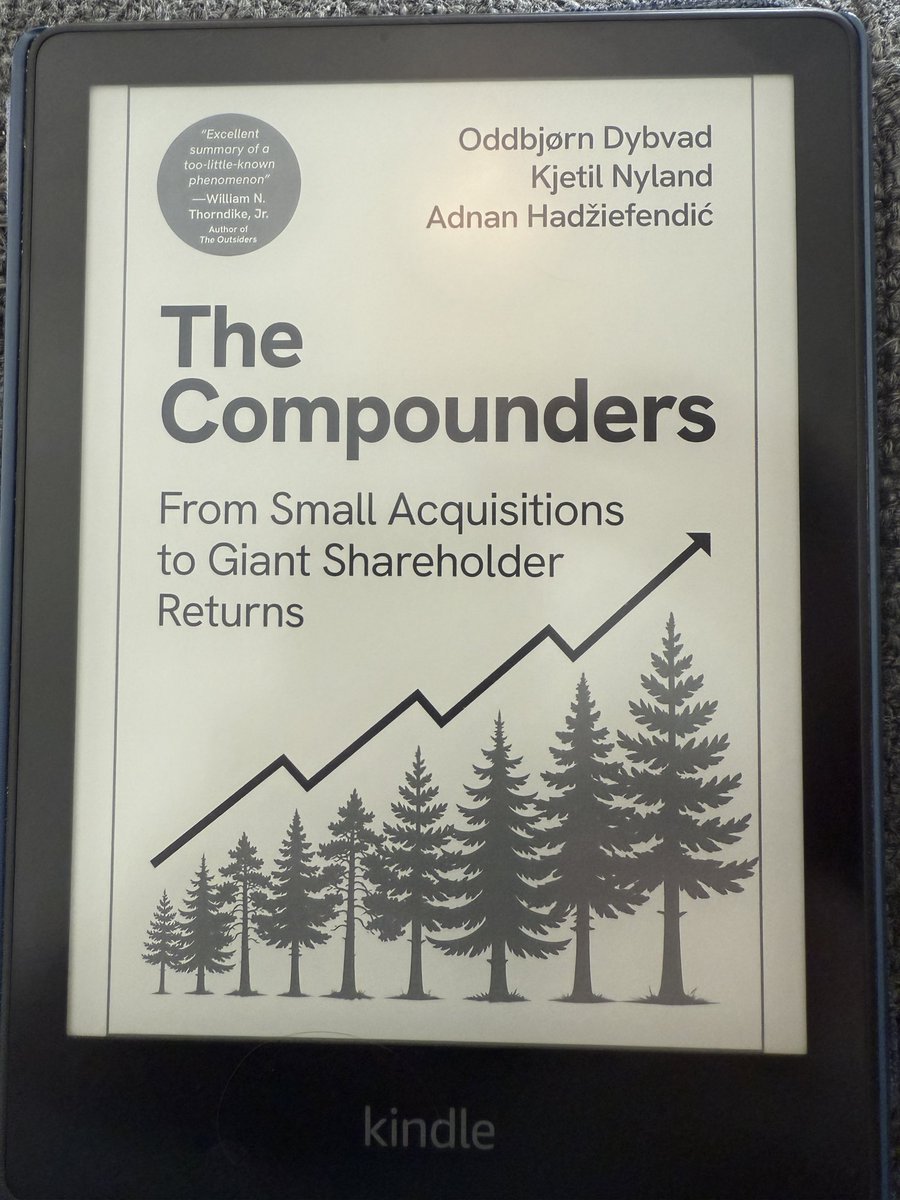
Recommend reading…
Akin to The Outsiders or Intelligent Fanatics.
Great chapter on Constellation Software. My favorite was Lifco.
Overall theme, summarized:
These acquisition-driven compounders operate with a simple and profoundly effective philosophy: decentralization. Push daily decision-making as close to the customer as possible, give extraordinary customer service, empower people with responsibility, accountability, and shareholder-friendly incentives, and give them ample room to grow. Pair this with an obsession and passion for delivering exceptional customer value and rewarding great performance, and people go the extra mile.
Someone once told me that ideal person lives their life being pulled equally between the monastery, the academy and the marketplace. It's the tension of each that creates the most insightful and interesting lives. Colin is a great example of this and there's nobody better than Johnathan to tease this out.
@SMBfugazzi Depends on the state you live in but if you have income taxes then I like Muni bonds otherwise just a nice bond index fund like BND or a treasury/CD latter or a combo of the two
When the $3M topline, 95% residential service HVAC owner you have been texting non-stop for 3 months to build a relationship with finally agrees to a follow-up lunch meeting next month, following a final 24 hours silence after you ask that sends you on an emotional rollercoaster
Reminder that PE shops like Thoma Bravo have institutional inertia that makes it very difficult for them to adopt the maxi view on AI disruption of software.
People who work there are very bright but are also highly process driven and default to thinking about things linearly.
For the occasional rockstar analyst who can think abstractly enough to properly address the terminal value risk for some of their recent deals it’s practically career suicide for him to pipe up in an IC meeting and say “I think software is dead in five years” because Orlando will turn to him and say “if we aren’t buying more software companies why the fuck am I paying you a salary”